
I want to say at the outset of this, that I intend no disrespect to my brothers and sisters in Christ – fellow pastors and teachers, or otherwise. But, I am concerned over the level of mud-slinging and stone-throwing that I’ve been seeing online over the past couple of days, in regards to the opening ceremony of the Olympics in Paris, France.
The specific part of the event in question involved an on-stage, live reenactment of what appears to be Leonardo da Vinci’s famous mural The Last Supper, painted about 500 years ago – with the obvious modification being that the “disciples” are depicted as a group of flamboyant drag queens.
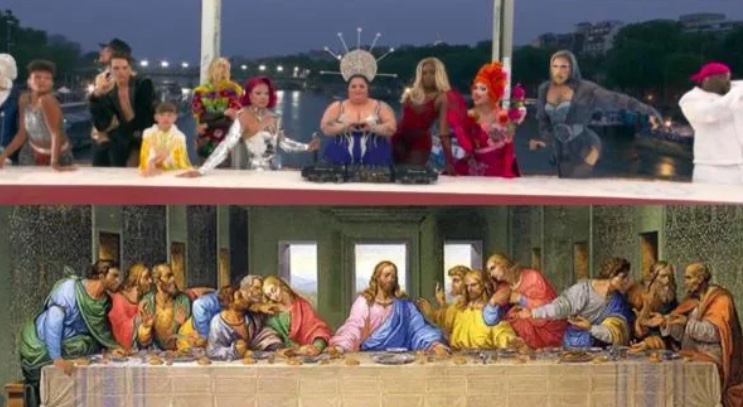
Ha. Ha. Ha. Good one… You really got us.
This, somewhat ironically, reminds me of a story from the Book of Acts. I say it’s ironic, because it occurred in Chapter 17, when the Apostle Paul found himself strolling through the city of Athens – which happens to be the place where the first modern Olympic Games were held in the Spring of 1896.
As often occurred on his epic missionary journeys across the Mediterranean, Paul went directly into the most public places of town to make his plea on behalf of Christ. Paul’s method of public preaching in the open squares was not unusual, offensive, or disrespectful. It was common at the time, especially in a city like Athens, for teachers to philosophize openly among the masses to anyone willing to listen, and even to invite criticism which would lead to further discussion and debate on the topic at hand.
Make no mistake, Paul was “greatly distressed to see that the city was full of idols,” as we’re told in 17:16 [NIV]. But although this idolatry provoked him, he didn’t allow himself to be overtaken by anger and bitterness. It’s completely reasonable (for those among us who believe that Christianity is being mocked) to feel provoked, distressed, or offended by the actions of non-Christians, but it’s important that we leave those feelings at the foot of the Cross, and that OUR ACTIONS reflect Christ’s response to such things.
“To this you were called, because Christ suffered for you, leaving you an example, that you should follow in his steps. 22 “He committed no sin, and no deceit was found in his mouth.” 23 When they hurled their insults at him, he did not retaliate; when he suffered, he made no threats” (1st Peter 2:21-23 [NIV]).
That’s how Paul responded to being offended. He presented the Gospel boldly but respectfully. And in his explanation, he even used the idolatry he witnessed as an avenue to reach the hearts of those listening to him. Look at what he says to the pagan citizens of Athens in Acts 17:22-23 –
22 So Paul, standing in the midst of the Areopagus, said: “Men of Athens, I perceive that in every way you are very religious. 23 For as I passed along and observed the objects of your worship, I found also an altar with this inscription: ‘To the unknown god.’ What therefore you worship as unknown, this I proclaim to you.” [ESV]
Paul’s reaction to the idolatry in Athens led to mockery by some, further inquiry and curiosity from others, and to the conversions of a few (17:32-34).
What would the outcome have been if Paul had allowed his distress to turn into vocal outrage? When I see my fellow pastors reacting to modern paganism in such ways, I think to myself, “Come on, guys, we can do better.”
In 2nd Corinthians 4:2, Paul says that, “The god of this age has blinded the minds of unbelievers, so that they cannot see the light of the gospel that displays the glory of Christ, who is the image of God.”
And in 1st Corinthians 2:14 he says, “The person without the Spirit does not accept the things that come from the Spirit of God but considers them foolishness, and cannot understand them because they are discerned only through the Spirit.”
Taken together, the overall point is that if a person is an unbeliever they do not have the light of God’s Spirit to show them the way of life. Even if their intention is to directly mock our faith, “they know not what they do.”
It’s our job to be Christ’s ambassadors in this world – to shine the light of truth, and to bring the love. We’re not living under the Old Covenant. We’re living under the New one. The “goliaths” that we have to fight are our own pride and self-righteousness.
We have to stop thinking about non-Christians in worldly terms – like it’s “us” versus “them.” There’s too many of you allowing the vitriol occurring in the political realm of this world to dictate your words and actions. Stop taking the bait. The enemy craves your outrage and your stone-throwing, because that’s what elevates his kingdom. You aren’t winning any souls by shouting about your lack of “Christian rights.” The Gospel doesn’t say we’re entitled to “Christian rights” in this world. It says we have a King, whose Kingdom “is not of this world” (John 18:36).
There’s all kinds of things in this world, and in our modern culture that are offensive to us. And these people making a parody of a painting of The Last Supper is not the worst of them. It’s actually kind of lame. Mel Brooks did a much better job of it in History of the World: Part 1 (1981).
I’m sure there were people that got upset about that one at the time too. So lastly, I’ll say this: If you’re too hurt and offended by this kind of thing, the answer is really simple: Don’t watch it.
 The Basmati House Review