In light of current events, (and the overwhelming ignorance of certain politicians in our country who claim to be Bible-believing Christians) it seems pertinent to share a set of three sermons I preached during the Autumn of 2023, on the Biblical, Historical, and Modern meanings of the name “Israel.”
As the title suggests, this first message deals with “Biblical Israel.”
If you prefer – the audio of this sermon can be found at the following SoundCloud link:
This audio version was originally written and preached for Dailey Chapel Christian Church, on October 15, 2023. The following transcript has been minimally updated since then.
_____________________
Last week when Nelly and I arrived at church, we were not aware of the horrific situation that had been unfolding in Israel since the day before – October the 7th. And that’s my fault. Over the past few years, I have intentionally cultivated the habit of not watching the news very often.
And that’s just been a personal decision for me, since I discovered a few years ago that listening to, or watching the news, on a regular basis, was adding more anxiety to my life than I wanted to manage. But we do watch the news, at times, if we really want to.
We don’t have network television or satellite TV in our house. We get everything we watch through streaming services, so that makes it really easy to not even accidentally watch the news – because we’re not flipping through channels. And last Saturday night, we had gone to the music festival out at the Wheat Ranch, and then we came home and ended up watching Back to the Future III before going to bed. So, we didn’t know what happened in Israel until it was mentioned during prayer request time here in church the next morning.
And even then, we didn’t know the scope of it, until we left church and looked it up online. We only knew what was said – that there was a terrorist attack in Israel.
And, not to be callous, but I just figured it was business as usual, before we looked it up. Terrorist attacks are part of the cultural environment over in that part of the world – they happen all the time, and they are always terrible, but we weren’t expecting it to be anything as bad as it actually was and is.
So anyway, I bring all this up, for a couple reasons. The first one, is that when this kind of violence occurs in the Middle East, and brings the State of Israel into the forefront of the news cycle, it tends to generate some questions and maybe even a little apprehension among us – and rightly so. A handful of us were already talking about it in Bible Study this past Wednesday.
As Christians who study the word of God, and believe the history that we have in the Bible, we know and recognize that just the name “Israel,” itself, is an important name. So, when the whole world is talking about Israel, we’re going to be talking about it, or at least thinking about it as well. As followers of Jesus Christ, we cannot escape our connection to the name Israel.
Secondly, the reason I bring this up, is because the particular section of Romans that we’ve been working through these past few months, mentions the name Israel repeatedly. The name Israel appears twelve times in chapters 9, 10, and 11 – and if we include pronouns referring to Israel, or related terms and synonyms as Paul uses them – such as “Israelite” and “Jew” – then it’s more like 30 times, or more, that Israel is mentioned. As we already know by now, Israel is the main subject of this middle section of Romans.
So, for these reasons, and because of the terrible events that have occurred over the last week, and which I’m sure will continue to unfold into the foreseeable future – I think it would be prudent of me to spend some time defining exactly who and what we are talking about when we read about Israel in the Bible, as well as when we hear about Israel on the news, or when we bring up the name Israel in conversation.
It’s extremely important for us to understand. It’s a complicated name – it’s an emotional trigger word (both good and bad) for millions of people in the world, in the three big monotheistic religions – Christianity, Judaism, and Islam. And it’s important for us to understand how the name Israel is used in the context of the Bible, how it’s used in the context of history, and how it’s used in the context of current events that are taking place.
So that’s what we’re going to talk about today. We will begin talking about it. It’s a little too large of a subject for just one Sunday morning. But over these next few weeks, we’re going to talk about what I call – the Three Israels.
I’m sure there are professional historians who would lambaste me for making these three distinctions, in this way. There’s a lot of Jews who would probably take issue with these labels as well. But this is how I think of them, based on what I’ve learned, and I think it’s an easy way to keep them categorized for the purposes of discussion – especially while we’re unpacking the conclusion of Paul’s discourse in Romans 9, 10, and 11.
The Three Israels are: Biblical Israel, Historical Israel, and Modern Israel.
Are they all the same? Are they all different? Can each of these manifestations of Israel be completely separated from the others, or are they inseparably tied together? That’s what we’re going to explore.
And, believe it or not, the text of Romans Chapter 11, just so happens to be, a great place to explore these questions. So, we’ll be working Romans 11 into this discussion of the Three Israels as well, which will have the added bonus of moving us along in our study of the letter, and concluding this second volume of Totally Righteous.
A hardback of Totally Righteous: Volume Two, can be purchased on Amazon by clicking on the picture below…

Let’s begin with Biblical Israel.
This is the Israel that we should all be pretty familiar with already. We talk about it every week in church. Anytime we read the Bible we’re dealing with Biblical Israel, because that’s who God revealed the Scriptures to – from beginning to end.
Biblical Israel is first mentioned in the Book of Genesis, Chapter 32, verse 28. Israel was originally the name of one man. His name was Jacob. He was the grandson of Abraham, a man defined by his faith, who God handpicked to be the father of many nations. God made an agreement with Abraham to bless him, to bless his descendants after him, and to one day, bless all the nations of the earth through his family bloodline.
That promise carried over to Abraham’s son Isaac, and then to his grandson Jacob. Each of these men, father, son, and grandson, all had defining moments in their lives, and Jacob’s defining moment was when God changed his name to Israel.
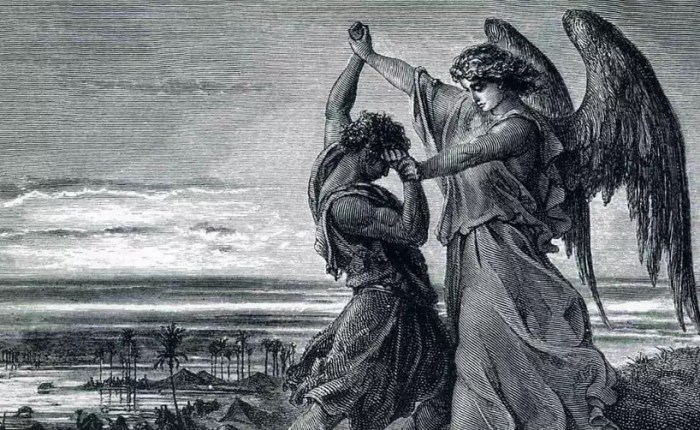
God came down to earth, took on the form of a man, wrestled with Jacob face to face, and then pronounced that his name was no longer Jacob, but Israel – which means: “he who struggles with God.” God seared this new name into this man’s mind by creating an experience for him whereby he actually physically struggled with God.
However, the name change was not just reflective of his immediate situation, but it was also an appropriate summary of Jacob’s whole life, and how he had spent years struggling with God relationally.
And that pattern that was characteristic of Jacob’s – now Israel’s – life, would also come to define the pattern of his descendants as well. God chose that name for His people, knowing that they would have an ongoing struggle with Him, relationally speaking. Every generation born from the house of Israel would have to struggle with their collective relationship to God. We’ve talked about this pattern before – it’s the cycle that we see unfold through the rest of the Old Testament, as one generation after another is born, takes their place in the history of God’s people, and is ultimately defined by their relationship to God.
They followed that revolving cycle of peace and prosperity in God’s grace, followed by idolatry and immorality and turning away from God, followed by God’s judgment and discipline, followed by humility and repentance, and then followed by God’s restoration and redemption for them. That’s their collective struggling with God happening over and over again, through the pages of the Old Testament and into the New.
Despite this struggle, or perhaps because they continued to struggle WITH HIM, rather than WITHOUT HIM – God blessed them, guided them, delivered them from slavery, and protected them as a nation of people. Even when they were almost completely wiped out, He preserved those who were faithful to Him. Even when they were forcibly ripped away from their homeland, He kept them alive, and He brought them back and re-planted them in their own piece of land.
Even in their darkest hours, when it seemed like there was no hope, God gave them hope. He sent them prophets to tell them that He had a plan. That there was always hope. Their suffering was only temporary. One day, He would send them a Son – the Prince of Peace, the King of Kings, the Lord of Lords – to establish a perfectly just and righteous Kingdom for all eternity. One day, God would fulfill His promise to Abraham to bless all nations of the world through him and his descendants.
When the story of Biblical Israel transitions from the Old Testament into the New Testament, it’s because the King had finally arrived. And one of his closest disciples and friends – the Apostle John – writes this about him, and says, in that famous passage of John Chapter 1:
“In the beginning was the Word, and the Word was with God, and the Word was God. He was with God in the beginning. Through him all things were made; without him nothing was made that has been made. In him was life, and that life was the light of all mankind. The light shines in the darkness, and the darkness has not overcome it.
The true light that gives light to everyone was coming into the world. He was in the world, and though the world was made through him, the world did not recognize him. He came to that which was his own, but his own did not receive him. Yet to all who did receive him, to those who believed in his name, he gave the right to become children of God—children born not of natural descent, nor of human decision or a husband’s will, but born of God. The Word became flesh and made his dwelling among us. We have seen his glory, the glory of the one and only Son, who came from the Father, full of grace and truth” (John 1:1-5; 9-14, NIV).
He came to establish a Kingdom that would last forever. The story of Biblical Israel does not end when Jesus goes back to Heaven after his death and resurrection. The story of Biblical Israel doesn’t end, even when the credits roll in the Book of Revelation. The promises that God made to Israel extend for all eternity through those who believe in Jesus Christ, and will live forever. The promises that God made to Israel extend beyond the boundaries of this temporary life, and beyond the boundaries of Abraham’s bloodline.
This is what Paul says in Galatians 3:26-29:
“So in Christ Jesus you are all children of God through faith, for all of you who were baptized into Christ have clothed yourselves with Christ. There is neither Jew nor Gentile, neither slave nor free, nor is there male and female, for you are all one in Christ Jesus. If you belong to Christ, then you are Abraham’s seed, and heirs according to the promise.”
It’s the same thing Paul says in Romans 9:6-9. To summarize and paraphrase – Not all those who are descended from Israel are Israel. Not all of Abraham’s descendants are his children. Abraham’s offspring, God’s chosen people, Israel, are those who have faith in Jesus Christ as Lord and Savior.
So, what’s that mean for this particular discussion? Well, it means that ever since Christ came to Earth and inaugurated his Kingdom; ever since he died, and rose again, and ascended to heaven, ever since the time when the Apostles were writing the New Testament, the scope of who can be accurately called by the name “Israel,” as defined in the Bible, has been changed.
The definition of Biblical Israel has been, in some ways, narrowed to include only those who follow Jesus. But in another way, it has been widened to include all those who enter into God’s spiritual kingdom through Jesus, no matter what race they are from – Jew or non-Jew. That is the definition of Biblical Israel.
Biblical Israel was founded physically under the Old Covenant, fulfilled spiritually in the New Covenant, and when Christ returns, the physical and spiritual will come together into one, and ripple out into all eternity. This is the Israel made up of all Jews and non-Jews who put their faith in Christ.
But this brings us to the next manifestation of Israel. What I call “Historical Israel.” There may be a better name for it. Paul would probably call them Unfaithful Israel, but we’ll stick with Historical Israel. In any case, since the birth of the Church, there has been another Israel, made up of those who did not put their faith in the Messiah.
One of the things that makes Paul a little hard to follow at times, in Romans 9, 10, and 11, is that in the midst of his theological discussion about Israel, he is going back and forth between these two Israels. He doesn’t refer to them specifically as two different Israels, but that’s what he’s describing – the idea of a faithful, Biblical Israel, and an unfaithful Historical Israel.
Historical Israel is the nation of Jewish people that continued on after the birth of the Church, the vast majority of whom had rejected Christ. That’s the problem that Paul is unpacking in this section of Romans. So many of his fellow Israelites had failed to live up to their full potential because they rejected Jesus, and Paul, as an Israelite who had accepted Christ, was greatly disturbed by this tragedy.
In Romans Chapter 11, after addressing the root of the issue in the previous two chapters – which is faith verses unbelief to summarize it as concisely as possible – Paul then addresses both faithful and unfaithful (Biblical and Historical Israel) at the same time. And this is what he says to them, and about them, in Romans 11:7-10:
“What then? What the people of Israel sought so earnestly they did not obtain. The elect among them did, but the others were hardened, as it is written: ‘God gave them a spirit of stupor, eyes that could not see and ears that could not hear, to this very day.’ And David says: ‘May their table become a snare and a trap, a stumbling block and a retribution for them. May their eyes be darkened so they cannot see, and their backs be bent forever’” (Romans 11:7-10, NIV).
So, this is Paul stating, by the use of Old Testament references, that there is a difference between Biblical Israel and Historical Israel. The elect that he mentions are those who we could call Biblical Israel – those who received salvation through faith in Christ.
The rest, are Historical Israel – those who rejected the New Covenant, and sought salvation through human effort, which is not possible. They rejected Christ, and because of that, they called down a curse upon themselves.
Paul references this curse by quoting Deuteronomy, Isaiah, and Psalms here in Romans 11:8-10. He mixes three Old Testament verses together to refer to their collective blindness and suffering. But this idea of them receiving a curse for their rejection of Christ is, perhaps, a little more viscerally communicated in Matthew Chapter 27.
It was at the end of Jesus’ trials, just before he was crucified. Pontius Pilate was looking for any excuse he could find to release Jesus, without causing a riot in Jerusalem. Even his own wife told him to let Jesus go. But he was caught between a rock and hard place, so to speak.
So, in verses 22-25 of Matthew 27, Pilate brings Jesus out in front of the crowd and lets them decide. He says:
“What shall I do, then, with Jesus who is called Christ?’
They all answered, ‘Crucify him!’
“Why? What crime has he committed?’ asked Pilate.
But they shouted all the louder, ‘Crucify him!’
When Pilate saw that he was getting nowhere, but that instead an uproar was starting, he took water and washed his hands in front of the crowd. ‘I am innocent of this man’s blood,’ he said. ‘It is your responsibility!’
All the people answered, ‘Let his blood be on us and on our children!’”
That is one of the most chilling verses in the Bible. The Jewish people in Jerusalem, yelling for Jesus their Savior to be executed, and so sure of their righteousness in doing so, that they were willing to call a curse down upon themselves and their children in the process.
Now, this curse that they called on themselves has been used, throughout history, by some, as a justification for anti-Semitism. So, I just want to say, emphatically, that it should never be taken that way. There is no justification for anti-Semitism, and any so-called Christian who has ever condoned violence and persecution and discrimination against the Jewish people, is not a real Christian.
As Christians, it is our duty to show Christ to all people through love and service. God still desires the reconciliation, of the historical people of Israel – and this is what Paul communicates as Romans 11 continues.
In Romans 11:11-12 he says:
“Again I ask: Did they stumble so as to fall beyond recovery? Not at all! Rather, because of their transgression, salvation has come to the Gentiles to make Israel envious. But if their transgression means riches for the world, and their loss means riches for the Gentiles, how much greater riches will their full inclusion bring!”
He’s saying that there is still hope for those who belong to the historical people of Israel descended from Abraham – even as there is hope for all nations of people; for every person who calls on the name of Christ. They did not stumble beyond recovery.
Redemption is still available. Historical Israel can still be folded back into Biblical Israel, if they accept Christ. And many countless individual Jews throughout history have done so.
Then, in the next set of verses, Paul talks to the Gentile Christians that he was writing to in the city of Rome. As far as we know, the Gentiles outnumbered the Jews in the Roman church, and some scholars think that the Gentile Christians needed to be reminded, and encouraged to not view themselves as superior to the Jewish Christians. Some scholars surmise that the Gentiles were getting a bit of a chip on their shoulder, and that they needed to have any notion of anti-Semitism squashed completely, before it could grow into something destructive. Which is why Paul says what he says in verses 13-21:
“I am talking to you Gentiles. Inasmuch as I am the apostle to the Gentiles, I take pride in my ministry in the hope that I may somehow arouse my own people to envy and save some of them. For if their rejection brought reconciliation to the world, what will their acceptance be but life from the dead? If the part of the dough offered as firstfruits is holy, then the whole batch is holy; if the root is holy, so are the branches. If some of the branches have been broken off, and you, though a wild olive shoot, have been grafted in among the others and now share in the nourishing sap from the olive root, do not consider yourself to be superior to those other branches. If you do, consider this: You do not support the root, but the root supports you. You will say then, ‘Branches were broken off so that I could be grafted in.’ Granted. But they were broken off because of unbelief, and you stand by faith. Do not be arrogant, but tremble. For if God did not spare the natural branches, he will not spare you either.”
He goes on in verses 22-24 to summarize his whole train of thought:
“Consider therefore the kindness and sternness of God: sternness to those who fell, but kindness to you, provided that you continue in his kindness. Otherwise, you also will be cut off. And if they do not persist in unbelief, they will be grafted in, for God is able to graft them in again. After all, if you were cut out of an olive tree that is wild by nature, and contrary to nature were grafted into a cultivated olive tree, how much more readily will these, the natural branches, be grafted into their own olive tree!”
There is still a chance for them. But unless, and until, they accept Christ, then they remain under the curse of their ancestors. Christ is the only way out of the curse, not just for them, but for all people. So, until they accept him, Historical Israel is not the same as Biblical Israel.
Biblical Israel is any Jew or Gentile that has put their faith in Jesus Christ as Lord and Savior. Historical Israel are the Jews who were cut out of the tree, but still exist, and for whom Paul had hope that some of them would still accept Christ and be saved as he had been.
So, there’s a branching off that occurred at that point in history when the Church was born. There were two Israels from that point on. So, the question is, what happened to Historical Israel after that time? What happened to the branches that were pruned off, and yet survived and carried on?
Well, we’ll talk about this more next week, and I mentioned it back at the beginning of this series, but just a handful of verses later, in Romans 11:28-29 Paul says about Historical Israel, that:
“As far as the gospel is concerned, they are enemies for your sake; but as far as election is concerned, they are loved on account of the patriarchs, for God’s gifts and his call are irrevocable.”
So, even though they rejected Christ in the first century, as a nation of people, they have persisted and thrived, despite being one of the most persecuted people to ever exist on planet Earth. Even though they may be enemies of the Gospel message, God loves them, on account of Abraham, Isaac, and Jacob, and He has not left them high and dry. So, what happened to them after the first century?
Well, to put it as simply as possible – they survived. They survived many hardships as a people group, in spite of incredible odds. Some of the history we know. Some of you have been around long enough to have seen some of the more recent history of the Jewish people. The rest of us learned about it in school when we were kids. But there’s a lot more than just what we know as the immediate history of the Jews. A lot happened in between the first century, and 1948 when a large portion of Historical Israel, coalesced into the third manifestation of Israel – the modern State of Israel.
I told you at the begging of this message we would talk about Biblical Israel, Historical Israel, and Modern Israel. And we will, but we just don’t have time to go into all of it today. Biblical Israel we’ve talked about, and I think everyone understands that this is the Israel we talk about every Sunday, or in every Bible study. This is the Israel that we are a part of – the olive tree that we’ve been grafted into as the Church.
Historical Israel, then, even though we’ve briefly defined it today, as Scripture defines it, as Paul defines it – there’s a lot more to say. As I said, there is a lot more history that many of us are not as familiar with, and I don’t want to brush over all that too quickly. It needs to be properly surveyed and discussed, because understanding Historical Israel, will help us understand how we get to Modern Israel, or the modern State of Israel.
And understanding how each of these three Israels are tied together, and how they diverge from one another, might help us make a little more sense out of the terrible things we see happening on the news – or at least help us understand what the name Israel means, and how different groups of people use this same name. The name Israel is important.
I said this at the beginning of the message, and I’ll say it again as I close: As followers of Jesus Christ, we cannot escape our connection to the name Israel. As those who have been grafted into the Olive Tree of Israel, we now carry with us the promise that God made to Abraham thousands of years ago. The Church is a part of what God views as His people Israel.
That means, that just as the name Israel was applicable to Jacob, and to his descendants, it’s also applicable to us as well. Who among us, can say with absolute honesty and certainty and sincerity that we NEVER struggle with God? I hope none of us say that.
We can still believe in Him, and remain faithful to Him, and still be obedient to Him, but also struggle with Him. He wants us to wrestle with Him. He wants us to go to Him with our problems and our anxieties, and our griefs and our confusion over things that happen in life. He wants us to go to Him with questions about why bad things happen.
He wants us to grab hold of Him and not let go until we get a blessing – the way Jacob did. Of course, Jacob’s blessing was a dislocated hip, but still, even that was a blessing that reminded him of his personal encounter with Almighty God. It reminded him of his name – HIS IDENTITY.
And we need to be reminded of our name, and our identity in Christ as well. Everyday. We’re all going to struggle. God wants us to struggle with Him, rather than struggling without Him.
If you’ve given up struggling with God. Now is the time to go back to Him.
The time is short. The days are evil.
But the Lord is reaching out and ready to receive all who call on his name.
If you’ve never believed in Jesus Christ, never put your faith in him, he is willing to meet you where you are.
_______
 The Basmati House Review
A wonderful series of messages; thanks for the reminder!