Many years ago, when I was just a young lad with a high-pitched voice that still sounded like my sisters’ … mom and dad read me the ancient story of one of the most mightiest of manliest of men to have ever existed – King David. Of course, due to my age, they were reading from an extremely abridged and docile version of the Bible with lots of pictures… that obviously contained none of the sex and violence that’s in the real Bible. If you’ve never read the sacred tomes of the Old Testament, and in particular the books of First and Second Samuel, they are more graphic and explicit than any episode of Game of Thrones. And that is not an exaggeration, but that is another review for another time. At any rate, what those fluffy 80s picture Bibles did not leave out, was the amount of running, chasing, and hiding that dominates so much of King David’s story. David was, quite literally, in regards to Judeo-Christian literature and culture – the original ‘man on the run.’ In his early years, before he became king, David was a hunted man. He was always on the move, unjustly accused, pursued by his enemies, pursued by the reigning authorities, hiding in caves, scrounging for food, ‘making his way… the only way he knew how…’ David’s early story is about how God protects him, guides him, and empowers him during this time in his life. It’s the story of how he remained faithful under constant duress, and how he waited patiently for the day when justice would be done, and he would finally become the king. This is one of the stories I found fascinating as a kid. And it’s one of the oldest stories in existence that is still being re-told to this day, and has been re-told, re-imagined, and re-worked over and over again so many times, in so many different ways. David’s journey from shepherd to king has been extrapolated, carefully pulled up by its deepest roots, stripped down to the core of its DNA, and transplanted into so many different stories that it’s probably impossible to list them all – I’m not even going to try. It’s the original seed from which so many other orchards have been cultivated.
As an example of what I’m talking about – I first encountered this re-grafting of David’s story when I read The Lord of the Rings for the first time. The character of Aragorn has a story arc, throughout Tolkien’s sprawling epic, that is taken completely from David’s early life. Aragorn’s story is an example of what I would call a pure distillation of the source material. It’s essentially the same general premise, with fantasy elements, names, and places substituting for counterparts in the original story. And of course, because it’s a fairy tale – not real life – it leaves out all the uncomfortable parts that the Biblical narrative isn’t afraid to show us.
Now, as I’m sure most of us are aware, The Lord of the Rings was eventually made into a landmark cinematic trilogy that was released between 2001 and 2003. But way back in 1935, at around the same time that Tolkien was crafting The Hobbit novel into its final form, another Englishman by the name of Alfred J. Hitchcock was releasing a film called The 39 Steps. And just to give credit where it is due, this film was an adaptation of a book written in 1915 by John Buchan, not an original work by Hitchcock. We can, however, give credit to Hitchcock for making (as far as I can tell) the very first masterpiece that translated the ancient literary example of the hero who is hunted down, on the run for his life, trying to find justice – The King David Motif, if you will – into a cinematic formula that has since been copied, tweaked, adjusted, and re-adapted many times over. Here’s a brief list of movies that I’ve seen, which employ some variation of this formula:
Running Man, The Fugitive, Enemy of the State, Waterworld, Mission Impossible, The Jason Bourne movies, Shooter, The Island, Minority Report, and Mad Max: Fury Road… just to name a few. There are many more of course, and the whole “Spy” genre itself, as we know it in movies today, is mostly an overgrowth from that indigenous sapling planted by Hitchcock so many years ago.
Side Note: Hitchcock himself used the same formula again in his later film, North by Northwest in 1959 – one of his most successful films.
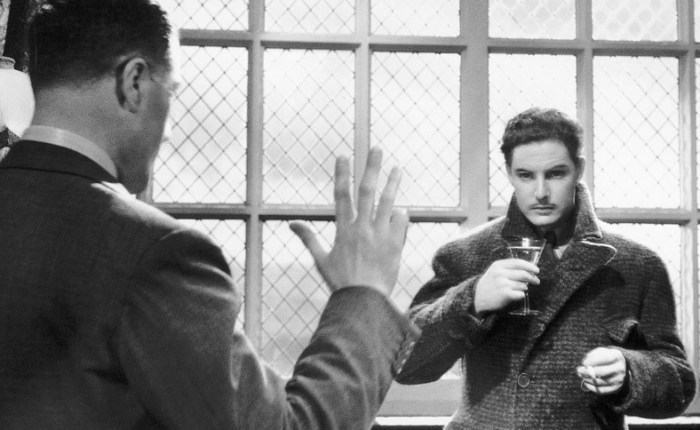
In The 39 Steps, the hero is Richard Hannay, a Canadian traveling in Britain who is unwittingly caught up in an espionage conspiracy, accused of murder, and chased up into the Scottish countryside by both the criminals and the police. Along the way (just to make things interesting) he jumps off a train, meets some odd characters up in the moors, is almost fatally shot, accidentally propelled to the front of a political rally, forced to give a public speech, and gets handcuffed to a woman named Pamela who hates him, and then eventually falls in love with him… at least, I think she falls in love with him… I mean they’re holding hands at the end, and this was 1935, so… you know. I guess, in Hitchcock’s mind, if you’re handcuffed to the same person long enough, you just eventually go with it. Actually, the relationship between Hannay and Pamela reminded me a great deal of the relationship that forms between Clark Gable and Claudette Colbert in Capra’s It Happened One Night. But that’s another review.
Perhaps most interestingly, as is often the case with these kinds of tales, there is usually either some small flourish, sweeping gesture, or over-arching plot element that indicates the presence of the divine in the midst of the hero’s struggle. These act as clues; small trails of crumbs that lead back to the original loaf of bread that started it all. If the early story of King David really is the ancient progenitor of this literary genre, and Hitchcock’s film a true echo of that, then we could expect to find the same kind of evidence in The 39 Steps. And Hitchcock, who was trained by Jesuits in Catholic school to analyze art at an early age, does not disappoint. In this case, we see the divine presence most clearly on display in the form of a church hymnal; it’s conspicuously situated snuggly in the left breast pocket of Hannay’s coat where it stops the aforementioned bullit that would have otherwise killed him. Bullseye.
Believe it or not, this was the first Hitchcock film that I’ve ever watched, and aside from the plot, which is interesting enough on its own, the thing that really makes this old movie shine is how much anxiety it’s able to convey through the screen. This is where Hitchcock’s talent as a filmmaker becomes apparent. He really makes you feel like you’re the one handcuffed to Richard Hannay as he frantically trots from one place to the next. Moreover, it’s extremely frustrating to witness how no one believes Hannay when he tries to tell them what’s happening to him, leaving him with no choice but to lie in order to get help from people! Hitchcock is indeed the legendary master of suspense that he’s been made out to be.
I’ve known about Alfred Hitchcock, and been aware of his impact on the history of filmmaking for most of my life – even having never seen one of his films. But after watching The 39 Steps, I now know why he’s considered one of the greatest directors of all time. In this movie at least, he took an ancient, timeless story that had been distilled into something that fit the time in which he was living, and crafted it into a cinematic formula that we can still appreciate 83 years later.



 💥
💥









 The Basmati House Review