Waterworld

Waterworld

Well, after last week’s foray into the dark world of JFK assassination conspiracies, I decided to keep it a bit lighter this week with a viewing of Waterworld. Released in 1995, almost a decade and a half into Costner’s movie career he finally reached his peak — and in the process went careening off the mountaintop in what could best be described as an atomic cannonball into the deep end of a 200 million dollar sea water tank — tank being the key word here. On record as the most expensive movie ever made at the time, Waterworld was a domestic box office disaster. Several months before it was released into theaters that summer, news reports were already decrying it as an inevitable flop; a shambling mess of cinematic production wrought with infighting between Kevin Costner and the director Kevin Reynolds, with a wildly overblown budget that smelled like the hubris of an actor and director who had no where else to go after winning the hand of Maid Marian, rescuing a tribe of Sioux from annihilation, becoming a Baseball prophet, putting Capone in the slammer, saving Whitney Houston from a stalker, and uncovering the plot to kill president Kennedy. I mean, what else can you do after all that?

Well, if your name is Kevin Costner, you can dump millions of your own money into recreating the Madmax franchise in the ocean, grow a pair of gills and webbed feet, blow up an army of chain-smoking numbskulls on jet skis, play it cool while Dennis Hopper calls you a “turd that won’t flush,” bungee jump from what looks like a hot air balloon straight out of the Flintstones, save a group of smug refugees from extinction by salt water, take crayons away from an orphaned 5 year old, and fall in love with Jeanne Tripplehorn before sailing off into the sunset like you just don’t care while on your way to make The Postman. The opening shot of the movie is Costner taking a whiz into a cup, running it through a make-shift chemistry set to give it some carbonation and then drinking it. Yes, folks, the first thing we see in this movie is Costner literally drinking his own urine. Is this a metaphor for the entire production of the film? No comment.

Critics gave Costner a lot of crap for this movie, for all the reasons just mentioned, but I don’t care — I think it’s awesome. Is it a brilliant film? Of course not. Is there anything in it to justify its ridiculous budget? Heavens no. Is this what happens when a man accumulates enough wealth and clout to put whatever he bloody well wants to on film? Heck yes it is. Is it pure 90s action extravaganza? Absolutely. In the same year that gave us Pierce Brosnan as James Bond, Sylvester Stallone as Judge Dredd, and Val Kilmer as the freaking Batman — Waterworld was right where it belonged, forever enshrined between Billy Madison and The Brady Bunch Movie, but inevitably eclipsed by such classics as the first Toy Story, Braveheart, and Apollo 13.

I’ve always had a soft spot for post apocalyptic dystopia… and Taco Bell. The two things go together quite remarkably. And like Taco Bell, which is great in small doses, but gastricly deadly when the object of overindulging, so these post apocalyptic movies and television shows have begun to leave a bad smell behind them nowadays. I apologize, that’s a really gross metaphor… I don’t know where I was going with that. The point is— I was lucky enough to see Waterworld when I was still a young guy, and back then, in the middle of the 90s, these types of stories still had happy endings for the most part. Waterworld, unlike many of the dystopian futures being conjured up in today’s market, still left us with some hope when the credits rolled. That’s good story-telling in my book. And beyond that, it’s just a really fun movie.

JFK

JFK

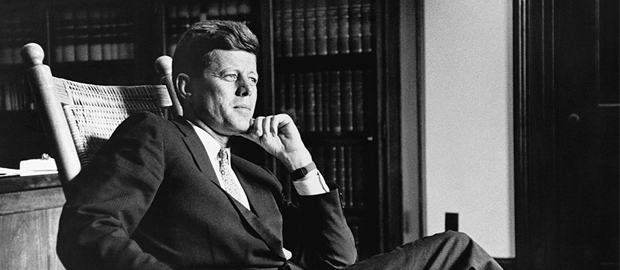
When I was about five years old, two things happened that drastically altered my innocent perception of the world at the time. The first thing was seeing President John F. Kennedy’s head exploding on the living room television set while getting ready to go to bed one night. I think I was probably too young for that. I had no idea what a Zapruder even was. The second thing was discovering my grandpa’s stack of Playboys during a game of hide-and-seek at my grandparents’ house. I was definitely too young for that experience. 1983 must have been a rough year for Mom and Dad. They had a lot of explaining to do that year. Their explanation about the magazines was pretty straightforward, though to be honest, after witnessing my mother unleash Hellfire on my grandfather, no explanation was really necessary. But the explanation they provided about the president getting whacked was not as clear. I remember Dad having to assure me—though I remained skeptical for awhile afterwards—that the president I had seen on the television was not the current president at the time. That president, he explained, was Ronald Reagan, and he had survived his shooting. Imagine my five year old brain trying to work this equation out while moping around the playground at recess as the other kids were chasing each other around like monkeys, and you’ll have a pretty accurate picture of my early grammar school days.

I obviously have no idea what it was like for those who lived through those times – not just the Kennedy assassination, but everything else from that era, the Vietnam War, the seemingly imminent threat of nuclear annihilation, the deep division in the country, the riots, the following assassinations of Dr. King and President Kennedy’s brother… but as a kid who gradually discovered these things from a considerable distance, and always through the foggy lens of other peoples’ differing views, it all sounded a lot like a very dark fairy tale—the kind you didn’t want to hear before going to bed at night. I knew I was supposed to learn something from it, that there was some kind of moral to the story, but I had no idea what it was, and no one else did either. My dad just told me it was a mystery, and that as much as we wanted to know what really happened to JFK, we probably never would. And he encouraged me not to think so much about it. So I didn’t. And when Oliver Stone’s 1991 film about the assassination was released it completely escaped my radar. As far as I knew, Kevin Costner was still just Robin Hood.

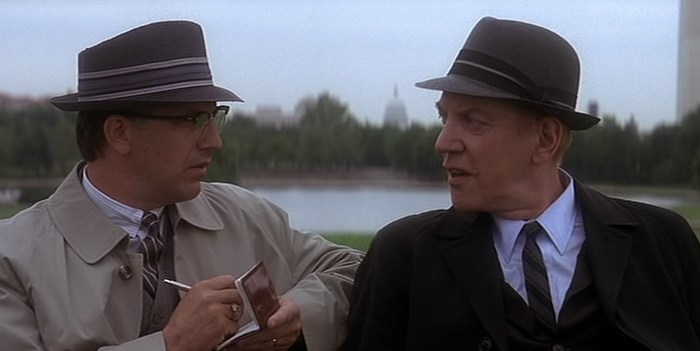
Then, about 10 years ago, while attending seminary, my brothers and I decided to unwind one evening with a viewing of JFK. I’m sure we had a pot of something on the stove, primed and ready, as we settled in for the three-hour duration of the film, but even so, the experience of seeing that movie wasn’t a relaxing one. It was exercise. It was a marathon of the mentally exhausting variety. Don’t get me wrong though. The film is brilliant; the work of a mad genius, and I’m pretty sure it accomplished exactly what Stone wanted it to accomplish – which as far as I can tell was to drudge up something from the nasty bog where United States History goes to die, and shine light on it in an effort to make people do that thing that we sometimes prefer not to do in these matters – think. And by the time I was done thinking, I was exhausted. The same was true this week when I watched it again. Stone and Costner didn’t just make a film about the determined lawyer in New Orleans named Jim Garrison who wanted to dig until he found the truth – they made a documentary of the crime, presented all the evidence, stated their case, and then used the film medium as a vehicle to get it where it needed to go so ordinary people could access it and make sense out of it. They succeeded in this. Regardless of whether you agree or disagree with the hypothesis, they did an excellent job in presenting it. The true brilliance of the movie is that you can’t separate the film from the historical account. They’re woven together in such a way that forces the viewer to examine the facts and consider the possible explanations in the same way the courtroom jury is doing in the third act of the movie. Wherever possible, Stone used real video and audio from the time period, along with painstakingly accurate recreations of incidents that were captured on film, including Abraham Zapruder’s home movie, and the news footage of Oswald’s murder. And to drive the intention of all this home, in the final courtroom scene, as Costner’s character is making his closing argument to the jury, he looks directly into the camera to deliver his final line, “it’s up to you.”

So what is the hypothesis of the film? If you haven’t seen it, or you don’t think you ever will, I’ll try and break it down for you as best I can. And there’s really two parts to the hypothesis. The first part deals with HOW Kennedy was assassinated, and takes a very simple and direct look at the forensic evidence – the Zapruder film which establishes the time frame and the exact place of the assassination, the number of shots that were fired, where they were fired from, the trajectory of the bullets, the autopsy photos, and other things of this nature. This is basically all the stuff that could not be faked, so if there was a conspiracy, the forensic evidence had to be cleaned up, wiped away, lost, or hidden from the public, and most of it was – even the Zapruder film was hidden from the public for many years after the assassination. An honest look at the HOW leads to one basic conclusion: that Lee Harvey Oswald could not have killed President Kennedy alone, even if he was the best sniper to have ever lived. Just to clarify: I’m not commenting on what I personally believe, I’m just relaying what the filmmakers have shown.

The second part of the film’s hypothesis is much more difficult to process. This deals with WHY Kennedy was killed. This is the realm where all the conspiracy theories come into play, and though there are many, the film focuses primarily on one. Most of the exposition for this theory is delivered by Donald Sutherland who shows up in the middle of the film as a sort of retired black ops agent with no name – his character delivers the goods to Costner who incorporates it into his investigation. The theory is as follows: John F. Kennedy was a very young man who inherited the presidency of the two old war horses before him, Harry S. Truman and Dwight D. Eisenhower. From the beginning, he was at odds with the Military Commanders in the Pentagon and the CIA. He failed to support their actions, fired many of them, and ultimately planned to keep the U.S. from fully committing to open war in Vietnam. None of that stuff is conjecture, and in fact, there’s a recent Ken Burns documentary available from PBS on the Vietnam War that is probably the most exhaustive work ever done on the subject. I watched some of the episodes before writing this review just to make sure I had somewhat of a grasp on what was going on. But it explains the troubled relationship between Kennedy’s White House and the rest of the government in 1962 and 1963. All of that is undisputed fact as far as I can tell. What isn’t provable, and where the film has obviously received the most criticism, is the theory that, because of the disagreements that Kennedy was having with the rest of the government, the CIA and the Pentagon decided to remove him from office via an invisible coup d’etat, for the purposes of putting Lyndon B. Johnson into office – a much more pliable president who was in agreement with the tide of power, rather than planting himself as a levy against it. The additional part of the theory is that Oswald was a very experienced spy, and black ops agent that the CIA commissioned to orchestrate the assassination, and once it was done, they sent Jack Ruby to kill him so no one would ever know. The best conspiracy theories, as they say, are the ones that can neither be proven or disproven.

One very interesting result of the film’s release in 1991 was the overwhelming public demand for the truth. The outcry was apparently so great that George Sr. signed into law the JFK Assassination Records Collection Act of 1992, which was to make all of the government’s documents on the assassination available to the public in 2017. If you’re following the current news, this is beginning to happen, at least in part – though “surprisingly” nothing of any real significance has been discovered. As of the date of this review, there are still a handful of the “most sensitive” documents waiting to be released by the President. If any of Oliver Stone’s theory were true, would they still have documents laying around 50 years later that could prove our government hasn’t been our government since 1963?

I guess, to sum up my honest thoughts about all this—not necessarily the JFK movie—but all the stuff it makes me think about, I have to go back to that part of myself that is still the little kid wandering around the edges of the school playground trying to figure things out for myself. The conclusion I couldn’t seem to find back then, just because I was too young, is the one that I accept now—that there used to be this mythical place called the United States of America. And at some point before I was alive, the king of this land was murdered in broad daylight with the whole country watching. And no one had a definite answer as to why he was killed… just conjectures, just fog, uncertainty, lies, smoke, and shadows. And on that day, because no one could stand up and tell the truth – the myth of America died along with him. And ever since then, we’ve been looking at ourselves, and seeing what is actually here, not the myth, but the reality. My generation, and the generations after us—we grew up in the reality, while being told about the myth. But the two things don’t match. So we’ve found our myths in other stories… in galaxies far far away, in cinematic universes, in books and in fairy tales about people and places that never existed.

And what about the reality of November 22, 1963? What really happened that day? The next guy took the throne and sent over 58,000 Americans to their deaths in an effort to stop a little country in southeast Asia from doing the same thing that our founding fathers did to the British Empire in the 1780s.

My Church History professor in seminary once said that, “given enough time, every institution eventually becomes the exact opposite of what it was originally intended to be.” I’ve pondered his quote many times in the years since I first heard him say it, mostly in an effort to convince myself that it’s not always true. Unfortunately, I haven’t yet found any evidence that it’s not. The older I get, the more I read, the more I learn—the more it seems like that old professor knew what he was talking about.

JFK2

The Untouchables

The Untouchables

The Costner film-of-the-week was The Untouchables, directed by Brian De Palma. That might mean something to you, and it might not, but as directors go, he’s a pretty good one. As far as I can tell this film was the linchpin in Kevin Costner’s successful movie career. He hadn’t really been much of a leading man before it was released in 1987, but after going toe-to-toe with James Bond and Vito Corleone it was clear that he had established himself enough to begin headlining his acting roles from there on out. The following year he would star in Bull Durham, and the year after that was when he did Field of Dreams.

Side note of the week: I’ve had a few requests/inquiries on Bull Durham, so I decided to blitzkrieg my way through it this week as well, and I’ve decided that, after having written an entire review on Field of Dreams which relates baseball to church, there is no way I can write a review on Bull Durham which, holy mackerel Andy, is a movie that relates baseball to sex!

ANYWAY…

What I found most interesting about The Untouchables is its place in the larger legend surrounding Prohibition era Chicago, Al Capone, and Eliot Ness. Back in 1957, just months before his memoirs were published, Ness died in relative obscurity, never seeing how popular his stories would become as they reverberated through the next 60 years in various forms. The book that Ness wrote was finished by a co-author who added a considerable amount of fictionalized material in order to make it more intriguing and entertaining. Because Ness wasn’t around to comment on (or refute) any of it, and because the book went on to sell over a million copies, eventually spawning two separate television adaptations, comic books, detective novels, cartoons, and this Costner film—the truth of what actually happened between the Federal Agent and the Notorious Gangster has gotten so woven together with the legend that it’s a futile endeavor to try unravelling them completely. The result is that we have been left with a good, old fashioned, morality tale about how a small team of outsider good guys takes down a powerful crime syndicate. It’s the Seven Samurai, it’s the Magnificent Seven, it’s the A-Team… it’s Frodo, Samwise, Meriadoc, and Peregrin; it’s Leonardo, Michelangelo, Donatello, and Raphael.

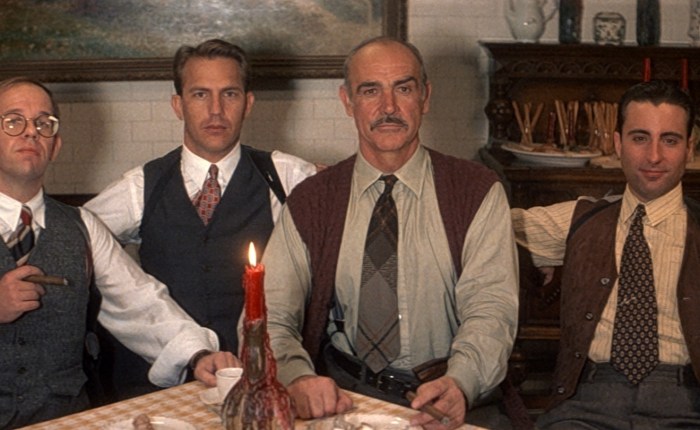
In De Palma’s iteration of the tale it’s the Federal Agent, the Nerdy Accountant, the Veteran City Cop, and the Skilled Rookie – played by a young Andy Garcia. The City Cop, Jim Malone is the anchor of the group, the standout performance, and it won Sean Connery his only, yet well deserved, Academy Award for the role. Something also has to be said about De Niro’s rather amazing performance as Al Capone. He plays the character like he was born to do so, unleashing his full range of bravado in only a few scenes, and yet it’s enough to make it feel as if he’s looming in the background of the entire movie. He’s fearless, foul, and full of himself in all the best ways.

With all that said, there’s no really deep metaphor here, nothing too terribly profound after digging around in the plot for awhile—at least I don’t think there is. And there doesn’t have to be. It’s a solid presentation of good guys versus bad guys, cops versus robbers, Costner versus Capone. Yet even so, there’s one really great gem that can be mined from the excavation of this film—the way it tells the story of the team coming together. Each member of the team is completely different, each one is inadequate by themselves, each one needs the others in order to overcome their own flaws and defeat their sworn enemy. It’s ironic, but also a stroke of genius, that it’s Capone who provides commentary on this during one of the film’s most memorable scenes…

What is that which gives me joy? Baseball! A man stands alone at the plate. This is the time for what? For individual achievement. There he stands alone. But in the field, what? Part of a team. Teamwork… Looks, throws, catches, hustles. Part of one big team. Bats himself the live-long day, Babe Ruth, Ty Cobb, and so on. If his team don’t field… what is he? You follow me? No one. Sunny day, the stands are full of fans. What does he have to say? I’m goin’ out there for myself. But… I get nowhere unless the team wins.

And now we’re back to baseball again.

untitled_15

The Bodyguard

The Bodyguard

This past week my Costner marathon took me to a long time ago, in a galaxy far far away… Just kidding. It only took me to 1992, but I actually had not seen this one before, and it was written by one of my favorite screenwriters – Lawrence Kasdan. At last count, Kasdan has written more Star Wars films than George Lucas, or anyone else for that matter, including my favorite The Empire Strikes Back. He was also the writer for one of my favorite westerns – Silverado – as well as Raiders of the Lost Ark. There’s quite a diverse collection of films in his trophy case, including The Bodyguard.

Like I said, I had never seen this movie before, though I was very aware of it because of its music which has immortalized five of Whitney Houston’s hit singles on what is still the best-selling film soundtrack of all time. If you were looking to set the mood for a romantic evening back in the 90s, or you were pining for a lost love – you didn’t have to look any further than Whitney’s version of “I Will Always Love You,” which was a remake of Dolly Parton’s original tune, yet arguably the best recorded version of the song. Side note: I was neither pining for lost love nor attempting to generate romance in 1992, as I had only recently discovered comic books… “two roads diverged in a wood, and I–I took the one less traveled by,” you might say. 

So anyway, unlike the previous Costner films I’ve reviewed so far, I went into this one with a fresh set of eyes, and a desire to finally see this movie which had eluded my view for so many years. And I was glad I did.

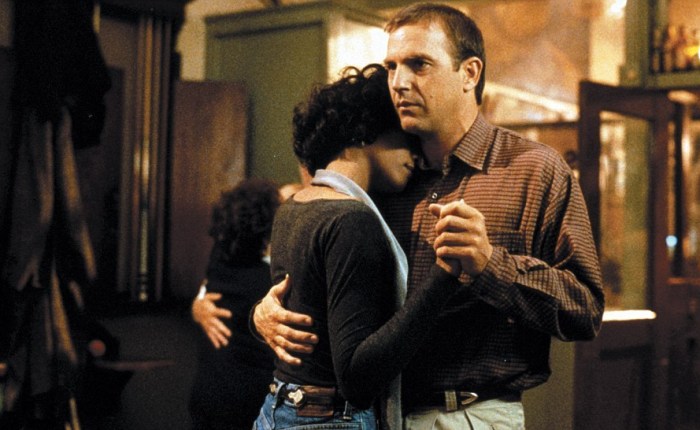
The plot is pretty straightforward. Whitney Houston dons the guise of a mega-famous singer named Rachel Marron who I would imagine isn’t that different from her real self at the time – when she was at the height of her career. Because of threats from an unknown stalker her manager hires Frank Farmer (Costner), a former secret service agent under the Reagan administration. What is not as straightforward as the plot, is the dynamic relationship between these two characters. There’s a lot of grit in the details of what ends up becoming the love story of two people who are as different as two people can be. They are complete opposites who journey together long enough to reach a place of complete trust with one another. Kasdan reverses the traditional order of the classic ‘Beauty and the Beast’ love story here by taking his characters first to a place of passionate romance, then to friendship, then to understanding, admiration, and trust. I’m not sure that it works quite as well on screen as the traditional avenue of trust, admiration, understanding, friendship, and then romance, but what does work is the complicated messiness of it all, the realness of the emotions spilling out of Costner and Houston, and the paradoxical beauty of two worlds colliding, smashing each other to pieces, and then being rebuilt into something new.

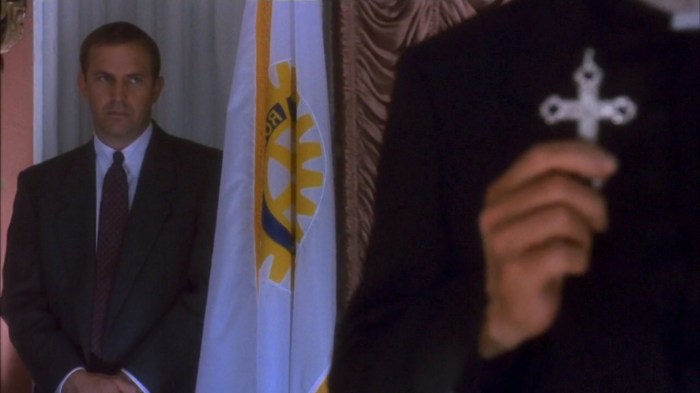
One of the things I really appreciate about older movies is that the Christological metaphors are usually not as subtle or as hidden as they often seem to be in newer films. That’s definitely the case with The Bodyguard. While the plot, as mentioned, is a non-traditional love story between two opposites, the wider meta-narrative is a compact declaration of one of the main themes in all of Scripture – best summed up by the Apostle Paul when he instructed the men he was addressing to, “love your wives, just as Christ loved the church and gave himself up for her.” If you suspect I might be reaching a little too hard for this metaphor, take note of the very end of the film which closes with the prayer of a priest holding up a cross and echoing a portion of the 23rd Psalm, “even though we may pass through the valley of the shadow of death, you are with us, guiding and protecting us.” Houston and Costner, having both grown up in the Baptist Church, knew exactly what movie they were making, and how timeless a story it really was.

IMG-7433

Field of Dreams

Field of Dreams

It was the summer of 1987. All the stories about baseball seem to begin with reminiscing about what year it was, so I figure I’ll start with that. It was the summer of 1987, and the Hazelwood Hoosiers baseball team were celebrating their championship victory over the Pee Wee League. My dad was one of the coaches which makes it especially sentimental when I think back on it now. We had gone undefeated at 15-0 and quickly swept the tourney. Having reached the end of my three years in the league, and about to turn the grizzled old age of 10, there was nothing left for this right-fielder to achieve. So I decided to retire while I was at the peak of my career. For the next several years I just kicked back and enjoyed watching occasional games with my dad, or going to see the minor league Indianapolis Indians play at the old Bush Stadium from time to time. I even had a decent collection of cards and a Colorado Rockies cap. In a time when DVR recording wasn’t yet invented, the World Series always took precedence on our living room television set during evenings in the Fall. My memories of those times are all mingled together with campfires and the Charle Brown Halloween special. Even as I grew into my teenage years baseball was still magical.

Adam027

Then The Strike happened. The Major League Baseball strike of August 1994 became the longest strike in MLB history, and it killed the postseason and the World Series – something that had not happened in 90 years. It was all about money of course… Millionaire players and millionaire owners were fighting over who was going to have just a little bit more. It was a disgusting display of greed that played out over months and laid bare an ugliness that had been festering below the surface of the game for some time I suppose. Eventually it was settled so everyone could go back to being millionaires again. But the damage had been done, and for me, there was no going back. When that summer was over, and the dust had settled, my love of baseball had been shattered. What was sacred had been profaned, trampled upon, and broken beyond repair. There was no longer any magic in it for me. Maybe I took it too personal, but I felt as if something had been stolen from me. That’s what greed does to things that are beautiful – it takes them away. It destroys them.

Then I saw The Sandlot one morning and a part of that magic found its way back into my heart. It was like uncovering an old treasure to discover that there were some movies out there about baseball that were somehow able to capture and contain the essence of the game – the purity that exists underneath when all the other stuff is pealed away. These films are idealizations of the values, history, and sentiments that baseball conjures up for us. There was one in particular that my 10th grade English teacher showed to us in class the year following the end of The Strike – Field of Dreams – and it is, perhaps, the purest and most elegant example of this.

Field of Dreams told me a story about what baseball really was at its core – not a sport – but a religious experience.

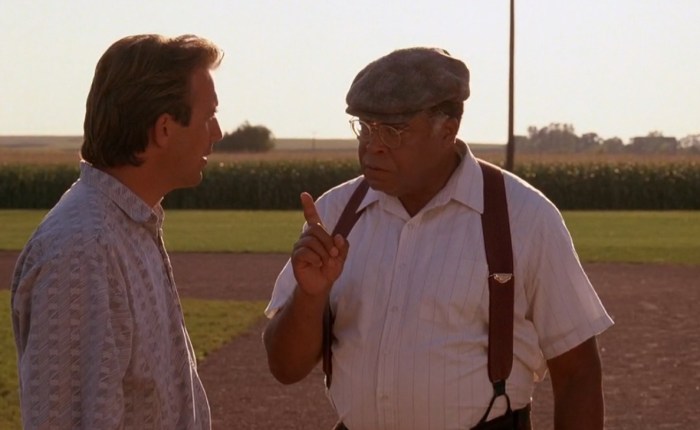
The film opens with Kevin Costner’s character Ray Kinsella standing in the middle of his Iowa cornfield hearing a voice. You probably already know what the voice said to him. It’s been echoing in my mind all week. “If you build it, he will come.” Sometimes, my mind likes to play puzzles and alter the words for me, so I end up hearing things like, “if you put it in the fridge, it will get cold,” or, “if you do the laundry now, you don’t have to do it tomorrow,” and my personal favorite, “if you let the dog poo in the park when no one is looking, you don’t have to pick it up.” But anyway, I’m getting off track a little bit. Back to Field of Dreams… It’s interesting to note that the morning after Ray first hears “the voice” he walks into the kitchen to discover that his daughter is watching an old black and white movie. We catch a brief glimpse of James Stewart from 1950, insisting that he’s talking to an invisible six foot rabbit named Harvey. Ray shuts the movie off, insisting to his daughter that it’s no laughing matter to hear something invisible talking to you. Eventually Ray has a vision that instructs him to build a baseball diamond in his cornfield. He proceeds to do so with the support of his wife and daughter, provoking the ire of the townsfolk and his brother-in-law in the process. Once completed, the field becomes a sanctuary in which players of the past come to find redemption and peace. You can interpret all this in many ways I suppose, but I like to think of Ray as a prophet of sorts, listening to the voice of God and obediently carrying out his instructions. The Bible is full of people hearing God’s voice, doing what He says even though it sounds crazy, and causing the people who are watching on the sidelines to lose their minds. As Ray says during the opening monologue, “Until I heard the voice, I’d never done a crazy thing in my whole life.” Along the way he hears a few other things from “the voice,” and it leads him to find James Earl Jones and Burt Lancaster – both playing the roles of aging acolytes in search of redemption themselves.

The beauty of the allegory here is that it’s not just in the film – it’s in baseball itself – and the movie is just a parable that’s showing us what has always been there. The ball field is like a church building. There’s the stands, the outfield, the infield, and there’s home base. These all mirror the essential parts of temples going back to ancient times. Solomon’s temple in Jerusalem once had an outer court, an inner court, and a Holy Place – and a Most Holy Place. Many of our churches today have a parking lot, a foyer, a sanctuary, and a communion table and baptistry at the center. In these places of worship, as on the ball field, people, friends, and families from the community gather together to participate in the same experience. There’s a structure to it all. There’s a rhythm. There is a set of rules that have been agreed upon – and there are guidelines that have been handed down to us from previous generations to show us how to follow them. There are emblems that give meaning, focus, form, and provide function for what is happening. In baseball we call these emblems the ball, the bat, the bases, the gloves. In the Church they are the Cross on the wall, the trays that hold the Communion Bread, the cups that contain the juice. Everyone has their place. Everyone has their own position to play. Everyone participates in some way. There’s the pitcher, the catcher, the batter, the basemen, the shortstop, the outfielders, the coaches, and the Ump. No one messes with the Ump. Even the spectators who aren’t directly playing in the game are invested in its outcome. There’s an energy to it all, an invisible force that pulls everyone together and puts them all on the same page for a few hours or so. It’s a spiritual experience. In its purest form there is no competition – only camaraderie, fellowship, and sharing time together – that’s the original intent anyway. It’s not really a game. It’s a sacred dance of worship. And in these sacred places, in the midst of the experience, encapsulated by memories, is an awareness of our connection to those who were here before us – those who shared time together and observed the rituals faithfully… those who found redemption on the field.

Like Ray Kinsella with his baseball field, we participate in our rituals as a means of re-connecting with our Father as well. And we do it to try and better understand what redemption really is, what it means, and how it will, in the end, take us all back to home base.

Sunkmanitu Tanka Owaci

Sunkmanitu Tanka Owaci

This past week I continued my Kevin Costner-athon by devoting a couple of evenings to Dances with Wolves. It took me two nights to finish it because I decided to watch the extended version which is nearly four hours long, and my couch is as old as this movie – so it can only accommodate my rear for two hours at a time before I go numb in the hindquarters. That’s probably more information than you need, but oh well. Regardless, the two-night viewing time was worth every minute. There is a shorter version of it, but I highly recommend going the extra mile for this one – it adds a great deal of information and rounds out the main characters quite nicely. And the movie has been around for 27 years, so if you’re really planning to watch it, you’re probably a bit of a film nerd like myself anyway, and in that case, why not watch the longer version?

I don’t know where to begin with this film, so I’ll just launch in with the statement that it’s a masterpiece all around, in every way, in every sense of the word. It absolutely deserves every one of the 7 Academy Awards it was given back in its day.

Ok, with that out of the way…

The simple truth is that they do not create movies in this way anymore. It was filmed just prior to the revolution that made the use of computer generated images a viable option in film-making, which means if it was being made today, the scenes where they’re riding horses alongside stampedes of buffalo would be done by computers and graphic artists who are sitting comfortably in cushioned chairs, sipping iced cafe breves – rather than by insane camera jockeys in the back of pickup trucks that are bouncing along the prairie at top speed to capture live video of an actual heard of beasts being corralled by dudes wearing loin cloths.

The way this movie was filmed is complimented by the attention that was given to meticulous authenticity. It’s in everything you see; from the weapons, to the clothing, to the council fires in the chief’s lodge – it’s all an accurate depiction of the Lakota Sioux in the late 1800s. It’s also in everything you hear. Pretty Shield, the wife of Chief Ten Bears, was played by Doris Leader Charge (1930-2001), a Lakota woman who lived her entire life on the Rosebud Reservation in South Dakota. She was also a professor of Lakota language at Sinte Gleska University, and her life’s work has been elegantly preserved in the authentic Lakota being spoken in the film. Without her influence on Costner and presence on the set, Dances with Wolves would have been an entirely different movie.

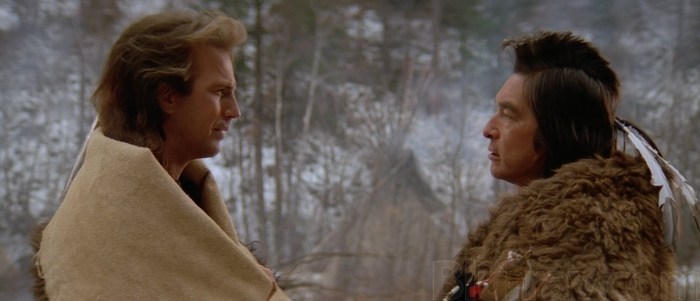
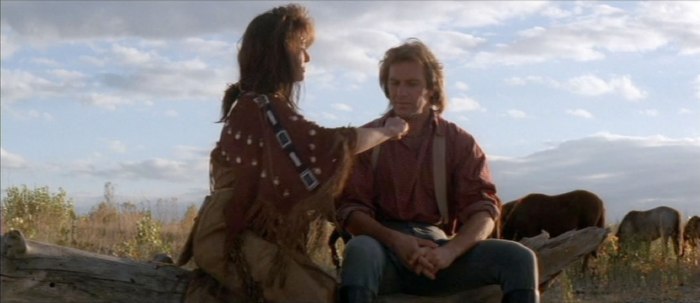
Costner, who also directed the film, plays Lieutenant John Dunbar, a Civil War veteran who is sent alone into Indian territory and takes up residence at an abandoned fort on the frontier. The story takes you slowly through the transformation that happens as he gradually leaves behind his native culture and adopts the life of the Sioux. A note on symbolism: the closer that Dunbar gets to making friends with the wolf Two Socks, the closer he gets to becoming more like one of the Lakota. The less said about the details of his death as a United States soldier and his resurrection as a Sioux warrior the better. Nothing I can say will capture the beauty of how the story is told.

My love and appreciation for this movie is, admittedly, the result of a great personal bias. It’s definitely in my top 10 favorite films. I think it’s true for all of us, that the movies we love the most are the ones that hit us deeply in the personal areas of the heart. That’s why I love this movie too. It was a movie my parents took me to see in the theater when I was 11 years old. I still remember blushing and my mom telling me not to look at the screen during the love scene (which is pretty innocuous by today’s standards), and I also remember my dad laughing out loud when Kevin Costner showed his bare ass. I don’t know why that’s funny, but I laughed when I saw it too this time. Like father like son, I guess. On a more somber note, it’s a movie my grandmother loved and spoke highly of with tears in her eyes. I really miss her, and I wish I could go back and talk to her about it now. But the older I’ve gotten, the more I connect with the parts of the story that deal with transformation and cultural metamorphosis. My heart and soul have inextricably tied it to experiences in my own life (both past and present) that reflect elements in the narrative. I obviously don’t know what it was really like to live back in those times. I don’t know what it’s like to be a soldier, or to have a wife, or to be shot at, or to wonder if my race is going to be wiped out by oppression and greed. I don’t know what it’s like to live in a teepee, get my water from a river, and cook every meal I eat over a fire. I don’t know what any of those things are like. But what I do know is how scary, how awesome, and how beautiful life can become when you leave behind everything you know as safe and familiar and comfortable, and pray that the strangers you meet will accept and love you, and make you feel like you belong with them. And I know what it’s like to have that prayer answered.

dww002

Kevin Costner: Prince of Robin Hoods

Kevin Costner: Prince of Robin Hoods

With Summer movie nights coming to an end, I’ve turned my attention toward revisiting the back catalog that’s been sitting quietly on my DVD shelf. I was able to get a good head start on these a couple of months ago when I decided to watch an old favorite from my adolescent years – Robin Hood: Prince of Thieves. In the late 80s and early 90s Kevin Costner had a solid string of movies that have stood the test of time, and I’ve been working my way through them, but I thought it was fitting to make this first review about my favorite Costner classic. It’s definitely not his best movie, but it occupies a place of importance in my personal experience of exploring and enjoying the art of film.

The Summer of 1991 was in full swing by the time Robin Hood hit theaters during the middle of that June. I was fresh out of grade school, with Jr. High still a couple of months away (this was back when Summer vacation actually lasted for, you know, the Summer), and I can’t believe I’m saying this, but those were the good ‘ole days. I remember seeing Robin Hood in the theater quite vividly because it was one of the last years that my parents took my sister and I on our annual vacation to visit friends who lived in Chesapeake, Ohio. So one afternoon, we made our way across the Ohio river to Huntington, West Virginia to see Robin Hood in the old Keith-Albee Theatre – the same place I had watched Michael Keaton become Batman two years earlier. And, incidentally, this was the same place where I would enjoy several movies as a college student a decade later.

The character and legend of Robin Hood was already quite developed in my mind by that time thanks to the animated Disney version that had come out in the 70s. My sister and I had a VHS copy that was probably close to being worn out. So Kevin Costner had a lot to accomplish if he was going to surpass Brian Bedford’s cartoon fox as the gold standard of Robin Hoods. And I’m happy to say that he met and exceeded my expectations. Even though he became the distinguished version of the English outlaw in my imagination, that old animated version is still my favorite Disney cartoon overall. But this new version of the Robin Hood myth had everything a 12 year old boy could want. It had characters that were serious, humor and comic relief that was never forced, a love story at its core, and booby traps – lots of booby traps – in the forrest. Growing up next to a sizable patch of woods, hidden from all manner of adult supervision, meant I could utilize what I had seen in the movie as I developed and honed my own booby-trap-making skills. I got pretty good at it too. ::::long, peaceful sigh of remembrance::::

Re-watching the film, all these years later, I think it still holds up as a good, fun, 90s action movie with a great deal of heart. It’s no masterpiece of cinema, by any means, but it hits that nostalgia button dead center. It has a supporting cast that’s nearly unrivaled in any movie from the time period. Marian, played by Mary Elizabeth Mastrantonio isn’t a completely helpless damsel in distress as Maid Marian was in her previous incarnations, and even though she does fill that role loosely, she also brings a great deal of energy and strength to the character. She doesn’t take crap from anyone. There’s also Christian Slater, donning the role of a Will Scarlett that is much more developed than any other version of the character. Young Professor Snape plays the role of the vile Sheriff of Nottingham (RIP Alan Rickman), and this movie is worth seeing for his character alone. He’s over-the-top, nasty, and humorously deranged the way a proper 90s villain should be. Not only does he kill Robin’s father, worship the devil, and attempt to force Marian into marrying him – but he also calls off Christmas in the process! And last, but not least, there’s Morgan Freeman, a little bit younger, and a little more stern in his role as Azeem Edin Bashir Al Bakir – the Muslim companion and friend of Robin Hood. It’s interesting to note that his character is not only the most likable, but also the moral compass for the others. The story has Robin Hood’s name on it, but if you ask me, Azeem is the real hero. He leaves his homeland to go to a place where he’s the only black person in a country that has sent armies to wage war against his fellow Muslims (the film takes place just after the 3rd Crusade). He stands out as a bastion of moral fortitude, refusing even to drink with the other “merry men.” He also devotes himself completely to the struggle against tyranny, challenges Robin to make sure his motives are pure, humbly accepts insults from Friar Tuck, and in his spare time successfully delivers a baby, produces rudimentary gun powder, trains the Sherwood Forrest outlaws in swordplay, and saves Robin’s life. He never calls Robin by name, but instead refers to him only as “the Christian.” He does this lovingly, and sincerely, subtly reminding Robin (and we the viewers) that there is something more to find within the identity of this outlaw – an outlaw whose enemies are protected and nurtured by a corrupt religious establishment, who struggles for those who are living in poverty, injustice, and oppression, and who (as Bryan Adams’ closing song indicates in proper 90s power ballad fashion) would die for his bride to be. It’s a small reminder that there is something more to this very old story, something important woven into the fabric of this tale that has been handed down through generations and retold for the last 700 years – something, dare I say, spiritual.

And… if that isn’t enough to get you to watch (or re-watch) Robin Hood: Prince of Thieves – the last few minutes contain the best surprise cameo in any 90s film.

CONFESSION TIME!

CONFESSION TIME!

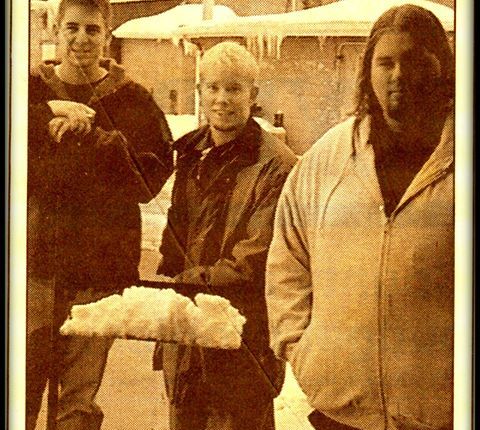
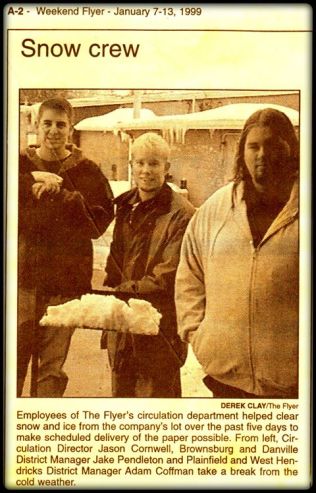
CONFESSION TIME: Back in ’99 my old buddy Jake and I were District Managers for the circulation department of the Hendricks County Flyer. During the second week of that January the snow and ice moved in heavy, and made “scheduled delivery” of the Flyer (which was free I might add) utterly impossible. And when I say, utterly impossible, I mean that Han Solo and Luke Skywalker couldn’t have done it on Tauntauns. Sorry if you don’t get the Star Wars reference.williamsburg-hoth-1

But anyway, because we were lowly underlings – minions if you will – we received a pretty severe verbal lashing from the owner of the Newspaper when he passed through the back garage and noticed there were several pallets containing some 3,000 papers that had not been delivered (actual number was closer to 30,000 – he only noticed the 3,000). I think his words were something along the lines of “[Expletive]! Get these [expletive] papers [expletiving] delivered… I don’t [expletive] care how [expletive] dangerous it [expletive] is!” He really wasn’t that bad of a guy, he just liked to yell and probably drank a little too much. Whatever the case, his message was clear: get the newspapers out of the garage.

Now, I don’t know if you’ve ever had to move 30,000 papers in less than a day, but it’s not an easy thing to do, especially when the weather has intervened and severed access to most of the roads we needed to transport them. So after brainstorming for about 5-10 minutes, Jake and I conjured up a plan – an ingenious plan. We decided, that since it was impossible to navigate the deluge of ice and snow covered back roads and neighborhoods, most of which had not been cleared or plowed, we would transport the newspapers directly to the recycling factory in Indianapolis. We could load my parent’s Blazer full of papers and take them there using interstate 70 (which was clear) the whole way. We did that three times, finishing up sometime in the early morning hours.

Needless to say, we were exhausted. But we got every last one of those newspapers out of that garage.

flyerphoto99

When we arrived back at work the following morning (actually only a few hours later), and the boss saw that our garage was completely clear and empty of papers – he treated us to a grand breakfast and had one of the reporters take our picture and give us a proper salute in the following weekend edition of the Flyer. See photo above. The boss never found out what really happened. No one ever said anything. No one cared.

The moral of the story is this… or at least this is the lesson I’ve learned from it all these years later: There are good leaders, and there are bad leaders. The good ones do their best to see what’s really there, what’s really going on, to understand and make decisions based on as many facts as they can. They want the people they’re leading to grow into better people. Bad leaders, on the other hand, see what they want to see. They care about what things look like, instead of how things actually are. They want to stand on top of the people they’re leading so they can make themselves look taller.

Don’t worry too much about the bad leaders… it’s very easy to fool them. Just clean up your own garage and let them think whatever they want to think.

Christmas Hill

Christmas Hill

This is something I wrote specifically for my church. I read it to them on Christmas Day, but I also thought I would share it here.

______________________

For Dailey Chapel Christian Church

December 25, 2016

I stood silently in the entrance of the house. It was completely quiet, empty, and cold. The carpet had all been removed, the walls were bare, and the only light getting in was from the western side of the house, where the setting sun was casting its last rays through the glass of the patio doors. I glanced briefly out the bay window which looked over the backyard, overgrown and wild with what the last six months had done to it. An even layer of fallen leaves was spread over the entire yard. Only the larger rocks around the old fire pit could be seen peaking through the tops of the overgrowth. They looked like tombstones. The whole scene looked like Halloween. I shrugged it off and turned my attention back to the interior of the house.

Halloween hadn’t brought me back here – Christmas had. I returned to look for a few things that I left when moving the previous Spring – in particular, a small Christmas tree that was absent from my moving boxes. I thought perhaps it was still in the house, tucked into some corner of a back room, or nestled peacefully in one of the closets. But as I stood there in the gathering dusk, I could tell immediately that everything was gone.

The house was stripped clean. Only the stone hearth in the middle of the house looked the same. It stood resolutely, just it had for the three and a half decades that my family had lived here. The wooden pegs were still stuck into the mantelpiece – a reminder of where our Christmas stockings had hung each year. I tried to pull one out, but it wouldn’t budge. Those wooden pegs were going to stay there until Jesus came back.

And that’s when it happened. I felt something strange, as if someone else was in the house, hiding in one of the dark rooms, and waiting to sneak up behind me. I turned around slowly. Nothing. But I felt it. The Ghost of Christmas past – at least that’s what Dickens called it. It knew I was there – why I had come back. I thought I could get in and out of the house without disturbing it, but I had deluded myself. It had awoken while I was struggling to remove the wooden peg from the mantel. It didn’t feel intimidating or cause me to hurry on with what I was doing there. On the contrary, it was familiar, comfortable, and inviting. I felt drowsy all the sudden – as if the house was trying to lull me to sleep. But it wasn’t the house – it was the ghost.

I didn’t have much time. The Sun was no longer visible, it was getting dark outside, and even darker in the house. I heard the ghost whispering then, renewing its silent attack on my mind. I tried to ignore it as I moved toward the back of the house, but it overtook me in the hallway. The spell it cast over my mind was immediate. I glanced into one of the bedrooms, and I didn’t see an empty room. I saw the bunk beds that were once there, years ago, and my brother and I being startled awake by Santa Claus yelling “Ho Ho Ho!” in the doorway – my dad in his favorite disguise.

Time to leave I thought

As I went back through the house I didn’t see how empty it was. I saw how full of life it had been. With each step I was moving in and out of time – three years ago, eight years ago, 20 years ago, and further into the past. I saw Legos spread across the floor, and VCR tapes stacked on the shelf next to the television. Longaberger baskets, porcelain houses from Charles Dickens’s stories, and strands of silver tinsel where everywhere. My grandmother’s nativity scene sat meticulously arranged on the living room hutch. I saw it all as if it was happening right now. I noticed the Christmas tree standing in the corner of the living room, freshly hewn from the pine tree farm we visited the day after Thanksgiving. The presents were there, piled high around it, and the angel standing at the top. I felt the warmth of the fireplace, and I heard the Christmas music playing softly in the kitchen where my mother was busy cooking a feast – I could smell the ham and the cornbread. I could see her smiling as she worked. I heard my dad’s voice, deep and strong, and excited as he yelled something at the ballgame on TV.

I saw others there too – aunts and uncles, cousins, great grandparents and friends – some long gone, some far away in other parts of the country, or other parts of the world. I saw my sister and I laughing as we emptied our Christmas stockings onto the floor, and then carefully placing everything back into them so we could do it again after we woke mom and dad up.

I pushed it all away and kept moving.

As I reached the back door that led into the garage, I noticed something that had been overlooked when the house was scoured. A small, wooden, hand-crafted harp the same color as the door still hung there securely in its place. It had been put there by my dad sometime in the early 90s, a final reminder of all the family trips we had taken down to Brown County each December. With a bit of difficulty I removed it from its fastenings as the small chimes rang chaotically – like they were protesting their removal from the door. I tucked the harp under my arm and then walked back out into the garage, and finally emerged in the driveway. I was back in the present. I was free of the spell the ghost had tried to cast upon me, but the effects of my struggle with it would take awhile to wear off.
Before getting into my car, I glanced at the house one last time. Then I turned and looked out at the neighborhood around me. It was silent, the only thing staring back at me were the Christmas lights from the other houses.

I knew this was it. There would no longer be any reason to return here. I stood there for a moment, thinking of the months that had passed since I left the old house. Getting out of there had been like waking up out of a very dark and depressing dream. Nothing but good had come of it. In the last couple of years I was there, the house had become more like a prison than a place of safety. And yet, even now, as I stood in the driveway, in the shadow of the bones that were left, a small part of me – deep down inside, wished that I could go back. I knew that would never happen. It wasn’t a logical thought… just an emotional one that was fading away.

“I was dying for some freedom, but now I hesitate to go – I am caught between the Promise, and the things I know. But these places that used to fit me cannot hold the things I’ve learned, and those roads were closed off to me while my back was turned.” *

It may seem sad, but in truth there was a great peace that settled over me as I headed west. I remembered the words of the Lord: “unless a grain of wheat falls into the earth and dies, it remains alone; but if it dies, it bears much fruit.” (John 12:24 NASB)

All those Christmases at home, all those memories – they were seeds that had been sewn into my life. God had used them to grow me into the person I had become. The house itself was the embodiment of all that was good, and comfortable, and safe. And to keep growing, I had to let it go – I had to let it die, so that something new could be born in its place.

I had a long drive ahead of me. I had time to think – time to remember. Christmas was a really magical time of year – when I was a child – when I had only experienced a small handful of them. But after I had a good twenty or so under my belt, it didn’t seem as special anymore. As I got older it seemed like I had to try extra hard to make it feel like it was something meaningful. In more recent years, the main things I noticed about the Christmas season, was that the lines of traffic in town were longer, people’s tempers were shorter, and I had less and less patience in dealing with both.

Bah humbug to all of that – maybe Scrooge had it right,
or maybe it was the Grinch.
Maybe both of them – were only off by an inch.
The Christmas I knew was now gone into dust.
I had no more house, no more place I could trust.
But then I remembered The Story that was old.
The one that couldn’t be lost, bought, or sold.
The story that was there for hundreds of generations –
that could not be captured inside mere decorations.
The story of the One we celebrate in our songs,
the One who made right ALL of our wrongs.
I know that story, but what does it mean?
What does it mean when the light can’t be seen?
What does it mean when the last cards have been dealt?
When the fireplace is cold, and the joy can’t be felt?
What does it mean when the shadows are taller,
than the tree you looked up at, when you were much smaller?
What does it mean when the peace you once knew –
now feels trampled and trod by those dragons you slew?
What does it mean when you’ve said goodbye so many times
that you can write about it, and make up clever rhymes?
Rhymes to cover the pain you feel,
as you wait patiently for your heart to heal?
I’ll tell you what it means, I’ll tell you today.
I’ll tell you right now, in this room far away,
from the place I knew, and once called home.
It means that we’re all of us, destined to roam –
whether it’s now, or in years yet to come,
our true home is still North – that is, North of the Sun.
But still as we wait, and we travel this earth,
or even find shelter in the land of our birth,
the Lord never leaves us, he takes us along,
and He teaches us how to sing a new song.
He’s doing it now, as He did long ago.
He is teaching us how through the people we know.
And while Christmas comes only once in a year,
and can sometimes move past us without very much cheer –
I can tell you today, as I preach in this church –
that our King never fails us, if only we search – for His truth day by day –
And Hope for His return.
And if it is for His Kingdom that our hearts truly yearn –
He will give us new friends, and new family still –
like He has with me,
on this day,
at this church,
on this hill.


*this quote is from a song called, “Painting Pictures of Egypt” by Sara Groves

My Friend Billy the Kid

My Friend Billy the Kid

This story doesn’t have a happy ending. But it’s one that I have to tell.

The last year of my life was one of the most difficult I’ve ever experienced. I hate to make the claim that it definitely was the most difficult, but honestly speaking, it probably was. I won’t go into all the reasons why, or the details, but a year ago this very week I was in a much different place. I had been struggling to find a job for some time, sending my resume to dozens of churches all over the place. After experiencing rejection after rejection, I broke protocol and sent some e-mails directly to a couple of the ministers from different churches that had rejected me as a candidate. They were kind enough to respond. It was pretty simple really – I wasn’t married. It’s too risky these days for a church to invest in someone in their thirties who isn’t married.

Side note: this whole Christianity thing was started by a man in his thirties who wasn’t married.

But that doesn’t really matter these days, because most churches (according to my calculations) are looking to get two for the price of one. That’s just how it is. Pardon my digression. I’ve since found a wonderful church that has never brought my singleness into question at all.

The point is – a year ago I was struggling. It got pretty bad. At one point my car was even repossessed. Then my dad moved to another town about an hour away. And I found myself alone, living in the crumbling house I had grown up in, no job, almost all of my closest friends very far away, in most cases living in other states and other countries. I had never lived alone before. There were a few times where I went an entire week without seeing another human being. Toward the end of the summer I came down with a bad case of pneumonia and there were several nights where I had to sleep sitting up in a chair so that I could breathe. I had a fever for an entire month. I honestly felt like dying. I’ve never been that depressed, that broken down, that hopeless. Climbing out of that pit was a miracle. It began with a simple prayer, “Lord, help me live.” And it continued from there, one small step at a time, generous friends helping me get my car back, seeing a doctor, getting a hold on my health situation, finding a new church that accepted me almost immediately, and beginning the process of moving out of my parents’ old house – a process that didn’t end until a month ago, when I finally moved out.

During this past year, through all of my ups and downs, I had one friend who was close enough to spend time with me on a regular basis. He was from my old youth group in Indianapolis. He was the oldest of all the students I had spent time with at West Park Christian Church during the two and a half years I was there. When I first met Billy he was 15, but we connected immediately over our mutual appreciation of video game history, comic book heroes, Star Wars, and junk food. He was a great student. And he was a great helper. And in time, he became a good friend. If I was Doc Brown, he would have been Marty McFly.

10418900_10152039020290947_8515115360348975074_n

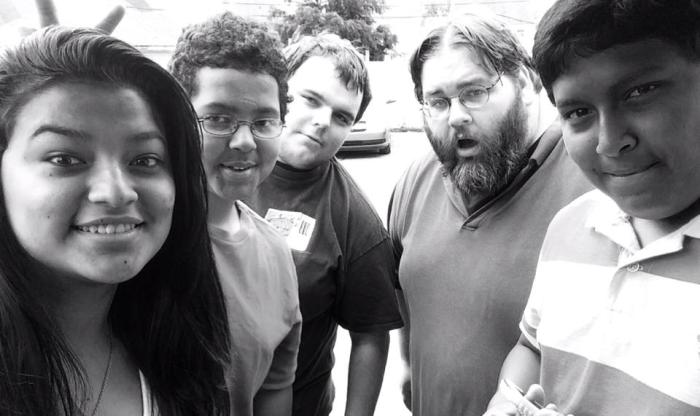
A constant struggle during my time at West Park was never having enough volunteers to help with the kids, but Billy was always there, along with his younger brother Mitchell. They lived just across the street from the church, so they were always on hand to help out. There were many things I couldn’t have gotten done without either of them. Billy had just graduated from High School a year ago, and then moved in with Rob Wilkes (the senior pastor of West Park) and his wife Sue. Billy loved to hang out and watch movies, so about once or twice a month during this past year I would go pick him up. We would go to the movie theater, buy frozen pizza or rotisserie chickens from Wal-Mart, and then go back to the house to fight zombies in Call of Duty. He helped me sort through and pack away tons of stuff from my family’s old home. Every time he came to visit, I would put him to work, having him pack boxes and move stuff into the garage, or into the back of my car. He never complained. Not one time. Of course he tested my patience a few times, including an incident last September where I woke up in the middle of the night to the smell of smoke in the house. I soon discovered that Billy, who liked to stay up at all hours of the night, at some point had put tater tots into the oven and then fallen asleep in a chair while watching Dragon Ball Z or something. The house smelled like burnt tater tots for two weeks after that. But I couldn’t stay mad at the kid. Sometimes I would pick him up from where he worked at Penn Station East Coast Subs, and he would come out to the car with a huge smile on his face, along with a Philadelphia Cheesesteak and a diet Pepsi for me. He came over a couple of times in May as I was getting closer to moving out, and even though there was a ton of work to do, we still found time to watch all seven Star Wars films with online commentaries from Collider. You have to be a really special kind of nerdy geek to watch Star Wars while listening to commentaries of other people watching Star Wars… we had that in common. On Memorial Day I spent the entire afternoon and evening with Billy and his brother Mitchell – as we had done many times before, we went to the movies, and then followed up with a trip to BW3’s and Starbucks to top it all off. When I dropped them off that night, Billy gave me one of his signature smiles and told me to take care.

A couple of days later I got the call that he was gone. He had taken his own life.

I knew that he struggled with being depressed at times, but I didn’t know how deepIy it ran through him. I know that there have been a few times in my own life where I felt the darkness around me too much, and the only thing that pulled me back from the edge were those four words, “Lord, help me live.”

I don’t really know why he decided to do what he did, but I wish he knew what a good friend he was. I wish he knew how much I appreciated all his help. I wish he knew how rare it is for people to have a heart as big as his these days. I wish he knew how much we all loved him. I wish I had told him all these things. I wish a hundred other things had happened – anything that might have kept him alive. I wish most of all, I had told him how God used him to help me live.

Billy was one of the good guys.

Rest in peace brother. Thank you for being my friend.

10155339_10151928616115947_3261719840374845260_n