
All in Good Time

FeaturedAll in Good Time

A couple of months ago, Parke County – in Indiana, opened a time capsule that was buried in the ground back in 1974.
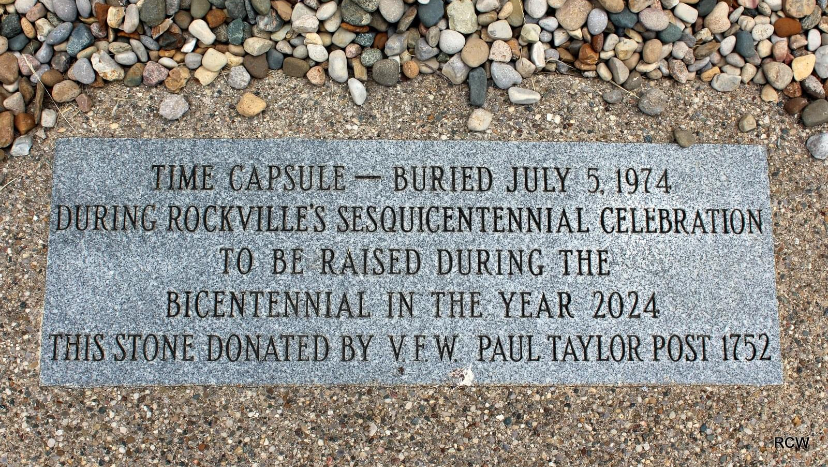
Below, is a photo shared by Jeff Gooch – Funeral Director of Gooch Funeral Homes – posting a picture of his father, with the following caption:

“This was my dad (Larry Gooch) putting the final touches on the time capsule for the Rockville Sesquicentennial in our backyard in July of 1974. When we arrived at the courthouse we were greeted by many of our townspeople waiting to place items inside. Gene Swaim from Rockville Vault and Monument Company placed a granite marker for future generations to see and remember the location. It is at the south end of the steps on the west entrance of our courthouse. Note the bumper sticker on his truck-it says Rockville Sesquicentennial July 2-6. I remember everyone in town had a sticker on their rear bumper. This time capsule is to be opened this year for our centennial celebration.”

The time capsule was successfully opened on July 27th of this year…
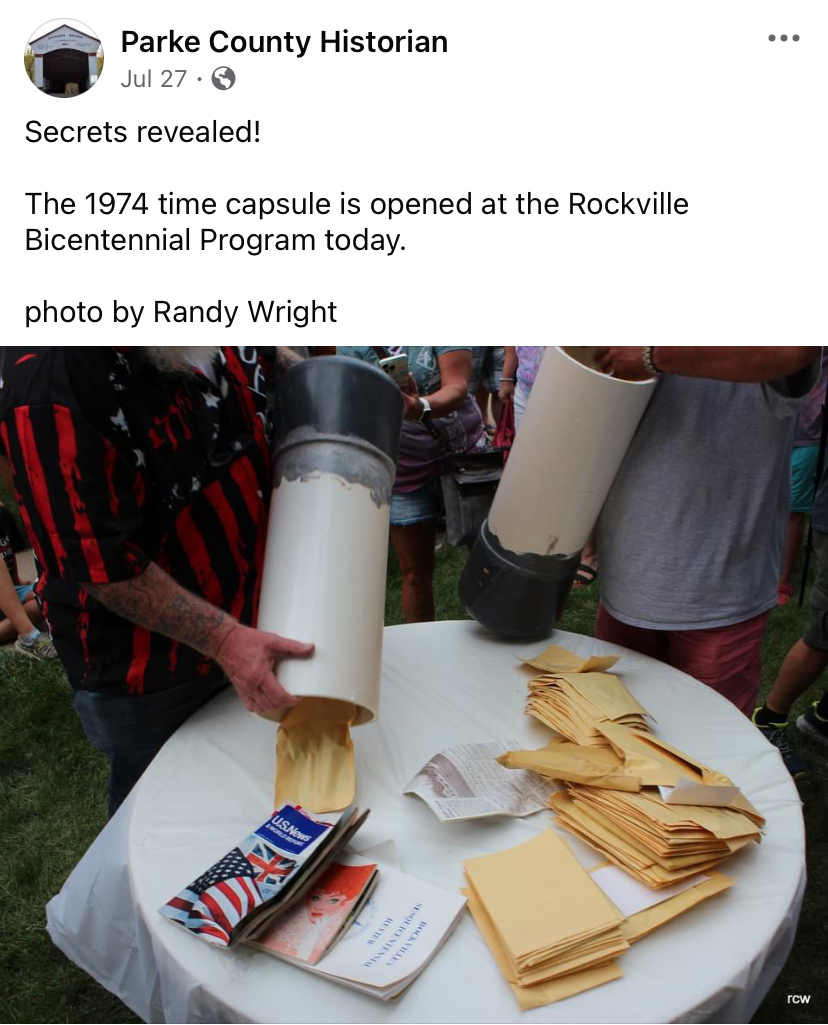
Wherever one time capsule is opened, another is sealed.

Thus, because my church is in Parke County, I’ve been asked to write a letter to my church – Dailey Chapel Christian – for the next time capsule that will be buried this week, and opened 50 years from now.

The following letter is what I’ve submitted to the future…

_____________________________________________

To the People of Dailey Chapel Christian Church in 2074:

Dear Brothers and Sisters,

I have no way of knowing who will be reading this (if I did, that would be really spooky). Do they still use that word “spooky” in 2074? Just curious. The truth is, there might not be anyone reading this. But I hope that some of the younger people in our church will be around to pull this out of the ground one day… little Lilie Lou or Scarlett Dickey… any Nepotes – Leila or Raegan… Nora or Tate Metheny… Daniel or Joe Lunsford… Maizee with the big smile, or little Sylvie… Henry, Jack, or George Overpeck… any of the Simmons kids – Evie Lou, Charlie, or Conway… any Haltom’s… Carson Cox – are you out there somewhere? I hope so.

It’s a crazy world we live in, and 50 years is a long time. One thing, that I’m pretty sure about, is that I won’t be around. But I’m ok with that. I know where I’ll be going. If I was still alive, I’d be 95 by then, and although it’s not impossible, it’s also not very likely. However, my beautiful bride Lynell (Nelly) is two years younger than me – and she’s a lot healthier and has really good genes, so perhaps she’s still kicking around down there. Please look her up, tell her I love her, and I’ll see her again soon.

Sorry… that might end up being a lot of work for one of you lucky listeners. It’s not every day that someone gets a chance to write a letter to the future, so I have to make good use of the opportunity.

In any case, I’ve been the Preacher/Minister/Pastor for Dailey Chapel for about 9 years now, and it’s been one of the most challenging, but also happiest times in my life so far. I’m glad to be the one writing this letter. And I suppose it’s my duty to impart some words of wisdom from the past, or at least come up with something clever to say, so here goes…

Disclaimer: This is one of the sermons (a revised version of it) that I preached for Dailey Chapel a few years ago (in 2021) and something I’ve used several times for funerals I’ve presided over… It’s one of my personal favorites. And it’s about the very thing you’ve all gathered together to commemorate this day: TIME.

On September 14, 2015, at exactly 5:51am Eastern Standard Time… Physicists from the Massachusetts and California Institutes of Technology were able to catch something in a very large net that had been traveling through space at the speed of light for 1.3 billion years.

A hundred years earlier, Albert Einstein had invented a bunch of math jargon to describe the existence of something he called gravitational waves. In his mad-genius sort of way, he speculated that when objects in space collide with each other, they create ripples the same way a rock does when thrown into a lake. Einstein was convinced of this, but he never thought it would be possible to prove. As it turned out, he was right about the existence of the waves. But he was wrong that it would never be known for sure.

In the mid 90s engineers from MIT and CALTECH began building two giant observatories to prove his theory. These facilities – one in Louisiana and one in Washington State, took several years to complete, but once activated, they worked in tandem to a create a digital net almost as wide as the Louisiana Purchase to try and catch and record the waves that Einstein had talked about.

And that is exactly what they did. They caught, measured, and tracked a series of gravitational waves passing through their net in 2015. When traced back to their origin point, it was discovered that 1.3 billion light years away from Earth, two giant black holes had slammed into each other, releasing a tidal wave of energy that exploded outward, and sent ripples in all direction. 100,000 years ago, that energy crossed the threshold of our galaxy The Milky Way and proceeded toward our solar system until passing harmlessly through our planet 9 years ago (9 years, as I write this letter).

Now, to help you visualize the amount of distance we’re talking about… It would take a human being 37,200 years to travel 1 light year through space. The gravitational waves detected in 2015 had traveled 1.3 billion light years to reach us. The universe we live in is SO BIG – that they don’t measure it with miles or kilometers – they measure it with TIME.

The light from our own Sun takes about 8 and half minutes to reach us. That means, if the Sun burned out and went dark or disappeared somehow – we wouldn’t know it until 8 and half minutes later. That means, when astronomers look at the sun through a telescope, they are seeing it the way it was 8 and a half minutes in the past.

The light that comes from the next star over – Proxima Centauri – takes a little over 4 years to reach us. So, if there was an alien in that star system looking at us through a telescope – they would be seeing us the way we were 4 years ago.

Information like this boggles the mind. We can barely fathom these vast distances, and the amount of time it takes to traverse them. And what does it mean? Does it even matter? Yes. It does. It matters, because this is one of the ways that our Lord shows us how great and powerful He is.

King David said it best — ”By the word of the LORD were the heavens made, their starry host by the breath of his mouth. 7He gathers the waters of the sea into jars; he puts the deep into storehouses. 8Let all the earth fear the LORD; let all the people of the world revere him. 9For he spoke, and it came to be; he commanded, and it stood firm.” (Psalm 33:6-9)

There’s a well-known theological concept called Natural Revelation. And although this is a concept that is touched upon in many places throughout the Bible, it is most clearly articulated by the Apostle Paul in Romans 1:20 – where he says that:  “since the creation of the world God’s invisible qualities – his eternal power and divine nature—have been clearly seen, being understood from what has been made, so that men are without excuse.”

In other words, he’s saying that when we look at everything around us – everything that God has made, we are looking at things that God has provided as evidence of His existence. So, whether we’re looking at the smallest of things right in front of us, through a microscope, or the very largest of things millions of miles away, through a telescope – all of it, reveals something about the One who created these things.

Moreover, Paul is also saying that this is an obvious truth. It’s common sense. To suggest otherwise is the very definition of foolishness. As King David once said at the beginning of Psalm 14 and Psalm 53, “it is the fool who says in their heart, ‘there is no God.’” –That’s actually the same Psalm. It’s in there twice.

Now Paul, also, in his letter to young Titus – warns him to not be prideful about his belief in God. He tells him in Titus 3:3 that, “At one time we too were foolish, disobedient, deceived, and enslaved by all kinds of passions and pleasures.” That’s Paul’s way of telling his protégé that the only thing separating us from the foolish – is the fact that we have fallen on the mercy of God. He’s reminding Titus that it is through love and humility and kindness that we demonstrate God’s mercy most clearly to those who have not accepted it.

If I tell someone that there is a God who loves them, in our culture, they probably won’t believe it. But if I tell them that God loves them, and I back it up by showing them that I love them too – THEN they might actually believe it.

But still, it’s not enough for people to know that we love them. We’re human beings. Our love is imperfect, and inconsistent, and flawed. And that’s why we have to point people to God whose love is perfect, and unwavering, and unparalleled.

So, that means we have to be patient with people who don’t believe the same things that we do. And in the meantime, we have to find ways to show them God’s love and mercy. We ourselves, have to ‘wait upon the Lord,’ and ask Him to use us – to lead us into the right situations and give us the right words when the time comes. And sometimes it’s hard to be patient. Sometimes it’s really difficult to wait for other people. But patience is one of the ‘fruits of the spirit,’ that Paul talks about in Galatians 5, and elsewhere.

We always want things to happen when we want them to happen. We want things to happen in our time. But God has his own time.

Now of course, when the Apostle Paul was writing about Natural Revelation he didn’t have microscopes or telescopes to see all the things that we can see today. But every advancement in science and technology that has come along since has only proven the concept of Natural Revelation even more. The more our technology allows us to see and observe, the more God’s immense power becomes visible. His fingerprints are all over the universe and everything in it.

And with this in mind, I’ve been taking some time, to go back to the Beginning of the Bible, into Genesis, so that we can do a little review on the 6 Days of Creation. What can we learn about God, what can we learn about ourselves, what can we learn about Christian faith from examining the Days of Creation through the lens of Natural Revelation?

For this message, I want to focus on something that God created on Day Four. So let’s take a look at that passage – Genesis 1:14-19.

And God said, “Let there be lights in the expanse of the sky to separate the day from the night, and let them serve as signs to mark seasons and days and years, 15and let them be lights in the expanse of the sky to give light on the earth.” And it was so. 16God made two great lights—the greater light to govern the day and the lesser light to govern the night. He also made the stars. 17God set them in the expanse of the sky to give light on the earth, 18to govern the day and the night, and to separate light from darkness. And God saw that it was good. 19And there was evening, and there was morning—the fourth day.

When we read through these verses we see the words ‘govern,’ and ‘separate,’ used in repetition. These words are both related to the idea of organization. God was organizing his creation under the canopy of time, and using the sun, moon, and stars to do it – he says it right there in verse 14, “let them serve as signs to mark seasons and days and years.”

The top researchers and scientists, and physicists in our culture (the ones that do not believe in God) explain away all the other things that exist in the universe – they have theories like evolution and the big bang that allow them to mentally evade the idea that there’s a God. But they haven’t been able to do that with TIME. They have no theory that allows them to provide an alternate reason for where time comes from. They can’t explain time.

The existence of time does not fit into any kind of scientific framework that currently exists. One of the most well-known physicists since Albert Einstein, a man named Richard Feynman – Richard Feynman was the George Washington, the Jimi Hendrix, and the Michael Jordan of physics all rolled into one. Any college student studying physics and space and time has to read his books and lectures. He’s considered to be one of the most brilliant minds ever on the subject – THAT GUY – back in the early 60s, when asked about the origin of time, basically said: I don’t know.

Most of the people who are considered to be experts in the field of physics today, with all the technological tools and more collective knowledge at their disposal than ever before – the kind of people who built those observatories to catch gravity waves in Louisiana and Washington – they basically scratch their heads when it comes to figuring out why time exists.

The scientists and the mathematicians don’t do well with the concept of time. As the Psalms of King David have shown us – it’s the writers and the poets that explain time much better. Time makes good material for poetry, and storytelling, and classic rock and roll power ballads.

My favorite non-bible author J.R.R. Tolkien once wrote: “Time all things devours. Birds, beasts, trees, flowers. It gnaws iron, bites steel, grinds hard stones to meal. It slays kings, ruins towns, and beats high mountains down.”

One of my favorite songwriters Roger Waters wrote some beautiful words on the subject of time: “You run and you run to catch up with the sun but it’s sinking. Racing around to come up behind you again. The sun is the same in a relative way, but you’re older. Shorter of breath and one day closer to death.”

Our culture is obsessed with time. Just think about all the phrases we have to describe time in different ways:

All in good time.

In the nick of time.

From time to time.

We’re living on borrowed time.

It’s a matter of time.

Time out. In time. Time flies. Time to go.

About that time.

Take some time. Make some time. Kill some time.

Once upon a time.

There’s Adventure time. A Wrinkle in Time. The Land Before time.

Hot Tub Time Machine.

Snack time. Dinner time. Summer time. Double time.

Hang time. High time. Game time. Face time.

Prime time. Local time. Real time. Record time.

Quality time. Screen time. Quiet time.

Miller time.

Big time. Small time. Nap time. Space time.

We keep time. We spend time. We lose track of time.

No time flat. No time to waste. Some other time. Make up for lost time. Now is the time.

Hit me baby one more time.

We can obsess ABOUT TIME all we want. But time cannot be controlled. It cannot be solved by a math equation. There is no end to its ability to baffle scientists. There is no end to its ability to inspire artists, poets, and writers. And whether you’re from the countryside or you’re a city dweller – you cannot escape the clock.

Time is the great transformer of things. It changes ALMOST everything. It dissolves things that we think are solid. It moves things that we think will always be there. It destabilizes, shakes, and decays everything around us. It cannot be stopped. It cannot be bought. It cannot be bargained with. It can’t be reasoned with. And, eventually, it will take every one of us by the hand and walk us into the grave.

Despite all the terrible things that time does to us – it is still a precious gift from God. God created it for us. And God saw that it was good.

The reason it stings us the way it does – is because it is one of those things that REMINDS us all, that WE ARE NOT GOD. It reminds us that we are powerless, we are fallen, and we need someone to save us.

The good news is that someone has saved us. His name is Jesus, and he is the Christ, the Son of the Living God.

The Bible tells us that we are not like the rest of humanity that has no hope. Why? Because we have a King who is Master over the Grave. Our God is Master of Time itself. He created it. It has no power over him. And as Hebrews 13:8 says, “Jesus Christ is the same yesterday, and today, and forever.”

He is immoveable, he is unstoppable, he is our only hope out of this mess, and he is the one who makes all things new.

Heaven and earth will pass away – just as I have passed away. But the words of Christ will never pass away. Call out to him today, ask him to speak to you.

In Christ’s Love,

Adam Joseph Coffman

September 11, 2024

The Cost of Being a Disciple of Jesus

FeaturedThe Cost of Being a Disciple of Jesus

DISCLAIMER: I originally wrote this sermon four years ago, in August of 2020. If you want to listen to it, I’ll embed the audio version at the bottom of this post.

But I’m trying to publish more regularly on this blog because that’s what you’re apparently supposed to do…

So, I pulled this one out of the archives, because it’s a real humdinger. And you should read it. Seriously, it’s a good one, if I do say so myself.

____________________________________

This morning, we’ll be reading through a passage from Luke 14:25-33.

But before we take a look at this passage in Luke, I want to tell you a story that’s a little bit closer to us in history. This isn’t something that happened 2,000 years ago, but much more recently.

It begins about a hundred years ago, in a city called Breslau. Breslau is in the southwest of Poland today, but a hundred years ago, and up until the end of World War II, it was still a part of Germany. And that’s where this story begins – in Breslau, Germany, a hundred years ago, in 1920, when a young man by the name of Dietrich gave his life to Christ, and decided that he wanted to study the Bible and become a teacher of God’s word.

Dietrich was a very intelligent young man, very devoted to his studies; by 1927 (when he was only 21 years old) he had graduated from the University of Berlin with a doctorate in Theology. Still young, and not quite sure where his place was in the world, he decided to come here to the U.S., and ended up as a professor at Union Theological Seminary in New York City. He was only in the U.S. for one year, but while he was here, he was lovingly accepted into a Baptist church in Harlem, where he taught Sunday School classes, and where he began to encounter the societal injustices being experienced by Christian minorities – in particular, black Christians that he had become friends with. As a white man, but still an outsider, a foreigner from Germany, he had slipped in between these two segregated worlds of American Christians – black and white, rich and poor, educated and uneducated. Dietrich knew his Bible really well. In the Gospels, he read, as we have been reading, about the reality of God’s Kingdom in the here and now. And he wrestled with the contrast between what he was reading about the Church in the New Testament, and what he was seeing the Church do (and not do) in New York and other places.

How could the Church in the New Testament be so united in purpose, and the Church of modern day be so fractured and divided?

Why was the wealthy Church so pre-occupied with its own position on the highest levels of secular society, and so blind to the suffering of the poor Church just a few blocks North?

How does that happen among God’s people? How does one group of Christians become obsessed with finding a seat at the table of high society, while another group focuses on pulling people out of the gutters and giving them food, and clothing, and housing?

Why do the Christians with the most resources at their disposal, hoard their wealth, while those with just enough to get by give away everything they have? Why can’t they work together? Why can’t they find balance in the community of God’s Kingdom – the community of people saved by grace – the community that Jesus gave his life to bring into existence?

What was the answer to these questions?

What could be done about it?

Dietrich wasn’t entirely sure, but he didn’t ignore these tough questions; he wrestled with them. And this unique perspective that he had, as an outsider and foreigner, influenced him a great deal. And he took that perspective with him, when he returned to his homeland in 1931.

When he returned to Germany, he began teaching theology at the University in Berlin where he had received his doctorate four years earlier, and not long after that, he was ordained as a pastor in the Lutheran Church.

And, it was less than two years later, on January 30, 1933, that the Nazis took control of his country.

As we all know now, with our 20/20 historical hindsight, Adolph Hitler’s rise to power would eventually culminate in the horrendous disaster that we call World War II, where millions of people would perish, and where terrible things had to be done in order to stop a man that was closer to an example of the Anti-Christ than almost anyone else in history.

Have there been others like Hitler?

Yes.

Joseph Stalin probably executed more people, for instance. But Hitler did three things that really single him out:

1. He lied to the Christians in Germany that were susceptible to deception.

2. He silenced, imprisoned, and killed the Christians who were not so easily deceived.

3. He waged genocide against the Jewish people.

If Hitler had succeeded in taking over the WHOLE WORLD, he would have been THE Anti-Christ.

As it turned out, he was only one of the many little antichrists like those the Apostle John warned us about in his first epistle (1st John 2:18).

Like I said, we all know this now. It’s more or less common knowledge. But to many of the Christians throughout Germany at the time Hitler took power it wasn’t as clear. Even though it SHOULD HAVE BEEN.

Hitler’s rise to power was hailed as an act of God by the majority of church leaders in Germany at the time. They threw their support behind him completely – telling their congregations that Hitler had been sent by God to lift them out of economic depression, and restore their honor on the world stage. Some went so far as to say that Hitler spoke on God’s behalf, and that the fulfillment of God’s Kingdom was embodied in the person of Adolph Hitler. Churches that had been firmly established and rooted in place for centuries, wasted no time in allowing Hitler to steam roll his way through them. In fact, they stepped aside as he removed Pastors, Bishops, and Elders who were not “pure-bloods” of Aryan descent. They remained silent when he demanded that he, the Fuhrer be recognized as head of the Church (rather than Jesus Christ), and they supported efforts made to remove the Old Testament from the Bible – because of its pro-Jewish agenda. These were not things that happened overnight. They were ideas that Hitler had been preaching for months BEFORE he was in power. There was plenty of opportunity for the churches in Germany to at least try to prevent his ascension to power – by speaking out against him. But those with the most influence in their society, remained silent. Or they openly supported him.

But not everyone.

There were small groupings of Christians in Germany, in the middle of all that madness, who refused to bow down and worship that man.

And the hero of this particular story – Dietrich – was among them.

Just a couple of days after Hitler became Chancellor, Dietrich was able to get onto a radio station in Berlin and sound the alarm.

Before they cut him off mid-sermon, he denounced Hitler and everything he stood for – and he rebuked every Christian who followed him for their idolatry to the “cult of the fuhrer.”

In the months and years that followed, he began organizing the minority groups of Christians who didn’t follow Hitler, by helping to create a network of churches dedicated to voicing opposition to him, as well as to rendering aid to their Jewish neighbors who were already under attack. He was putting into practice what he had learned when he was in New York – that he couldn’t just talk about the Gospel – he had to live in its reality. He couldn’t just stand around and do nothing while so much evil was taking place around him. He had to actually do something about it.

So, he did.

Between 1933 and 1939, he helped organize and lead an underground seminary where he taught his students that the cost of being a modern disciple of Jesus was complete loyalty to the King and His Kingdom, above all else. –Even if it meant losing your friends, losing your family, or losing your country.

And for this, Dietrich was branded an enemy of the state, his coalition of churches and his seminary were deemed illegal by Heinrich Himmler, and Dietrich himself was exiled from the city of Berlin.

Dietrich’s friends in New York City urged him to flee the country, and he did in the Summer of 1939. But he did not stay in the United States for very long. In a letter to one of his former professors at Union Seminary, this is what he wrote, shortly before returning to Germany:

“I have come to the conclusion that I made a mistake in coming to America. I must live through this difficult period in our national history with the people of Germany. I will have no right to participate in the reconstruction of Christian life in Germany after the war if I do not share the trials of this time with my people … Christians in Germany will have to face the terrible alternative of either willing the defeat of their nation in order that Christian civilization may survive or willing the victory of their nation and thereby destroying civilization. I know which of these alternatives I must choose but I cannot make that choice from security.”

It wasn’t long after his return home, that because of close trusted contacts within the German military, he first became aware of concentration camps where Jews were being systematically exterminated. And that put Dietrich in the position of finally having to choose, definitively, which of his two kingdoms he would betray.

Would he become a traitor to Germany? Or would he become a traitor to God’s Kingdom, by looking the other way as his neighbors were being murdered? He chose God’s Kingdom over the kingdom he had been born into.

When asked by a Dutch colleague of his at the time, “what he was praying for these days?” Dietrich told him, “If you want to know the truth, I pray for the defeat of my nation.”

And that’s when Dietrich became a spy.

He began working within the Abwehr – the German Military Intelligence network –which was not yet under the control of the SS. There were many German officers in the Abwehr, already functioning as allied spies against Hitler. They recruited Dietrich with the understanding that he would use his contacts in Europe and the United States to smuggle intelligence to the Allies, and to help Jews escape from Germany. And that’s what he did for the next few years…

Before he was eventually caught and arrested in the Spring of 1943.

Dietrich spent two years in prison for treason, during which time he was the pastor for his fellow prisoners, and even some of his prison guards.

On April 4, 1945 Hitler personally ordered Dietrich’s execution, and he was hung that same week at Flossenburg Concentration Camp.

Two weeks later, the U.S. 90th and 97th Infantry Divisions liberated that camp.

A week after that, the Soviets took Berlin.

Hitler committed suicide at the end of the month, and Germany surrendered on May 7th.

Dietrich’s prayers for the defeat of his nation came to pass. But he himself, had already gone home to his real country.

The doctor who saw Dietrich’s hanging described his final moments like this:

“I saw [the] Pastor … kneeling on the floor praying fervently to God. I was most deeply moved by the way this lovable man prayed, so devout and so certain that God heard his prayer. At the place of execution, he again said a short prayer and then climbed the few steps to the gallows, brave and composed. His death ensued after a few seconds. In the almost fifty years that I worked as a doctor, I have hardly ever seen a man die so entirely submissive to the will of God.”

And that brings, the story of Dietrich Bonhoeffer to a close.

Now… why am I telling you all of this? Why is this story an important one?

Well, let’s finally get to Luke 14:25-33, and you’ll see why…

“Large crowds were traveling with Jesus, and turning to them he said: 26 “If anyone comes to me and does not hate father and mother, wife and children, brothers and sisters—yes, even their own life—such a person cannot be my disciple. 27 And whoever does not carry their cross and follow me cannot be my disciple.

28 “Suppose one of you wants to build a tower. Won’t you first sit down and estimate the cost to see if you have enough money to complete it? 29 For if you lay the foundation and are not able to finish it, everyone who sees it will ridicule you, 30 saying, ‘This person began to build and wasn’t able to finish.’

31 “Or suppose a king is about to go to war against another king. Won’t he first sit down and consider whether he is able with ten thousand men to oppose the one coming against him with twenty thousand? 32 If he is not able, he will send a delegation while the other is still a long way off and will ask for terms of peace. 33 In the same way, those of you who do not give up everything you have cannot be my disciples.”

Now, those are some harsh sounding words, are they not?

There’s a huge crowd following Jesus, and instead of reveling in all of his many followers, it’s almost as if he’s trying to get rid of them. He tells them they can’t follow him unless they hate everyone else… that they even have to hate their own life! Now, he doesn’t mean this literally – that they have to hate. After all, this is Jesus – he teaches us to love everyone, even our enemies.

So, he’s not literally telling us we have to hate ourselves and our families. He’s saying that His Kingdom always comes first. The Kingdom always takes precedence. He’s saying that our love for Him has to be total. Our loyalty to Him has to be complete. He’s saying, if you really want to follow me, you might have to say goodbye to the people you care about. He’s saying: If you say ‘yes’ to me, you might have to say ‘no’ to the people you love.

Jesus is using this allegorical language about building towers and going to war, which might all sound a little strange to us. But he’s pointing out the natural human tendency to look ahead. If we’re being wise, then we think before we make a major decision about something; we think about what that decision is going to mean, and whether or not it’s going to be good or bad, and we think about what we’re going to have to give up, or let go of.

We have to estimate what it’s all going to cost.

How much money to build that building?

How many troops to win that war?

Well, we don’t have to estimate what it costs to follow Jesus; he tells us EXACTLY what it costs – it costs EVERYTHING.

Dietrich knew that. He knew it really well. He knew that we can’t just hide in the comforting glow of God’s grace – that to do so, cheapens the sacrifice that Jesus made. We have to go into the darkness with the light that we have.

We have to do something.

And whatever that is – it might cost us everything.

It MIGHT cost us family; It MIGHT cost us friends; It MIGHT cost us our country.

And if so, that’s ok.

That’s what it means to pick up YOUR CROSS and FOLLOW HIM.

In John 15:18-19, Jesus said quite clearly: “If the world hates you, keep in mind that it hated me first. 19 If you belonged to the world, it would love you as its own. As it is, you do not belong to the world, but I have chosen you out of the world…”

Let’s remember these words of Jesus in the coming months.

Let’s hold tightly to them, as the rhetoric in the world around us becomes louder, and the nonsense becomes overwhelming. Our job is still the same: To love our neighbors, to love our enemies, and to love God the most.

The kingdom we’re living in is temporary; it is crumbling. But the Kingdom we belong to is eternal, and it will never fall.

There won’t be any Democrats or Republicans in Heaven, my friends.

“Then the sovereignty, power and greatness of all the kingdoms under heaven will be handed over to the holy people of the Most High. His kingdom will be an everlasting kingdom, and all rulers will worship and obey him.” – Daniel 7:27

Dailey Chapel’s Annual Basket Dinner

FeaturedDailey Chapel’s Annual Basket Dinner

This past Sunday, I decided to depart from our regularly scheduled program, to deliver a message that suited the occasion – our church’s annual celebration which we call “Basket Dinner.”

One thing that I find interesting about Basket Dinner – and this was true from the very first time I heard someone mention it. Back when I had no clue what it was… Basket Dinner has always been talked about around here, like it’s a universal event; as if it’s something that every Christian on Earth celebrates every year – like Christmas and Easter.

I remember once, asking a younger Caleb Dickey who grew up in my church, about Basket Dinner — just a few weeks after I moved out here… before I had ever been to one, and he was still in High School at the time, but he described Basket Dinner, as if it was a universal, concrete fixture of reality – something that all Christians partake of each year. And I know that he knew it wasn’t this universal Christian holiday, but that’s how he spoke about it. And it made me realize, that this was a deeply rooted part of Dailey Chapel’s history. I’ve realized that more and more with each year that I’ve been here.

Basket Dinner is a special, unique fixture of Dailey Chapel, and it’s very personal and meaningful to us, especially to all those who have celebrated it for decades, or for some – most of their lives, or whole lives. But there is also something about it, that is relatable to all churches.

So… I was thinking, this past week, about how we observe this special Sunday each year to honor those who’ve come before us, and met together in years past under the banner of Dailey Chapel – whether it was in our current building, or the previous one.

And, off course we know, that a building isn’t what makes a group of people into a church – it’s the gathering together, in fellowship, around the Lord’s table, around his word, to break bread and pray. Those are the main ingredients of church. A building isn’t necessary – it’s a blessing, and a luxury, and we enjoy having it – but the church isn’t a building.

If you ever happen to be up here, sometime after dark, by yourself, you’ll realize very quickly how different this building is when the people of the light are not gathered together in it. We’re up in the woods, and it’s a VERY scary place at night!

And at one point, in the past — as Mrs. Joanie Lunsford retells our history each year — the people of Dailey Chapel lost their building in a fire, about 84 years ago. But they didn’t lose each other, and they didn’t lose their faith. And as far as I can tell, they used the opportunity to grow stronger. And the evidence is all around us now. All those people are gone, but their church has outlived them.

It’s a feature of our existence on earth that sometimes, things have to go wrong, or something bad has to happen, in order for God to receive the glory that is due him. Sometimes, things have to go wrong, so that, they can be made right again – proving that our God is one of redemption, renewal, recovery, and restoration.

And this is nothing new. This is an old lesson – one that’s true for all of us. It’s woven into the fabric of reality itself.

And Scripture teaches us this old lesson over and over again. That things sometimes have to go wrong, before they can be made right. That things have to be broken, so that they can be put back together even stronger than they were. King David said in Psalm 30 that “there is weeping throughout the night, but joy comes in the morning.”

One of the beautiful things about the stories in Scripture, is how they capture truths that are common to all people of all times. The stories themselves are rooted in history, among real people, who really lived. But the lessons that the people in the stories learn, transcend the times and places in which they happened. In other words, the lessons that God wants us to learn are the same lessons that He has always wanted His people to learn.

And one of the biggest lessons – is that sometimes things go wrong, so that God’s people can remember their need for him, in all areas of life. And when they do, then the soil of hardship produces the fruit of victory.

That’s what we’re really commemorating each year on Basket Dinner Sunday. And as I said, it’s an old lesson – and it’s told over and over in the pages of Scripture, through the lives of many people.

We could go back to Genesis and read about Abraham for instance. A lot of things went wrong in Abraham’s life. He was constantly ending up in places he shouldn’t have been, and at times, in situations that were dangerous. And God always took care of him. God blessed him abundantly.

But the main thing on his mind was the fact that he wasn’t going to have any children to leave behind after him. So what did God do? He let Abraham and Sarah get so old, that the prospect of having children was completely hopeless from a human perspective. Sarah had presumably already gone through menopause, I think it’s safe to say – she was 90! But God allowed her to get pregnant and give birth to Isaac, through whom, she became the Mother of Nations. Hopelessness was turned into blessing.

Abraham and Sarah’s grandson Jacob, learned the same lesson. He was forced to flee his family, and leave behind his home, and everything he had – his own brother literally wanted to murder him. Everything went wrong in his life. He lost everything, just so God could get his attention.

And once God had his attention, he put Jacob’s life back together piece by piece. He blessed him with wealth and abundance, and many children, and peace with his brother who had wanted to kill him. Jacob’s life had to go completely off the rails, before it could be put on the right track.

Jacob had a son named Joseph. Joseph became the head official of the Egyptian Empire, second only to the Pharaoh. But he got to that position, only after spending years as a prisoner, sold into slavery by his own brothers because they were jealous of him.

From what we read about Joseph, he didn’t really do anything wrong. God wasn’t putting him through difficult circumstances to get his attention like he had done with his father Jacob. God already had Joseph’s attention. And because of that, he was able to use Joseph’s life as a powerful foreshadowing of Jesus. But that meant suffering, before it meant victory.

God let Joseph’s whole life go wrong on the floor of a dungeon, and then, he lifted him up out of the pit, by making him the Prime Minister of Egypt, and using his talents, and ingenuity to save millions of people from starvation, including his own brothers who had sold him into slavery.

It was those same brothers that Joseph spoke to in Genesis 50:20, saying to them, “You intended to harm me, but God intended it for good to accomplish what is now being done, the saving of many lives.” 

300 years after Joseph died, the same thing happened, on a much larger scale. All of the Hebrews were slaves in Egypt. And God used Moses to bring them out of bondage and form them into their own nation.

Then there’s the Judges and the Kings. Their were those like Samson who was strong and powerful, but had to have his strength taken from him, and his eyes burned out, and his body put in chains – all so God could show Samson and his enemies where strength and power truly come from.

I mentioned King David already. We see this pattern play out many times as we read about his life in 1st and 2nd Samuel. His life was constantly falling apart, and going wrong, and each time, he came back stronger.

When he was still a teenager, he became stronger than all the fighting men in his nation. When he was a fugitive, God sheltered him. When he sinned, God forgave him. When he lost a child, God comforted him. Whenever David lost his way, the Lord was there, to pick him up, and set him on the right path again.

It’s David who wrote, in Psalm 30:1-5, “I will exalt you, LORD, for you lifted me out of the depths and did not let my enemies gloat over me. LORD my God, I called to you for help, and you healed me.You, LORD, brought me up from the realm of the dead; you spared me from going down to the pit. Sing the praises of the LORD, you his faithful people; praise his holy name.For his anger lasts only a moment, but his favor lasts a lifetime; weeping may remain for a night, but rejoicing comes in the morning.”

Sometimes things have to go wrong, before they can go right.

Moses led the Israelites into a dead end, so God could make a new path for them through the sea.

Jonah had to be eaten by a fish, so that the people of Nineveh could be saved.

Esther was forced into the harem of King Xerxes, so that she could become the queen and save her people from genocide.

Hezekiah had to be face to face with the entire Assyrian army on his front porch, so that God could give him a front row seat to their complete annihilation by one of his angels.

Jerusalem was destroyed by Nebuchadnezzar, so that Nehemiah could rebuild it for people who learned that the Lord gives, the Lord takes away, and the Lord gives again.

That’s the whole story of Job too. The Lord allowed Satan to take everything the man had – his wealth, his family, even his health. Where most of us would probably complain to God about something like, Job only said: “The Lord gave, and the Lord has taken away; Blessed be the name of the Lord.” And then God gave it all back to him double.

We could go on identifying this same lesson in Bible stories all afternoon.

Peter denied that he knew Jesus, before realizing how much he loved him, and was willing to die for him.

Paul had to be struck blind, BEFORE he could truly see who Jesus was.

Jesus had to die in order to prove that he had authority over death. He had to sacrifice himself, so that all of us could be saved. Things had to go wrong for him, so that everything could go right for us.

It’s not easy for us to learn these kinds of lessons. We can read about them in Scripture, but it’s not until we really go through something difficult that we have the opportunity to understand them. The lessons become real. And we learn. We grow. And then we forget.

They’re easy to forget. And then we have to re-learn the lesson. It’s painful. It’s humbling. It sometimes feels like God is abandoning us.

Believe me, even as a minister, I have days where I get pretty upset with God. And when I do, I go to him with all the classic complaints. Why is this happening God? What are you doing to me? Where are you? Why does it feel like you’re not here?

And then, God reminds me that sometimes things have to go wrong, so that they can be made right again.

Every year, when we have our Basket Dinner… when we eat the fried chicken, and go listen to the music – I have my own commemoration that happens inside my thoughts.

I’ve talked about this several times before, but one of the other things Basket Dinner is about, is repetition. So, I’ll speak about it again, just for a moment.

When I first came to Dailey Chapel – 9 years go – it was not Basket Dinner Sunday. It was a few weeks later, in the last week of August. But I tend to reflect on my arrival here more, during the week of Basket Dinner, because it’s a time of thinking about what our Church is, and where it came from, and how it’s a blessing to all of us that we have this fellowship.

And as Mrs. Carmen Palma can attest – she later remarked that I was the saddest preacher she had ever met. And I certainly was very sad. I was so sad and broken down, that I have only ever told this story in small pieces over the years. That’s how I’ve processed what happened to me during the two years before I found Dailey Chapel, or Dailey Chapel found me. I’ve had to process it in small doses.

So, whenever I talk about it, it’s always in fragments. But I was very traumatized. And I know that word gets a little over-used a lot these days. But I’m pretty sure that I had some kind of post-traumatic stress, after experiencing two years at a church in Indianapolis that almost killed me.

And the stress from that had manifested physically in the fact that I was the most unhealthiest I had ever been. And a lot of that was my own fault. I wasn’t taking care of myself properly. And also, I was trying to take care of a lot of other people, and I wasn’t mature enough to handle that, or know how to set healthy boundaries. I thought I could be a hero, and I was humbled to discover, quite painfully, that I was just another person in need of saving. And eventually, I came to the realization that I could no longer serve as a minister in that church.

And when I finally made the decision to resign as the youth minister of that church, I went to the elders, and I had a good talk with them. I told them I felt that I needed to be somewhere else, where I could do something other than youth ministry, because you have to have a lot of energy to be a good youth minister.

You have to be physically capable of keeping up with the kids, and break up fights, and clean up messes, and do a lot of traveling. Some of that I couldn’t do, and some of it I just didn’t want to do anymore.

So, I went to the elders, and we agreed that I would keep working until they found someone else to replace me, or I found another job. And if nothing had happened in three months, we would reassess the situation. That was my agreement with the group of elders.

And the following week, they met in secret, without me, and decided to fire me – but they also agreed not to tell me I was fired, but just to let me keep working and figure it out when they didn’t pay me. They were banking on the fact that I would keep doing the job for free, as a volunteer.

Now, the associate minister at that time, was a friend of mine, and he knew me since I was a kid; he went to church with our family. And when he discovered the plot, he called and told me about the secret meeting and the decision of the elders, and how it was the Senior Pastor’s idea. And I was stunned. I felt betrayed.

And I did confront the Pastor about it, directly, to his face. I told him, I couldn’t believe how he was treating me that way, like I was trash, especially after all the work I had done for the church. And he didn’t say anything. He had no response at all.

And that was the end of my youth ministry career. I did still maintain my connection with a number of the high school kids, that I was closest to. I didn’t need to be paid to be friends with those kids.

But I did need another job. And I needed to get healthy. And it took me almost a year to find Dailey Chapel. In the meantime, I had an online job doing editing for a Bible software company, and I did some other stuff to get by; I was an Uber driver for a little while.

I had just bought a car the month before I lost my job. So, I had to do whatever I could. I was selling all my collectibles, my massive Star Wars collection, my comic books, my video games, and all the stuff that I had collected over the years to one day pass along to my kids – if I ever had them.

But it wasn’t enough, so I had moments where things were pretty scary.  I was struggling to make the car payments. It was repossessed once, but some friends got it back for me. A couple of my best friends, who are missionary teachers, and were in South Korea at the time, were sending me money so I could get by. A neighbor across the street who had been my grade school principal, and the super intendant of my high school, brought dinner to me one evening. He heard it through the grapevine that I was struggling, and still living in my parents’ house, which had been foreclosed. A few other people that had been close to my parents also brought food to me so I could eat. It was very humiliating, but I was so thankful for their generosity.

In short, I was barely scraping by. And I was getting really tired of life in the process.

A person can only take so much humiliation before they start to think about ending it all. And I was alone, most of the time, without anyone to talk to or encourage me. My home church was really big. And I was just another face in the crowd. I could go there and be among 500 people and never talk to anyone. But to be completely honest, I didn’t go most of the time. Because I felt like I was a failure. I felt ashamed. And no church wanted to hire me. I had a Bible college degree in Biblical Studies and Missions, and a Master’s in Theology and Church History… and a great deal of practical ministry experience. And I couldn’t get a job because I wasn’t married at the time.

So, I almost gave up. I contemplated suicide. I really gave it some thought. Now, looking back, I believe there were demonic forces attacking me pretty persistently with that kind of thinking. But, I stayed in my Bible, I kept praying – and God sent me enough life-lines to get me through each day. One day at a time.

And, by some miracle, I held on long enough for Tim Dickey (the chairman of the board, and the Commissioner Gordon of Dailey Chapel) to respond to my desperate email for a chance to be considered their next minister.

Yes… that means, that I am the Batman in this story.

And here we are, 9 years later. And I consider all that to be just as much a part of our church’s history, as all the rest of it.

Sometimes, things have to go completely wrong, before they can be made right. Basket Dinner is a time for remembering the history of our Church, and what has been given to us, through the Lord’s providence, from those who came before.

And for me personally, it’s also about remembering my own history with this church. And what I was before I found them, and what they have given me since then.

A fire had burned up just about everything in my life, except my faith. And Dailey Chapel has helped me to rebuild it, stronger than it ever was before.

Some of you are going through things now that are rough and unpleasant to say the least. Some of you have lost family, some have lost friends. Some of you have health issues that are causing you pain or making life more difficult. Others of you have people in your lives that are going through terrible suffering and you don’t know what to say to them.

And that’s to say nothing of all the chaos and confusion and hatred we see happening in the world outside.

Christ is the only answer we have. He’s the only answer we need. Keep following him. Keeping moving forward. If we are in Christ – if we belong to Him – if we stay in the vine, then there is purpose and meaning behind all of the pain and suffering and brokenness and death.

He’s already made everything right – we’re just in the process of learning it right now.

I’ll close today with Paul’s words from 2nd Corinthians 4:16-18. “Therefore we do not lose heart. Though outwardly we are wasting away, yet inwardly we are being renewed day by day. 17 For our light and momentary troubles are achieving for us an eternal glory that far outweighs them all.18 So we fix our eyes not on what is seen, but on what is unseen, since what is seen is temporary, but what is unseen is eternal.”