All in Good Time

All in Good Time

A couple of months ago, Parke County – in Indiana, opened a time capsule that was buried in the ground back in 1974.
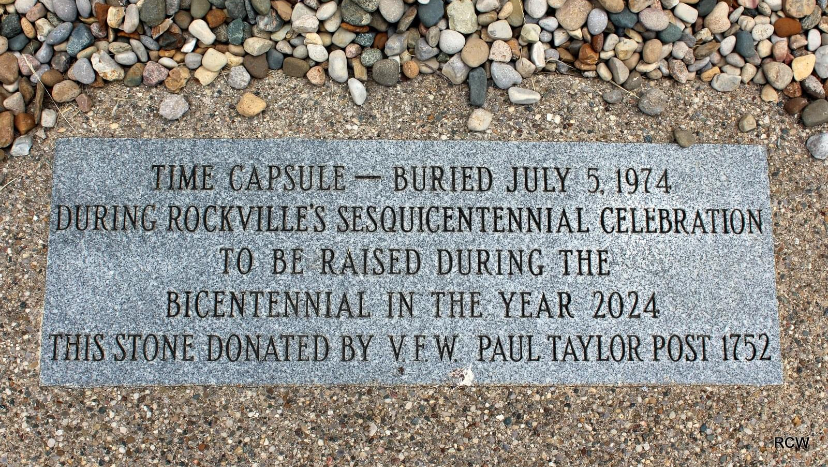
Below, is a photo shared by Jeff Gooch – Funeral Director of Gooch Funeral Homes – posting a picture of his father, with the following caption:

“This was my dad (Larry Gooch) putting the final touches on the time capsule for the Rockville Sesquicentennial in our backyard in July of 1974. When we arrived at the courthouse we were greeted by many of our townspeople waiting to place items inside. Gene Swaim from Rockville Vault and Monument Company placed a granite marker for future generations to see and remember the location. It is at the south end of the steps on the west entrance of our courthouse. Note the bumper sticker on his truck-it says Rockville Sesquicentennial July 2-6. I remember everyone in town had a sticker on their rear bumper. This time capsule is to be opened this year for our centennial celebration.”

The time capsule was successfully opened on July 27th of this year…
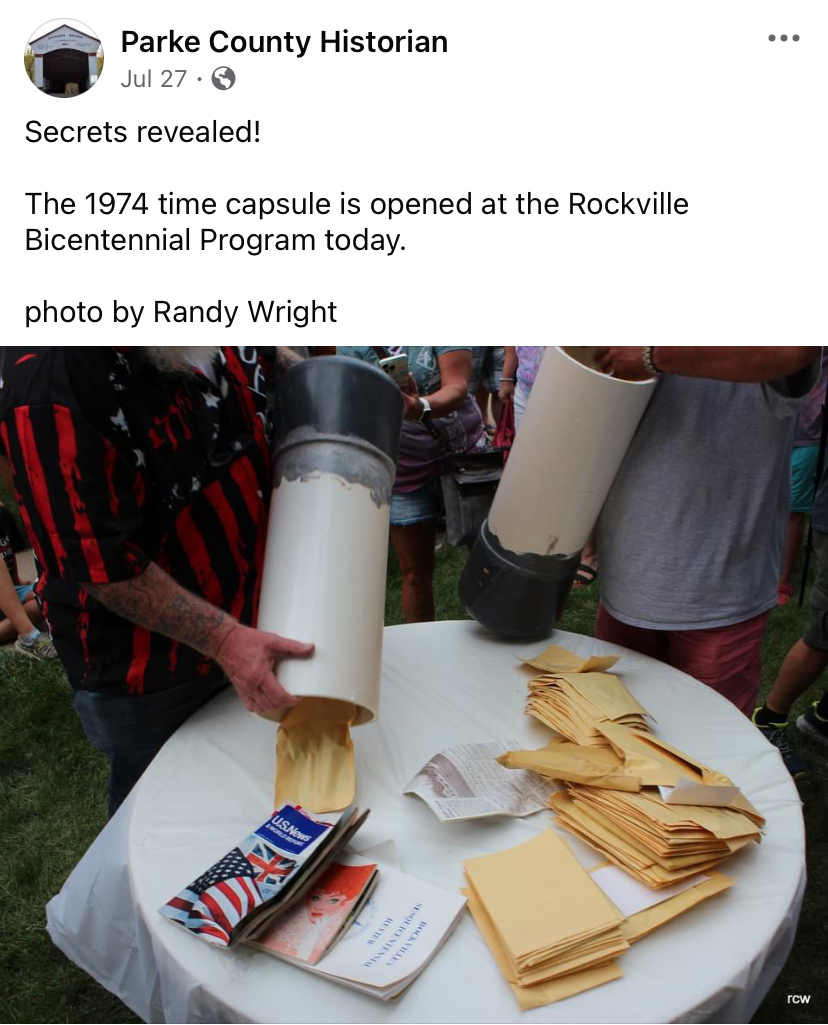
Wherever one time capsule is opened, another is sealed.

Thus, because my church is in Parke County, I’ve been asked to write a letter to my church – Dailey Chapel Christian – for the next time capsule that will be buried this week, and opened 50 years from now.

The following letter is what I’ve submitted to the future…

_____________________________________________

To the People of Dailey Chapel Christian Church in 2074:

Dear Brothers and Sisters,

I have no way of knowing who will be reading this (if I did, that would be really spooky). Do they still use that word “spooky” in 2074? Just curious. The truth is, there might not be anyone reading this. But I hope that some of the younger people in our church will be around to pull this out of the ground one day… little Lilie Lou or Scarlett Dickey… any Nepotes – Leila or Raegan… Nora or Tate Metheny… Daniel or Joe Lunsford… Maizee with the big smile, or little Sylvie… Henry, Jack, or George Overpeck… any of the Simmons kids – Evie Lou, Charlie, or Conway… any Haltom’s… Carson Cox – are you out there somewhere? I hope so.

It’s a crazy world we live in, and 50 years is a long time. One thing, that I’m pretty sure about, is that I won’t be around. But I’m ok with that. I know where I’ll be going. If I was still alive, I’d be 95 by then, and although it’s not impossible, it’s also not very likely. However, my beautiful bride Lynell (Nelly) is two years younger than me – and she’s a lot healthier and has really good genes, so perhaps she’s still kicking around down there. Please look her up, tell her I love her, and I’ll see her again soon.

Sorry… that might end up being a lot of work for one of you lucky listeners. It’s not every day that someone gets a chance to write a letter to the future, so I have to make good use of the opportunity.

In any case, I’ve been the Preacher/Minister/Pastor for Dailey Chapel for about 9 years now, and it’s been one of the most challenging, but also happiest times in my life so far. I’m glad to be the one writing this letter. And I suppose it’s my duty to impart some words of wisdom from the past, or at least come up with something clever to say, so here goes…

Disclaimer: This is one of the sermons (a revised version of it) that I preached for Dailey Chapel a few years ago (in 2021) and something I’ve used several times for funerals I’ve presided over… It’s one of my personal favorites. And it’s about the very thing you’ve all gathered together to commemorate this day: TIME.

On September 14, 2015, at exactly 5:51am Eastern Standard Time… Physicists from the Massachusetts and California Institutes of Technology were able to catch something in a very large net that had been traveling through space at the speed of light for 1.3 billion years.

A hundred years earlier, Albert Einstein had invented a bunch of math jargon to describe the existence of something he called gravitational waves. In his mad-genius sort of way, he speculated that when objects in space collide with each other, they create ripples the same way a rock does when thrown into a lake. Einstein was convinced of this, but he never thought it would be possible to prove. As it turned out, he was right about the existence of the waves. But he was wrong that it would never be known for sure.

In the mid 90s engineers from MIT and CALTECH began building two giant observatories to prove his theory. These facilities – one in Louisiana and one in Washington State, took several years to complete, but once activated, they worked in tandem to a create a digital net almost as wide as the Louisiana Purchase to try and catch and record the waves that Einstein had talked about.

And that is exactly what they did. They caught, measured, and tracked a series of gravitational waves passing through their net in 2015. When traced back to their origin point, it was discovered that 1.3 billion light years away from Earth, two giant black holes had slammed into each other, releasing a tidal wave of energy that exploded outward, and sent ripples in all direction. 100,000 years ago, that energy crossed the threshold of our galaxy The Milky Way and proceeded toward our solar system until passing harmlessly through our planet 9 years ago (9 years, as I write this letter).

Now, to help you visualize the amount of distance we’re talking about… It would take a human being 37,200 years to travel 1 light year through space. The gravitational waves detected in 2015 had traveled 1.3 billion light years to reach us. The universe we live in is SO BIG – that they don’t measure it with miles or kilometers – they measure it with TIME.

The light from our own Sun takes about 8 and half minutes to reach us. That means, if the Sun burned out and went dark or disappeared somehow – we wouldn’t know it until 8 and half minutes later. That means, when astronomers look at the sun through a telescope, they are seeing it the way it was 8 and a half minutes in the past.

The light that comes from the next star over – Proxima Centauri – takes a little over 4 years to reach us. So, if there was an alien in that star system looking at us through a telescope – they would be seeing us the way we were 4 years ago.

Information like this boggles the mind. We can barely fathom these vast distances, and the amount of time it takes to traverse them. And what does it mean? Does it even matter? Yes. It does. It matters, because this is one of the ways that our Lord shows us how great and powerful He is.

King David said it best — ”By the word of the LORD were the heavens made, their starry host by the breath of his mouth. 7He gathers the waters of the sea into jars; he puts the deep into storehouses. 8Let all the earth fear the LORD; let all the people of the world revere him. 9For he spoke, and it came to be; he commanded, and it stood firm.” (Psalm 33:6-9)

There’s a well-known theological concept called Natural Revelation. And although this is a concept that is touched upon in many places throughout the Bible, it is most clearly articulated by the Apostle Paul in Romans 1:20 – where he says that:  “since the creation of the world God’s invisible qualities – his eternal power and divine nature—have been clearly seen, being understood from what has been made, so that men are without excuse.”

In other words, he’s saying that when we look at everything around us – everything that God has made, we are looking at things that God has provided as evidence of His existence. So, whether we’re looking at the smallest of things right in front of us, through a microscope, or the very largest of things millions of miles away, through a telescope – all of it, reveals something about the One who created these things.

Moreover, Paul is also saying that this is an obvious truth. It’s common sense. To suggest otherwise is the very definition of foolishness. As King David once said at the beginning of Psalm 14 and Psalm 53, “it is the fool who says in their heart, ‘there is no God.’” –That’s actually the same Psalm. It’s in there twice.

Now Paul, also, in his letter to young Titus – warns him to not be prideful about his belief in God. He tells him in Titus 3:3 that, “At one time we too were foolish, disobedient, deceived, and enslaved by all kinds of passions and pleasures.” That’s Paul’s way of telling his protégé that the only thing separating us from the foolish – is the fact that we have fallen on the mercy of God. He’s reminding Titus that it is through love and humility and kindness that we demonstrate God’s mercy most clearly to those who have not accepted it.

If I tell someone that there is a God who loves them, in our culture, they probably won’t believe it. But if I tell them that God loves them, and I back it up by showing them that I love them too – THEN they might actually believe it.

But still, it’s not enough for people to know that we love them. We’re human beings. Our love is imperfect, and inconsistent, and flawed. And that’s why we have to point people to God whose love is perfect, and unwavering, and unparalleled.

So, that means we have to be patient with people who don’t believe the same things that we do. And in the meantime, we have to find ways to show them God’s love and mercy. We ourselves, have to ‘wait upon the Lord,’ and ask Him to use us – to lead us into the right situations and give us the right words when the time comes. And sometimes it’s hard to be patient. Sometimes it’s really difficult to wait for other people. But patience is one of the ‘fruits of the spirit,’ that Paul talks about in Galatians 5, and elsewhere.

We always want things to happen when we want them to happen. We want things to happen in our time. But God has his own time.

Now of course, when the Apostle Paul was writing about Natural Revelation he didn’t have microscopes or telescopes to see all the things that we can see today. But every advancement in science and technology that has come along since has only proven the concept of Natural Revelation even more. The more our technology allows us to see and observe, the more God’s immense power becomes visible. His fingerprints are all over the universe and everything in it.

And with this in mind, I’ve been taking some time, to go back to the Beginning of the Bible, into Genesis, so that we can do a little review on the 6 Days of Creation. What can we learn about God, what can we learn about ourselves, what can we learn about Christian faith from examining the Days of Creation through the lens of Natural Revelation?

For this message, I want to focus on something that God created on Day Four. So let’s take a look at that passage – Genesis 1:14-19.

And God said, “Let there be lights in the expanse of the sky to separate the day from the night, and let them serve as signs to mark seasons and days and years, 15and let them be lights in the expanse of the sky to give light on the earth.” And it was so. 16God made two great lights—the greater light to govern the day and the lesser light to govern the night. He also made the stars. 17God set them in the expanse of the sky to give light on the earth, 18to govern the day and the night, and to separate light from darkness. And God saw that it was good. 19And there was evening, and there was morning—the fourth day.

When we read through these verses we see the words ‘govern,’ and ‘separate,’ used in repetition. These words are both related to the idea of organization. God was organizing his creation under the canopy of time, and using the sun, moon, and stars to do it – he says it right there in verse 14, “let them serve as signs to mark seasons and days and years.”

The top researchers and scientists, and physicists in our culture (the ones that do not believe in God) explain away all the other things that exist in the universe – they have theories like evolution and the big bang that allow them to mentally evade the idea that there’s a God. But they haven’t been able to do that with TIME. They have no theory that allows them to provide an alternate reason for where time comes from. They can’t explain time.

The existence of time does not fit into any kind of scientific framework that currently exists. One of the most well-known physicists since Albert Einstein, a man named Richard Feynman – Richard Feynman was the George Washington, the Jimi Hendrix, and the Michael Jordan of physics all rolled into one. Any college student studying physics and space and time has to read his books and lectures. He’s considered to be one of the most brilliant minds ever on the subject – THAT GUY – back in the early 60s, when asked about the origin of time, basically said: I don’t know.

Most of the people who are considered to be experts in the field of physics today, with all the technological tools and more collective knowledge at their disposal than ever before – the kind of people who built those observatories to catch gravity waves in Louisiana and Washington – they basically scratch their heads when it comes to figuring out why time exists.

The scientists and the mathematicians don’t do well with the concept of time. As the Psalms of King David have shown us – it’s the writers and the poets that explain time much better. Time makes good material for poetry, and storytelling, and classic rock and roll power ballads.

My favorite non-bible author J.R.R. Tolkien once wrote: “Time all things devours. Birds, beasts, trees, flowers. It gnaws iron, bites steel, grinds hard stones to meal. It slays kings, ruins towns, and beats high mountains down.”

One of my favorite songwriters Roger Waters wrote some beautiful words on the subject of time: “You run and you run to catch up with the sun but it’s sinking. Racing around to come up behind you again. The sun is the same in a relative way, but you’re older. Shorter of breath and one day closer to death.”

Our culture is obsessed with time. Just think about all the phrases we have to describe time in different ways:

All in good time.

In the nick of time.

From time to time.

We’re living on borrowed time.

It’s a matter of time.

Time out. In time. Time flies. Time to go.

About that time.

Take some time. Make some time. Kill some time.

Once upon a time.

There’s Adventure time. A Wrinkle in Time. The Land Before time.

Hot Tub Time Machine.

Snack time. Dinner time. Summer time. Double time.

Hang time. High time. Game time. Face time.

Prime time. Local time. Real time. Record time.

Quality time. Screen time. Quiet time.

Miller time.

Big time. Small time. Nap time. Space time.

We keep time. We spend time. We lose track of time.

No time flat. No time to waste. Some other time. Make up for lost time. Now is the time.

Hit me baby one more time.

We can obsess ABOUT TIME all we want. But time cannot be controlled. It cannot be solved by a math equation. There is no end to its ability to baffle scientists. There is no end to its ability to inspire artists, poets, and writers. And whether you’re from the countryside or you’re a city dweller – you cannot escape the clock.

Time is the great transformer of things. It changes ALMOST everything. It dissolves things that we think are solid. It moves things that we think will always be there. It destabilizes, shakes, and decays everything around us. It cannot be stopped. It cannot be bought. It cannot be bargained with. It can’t be reasoned with. And, eventually, it will take every one of us by the hand and walk us into the grave.

Despite all the terrible things that time does to us – it is still a precious gift from God. God created it for us. And God saw that it was good.

The reason it stings us the way it does – is because it is one of those things that REMINDS us all, that WE ARE NOT GOD. It reminds us that we are powerless, we are fallen, and we need someone to save us.

The good news is that someone has saved us. His name is Jesus, and he is the Christ, the Son of the Living God.

The Bible tells us that we are not like the rest of humanity that has no hope. Why? Because we have a King who is Master over the Grave. Our God is Master of Time itself. He created it. It has no power over him. And as Hebrews 13:8 says, “Jesus Christ is the same yesterday, and today, and forever.”

He is immoveable, he is unstoppable, he is our only hope out of this mess, and he is the one who makes all things new.

Heaven and earth will pass away – just as I have passed away. But the words of Christ will never pass away. Call out to him today, ask him to speak to you.

In Christ’s Love,

Adam Joseph Coffman

September 11, 2024

Love Your Enemies

Love Your Enemies

Last week, we looked at a passage from Luke Chapter 14, where Jesus talked about the Cost of Discipleship, – the willingness to let go of everything we have, everyone we know, and everything we care about – even our own lives – if our King should ever call upon us to do so.

This week, we’re going to focus on Luke 6:27-36.

These words of Jesus touch on one of the great pillars of God’s Kingdom – a cornerstone of the entire message of the whole Bible. It’s no exaggeration to say, that if we miss the message that Jesus gives us here in Luke 6:27-36, then we are missing the whole point of the Gospel itself.

Now, before we look at this passage in Luke, I want to go back to the Old Testament for a few moments, and talk a little about one of the more interesting characters we find there – a man, by the name of Jonah.

Now, many of us, when we think of Jonah, automatically associate him with the giant fish!

We think of Jonah and the fish, or Jonah and the whale, because we heard this story when we were still children, and to the mind of a child, that is the most memorable thing that happens in this story.

When I was a kid, it made me think of the story of Pinocchio.

And, actually, there are some overlapping themes between the story of Jonah and the fairytale of Pinocchio – both are about redemption and transformation for instance.

Pinocchio learns how to become a “real boy,” and Jonah learns how to become a “real man.”

And they both go through their transformation from one to the other while being swallowed by huge sea creatures.

So, I think – to any of us who heard both of those stories as children – it’s somewhat easy to blend them together in our memories, and maybe think of Jonah as being one of the stories in the Bible that is more for kids.

But the truth is, that Jonah’s story is really not a children’s story.

Not at all.

And the part where he gets swallowed by the fish is an important part of the book, but it’s not the most important thing that happens. The most important part of Jonah’s story, is not his encounter with the fish, but rather, his encounter with God.

And Jonah’s encounter with God was not a pleasant one.

Jonah’s relationship with God was not amicable or friendly – to say the least. In fact, the main emotion that Jonah expresses to God is ANGER.

He’s very angry at God.

Jonah had a very big problem with God, because God asked him to do something that was, in Jonah’s mind, completely unacceptable.

The story of Jonah happened at a complicated time in the history of Israel.

The Northern Kingdom of Israel had been dealing with foreign invasions for almost a century by then. And these invaders were from the Assyrian Empire, which today would be primarily in the countries of Iraq, Iran, and Syria. But the Assyrians were an exceedingly brutal people; their culture was built on two main principles: warfare, and building projects.

The Assyrians were constantly going to war in order to expand their empire, and plunder the people they defeated. And those they didn’t kill, they would turn into slaves, and take them back to Assyria so they could have slaves build their buildings and serve their people.

Whenever the Assyrians captured a city, they would mutilate anyone who resisted them. They would skin people alive, they would impale them on stakes and line the roads with them, they would pull their intestines out to use as burnt offerings, they would create huge piles in front of the city gates – one pile of enemy corpses, and another pile of all the heads they had decapitated from those corpses. And they didn’t just do this for the sake of being brutal – they considered it part of their religious duties – the mass murder and executions were how they made sacrifices to the demons they worshipped as gods. They were very meticulous and artistic about how they dismembered the bodies of their enemies, and who they chose to take as slaves.

That’s who the Assyrians were.

And they had been slowly making these kinds of invasions into the north of Israel for about a hundred years by the time Jonah came along, and by the time God asked Jonah to go to their capitol city, which was called Nineveh, and preach against all of their wickedness.

But Jonah had a very big problem with God asking him to go on this journey and do this.

And we might think it was because of fear; we might think Jonah was just afraid to go to Nineveh and preach against them because they would probably just kill him. But there’s really no indication in the story that Jonah was in the least bit afraid. He was not a fearful man.

He was an angry man. And the reason he had a problem with God telling him to go preach to the Assyrians of Nineveh was because HE HATED THEM.

They were the arch enemies of Jonah’s people. They had invaded his country, they had killed and enslaved his countrymen, and they were looming over Israel’s borders, so that they could continue doing these things, with no end in sight.

So, Jonah hated them.

And more than that, he believed his hatred of the Assyrians was absolutely justified.

And if we were in his shoes today, we would very likely feel the same way.

In fact, if you were to look on a map, and find where Nineveh is located – you would see the present-day city of Mosul in Iraq.

The ruins of Nineveh are right next to Mosul, and up until about a few years ago, Mosul was in ISIS occupied territory.

Of course, we’ve all heard about the atrocities of ISIS over the past decade. They’ve attempted to build their own country by conquest and bloodshed; they’ve killed and enslaved tens of thousands, they’ve carried out terrorist attacks across the Middle East, Asia, and Europe, and have publically executed almost anyone who has opposed them – including many Christians – which are, of course, in the minority in that part of the world.

If God spoke to any of us, and told us to go preach the Gospel to ISIS – how would we feel about it?

It’s probably an understatement to say that we wouldn’t want to go – and if we decided to go anyway – the people who love us would do their best to convince us that we were making a big mistake.

Well Jonah, back in his day – was told, by God, to go preach to people that were not very much different from ISIS. And he said (basically), ‘No, God,’ I’m not going to do that.’

And then, he went down to the nearest port, and hopped on the first ship available, so that he could sail as far away as possible in the OPPOSITE DIRECTION of where God told him to go.

And like I said, he didn’t refuse to go because he was afraid of the Ninevites… he refused to go because HE HATED THEM.

You may remember what happens next.

God decides not to let him off the hook so easily, and sends a storm to keep him from sailing away – and so, Jonah, partly because he doesn’t want the other people on the boat to die because of his disobedience, and partly because he thinks he can escape God by different means – has himself thrown into the sea. But even that attempt to get out of the work God was asking him to do fails – as God sends the infamous giant fish to swallow him – and actually rescue him.

And it’s there, in the belly of the fish – in that terrible, unimaginable darkness – where he’s an inch away from death – that Jonah FINALLY has a heart to heart with God about his life, and about his responsibility as one of God’s chosen people – to take the light of God into a dark place.

God uses that place of suffering and darkness to get Jonah’s attention – and when Jonah is spewed back onto dry land again – he’s ready to head to Nineveh, and preach to the Assyrians like God told him to.

He’s changed his actions from disobedience to obedience,

But, as the story continues, we discover that his heart has not changed at all – he still harbors the same hatred in his heart.

His actions have changed because of God’s discipline, but his heart stays the same.

And when he preaches to the city of Nineveh, the people do repent of their sin and their evil, and they turn to God.

And Jonah responds to their repentance like this:

This is what is says in Jonah 4:1-3

“But to Jonah this seemed very wrong, and he became angry. He prayed to the Lord, “Isn’t this what I said, Lord, when I was still at home? That is what I tried to forestall by fleeing to Tarshish. I knew that you are a gracious and compassionate God, slow to anger and abounding in love, a God who relents from sending calamity. Now, Lord, take away my life, for it is better for me to die than to live.”

This is the most successful revival on record in history – 120,000 people in Nineveh – repenting of their sin en masse – and turning to God. Jonah’s one of the most successful preachers in history. And he’s so mad at this, and so filled with hatred towards the people he’s preaching to, that he just wants God to kill him. He just wants God to end his life.

He’s had enough of God showing MERCY to his enemies.

So, as the story ends, Jonah and God have another little chat about Jonah’s attitude, and the condition of his heart, and then the story sort of abruptly ends.

And it ends with God asking a question.

And the question is directed towards Jonah – but the writer of the book, by ending it with a question – is saying that it’s really directed towards the reader.

This question is directed toward us.

And the question that God asks, is why shouldn’t I care about saving these people? These are people. They’re human beings. Why shouldn’t I care about them?

That’s what God asks.

And we might think of that question of God’s, as sort of hanging in the air like a dense fog for the next 700 years, until Jesus comes along, and clears all the fog away and says this – in Luke 6:27-36

“But to you who are listening I say: Love your enemies, do good to those who hate you, 28 bless those who curse you, pray for those who mistreat you. 29 If someone slaps you on one cheek, turn to them the other also. If someone takes your coat, do not withhold your shirt from them. 30 Give to everyone who asks you, and if anyone takes what belongs to you, do not demand it back. 31 Do to others as you would have them do to you.

32 “If you love those who love you, what credit is that to you? Even sinners love those who love them. 33 And if you do good to those who are good to you, what credit is that to you? Even sinners do that. 34 And if you lend to those from whom you expect repayment, what credit is that to you? Even sinners lend to sinners, expecting to be repaid in full.35 But love your enemies, do good to them, and lend to them without expecting to get anything back. Then your reward will be great, and you will be children of the Most High, because he is kind to the ungrateful and wicked. 36 Be merciful, just as your Father is merciful.”

Powerful words, yes?

Difficult to read.

And even more difficult to actually follow.

Jesus was the revolutionary of all revolutionaries.

No one, as far as I know, had ever said something like this before him, and if there were those who said something like this, they didn’t believe it so thoroughly and completely as he did – and follow it all the way through to the point of being executed. This kind of idea is not popular – it’s never been popular.

It’s not popular today.

We live in a world that runs completely counter to this idea.

What do we hear?

We hear people telling us who to be angry with, who to accuse, who to argue with, who to blame – who to hate.

We turn on the news, and what do we see?

Our society does not know the concept of loving one’s enemies.

The world tells us to shout them down, give ‘em what for, take ‘em to the cleaners… and then it gives us a list to choose from – pick your group… pick the group of people you want to be angry with this week.

And, unfortunately, for many of us, it’s often easy to pick a whole group of people to look down on, and be angry with, because the horrible truth about all this – the reason that these words of Jesus can sometimes sting us so much – is that we have the hardest part, not with loving the enemies that are on the TV or far away somewhere else, but with loving the enemies that are right in front of us.

Yeah, it’s hard to love people that we blame for causing the big problems in our society – but, if we’re honest, it’s even harder to love the people THAT WE KNOW – who have hurt us in some way… or spoken bad about us… or ignored us. That’s the really hard part about what Jesus says.

It’s hard for me.

Believe me, I have plenty of people that I can’t stand to be around. None of you guys here… ok… but it’s all I can do – to ask God for enough grace to not be bitter and angry at some of the people that have hurt me in the past.

There are people who have lied to me, lied about me, told me that I had no business being a minister, told me I was a loser who wasn’t worth anything – people who turned their backs on me when I needed them the most; leaders in churches who ostracized me, and kicked me out of their “church” group, because I asked them questions they didn’t know how to answer – so they just got offended and told me I was a bastard.

It’s hard to forgive that. It’s much easier to feel the emotions of anger, than to feel the emotions of pain or heartache.

It’s difficult work to let Jesus take a knife, and carve out the places of our heart that have become calloused and overgrown with bitterness.

It hurts.

But he died so that he could do that work for us.

Paul says, it like this in Romans 5:6 and Romans 5:8

“You see, at just the right time, when we were still powerless, Christ died for the ungodly….  

But God demonstrates his own love for us in this: While we were still sinners, Christ died for us.”

He’s saying, quite simply, that we were all, at one time, ENEMIES of God. And he still showed compassion on us anyway, by dying the way he did.

I’ll close this morning, with a brief historical anecdote.

This one happened in Northern Ireland, in November of 1987, when the Irish Republican Army bombed a small town called Enniskillen. If you’re not very familiar with the situation in Northern Ireland at that time, they were about 20 years into a 30-year conflict that was very messy, very violent, and, at the risk of oversimplifying things, was mainly caused by a mixture of disagreements surrounding politics and religion.

This was a conflict between Catholics and Protestants, Irish nationalists and British loyalists; the British Army against armed civilian terrorists.

And on November 8, 1987 the people of the town of Enniskillen were celebrating Remembrance Day – which is the British version of our Veteran’s Day.

It was a cold and dreary November day in Enniskillen, Northern Ireland. The town was quiet, with the sound of rain tapping against the windows of the local shops and houses. The streets were lined with colorful autumn leaves, creating a vibrant contrast against the gray skies above.

Despite the weather, the people of Enniskillen went about their daily routines. Some were out shopping for groceries, while others hurried to catch the bus to work. The town had a sense of resilience about it, a reminder of the turbulent history that had shaped this community.

As the day turned to evening, the lights of the town began to flicker on, casting a warm glow against the darkness outside. The smell of turf fires filled the air, adding a sense of coziness to the town’s atmosphere.

In a local pub, a group of friends gathered around a table, sharing stories and laughter over pints of Guinness. The sound of traditional Irish music filled the room, creating a lively and welcoming ambiance.

Despite the troubles that had plagued Northern Ireland for so long, the people of Enniskillen remained united in their resilience and sense of community. As the night went on, it was clear that this small town had a spirit that could not be dampened by any storm.

That’s when the IRA detonated a large bomb in the town square.

12 people died from that bomb, and many more were injured.

Among those caught in the blast was a man named Gordon Wilson, and his daughter Marie.

The blast did not kill them, but a building collapsed on them, and they were trapped in the rumble for several minutes waiting to be rescued.

Those minutes when they were waiting to be rescued, were the last minutes that Gordon would spend with his daughter.

He held her hand while she told him that she loved him, and then she lost consciousness and never woke up.

Within hours – hours after losing his daughter – Gordon was on BBC Television, lamenting the loss of his daughter, assuring those watching that she was a child of Christ, and he would see her again – AND – to the HORROR of many people listening to him, and discussing the tragedy on the News that day – he told those who had killed her, that he held no ill will against them, that he forgave them, and then he urged there to be no retaliation for the attack.

His words of forgiveness and grace were an earthquake that caused that entire conflict to begin crumbling.

He eventually met with the IRA leaders, publicly, and forgave them in person, and he later became a senator in Ireland, and helped to bring a final end to the 30 years of violence that had claimed his daughter.

Before all that happened, Gordon Wilson was a window treatment specialist – he made drapes for a living.

__________________________

Matthew 5:3-10:

“Blessed are the poor in spirit, for theirs is the kingdom of heaven.
Blessed are those who mourn, for they will be comforted.
Blessed are the meek, for they will inherit the earth.
Blessed are those who hunger and thirst for righteousness, for they will be filled.
Blessed are the merciful, for they will be shown mercy.
Blessed are the pure in heart, for they will see God.
Blessed are the peacemakers, for they will be called children of God.
10 Blessed are those who are persecuted because of righteousness, for theirs is the kingdom of heaven.”

Loving our enemies – forgiving those who have hurt us – does not mean that we excuse their bad behavior.

It does not mean that we have to entertain their foolishness, or their wickedness. It doesn’t mean we have to give them our trust.

IT DOES MEAN, that we have to see them as our fellow human beings who are just as much in need of God’s love and grace as we are.

And that love and grace MIGHT cause those people to change.

We hope that it does.

But that’s not our responsibility.

It’s not our job to change people.

It’s not our duty to turn people into better human beings – we can’t make other people forgive.

But we can choose to forgive them.

We can choose to ask God to change what’s in our hearts. And then, when our hearts have been changed by Him – then He can use us for something that will (as Maximus Decimus Meridius once put it) “echo into eternity.”

Enniskillen Memorial

The Cost of Being a Disciple of Jesus

The Cost of Being a Disciple of Jesus

DISCLAIMER: I originally wrote this sermon four years ago, in August of 2020. If you want to listen to it, I’ll embed the audio version at the bottom of this post.

But I’m trying to publish more regularly on this blog because that’s what you’re apparently supposed to do…

So, I pulled this one out of the archives, because it’s a real humdinger. And you should read it. Seriously, it’s a good one, if I do say so myself.

____________________________________

This morning, we’ll be reading through a passage from Luke 14:25-33.

But before we take a look at this passage in Luke, I want to tell you a story that’s a little bit closer to us in history. This isn’t something that happened 2,000 years ago, but much more recently.

It begins about a hundred years ago, in a city called Breslau. Breslau is in the southwest of Poland today, but a hundred years ago, and up until the end of World War II, it was still a part of Germany. And that’s where this story begins – in Breslau, Germany, a hundred years ago, in 1920, when a young man by the name of Dietrich gave his life to Christ, and decided that he wanted to study the Bible and become a teacher of God’s word.

Dietrich was a very intelligent young man, very devoted to his studies; by 1927 (when he was only 21 years old) he had graduated from the University of Berlin with a doctorate in Theology. Still young, and not quite sure where his place was in the world, he decided to come here to the U.S., and ended up as a professor at Union Theological Seminary in New York City. He was only in the U.S. for one year, but while he was here, he was lovingly accepted into a Baptist church in Harlem, where he taught Sunday School classes, and where he began to encounter the societal injustices being experienced by Christian minorities – in particular, black Christians that he had become friends with. As a white man, but still an outsider, a foreigner from Germany, he had slipped in between these two segregated worlds of American Christians – black and white, rich and poor, educated and uneducated. Dietrich knew his Bible really well. In the Gospels, he read, as we have been reading, about the reality of God’s Kingdom in the here and now. And he wrestled with the contrast between what he was reading about the Church in the New Testament, and what he was seeing the Church do (and not do) in New York and other places.

How could the Church in the New Testament be so united in purpose, and the Church of modern day be so fractured and divided?

Why was the wealthy Church so pre-occupied with its own position on the highest levels of secular society, and so blind to the suffering of the poor Church just a few blocks North?

How does that happen among God’s people? How does one group of Christians become obsessed with finding a seat at the table of high society, while another group focuses on pulling people out of the gutters and giving them food, and clothing, and housing?

Why do the Christians with the most resources at their disposal, hoard their wealth, while those with just enough to get by give away everything they have? Why can’t they work together? Why can’t they find balance in the community of God’s Kingdom – the community of people saved by grace – the community that Jesus gave his life to bring into existence?

What was the answer to these questions?

What could be done about it?

Dietrich wasn’t entirely sure, but he didn’t ignore these tough questions; he wrestled with them. And this unique perspective that he had, as an outsider and foreigner, influenced him a great deal. And he took that perspective with him, when he returned to his homeland in 1931.

When he returned to Germany, he began teaching theology at the University in Berlin where he had received his doctorate four years earlier, and not long after that, he was ordained as a pastor in the Lutheran Church.

And, it was less than two years later, on January 30, 1933, that the Nazis took control of his country.

As we all know now, with our 20/20 historical hindsight, Adolph Hitler’s rise to power would eventually culminate in the horrendous disaster that we call World War II, where millions of people would perish, and where terrible things had to be done in order to stop a man that was closer to an example of the Anti-Christ than almost anyone else in history.

Have there been others like Hitler?

Yes.

Joseph Stalin probably executed more people, for instance. But Hitler did three things that really single him out:

1. He lied to the Christians in Germany that were susceptible to deception.

2. He silenced, imprisoned, and killed the Christians who were not so easily deceived.

3. He waged genocide against the Jewish people.

If Hitler had succeeded in taking over the WHOLE WORLD, he would have been THE Anti-Christ.

As it turned out, he was only one of the many little antichrists like those the Apostle John warned us about in his first epistle (1st John 2:18).

Like I said, we all know this now. It’s more or less common knowledge. But to many of the Christians throughout Germany at the time Hitler took power it wasn’t as clear. Even though it SHOULD HAVE BEEN.

Hitler’s rise to power was hailed as an act of God by the majority of church leaders in Germany at the time. They threw their support behind him completely – telling their congregations that Hitler had been sent by God to lift them out of economic depression, and restore their honor on the world stage. Some went so far as to say that Hitler spoke on God’s behalf, and that the fulfillment of God’s Kingdom was embodied in the person of Adolph Hitler. Churches that had been firmly established and rooted in place for centuries, wasted no time in allowing Hitler to steam roll his way through them. In fact, they stepped aside as he removed Pastors, Bishops, and Elders who were not “pure-bloods” of Aryan descent. They remained silent when he demanded that he, the Fuhrer be recognized as head of the Church (rather than Jesus Christ), and they supported efforts made to remove the Old Testament from the Bible – because of its pro-Jewish agenda. These were not things that happened overnight. They were ideas that Hitler had been preaching for months BEFORE he was in power. There was plenty of opportunity for the churches in Germany to at least try to prevent his ascension to power – by speaking out against him. But those with the most influence in their society, remained silent. Or they openly supported him.

But not everyone.

There were small groupings of Christians in Germany, in the middle of all that madness, who refused to bow down and worship that man.

And the hero of this particular story – Dietrich – was among them.

Just a couple of days after Hitler became Chancellor, Dietrich was able to get onto a radio station in Berlin and sound the alarm.

Before they cut him off mid-sermon, he denounced Hitler and everything he stood for – and he rebuked every Christian who followed him for their idolatry to the “cult of the fuhrer.”

In the months and years that followed, he began organizing the minority groups of Christians who didn’t follow Hitler, by helping to create a network of churches dedicated to voicing opposition to him, as well as to rendering aid to their Jewish neighbors who were already under attack. He was putting into practice what he had learned when he was in New York – that he couldn’t just talk about the Gospel – he had to live in its reality. He couldn’t just stand around and do nothing while so much evil was taking place around him. He had to actually do something about it.

So, he did.

Between 1933 and 1939, he helped organize and lead an underground seminary where he taught his students that the cost of being a modern disciple of Jesus was complete loyalty to the King and His Kingdom, above all else. –Even if it meant losing your friends, losing your family, or losing your country.

And for this, Dietrich was branded an enemy of the state, his coalition of churches and his seminary were deemed illegal by Heinrich Himmler, and Dietrich himself was exiled from the city of Berlin.

Dietrich’s friends in New York City urged him to flee the country, and he did in the Summer of 1939. But he did not stay in the United States for very long. In a letter to one of his former professors at Union Seminary, this is what he wrote, shortly before returning to Germany:

“I have come to the conclusion that I made a mistake in coming to America. I must live through this difficult period in our national history with the people of Germany. I will have no right to participate in the reconstruction of Christian life in Germany after the war if I do not share the trials of this time with my people … Christians in Germany will have to face the terrible alternative of either willing the defeat of their nation in order that Christian civilization may survive or willing the victory of their nation and thereby destroying civilization. I know which of these alternatives I must choose but I cannot make that choice from security.”

It wasn’t long after his return home, that because of close trusted contacts within the German military, he first became aware of concentration camps where Jews were being systematically exterminated. And that put Dietrich in the position of finally having to choose, definitively, which of his two kingdoms he would betray.

Would he become a traitor to Germany? Or would he become a traitor to God’s Kingdom, by looking the other way as his neighbors were being murdered? He chose God’s Kingdom over the kingdom he had been born into.

When asked by a Dutch colleague of his at the time, “what he was praying for these days?” Dietrich told him, “If you want to know the truth, I pray for the defeat of my nation.”

And that’s when Dietrich became a spy.

He began working within the Abwehr – the German Military Intelligence network –which was not yet under the control of the SS. There were many German officers in the Abwehr, already functioning as allied spies against Hitler. They recruited Dietrich with the understanding that he would use his contacts in Europe and the United States to smuggle intelligence to the Allies, and to help Jews escape from Germany. And that’s what he did for the next few years…

Before he was eventually caught and arrested in the Spring of 1943.

Dietrich spent two years in prison for treason, during which time he was the pastor for his fellow prisoners, and even some of his prison guards.

On April 4, 1945 Hitler personally ordered Dietrich’s execution, and he was hung that same week at Flossenburg Concentration Camp.

Two weeks later, the U.S. 90th and 97th Infantry Divisions liberated that camp.

A week after that, the Soviets took Berlin.

Hitler committed suicide at the end of the month, and Germany surrendered on May 7th.

Dietrich’s prayers for the defeat of his nation came to pass. But he himself, had already gone home to his real country.

The doctor who saw Dietrich’s hanging described his final moments like this:

“I saw [the] Pastor … kneeling on the floor praying fervently to God. I was most deeply moved by the way this lovable man prayed, so devout and so certain that God heard his prayer. At the place of execution, he again said a short prayer and then climbed the few steps to the gallows, brave and composed. His death ensued after a few seconds. In the almost fifty years that I worked as a doctor, I have hardly ever seen a man die so entirely submissive to the will of God.”

And that brings, the story of Dietrich Bonhoeffer to a close.

Now… why am I telling you all of this? Why is this story an important one?

Well, let’s finally get to Luke 14:25-33, and you’ll see why…

“Large crowds were traveling with Jesus, and turning to them he said: 26 “If anyone comes to me and does not hate father and mother, wife and children, brothers and sisters—yes, even their own life—such a person cannot be my disciple. 27 And whoever does not carry their cross and follow me cannot be my disciple.

28 “Suppose one of you wants to build a tower. Won’t you first sit down and estimate the cost to see if you have enough money to complete it? 29 For if you lay the foundation and are not able to finish it, everyone who sees it will ridicule you, 30 saying, ‘This person began to build and wasn’t able to finish.’

31 “Or suppose a king is about to go to war against another king. Won’t he first sit down and consider whether he is able with ten thousand men to oppose the one coming against him with twenty thousand? 32 If he is not able, he will send a delegation while the other is still a long way off and will ask for terms of peace. 33 In the same way, those of you who do not give up everything you have cannot be my disciples.”

Now, those are some harsh sounding words, are they not?

There’s a huge crowd following Jesus, and instead of reveling in all of his many followers, it’s almost as if he’s trying to get rid of them. He tells them they can’t follow him unless they hate everyone else… that they even have to hate their own life! Now, he doesn’t mean this literally – that they have to hate. After all, this is Jesus – he teaches us to love everyone, even our enemies.

So, he’s not literally telling us we have to hate ourselves and our families. He’s saying that His Kingdom always comes first. The Kingdom always takes precedence. He’s saying that our love for Him has to be total. Our loyalty to Him has to be complete. He’s saying, if you really want to follow me, you might have to say goodbye to the people you care about. He’s saying: If you say ‘yes’ to me, you might have to say ‘no’ to the people you love.

Jesus is using this allegorical language about building towers and going to war, which might all sound a little strange to us. But he’s pointing out the natural human tendency to look ahead. If we’re being wise, then we think before we make a major decision about something; we think about what that decision is going to mean, and whether or not it’s going to be good or bad, and we think about what we’re going to have to give up, or let go of.

We have to estimate what it’s all going to cost.

How much money to build that building?

How many troops to win that war?

Well, we don’t have to estimate what it costs to follow Jesus; he tells us EXACTLY what it costs – it costs EVERYTHING.

Dietrich knew that. He knew it really well. He knew that we can’t just hide in the comforting glow of God’s grace – that to do so, cheapens the sacrifice that Jesus made. We have to go into the darkness with the light that we have.

We have to do something.

And whatever that is – it might cost us everything.

It MIGHT cost us family; It MIGHT cost us friends; It MIGHT cost us our country.

And if so, that’s ok.

That’s what it means to pick up YOUR CROSS and FOLLOW HIM.

In John 15:18-19, Jesus said quite clearly: “If the world hates you, keep in mind that it hated me first. 19 If you belonged to the world, it would love you as its own. As it is, you do not belong to the world, but I have chosen you out of the world…”

Let’s remember these words of Jesus in the coming months.

Let’s hold tightly to them, as the rhetoric in the world around us becomes louder, and the nonsense becomes overwhelming. Our job is still the same: To love our neighbors, to love our enemies, and to love God the most.

The kingdom we’re living in is temporary; it is crumbling. But the Kingdom we belong to is eternal, and it will never fall.

There won’t be any Democrats or Republicans in Heaven, my friends.

“Then the sovereignty, power and greatness of all the kingdoms under heaven will be handed over to the holy people of the Most High. His kingdom will be an everlasting kingdom, and all rulers will worship and obey him.” – Daniel 7:27

BREAKING NEWS: Non-Christians Behave Like Non-Christians

BREAKING NEWS: Non-Christians Behave Like Non-Christians

I want to say at the outset of this, that I intend no disrespect to my brothers and sisters in Christ – fellow pastors and teachers, or otherwise. But, I am concerned over the level of mud-slinging and stone-throwing that I’ve been seeing online over the past couple of days, in regards to the opening ceremony of the Olympics in Paris, France.

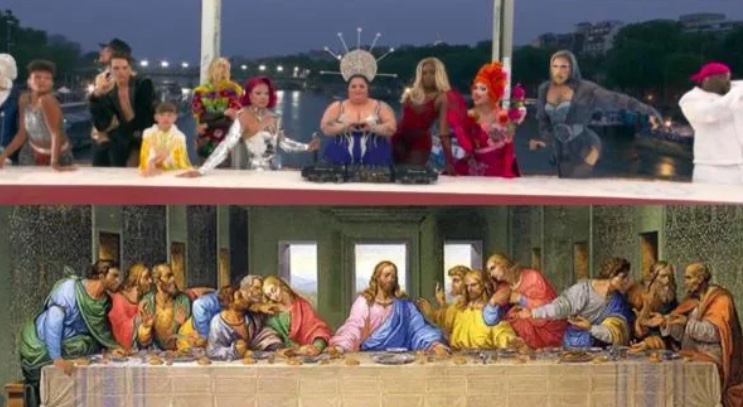
The specific part of the event in question involved an on-stage, live reenactment of what appears to be Leonardo da Vinci’s famous mural The Last Supper, painted about 500 years ago – with the obvious modification being that the “disciples” are depicted as a group of flamboyant drag queens.

Ha. Ha. Ha. Good one… You really got us.

This, somewhat ironically, reminds me of a story from the Book of Acts. I say it’s ironic, because it occurred in Chapter 17, when the Apostle Paul found himself strolling through the city of Athens – which happens to be the place where the first modern Olympic Games were held in the Spring of 1896.

As often occurred on his epic missionary journeys across the Mediterranean, Paul went directly into the most public places of town to make his plea on behalf of Christ. Paul’s method of public preaching in the open squares was not unusual, offensive, or disrespectful. It was common at the time, especially in a city like Athens, for teachers to philosophize openly among the masses to anyone willing to listen, and even to invite criticism which would lead to further discussion and debate on the topic at hand.

Make no mistake, Paul was “greatly distressed to see that the city was full of idols,” as we’re told in 17:16 [NIV]. But although this idolatry provoked him, he didn’t allow himself to be overtaken by anger and bitterness. It’s completely reasonable (for those among us who believe that Christianity is being mocked) to feel provoked, distressed, or offended by the actions of non-Christians, but it’s important that we leave those feelings at the foot of the Cross, and that OUR ACTIONS reflect Christ’s response to such things.

“To this you were called, because Christ suffered for you, leaving you an example, that you should follow in his steps. 22 “He committed no sin, and no deceit was found in his mouth.” 23 When they hurled their insults at him, he did not retaliate; when he suffered, he made no threats” (1st Peter 2:21-23 [NIV]).

That’s how Paul responded to being offended. He presented the Gospel boldly but respectfully. And in his explanation, he even used the idolatry he witnessed as an avenue to reach the hearts of those listening to him. Look at what he says to the pagan citizens of Athens in Acts 17:22-23 –

22 So Paul, standing in the midst of the Areopagus, said: “Men of Athens, I perceive that in every way you are very religious. 23 For as I passed along and observed the objects of your worship, I found also an altar with this inscription: ‘To the unknown god.’ What therefore you worship as unknown, this I proclaim to you.” [ESV]

Paul’s reaction to the idolatry in Athens led to mockery by some, further inquiry and curiosity from others, and to the conversions of a few (17:32-34).

What would the outcome have been if Paul had allowed his distress to turn into vocal outrage? When I see my fellow pastors reacting to modern paganism in such ways, I think to myself, “Come on, guys, we can do better.”

In 2nd Corinthians 4:2, Paul says that, “The god of this age has blinded the minds of unbelievers, so that they cannot see the light of the gospel that displays the glory of Christ, who is the image of God.”

And in 1st Corinthians 2:14 he says, “The person without the Spirit does not accept the things that come from the Spirit of God but considers them foolishness, and cannot understand them because they are discerned only through the Spirit.”

Taken together, the overall point is that if a person is an unbeliever they do not have the light of God’s Spirit to show them the way of life. Even if their intention is to directly mock our faith, “they know not what they do.

It’s our job to be Christ’s ambassadors in this world – to shine the light of truth, and to bring the love. We’re not living under the Old Covenant. We’re living under the New one. The “goliaths” that we have to fight are our own pride and self-righteousness.

We have to stop thinking about non-Christians in worldly terms – like it’s “us” versus “them.” There’s too many of you allowing the vitriol occurring in the political realm of this world to dictate your words and actions. Stop taking the bait. The enemy craves your outrage and your stone-throwing, because that’s what elevates his kingdom. You aren’t winning any souls by shouting about your lack of “Christian rights.” The Gospel doesn’t say we’re entitled to “Christian rights” in this world. It says we have a King, whose Kingdom “is not of this world” (John 18:36).

There’s all kinds of things in this world, and in our modern culture that are offensive to us. And these people making a parody of a painting of The Last Supper is not the worst of them. It’s actually kind of lame. Mel Brooks did a much better job of it in History of the World: Part 1 (1981).

I’m sure there were people that got upset about that one at the time too. So lastly, I’ll say this: If you’re too hurt and offended by this kind of thing, the answer is really simple: Don’t watch it.

What Then Shall We Say?

by Adam J. Coffman

What then shall we say in view of these things? What then shall we say in response to all this?

From dust we all were made,

and back into the dust, we one day will fade.

We’re dust mites on a rock, spinning through space;

hanging on for dear life, until death, puts us in our place.

What then shall we say in view of these things? What then shall we say in response to all this?

God is very angry. He went to great length,

to show us his splendor, his majesty, his strength.

He created the stars, the mountains, the rivers, the seas…

And a zillion other things, like turtles, tigers, and honey bees.

Then at last, he made us, and set us aside.

He gave us his breath and then opened his arms wide—

and said, “Be fruitful, increase, rule the whole place.

Be my children, my image, and the reflection of my face.”

What then shall we say in view of these things? What then shall we say in response to all this?

God made us different, he set us apart.

He gave us a mind, and a will, and a freedom of heart.

And well, the rest is history, as they like to say…

We all like sheep have gone astray.

Each to their own pasture, and piles of manure and straw.

Each with this terrible and fatal flaw.

We’re lame and we’re broken, and bruised through and through.

Our years might be a hundred, or only a few.

In the meantime, we’re building sand castles, or playing in the mud.

We’re feeding on nothing but regurgitated cud.

We have cravings and appetites that cannot be quenched.

And in the grand game of eternity, we’ve all been benched.

What then shall we say in view of these things? What then shall we say in response to all this?

We’ve been worse than benched, we’ve been tried and convicted.

We’ve been judged by God’s Law as guilty and wicked.

No one is right, not even one,

and the consequences cannot ever, be outrun.

And God is just, his verdict is true.

We deserve his wrath, and the penalties too.

We are the clay that has said to the potter,

We don’t need you, and your words are just fodder.

The Law is holy, it’s righteous and good.

We know what to do, but don’t do what we should.

There’s Ten great Commandments, and we are its breakers.

Just one of them broken, makes us liars, killers, and takers.

That’s the first part of Romans, according to Paul.

Between us and God, is an unbreachable wall.

But that’s not the end, there’s more to the book.

So buckle your seat belts and let’s take a look.

What then shall we say in view of these things? What then shall we say in response to all this?

Well, there’s more to this tale that needs to be told.

There’s more to God’s mercy than we can possibly behold.

Dust mites we are, and to dust we will return,

but in the grand scheme of things, there’s been an upturn.

God himself became one of us, on this rock – a dust mite

To show us he’s real, and to give us his light.

We’ve lost many battles, but he’s won the war.

And if we look to him, then like Eagles we will soar.

There is righteousness by faith to all who believe—

To all those who, the Lord Christ Jesus, receive—

Grace and mercy have given us freedom.

We’re no longer destined for Hell’s mausoleum.

Now blessed are those whose sins are covered.

There’s a whole new world and new life has been discovered.

We’ve been saved from futility, and uselessness, and waste.

And now, in our hands, a great gift has been placed.

The looming darkness to come, will not be the end.

Just a moment of passing, and then we’ll transcend.

But that’s not for now, that’s not for today.

For today, there’s something else that God’s Word has to say…

What then shall we say in view of these things? What then shall we say in response to all this?

We’re here for a purpose, a plan, and a reason.

God’s timing is perfect, to all things there’s a season.

We struggle and we strife, we toil, suffer, and die.

But there is a reason. There is a why.

Our momentary troubles are just symptoms of glory.

They remind us we’re alive, and they add some meat to our story.

Our woes are small echoes of Christ on his Cross.

They point the direction to the only true Boss.

It’s him that we follow, not John, not Calvin, not Donald or Joe.

They’re not the bosses, they’re just running a show.

We have a real King, on eternity’s throne.

It’s in him that our peace and assurance are sewn.

He’s taken the Scroll, and he’s opened the seals.

One, two, three, four, while the Creation all kneels.

When the 5th seal was broken, then came the cries.

Our brethren who fell without believing the lies.

When he opened the sixth, then set in motion,

Fire, darkness, and thunder, and apocalyptic commotion.

The 7th is the end, and we’re not quite there.

There’s still some time left, for truth, love, and for prayer.

Now, that’s the grand scheme, the big picture view.

And we’re only simple people, with a tiny Church crew.

But our gifts work together, and we each have a calling.

And we can make a difference, ere the stars begin falling.

What then shall we say in view of these things? What then shall we say in response to all this?

Now, it’s not an easy game, we’re playing down here.

We sweat and we bleed and we shed more than one tear.

But through darkness and death, we still have a King.

And we still meet together, around his table to sing.

He fills up our cups, while we put on our packs.

He gives us living water and straps a cross to our backs.

In the bread and in the wine, we remember our condition.

That we need him as we set forth, on this Great Commission.

Because, when we want to do good, evil is right there.

It saturates everything and it fills the whole air.

Who will save us from ourselves and our wretched discord?

Thanks be to God, through Christ Jesus, our Lord!

The Spirit of God is now driving our car.

He’s bound for eternity, and it’s not that far.

We’re almost there, just a few exits more.

And we can stop our groaning, at Heaven’s great door.

We are children of God, we are those he has chosen.

We are destined to be free like the Earth from its corrosion.

The decay will end, all things will be fresh.

But the wheat and the chaff, in his hands he will thresh.

But we have a Savior, a redeemer, a King, and a friend.

In him our hopes, our dreams, and our eternal lives all depend.

By faith we go forward and we move down the road,

And we put to good use, these gifts he’s bestowed.

The task is before us, there is much work still to do.

It doesn’t matter if we have 50, or only 2.

He has given us new hearts, and blessed us with power.

Even when we’re tired and our thoughts become sour.

What then shall we say in view of these things? What then shall we say in response to all this?

Well now, with all said, let’s briefly review…

Romans 8:31, is the verse it all points to.

His word is final, and the conclusion is thus:

If God is for us, who can be against us?

Or you can listen here 👇

The Churchmare Before Christmas

It was the night before Christmas, when up at the church,
the preacher had arrived for a midnight search.

In his office among all the books and the notes,
he’d stashed his old sermons in some small plastic totes.

Christmas Sunday was tomorrow, it was almost here,
and the preacher was taken by that preacherly fear…

That he had no sermon for that Christmas Day,
that he had no words, and nothing special to say.

So he’d gone to the church in the middle of the night
despite the dark and the risk of frostbite,

to find and old story that he’d written a few years before…
It was about Silent Night during the First World War.

But he just couldn’t find it, in all of his files.
It wasn’t in his computer or in his office stockpiles.

Defeated and tired he looked at the clock; what would he do?
He had no sermon, and it was half past two.

And so, disappointed he sat down, in his brown leather chair,
and he bowed his head to say a desperate prayer.

But the church was dark, and it was warm and quite cozy,
and before he knew it, he was feeling a bit dozy.

As sometimes happens, when we last resort to pray,
we happen to fall asleep and wake up the next day.

And thus away he went into Never Never Land,
and lost several more hours in a way he hadn’t planned.

When he finally woke up and regained his sense,
he discovered that Sunday service was about to commence…

Everything seemed normal; the lights were all on, and all was in place.
So he just rose from his chair, and put on his best poker-face.

Then he took a look around, and he surveyed the room.
It was no longer dark and shrouded like a tomb.

It was full of brightness; it was calm and serene.
Annette and Carson had swept up the dust, and made it all clean.

There was the hand sanitizer placed by the foyer with care—
since the Spring of 2020 it was the same bottle that had been there.

The children had gone with Karlie and Kloe down the stairs,
to learn about Jesus, and to say their prayers.

Ben Jackson was there nestled, all snug in his pew,
after arriving at church early, to make good use of the loo.

But something was still missing, something was still wrong—
the thing that had made the Preacher, pry himself out of bed hours before dawn…

He had no sermon, so what would he say?
This was no ordinary service, this was on Christmas Day!

Well, Doctor Nicholas and the Wheats could tell with one look,
that the Preacher was sweating when he opened the good book.

The Nepotes, and Lunsfords, the Natale’s, and Sandy, and Alicia too,
the preacher looked at them and wondered, if they could tell… if they knew…

And what about all the others? He glanced all around,
but he was only humbled by all the smiles he found.

Mary Kay and Sarah were right where they always sat.
Vicki and Julia – across the aisle from where the Engle’s used to sit beside Pat.

At the piano was one of five people – (I didn’t know when I wrote this story)
if it was gonna be Grant, Terri, Carmen, Judy, or Lori.

Roseann was all ready to call out the first song,
as Jerry once did for the congregation to sing along.

George was smiling, with a twinkle in his eye,
I think he knew what was up, but he was too kind to ask why.

The Harpolds were there, in the second row on the right…
wondering if the Preacher was feeling alright.

They said hello, and they smiled as they usually did,
just like Karen, and the Cox’s, and Carson the kid.

Michael, Angie, and the Dickeys were all there in their pew,
as patient and faithful as Farmer Shew.

And back in the back like Ebenezer’s Stone,
sat Mr. Chet – sometimes with Kailynn, but never alone.

There was the Jukes’, and Ginni, and Jalen too,
and let’s not forget little Sylvie, the Christmas pooh.

But where was Jordan? He’d been here before…
we all missed him and his track suit of soft red velour.

But we also missed others, like old Jim Trout,
and some that were still with us, but they were out and about.

Where had they gone, what had taken them away?
Well, I don’t really know, but maybe we’ll see them again on Easter Sunday.

But, even though some were gone, new ones had come along—
little ones that to our Lord belong; they are weak, but he is strong!

There was the Methenys, and the Kelleys, and the Overpecks, and their brood—
who always came prepared with toys, and with food.

The Preacher was thankful for all of the people,
because to really have church you didn’t need a building or a steeple.

They had the main things – faith, hope, and love.
And they were thankful for all of their blessings from above.

But the time had arrived for the preacher to speak,
and with no message to give, he hung his head low, and was feeling quite bleak…


Then all of the sudden, from out in the parking lot, there arose such a clatter
that he sprang from the pulpit to see what was the matter!

Away to the window… (he didn’t fly, let’s be honest) he went slow…
This Preacher moves like a tortoise, as by now you all know.

But the sun was shining, and there was a sheen of fallen snow,
that gave the gloss of mid-day to the tombstones below.

When, what to his wondering ears did he hear?
It was Farmer Seth arriving on a brand new John-Deere!

He rushed to his pew, so lively and quick,
and right behind him, through the door came the 3rd Domenic.

But they weren’t the only ones arriving at church
causing Rhonda, and Brenda to jump aside with a lurch.

‘Here they come!’ Yelled Sue Weber, as she chuckled and smiled
at the little ones who ran up the stairs fast and wild.

Up out of the basement, like reindeer they came,
as Tim and Lori whistled, and shouted, and called them by name:

Now, Cadence. Now, Leila. Now, Raegan. Now, Norah and Avery,
Tate, Jack, George, Henry, Hazel and Maizee…


But, in all the excitement, the Preacher had almost forgot
that he had no message… or so he thought…

And that’s when, without warning, he woke up and he found
that he had slipped out of his chair, and was lying on the ground.

The whole thing was a dream, thank the Lord for his mercy,
he had just fallen asleep and there was no need for controversy!

So, he picked himself up, and walked to the door,
but before he left, he looked back, and he thought once more…

How it made him feel dreary, and it made him feel bad,
but it was true; without people – this building could be really sad.

And more than that, it could sometimes be really scary—
in the dark, with the shadows, and the old cemetery.

It was the people who made this, into a place that was bright.
And without them here, even with lamps, there would be no light.

For the Lord to be here, it takes only a few.
That’s what he said, in the 18th Chapter of Matthew.

That was the message that this preacher would stress
when Christmas morning arrived in a few hours or less.

That Christ is with us, when we gather together, and invoke his name.
And it’s the Spirit that ignites, within us, a flame.

Whether it’s Christmas, or Easter, or Halloween,
or any of the other days that fall in between…

The Lord has come, he has died, he has risen again—
And all the host of heaven, has declared AMEN!

And this is the message we have all heard the same:
If we walk in His light, we are cleansed from our shame.

But if we ignore him, and decide to walk elsewhere,
The day will come; we’ll wake up, but we’ll be inside a nightmare.

And so that was the message, he’d preach on Christmas morn—
The story of Christ’s death, not just when he was born.

Then the Preacher went home, and he wrote it all down…
And he got up the next morning and he drove out of town.

He went back to the Church on that Christmas Day,
and his sermon had everything, he wanted to say.


Now, that sermon, was not the story I tell.
That message came from a much deeper well.

This poem is nothing much more than a tribute,
and I beg your pardon as I attempt to distribute…

But that is the story of just one Christmas, up on this hill.
There were many before, and there may be many still, if the Lord tarries, and if, it be His will.

You can also listen to this poem on Soundcloud:

Chapter 41 – The Empire Strikes Back

Chapter 41 – The Empire Strikes Back

Greetings from Echo Base, my fellow Earth people. In honor of Star Wars Day, I’m posting Chapter 41 of my new book – SACRED FILMS – for your reading consumption. May the 4th be with you.

_______________________________________________

CHAPTER 41

The Empire Strikes Back

I was about a year and a half out from making my entrance into this world when the original Star Wars film was making its entrance into theaters during the Spring of 1977. As such, I was first introduced to the legendary saga through its second film The Empire Strikes Back that landed on the scene in 1980. Because the sequel was such a massive success it was re-released a few more times, and during one of these subsequent theater runs in November of 1982 my dad—through what can only be described in retrospect as divine inspiration—drove me to one of the small movie theaters in his home neighborhood on the south side of Indy. It was a crucial parenting move on his part, and it insured that my fledgling four-year-old brain would henceforth have all the creative fuel it would ever need to see me through the rest of my childhood and beyond. The film had a monumental impact on my development as a human being. I know that sounds quite dramatic, and maybe even a little disturbing, but there’s simply no denying it. I don’t have many clear memories left from when I was four, but I remember, most vividly, the experience of sitting in that theater and witnessing a green, two-foot-tall puppet raise a man’s spaceship out of a swamp using nothing but its mind. I had seen puppet shows at Vacation Bible School, to be sure, but all they did was talk about things I was too young to understand. Yoda, on the other hand, showed me something awesome, something powerful, something I would never forget. Even though he was only a puppet, he became real to me on that day.

That was only the very beginning of my own personal Star Wars adventure. A week or so later, I received my first action figure—a 4-inch imperial snowtrooper—as a gift from my parents. That was only a preview of the influx of Star Wars toys I was to receive a month later on Christmas morning. What followed in the next few years, with the release of the original film on television and VHS, the release of the third film Return of the Jedi in 1983, and the wave of merchandise that accompanied all of it, was a cornucopia of psychological building materials for my imagination. By the time I was ten I had the original trilogy memorized line by line. Every Christmas, birthday, and trip to the Greenwood Park Mall, saw my collection of Star Wars toys continue to grow. Mr. Rogers had taught me the basics about how to conjure up the “land of make-believe.” My Star Wars toys gave me the raw materials to actually do it. My imagination was constantly running free with new adventures that I made up in my mind, given life through massive toy battles that spread across the house, often spilling out into the backyard. Even in deep snow I would haul my figures out into the yard and re-create the Battle of Hoth in front of the whole neighborhood (who were nestled warmly in their homes and didn’t care of course). By the time I was a teenager the mythological bedrock of Star Wars, and the story that unfolds through The Empire Strikes Back in particular, had helped to shape a great deal of my view of the world. The only influences that rivaled anything close to the profound effect it had on me were the love of my parents, and their devotion to Christ, the Church, and the Bible. My parents were never the type of people to be overly critical of things, and they definitely didn’t analyze and scrutinize movies the way I do—but still, their intuition concerning what was truly good or bad was always spot on. They could sense whether something would have a positive or negative effect on us kids, and whether or not the messages we were absorbing through the movies and the shows we watched, as well as the books we read, would conflict with the truth they were instilling within us through God’s word. And they did adjust what we were exposed to according to their perceptions. They were much stricter in this way when we were really young, but as we grew older they allowed us the freedom to discern these kinds of things for ourselves. I’m grateful for their parenting skills in this regard. Many of the other kids in our church had parents who tried to teach them that anything that wasn’t produced by Christians was inherently evil and should be avoided and shunned. My parents never bought into this unfortunate fallacy. Instead, they taught me to look deeper when it came to movies, shows, books, and music. They taught me to dig for the meaning inside these things, and then to judge for myself whether something was beneficial, uplifting, and had redeeming qualities to it—or not. Instead of teaching me only what to think, they taught me how to think. And I’m continually grateful for this, especially in regards to Star Wars, and the messages it contains within its depths. Because the older I’ve gotten, the more I’ve realized how much of the Star Wars story is timeless, how much of it reflects the deeper truths of humanity, and how it depicts a spiritual realm that, through fantasy, provides a symbolic abstraction of the reality we actually live in. More on that in a bit…

When George Lucas brought the original film to life in the late 70s, no one knew it was going to be the massive success that it very quickly became. When it was clear that the film was well received and profitable, the corporate tycoons came for their piece of the action. But Lucas had the foresight to side-step their attempts to own him, and to control his decision making for the next two movies. He broke from the Hollywood machine, established his own production company, and proceeded to make The Empire Strikes Back with his own money. His deft maneuvering paid off, and the result has gone down in history as the most successful independent film ever made. We can’t fault the man for building one of the most successful brands ever, and then cashing it in for 4 billion dollars a few decades later. But, for those fans like myself noticing the differences between the Star Wars that was, and the Star Wars that is—this is the reason. Individual creativity, ingenuity, and hard work produces different results from corporate greed, political agendas, and lazy writing. If the Star Wars fan base is truly as divided now as the internet would have us believe, this is why.

Alright then… enough about all that. On to the important stuff.

The Empire Strikes Back is a powerful story. It’s not just the greatest of all the Star Wars films that have been made, and it’s not just one of the greatest epic fantasy movies ever made, but it’s one of the greatest films ever made. It takes the viewer through a vicarious journey with its heroes that has been described by psychologists, philosophers, historians, and sociologists as a “monomyth.” Many of the films I’ve written about in this book, and countless others that I haven’t written about, make use of this formula to some extent. The Empire Strikes Back is a nearly flawless depiction of it. This formula, sometimes referred to as “The Hero’s Journey,” was popularized by the late literature professor Joseph Campbell through the publications of his research. His ideas were studied, surveyed, and adapted by Lucas when he began constructing the backbone of the Star Wars myth. The main theory underlying the existence of the monomyth, or the Hero’s Journey, is that the human race, since its earliest beginnings has been telling and re-telling the same general story throughout time. This general story takes on new characteristics, produces tributaries that spin off of the main tale, and is clothed in different guises depending on what era it’s being told in, what culture is telling it, what the religious beliefs of that culture are, and where, geographically speaking, these cultures reside—but it’s still all the same story underneath its external trappings and layers. If understood correctly, that same general story (or the things about that story that are always the same across time, culture, belief, and geography) can be extrapolated and clothed in an infinite number of ways to produce “new” stories on top of the original monomyth. The result is that we end up with The Lion King, The Matrix, Robin Hood, and of course Star Wars (to name some recognizable examples). All of these stories tell the same general tale with different outward appearances. Christian writers like C.S. Lewis and J.R.R. Tolkien made use of this formula in their writings as well, but they also believed, as do I, that the common general story, or source of the one great monomyth at the heart of all stories, is the one that God has been telling since the beginning. In other words, the main story that the human race cannot help but keep trying to tell comes from the one original story that’s shared by all—the true story that has been given voice and form and finality in the word of God.

Think for a moment, about the journey that Luke Skywalker takes through A New Hope, The Empire Strikes Back, and Return of the Jedi. Luke’s main goal is to answer one simple question—who am I? His search for the answer to this question leads him to discover many other things about himself, about his family, and about his environment. He learns the nature of good and evil, he learns how to cope with loss, how to recover from being wounded physically, how to recover from being wounded emotionally, what it means to sacrifice your own needs and desires for the needs and desires of those you love, how to deal with power, how to stand against injustice, and how to speak the truth. The main lessons that Luke learns in The Empire Strikes Back revolve around how to overcome temptation, and how to connect with the invisible, unseen “force” behind the creation, cohesiveness, and sustenance of the entire universe. The Force is a nebulous, undefined, impersonal deity of sorts, but it’s this vagueness that allows it to be appreciated and understood by many different kinds of people who believe in very different deities—including the Christian God that we recognize through the person of Jesus Christ. After all, we’re talking about a fictional movie narrative. It’s not meant to communicate truth to us directly, but only to provide us with a backdrop upon which we can shine our own beliefs in a neutral way. All art does this to some extent.

When Luke goes about connecting himself to the power of the Force, it requires him to develop faith and discipline. He has to learn how to see past the physical realm, and into a spiritual world that is invisible, yet ever present. This is something that Christians should be able to understand and relate to in some way. Overcoming temptation is another thing that Christians can find resonance with. For Luke Skywalker, overcoming the “dark side” requires him to face temptation in the most visceral way possible. When we catch up to him in the climax of the film he’s a broken man. He has nothing. He stands completely alone, backed onto the edge of an abyss, beaten down, maimed, and compelled to accept a truth about himself that cuts through him more painfully than Vader’s lightsaber. And the only way out is to accept Vader’s offer of power and authority and become evil in the process, or to plunge to his death and remain good. Luke’s choice to fall to his death rather than betray his conscience opens the doorway to redemption. He experiences grace in an immediate way, being rescued by his sister Leia, which enables him to extend grace and rescue his father in the next film. It’s a brilliant story of redemption.

And while I’m mentioning Leia, I should also point out that her character is proof that strong female leads can be portrayed in movies with grace, dignity, power, and intelligence—without resorting to militant feminism—and while still sharing equal screen time with the male leads. Just look at what Leia does in this movie: At the beginning, she’s running the entire Rebel base, bossing orders to the squadrons of pilots, organizing the defenses, planning the retreat, and putting herself in danger by not leaving until everyone else has gotten out of harm’s way. At the end, she’s engaged in a direct firefight with imperial troops, piloting the Millennium Falcon and rescuing Luke from certain death. Throughout the movie the Rebels are getting their rear ends handed to them the entire way, and Leia is the one holding them all together. And, just to top it all off and make my point—she does all this without sacrificing an ounce of her femininity, and while falling in love in the process. Leia’s strength and leadership are natural to the flow of the story. Everything she does makes complete sense, because her character is still serving the story that undergirds all of the characters. This is how to write a strong female character. In today’s over-politicized, movie making climate, this is becoming a lost art form. These days, it seems that people don’t know how to write strong female leads that fit within a good story. Crafting female heroes to fit the monomyth and serve a good story is entirely possible, as George Lucas and James Cameron showed us back in the 80s through the characters they wrote for Carrie Fisher and Sigourney Weaver. There are too many writers in Hollywood today that don’t understand this, and they instead alter the story to serve the female characters, functionally turn the females into men (so to speak), and then turn the men into complete morons. The male characters in the new Star Wars films are all one of four things: They’re either incompetent, evil, angry, or immature, and they all need women to show them the right way to be men. Anyway, I guess I just yearn for simpler times.

Most of these motifs, symbols, story structure, and underlying themes sailed completely over my four-year-old head that day in the theater back in 1982. I was too young to comprehend all these things. But the images and the story stuck with me. And in time, I began to understand why this movie was so important to me. It taught me truths about life; that good and evil are real, that they actually exist, that they are constantly at war, that our decisions are important, that the choices we make every day cause us to land in real places on the battlefield of life, that pride in our own abilities and knowledge can send us down a path that will corrupt even the purest of hearts, and that conversely, those who are enslaved to the darkest evils are never beyond redemption.

12 Thoughts for November 11

12 Thoughts for November 11

I was born late at night, on November 11, 1978, and it has taken me the entire 41 years since to learn these 12 things. I wish I had learned them all sooner, but at least I learned them.

1.  Do something kind for someone who can’t do anything for you—as often as possible. That’s the best way to keep yourself from turning into a jerk over the long haul.

2.  Drink more water. It’s what you’re made of, God made it for you, and where there’s water there’s life.

3.  Don’t be stingy when tipping your waiters and waitresses. They handle your food, they listen to your complaining, they’re on their feet all day, and they get paid crap. Five extra bucks is a small price to pay for letting a complete stranger know that you appreciate them.

4.  Spend more time with your parents. Talk to them, listen to them, make their lives easier if you can. They’re going to be gone one day, and you’ll wish you had done more with them.

5.  Get a dog. Keep it close to you. Their loyalty, their love, and their unwavering devotion cannot be adequately replicated by human beings, and they are remarkable testimonies of what we’re supposed to have for God.

6.  In the words of Brandon Flowers, “Smile like you mean it.” You only have so many smiles available to you. Don’t waste them.

7.  When you’re meeting someone for dinner, leave your phone in the car. You’ll survive without it for an hour or two, and nothing says, “You’re important to me,” like putting the rest of the world on hold.

8. Take Monday Morning by the gonads. If you have 6:30 AM Monday by the short and curlys, you’ve got the rest of the week too.

9.  The right girl (or guy) for you, is the person you can tell all your deepest secrets to without reservation. If you can’t be completely honest with that person, then they’re not the right person for you. If you can’t see yourself being completely honest with anyone, then you’re not the right person yet.

10.  Read or listen to the Bible from cover to cover at least once. There’s a reason why Jesus said that, “Man does not live on bread alone.” There really is nothing else like it in all the world. Also, there is more of them in print than any other book in existence, so they should never be hard to find.

11.  Be yourself, even if it’s painful, even if no one cares, and even if the whole world gets mad at you for it. There’s only one of you. God made you. He loves you EXACTLY the way you are. And no one else can do anything about that.

12. Learn when to shut up.


Candlelight 2013

Candlelight 2013

Tuesday, December 24, 2013

It was dark in the city of Indianapolis. Not in the whole city, of course…  But in the sanctuary of West Park Christian Church – All the lights were out. We were nearing the end of our annual candlelight service, and the forty of us who were in attendance were struggling to make a circle that went around the entire room—A room, that at one time, had held almost a thousand people.

But that was a hundred years ago. All the people who had built the church were asleep now – awaiting the final Great Awakening at the end of the age. In the meantime, they had left us this building.

It was a magnificent place, even now – despite the fact that parts of it were slowly crumbling into dust, and the ground underneath was making every effort to swallow it back into the earth.

The steeple still towered boldly over the tops of the houses—a beacon of light and hope that reflected nothing of the city around it. For the neighborhood where it was nestled had long since fallen into decay and ruin and this GREAT HALL which had once shined brightly for the people of the West Side was now being slowly digested and absorbed by the darkness around it. The darkness was relentless, persistent, it never slept, it only ever kept moving… it only ever kept growing… Only ever kept plotting the demise of the old church.

I suppose that was why we NEEDED these candlelight services each year. We needed to turn all the actual lights out—-for just a moment—-We needed to be immersed in tangible darkness. And we needed to watch the darkness slowly give way to the illumination of tiny flames popping up, one by one, until we could see who we were again… so we could remember who we are…  We needed this visual reminder of the responsibility that we had to, “Let our light shine..,” – As Jesus once said. I mean… after all… This is what we were taught – even as small children:

“THIS LITTLE LIGHT OF MINE… I’M GONNA LET IT SHINE…”

As we stood there in the candlelight of the sanctuary, someone said a prayer. Then we sang, “Silent Night, Holy Night, All is calm, all is bright…”  Then we blew our candles out, gathered ourselves at the door, turned the lights off, and shuffled out into the silent night.

There were three teenage boys following me to the car – the oldest in my youth group –Resident hoodlums who had grown up across the street from the church. On their better days they were the Three Wise Men… But on most days – they were more like Huey, Dewey, and Louie.

The four of us piled into the Mitsubishi.

First Stop: The Valero Gas station just a block away. It was Christmas Eve after all, and I wanted to make sure the boys had the proper amount of snacks before the long night of video game playing that was ahead of them. I had been at the church for just over year, and in that time, I had learned that an abundance of SNACKS was the KEY to Youth Ministry.

As we pulled into the station, the boys ran into the store to gather provisions while I fed and watered the mule for my long ride back to Hendricks County.

I was still thinking about the Candlelight service we had just left. Or maybe I wasn’t so much thinking about it, as much as I was feeling the effects of it. It had hit me in the gut just enough to get my attention—To let me know that there was still a purpose… Still a reason to keep these old rituals… Still a reason to gather, to remember, to sing, to pray, and to celebrate.

I needed the reminder too–

I sort of felt like I had been on auto-pilot this entire Christmas Season. It felt like Christmas was just happening on TV, and I was barely tuning in. My mom had died several months earlier, and this was our first Christmas without her. I hadn’t realized how much of my experience of Christmas had been the direct result of my mother’s unquenchable enthusiasm for the Holiday.

But I knew it now.

I was still lost in my thoughts when the boys reappeared from their treasure hunt inside the convenience store – each of them already munching away on cans of Pringles and gulping down that insidious, poisonous, diabolical, and glorious elixir – Mountain Dew.

As I finished gassing up the ride, we all piled back in so I could take them back to their homes…

And that’s when it happened.

We heard it before we saw what it was. And it took us a few seconds to realize that the horrible sound emanating from the other side of the parking lot was the sound of a woman screaming. She was screaming loudly—the kind of screaming that didn’t just indicate distress—but pain.

Then we saw her. She was running directly at us, and having covered the distance of the parking lot before we were able to comprehend what we were hearing and seeing… There she was.

She slammed her hands onto the hood of my car, begging and screaming for help. My immediate reaction was FEAR. I thought to myself – No way, lady – no way – I’m outta here—Whatever her deal was, I didn’t want to get involved. I wanted to pretend this wasn’t happening. I wanted to leave.

But I couldn’t do that

My entire job as a youth minister would be completely pointless if I did that. There were three teenage boys—Boys who saw me as a mentor—who looked to me as an example—waiting to see what I would do.

So I froze.

I was looking at the woman who was standing in front of my car, trying to decide what to do. She wasn’t that much older than me. But whatever she had been through – the world hadn’t been kind to her. It was obvious from her appearance that whatever trauma was happening to her that night had started years ago – and this was just one more stop along the train tracks of despair.

It was a very cold night, but she had no coat on, no gloves, no hat—But the worse thing was all the blood. Her entire mouth and chin were covered in it, and there was so much that it had run down her neck and soaked the front of her shirt. It was all over her hands, her arms, and the side of her face where she had been wiping away tears. She was obviously hurt, and she was desperate for help.

I was terrified.

But I put the window down and asked her what I could do? She was sobbing, and she wasn’t speaking clearly, but I was able to understand that she wanted me to drive her to her dad’s house a few miles away. I almost said no. I almost told her that I would call someone for her, or call an ambulance. But she was crying uncontrollably, and all she could say was that she wanted to go home to her dad.

So I told the boy riding shotgun to move to the back…. And I told the woman to get in.

As she climbed into the passenger seat, I offered to take her to the hospital. But she said it wasn’t that bad—that it looked worse than it felt—that she had been hit harder than this before.

So I followed her directions…pulled up to the house she had pointed out, and waited a few moments until someone answered the door and she disappeared inside.

The boys in the back were silent for a few minutes after we drove away. And then one of them asked: “Why did you do that?”

I gave him the proper “YOUTH MINISTER” answer at the time… Something along the lines of, “that’s what Jesus would have done.” But the truth is, at the time, I didn’t really have a good answer. If those boys hadn’t been with me, I probably would not have helped that woman. I probably would have left her there. Who wants some strange person bleeding all over their nice clean car?

So I dropped the boys off at their homes, and then I began driving back out of the city—driving back to the safety and comfort of a home that was far away from this madness. But I couldn’t stop thinking about what had happened that night.

And I’m still thinking about it five years later.

What was it that night, those five years ago?

What was it that filled me with so many fears?

-from a poor woman who had nothing but helplessness and tears.

These were the people that Jesus had helped.

These were the ones he pulled from the dust.

These were the ones who gave Him their trust.

That woman had scared me because her life and brokenness were all out in the open.

And the helplessness she showed on the outside

reflected something in me…

…something I didn’t want others to see.

That I was helpless too–

That my own heart was broken–

That even though my pain was much better hid–

I still needed a Savior just as much as she did.

But I had a place.

A place to run away.

A place with a wall to keep the darkness at bay.

Something to hide behind.

Something to protect.

Something that allowed me the freedom to deflect

the pain of lost people, out in the cold…

…the cries of a woman whose body had been sold.

It’s easy, so easy… to turn a blind eye,

or to judge these people with an indignant sigh.

Believe me, I know, I’ve done it many times.

I’ve acted like no one has paid for my crimes.

But someone has…

And we sing to Him here…

We sing without hunger, or coldness, or fear.

We sing for the Day when all things will be NEW.

When this darkness will pass and His light remain true.

The Light of the World

That’s the Savior we know.

The one we remember as we stand in the glow

of the candles we light, and the hope we profess,

in front of a world that knows only distress.

His name is Jesus,

and He is the same–

Yesterday, today, and forever He reigns.

And if we fail to follow His path,

To love and to serve the hurting people we find

Then it’s only because we too have grown blind.

* “For the world is sleeping in the dark…

which the Church cannot fight, if it’s asleep in the light.” *

It was dark in the city that night. Not in the whole city, of course…

In the sanctuary of the Christian Church – All the lights were on.


Merry Christmas.


*I stole this line from the late great saint–Keith Green.

CONFESSION TIME!

CONFESSION TIME!

CONFESSION TIME: Back in ’99 my old buddy Jake and I were District Managers for the circulation department of the Hendricks County Flyer. During the second week of that January the snow and ice moved in heavy, and made “scheduled delivery” of the Flyer (which was free I might add) utterly impossible. And when I say, utterly impossible, I mean that Han Solo and Luke Skywalker couldn’t have done it on Tauntauns. Sorry if you don’t get the Star Wars reference.williamsburg-hoth-1

But anyway, because we were lowly underlings – minions if you will – we received a pretty severe verbal lashing from the owner of the Newspaper when he passed through the back garage and noticed there were several pallets containing some 3,000 papers that had not been delivered (actual number was closer to 30,000 – he only noticed the 3,000). I think his words were something along the lines of “[Expletive]! Get these [expletive] papers [expletiving] delivered… I don’t [expletive] care how [expletive] dangerous it [expletive] is!” He really wasn’t that bad of a guy, he just liked to yell and probably drank a little too much. Whatever the case, his message was clear: get the newspapers out of the garage.

Now, I don’t know if you’ve ever had to move 30,000 papers in less than a day, but it’s not an easy thing to do, especially when the weather has intervened and severed access to most of the roads we needed to transport them. So after brainstorming for about 5-10 minutes, Jake and I conjured up a plan – an ingenious plan. We decided, that since it was impossible to navigate the deluge of ice and snow covered back roads and neighborhoods, most of which had not been cleared or plowed, we would transport the newspapers directly to the recycling factory in Indianapolis. We could load my parent’s Blazer full of papers and take them there using interstate 70 (which was clear) the whole way. We did that three times, finishing up sometime in the early morning hours.

Needless to say, we were exhausted. But we got every last one of those newspapers out of that garage.

flyerphoto99

When we arrived back at work the following morning (actually only a few hours later), and the boss saw that our garage was completely clear and empty of papers – he treated us to a grand breakfast and had one of the reporters take our picture and give us a proper salute in the following weekend edition of the Flyer. See photo above. The boss never found out what really happened. No one ever said anything. No one cared.

The moral of the story is this… or at least this is the lesson I’ve learned from it all these years later: There are good leaders, and there are bad leaders. The good ones do their best to see what’s really there, what’s really going on, to understand and make decisions based on as many facts as they can. They want the people they’re leading to grow into better people. Bad leaders, on the other hand, see what they want to see. They care about what things look like, instead of how things actually are. They want to stand on top of the people they’re leading so they can make themselves look taller.

Don’t worry too much about the bad leaders… it’s very easy to fool them. Just clean up your own garage and let them think whatever they want to think.