This film review is brought to you by the number twelve.
A very long time ago, before I was born, and probably before you were born too… someone decided that twelve was the number of roses it takes for a man to show a woman how much he really loves her—or to get out of the doghouse—whichever the case may be.
And a very long time before that, someone decided that Christmas should consist of twelve days. They wrote a song about that, but I’m not sure why because I’ve never seen a twelve day-long Christmas in my life.
But way back, even before that, someone decided that clocks should measure the progression of twelve hour intervals. The plot thickens…
And still further back than that, someone decided that a year should consist of twelve months.
Now, since we’re talking about the number twelve, and because Bible nerding is what I do for a living, it would be remiss of me if I failed to mention that twelve is a very important number in the Bible. In about the middle of Genesis, for instance, God decides that a man named Jacob should have twelve sons, and that their descendants should be divided into twelve tribes. And much later on, a guy named Jesus who was descended from one of those twelve tribes came along, and he picked twelve men to begin the process of changing the entire world. And eventually, at the end of the Bible, you can read about the Heavenly City with its twelve foundations of precious stones, twelve gates going in and out, and twelve angels guarding the gates. The Bible doesn’t joke around with the number twelve.
And, of course, we also have a dozen eggs, a dozen donuts, a dime a dozen, the dirty dozen, and six and one half dozen of the other (which by my calculations is still twelve… I think.)
However! Somewhere back in the depths of history, in the middle of all this twelve business, some king in medieval England began using something called a jury, at times consisting of twelve men, to decide whether or not a person was guilty of a crime. He wasn’t the first person to have this idea, which according to some sources finds its origins in ancient Greece. But whatever its true beginnings may be, the idea caught on, and it was eventually adopted into English law, and from there it was passed on to the legal system in America. And then in 1957 Reginald Rose and Sidney Lumet made a movie about it called 12 Angry Men.
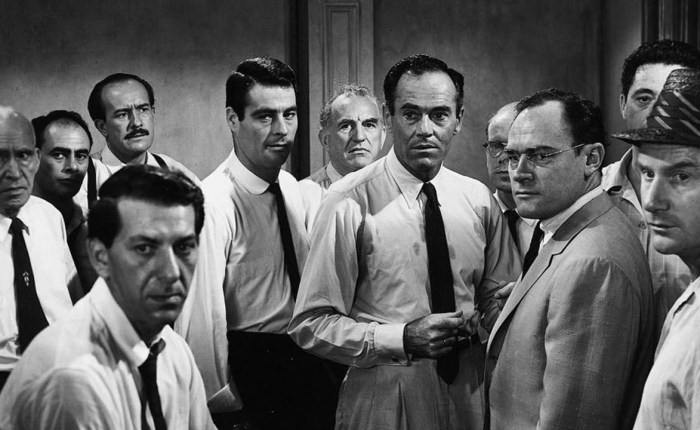
I’ve known about this film for many years, but this was my first time to watch the enduring classic that keeps resurfacing into contemporary culture from time to time—a testament to the ageless nature of what it explores and displays in regards to human nature. And despite my opening reflections on the number twelve, this movie has little to do with the number of “angry men” in the picture, and more specifically about what these men are doing, and what is making them angry. If I could boil it down to the simplest of terms—they’re trying to make a decision. They’re trying to decide if the 18-year-old kid on trial really did stab his father to death. If he did, he will most certainly be given the death penalty. And for an added layer of tension, the kid in question is from an un-specified (non-white) ethnicity, and he hails from a likewise un-named slum in New York City. In 1957 America, this kid is the lowest of the low.
A preliminary vote by the jury members results in 11 guilty votes and only one for not-guilty. And herein lies the drama. It takes a unanimous 12 votes to convict or acquit, so this one guy (played masterfully by Henry Fonda) is the only thing keeping the other 11 guys from quickly escaping the confines of the sweltering back room in the courthouse—and speedily condemning a young man to the execution that would follow. On this basis alone, Henry Fonda appeals to the rest of them saying, “It’s not easy to raise my hand, and send a boy off to die without talking about it first.”
And so they talk. If you want to find out where they end up after the lengthy, heated, discussion that follows—go watch the film.
There are several different themes orbiting around the central discussion taking place in 12 Angry Men, including leadership, conformity, group dynamics, racism, class inequality, and personal prejudice. Each of these themes is personified by at least one or two of the jurors, but my favorite of these themes is the leadership exemplified in Fonda’s Juror Number 8, as he stands alone against the rest of the group, humbly beseeching them to carefully consider the gravity of their decision, and exhorting them to engage in honest dialogue with each other. Throughout the course of the film he takes the most punishment from the rest of the group, and still remains steadfast in his conviction despite their incessant criticism.
And it’s this theme of leadership that has continued to resonate in my thoughts over the last few weeks, as I’ve pondered the real meaning of a movie like this—not only what it meant when it was made some 62 years ago, but what it means today.
What is real leadership? Does this movie show us an example of what real leadership looks like?
Yes, I believe it does.
First off, real leadership seeks to reconcile opposing groups of people (if possible), rather than push them further apart. Henry Fonda, though standing alone against the rest of the group, never says or does anything to intentionally insult them. His goal is reconciliation between their decision and his, and he knows that this cannot be accomplished by alienating them. There are moments when he speaks sternly to them, and moments when he risks pushing them too far, but he does this only to keep them focused on the problem at hand. Bad leaders don’t know how to reconcile opposing groups or opinions. Bad leaders only know how to create more dissonance, confusion, and fracturing among people. The problem that these men in the movie are attempting to solve will not go away unless they can come together in some kind of agreement, one way or the other. Keeping them at the table, keeping them talking, encouraging them to dig down and really think together—this is the main task that Fonda’s character engages in from the beginning—and it makes him a good leader.
Second, real leadership is humble and kind. Fonda’s character never assumes a position of dominance over the other men. He doesn’t try to be the leader. But we the audience (like the other characters in the movie) recognize him as the leader by what he does, and how he does it. He meets arrogance with kindness, he counters emotional outbursts with the calm delineation of salient details, and he arrests pre-judgment with simple rationalism. His goal is not to make the other men agree with him, or force them into a decision they’re not comfortable with—his goal is to examine the issue as thoroughly as possible, and come to the best possible conclusion—together.
Third, and I’ll close with this point—real leadership doesn’t lie. The entire purpose of Fonda’s character engaging in an opposing dialogue with the rest of the men in the group is to find the truth. Moreover, he admits to them near the beginning of their discussion that he simply “doesn’t know” whether the kid is guilty or not, and that this is why they need to talk about it further—so they can be sure of what the truth actually is. We can see the doubt in his eyes at times, and we can see that he isn’t completely confident about his position, but he never tries to hide this from the other men. He doesn’t create a false persona of exuberance, or phony confidence to convince them that he’s right and they’re wrong. Bad leaders don’t care about this. Bad leaders just want to please the majority so they can go on being the boss.
As I said earlier, there are many other themes floating through the narrative of 12 Angry Men, not the least of which is how easy it is to make conclusions about anything without actually thinking. It’s much easier, for all of us, to formulate conclusions based on our emotions, or based on our past experiences, or to simply go along with whatever the closest crowd to us is doing… it’s much more difficult, on the other hand, to apply focused reasoning and critical thinking to our collective issues and problems. It takes time, it takes energy, and it takes a willingness to be ok with the fact that we could, possibly, be wrong. And it’s always difficult to do this with people who think differently, and who easily draw conclusions that are completely opposite to our own. But that’s how problems actually get solved.
We might all be able to learn a thing or two from this old movie.
 The Basmati House Review