The Curry House

FeaturedThe Curry House

I originally published the first part of this 16 years ago, as the events described therein were still in the process of unfolding.

Sometimes, things happen in life that you just cannot forget, no matter how much time passes.

The Curry House is one of these things.

___________________________________

For those who are interested, the story of how the Curry House happened is a tale of epic proportions that stretches across the globe and crosses the borders of three states.

For practical purposes, it all began in the Autumn of 2002 when Adam Coffman from Indiana, and Jeffery Gujjarlamudi from India crossed paths on the campus of Kentucky Christian University in the small town of Grayson in the Appalachian foothills. It was at this school that they slowly forged a friendship by sharing with each other the mutual struggles and experiences they each had endured as servants of Jesus Christ. Though they came from two vastly different worlds, they recognized in each other, the similarities that Christ had authored into their lives.

In those early days, the campus life at Kentucky Christian University was fraught with hidden perils and discouraging pitfalls of all kinds. Thus it was, that in a small corner of the guys’ dorm, Waters Hall, Jeffery and Adam began to fortify a place of refuge among the chaos and ruin that plagued the college grounds.

In the midst of their unexpected ministry opportunities, (while paying thousands of bucks to get their degrees) the two friends often found sustenance in that staple of college-life foods known to many as Ramen noodles.

However, the pre-packaged spice packets that accompanied these sodium laden rations were ultimately unsatisfactory to Jeffery’s attuned Indian taste buds. And in a moment of divine significance, Jeffery remembered that his mother had imparted to him upon the day of departure from his homeland a small package of Indian Spices known as “Curry spices” and “Garam Masala.”

Thus it came to pass, that sometime in the early spring of 2003 Adam and Jeffery received what can only be termed as a flash of divine insight, as they were inspired to combine Ramen noodles with Garam Masala and Chili Powder – along with some clarified butter known as ghee.

And so, as the East met the West in that tiny pot of noodles, the gloom of their environment subsided briefly as the divine wind of change and revival blew in from the heavens.

Thus it was, that an entire year went by which held many trials and adventures for the unlikely friends who labored under the darkening sky of a land lost in its own shadows.

Tales of those times have been told elsewhere, but what is important to tell here, is that Jeff eventually imparted the ancient wisdom of curry-making to Adam, as it had been handed down from his parents Sam and Esther.

Eventually, now in another room of the same dorm, Jeffery brought forth a gift that had been carried to him by his parents upon a recent visit from India. This gift was a jar of Mutton Pickle, which is essentially a combination of fried pieces of lamb and tomato sauce preserved in an extremely potent mixture of heavily concentrated Indian spices. Just one small spoonful of Indian Pickle is enough to flavor an entire bowl of rice, which at this point had replaced noodles as the preferred form of carbohydrate. Jeffery would later share other jars of assorted kinds of Pickle (such as Tomato, Lime, Spinach, and Mango) that his mother had prepared for the growing number of people who began showing up to share in the food and fellowship that God had provided.

In the Spring of 2004, Jeffery and Adam met Kiel Nation, a young lad from the region of Lexington, Kentucky. During the next several months, and on into the following autumn, Kiel became the third member of the Curry House Posse which was at that time still in its infancy.

It was at this time that Adam journeyed forth into the wilderness, as God had ordained that his time in the foothills of Kentucky was at an end. And so he set out for his homeland in Indiana, leaving Jeffery and Kiel to carry on the work that God had begun on the campus.

It was at this time as well, that the Lord brought into their midst one Keith Doyle, a humble brother from Cuyahoga Falls, Ohio. Keith moved into Jeffery’s room and the three brothers still left on the campus began to propel the sharing of food and fellowship to another level.

As the brothers, Kiel, Keith, and Jeffery began to meet and host more and more guys in the Waters Hall dorm; eventually the need arose to produce entire dishes of Indian cuisine.

And so, in direct insubordination of school policy, and working in secret, like the Roman Christians hiding in the catacombs of the Second Century — (because there were, in those days, a couple of immature, jerks in charge of the dorm) the three brothers would cook dishes of Vegetable Curry, Chicken Curry, Beef Curry, or variations of these and other ingredients each night throughout the week for whomever wished to come.

As a side note, Curry is a general term used to denote that ingredients have been cooked in a sauce of Indian spices. Common blends of Indian spices generically labeled as ‘Curry’ might contain coriander, cumin, chili powder, fennel seeds, cardamom seeds or powder, mustard seeds, turmeric, or several other variations of spices such as fenugreek, paprika, cloves, and cinnamon. Along with these spice combinations, onion, garlic, and cilantro are essential ingredients in almost every dish given the name Curry.

And for the next two years, the brothers continued the ritual of serving food in their rooms to those who came in search of food and fellowship. There were no regulations, no rules, and no expectations of any kind… only a desire to serve the Lord by serving others, and giving freely to others as Christ had freely given to them.
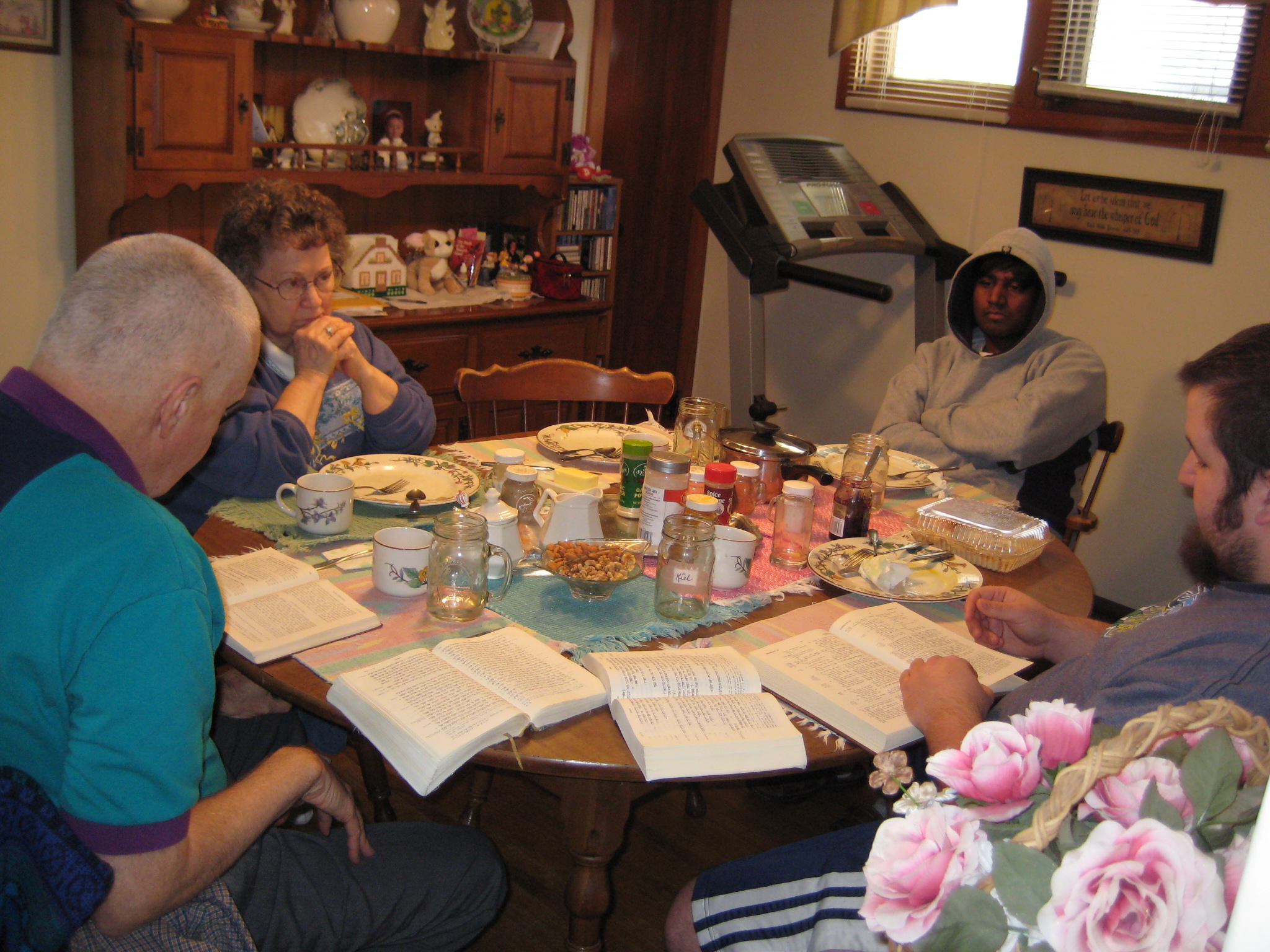
Engaged in many struggles these three brothers fought their way through a gauntlet of malicious principalities aligned against them. Yet through God’s provision they eventually graduated, and upon their departure from Kentucky Christian University, Keith went to live in Lexington, Kentucky, and Jeff and Kiel, now rejoined by Adam began attending Winebrenner Theological Seminary in Findlay, Ohio.

Throughout the fall of 2007, and the winter and spring of 2008, Jeff, Kiel, and Adam would voyage to the home of Gary and Janet Staats in Findlay a couple of nights a week where they would make Curry and attend the seminary. Because Dr. Staats and his wife are extremely hospitable people, they began opening up their house each Tuesday night for those at the seminary to come and enjoy the fellowship meal as well.

Alas, by the summer of 2008, the Lord had called these four brothers out of their homes in Kentucky, Indiana, and Ohio, and directed them to reside in a house which he had provided for them on the main street of Findlay. And so it is, that these four brothers, doing only what their Lord had trained them to do over the years, continued to cook food and invite whoever happened along to join them in camaraderie.

____________________________________

Well, like I said, that was 16 years ago.

These past few weeks, I’ve been editing a series of videos that I captured, haphazardly, during that time – and which have just been sitting in my computer all these years.

The Curry House, which evolved into the first church I pastored – Night Church – still remains, to this day, a phenomenon of Christian community which I have often looked back to, as a reference point, and at the same time, a cause for lamentation at the fact that I have no idea how to re-create it.

It was special, powerful, beautiful, and unique.

It was something that the Lord did, and those of us who experienced it, were simply along for the ride.

Here’s the video I edited of it, which is my primary motivation for making this post. 👇

The Cost of Being a Disciple of Jesus

FeaturedThe Cost of Being a Disciple of Jesus

DISCLAIMER: I originally wrote this sermon four years ago, in August of 2020. If you want to listen to it, I’ll embed the audio version at the bottom of this post.

But I’m trying to publish more regularly on this blog because that’s what you’re apparently supposed to do…

So, I pulled this one out of the archives, because it’s a real humdinger. And you should read it. Seriously, it’s a good one, if I do say so myself.

____________________________________

This morning, we’ll be reading through a passage from Luke 14:25-33.

But before we take a look at this passage in Luke, I want to tell you a story that’s a little bit closer to us in history. This isn’t something that happened 2,000 years ago, but much more recently.

It begins about a hundred years ago, in a city called Breslau. Breslau is in the southwest of Poland today, but a hundred years ago, and up until the end of World War II, it was still a part of Germany. And that’s where this story begins – in Breslau, Germany, a hundred years ago, in 1920, when a young man by the name of Dietrich gave his life to Christ, and decided that he wanted to study the Bible and become a teacher of God’s word.

Dietrich was a very intelligent young man, very devoted to his studies; by 1927 (when he was only 21 years old) he had graduated from the University of Berlin with a doctorate in Theology. Still young, and not quite sure where his place was in the world, he decided to come here to the U.S., and ended up as a professor at Union Theological Seminary in New York City. He was only in the U.S. for one year, but while he was here, he was lovingly accepted into a Baptist church in Harlem, where he taught Sunday School classes, and where he began to encounter the societal injustices being experienced by Christian minorities – in particular, black Christians that he had become friends with. As a white man, but still an outsider, a foreigner from Germany, he had slipped in between these two segregated worlds of American Christians – black and white, rich and poor, educated and uneducated. Dietrich knew his Bible really well. In the Gospels, he read, as we have been reading, about the reality of God’s Kingdom in the here and now. And he wrestled with the contrast between what he was reading about the Church in the New Testament, and what he was seeing the Church do (and not do) in New York and other places.

How could the Church in the New Testament be so united in purpose, and the Church of modern day be so fractured and divided?

Why was the wealthy Church so pre-occupied with its own position on the highest levels of secular society, and so blind to the suffering of the poor Church just a few blocks North?

How does that happen among God’s people? How does one group of Christians become obsessed with finding a seat at the table of high society, while another group focuses on pulling people out of the gutters and giving them food, and clothing, and housing?

Why do the Christians with the most resources at their disposal, hoard their wealth, while those with just enough to get by give away everything they have? Why can’t they work together? Why can’t they find balance in the community of God’s Kingdom – the community of people saved by grace – the community that Jesus gave his life to bring into existence?

What was the answer to these questions?

What could be done about it?

Dietrich wasn’t entirely sure, but he didn’t ignore these tough questions; he wrestled with them. And this unique perspective that he had, as an outsider and foreigner, influenced him a great deal. And he took that perspective with him, when he returned to his homeland in 1931.

When he returned to Germany, he began teaching theology at the University in Berlin where he had received his doctorate four years earlier, and not long after that, he was ordained as a pastor in the Lutheran Church.

And, it was less than two years later, on January 30, 1933, that the Nazis took control of his country.

As we all know now, with our 20/20 historical hindsight, Adolph Hitler’s rise to power would eventually culminate in the horrendous disaster that we call World War II, where millions of people would perish, and where terrible things had to be done in order to stop a man that was closer to an example of the Anti-Christ than almost anyone else in history.

Have there been others like Hitler?

Yes.

Joseph Stalin probably executed more people, for instance. But Hitler did three things that really single him out:

1. He lied to the Christians in Germany that were susceptible to deception.

2. He silenced, imprisoned, and killed the Christians who were not so easily deceived.

3. He waged genocide against the Jewish people.

If Hitler had succeeded in taking over the WHOLE WORLD, he would have been THE Anti-Christ.

As it turned out, he was only one of the many little antichrists like those the Apostle John warned us about in his first epistle (1st John 2:18).

Like I said, we all know this now. It’s more or less common knowledge. But to many of the Christians throughout Germany at the time Hitler took power it wasn’t as clear. Even though it SHOULD HAVE BEEN.

Hitler’s rise to power was hailed as an act of God by the majority of church leaders in Germany at the time. They threw their support behind him completely – telling their congregations that Hitler had been sent by God to lift them out of economic depression, and restore their honor on the world stage. Some went so far as to say that Hitler spoke on God’s behalf, and that the fulfillment of God’s Kingdom was embodied in the person of Adolph Hitler. Churches that had been firmly established and rooted in place for centuries, wasted no time in allowing Hitler to steam roll his way through them. In fact, they stepped aside as he removed Pastors, Bishops, and Elders who were not “pure-bloods” of Aryan descent. They remained silent when he demanded that he, the Fuhrer be recognized as head of the Church (rather than Jesus Christ), and they supported efforts made to remove the Old Testament from the Bible – because of its pro-Jewish agenda. These were not things that happened overnight. They were ideas that Hitler had been preaching for months BEFORE he was in power. There was plenty of opportunity for the churches in Germany to at least try to prevent his ascension to power – by speaking out against him. But those with the most influence in their society, remained silent. Or they openly supported him.

But not everyone.

There were small groupings of Christians in Germany, in the middle of all that madness, who refused to bow down and worship that man.

And the hero of this particular story – Dietrich – was among them.

Just a couple of days after Hitler became Chancellor, Dietrich was able to get onto a radio station in Berlin and sound the alarm.

Before they cut him off mid-sermon, he denounced Hitler and everything he stood for – and he rebuked every Christian who followed him for their idolatry to the “cult of the fuhrer.”

In the months and years that followed, he began organizing the minority groups of Christians who didn’t follow Hitler, by helping to create a network of churches dedicated to voicing opposition to him, as well as to rendering aid to their Jewish neighbors who were already under attack. He was putting into practice what he had learned when he was in New York – that he couldn’t just talk about the Gospel – he had to live in its reality. He couldn’t just stand around and do nothing while so much evil was taking place around him. He had to actually do something about it.

So, he did.

Between 1933 and 1939, he helped organize and lead an underground seminary where he taught his students that the cost of being a modern disciple of Jesus was complete loyalty to the King and His Kingdom, above all else. –Even if it meant losing your friends, losing your family, or losing your country.

And for this, Dietrich was branded an enemy of the state, his coalition of churches and his seminary were deemed illegal by Heinrich Himmler, and Dietrich himself was exiled from the city of Berlin.

Dietrich’s friends in New York City urged him to flee the country, and he did in the Summer of 1939. But he did not stay in the United States for very long. In a letter to one of his former professors at Union Seminary, this is what he wrote, shortly before returning to Germany:

“I have come to the conclusion that I made a mistake in coming to America. I must live through this difficult period in our national history with the people of Germany. I will have no right to participate in the reconstruction of Christian life in Germany after the war if I do not share the trials of this time with my people … Christians in Germany will have to face the terrible alternative of either willing the defeat of their nation in order that Christian civilization may survive or willing the victory of their nation and thereby destroying civilization. I know which of these alternatives I must choose but I cannot make that choice from security.”

It wasn’t long after his return home, that because of close trusted contacts within the German military, he first became aware of concentration camps where Jews were being systematically exterminated. And that put Dietrich in the position of finally having to choose, definitively, which of his two kingdoms he would betray.

Would he become a traitor to Germany? Or would he become a traitor to God’s Kingdom, by looking the other way as his neighbors were being murdered? He chose God’s Kingdom over the kingdom he had been born into.

When asked by a Dutch colleague of his at the time, “what he was praying for these days?” Dietrich told him, “If you want to know the truth, I pray for the defeat of my nation.”

And that’s when Dietrich became a spy.

He began working within the Abwehr – the German Military Intelligence network –which was not yet under the control of the SS. There were many German officers in the Abwehr, already functioning as allied spies against Hitler. They recruited Dietrich with the understanding that he would use his contacts in Europe and the United States to smuggle intelligence to the Allies, and to help Jews escape from Germany. And that’s what he did for the next few years…

Before he was eventually caught and arrested in the Spring of 1943.

Dietrich spent two years in prison for treason, during which time he was the pastor for his fellow prisoners, and even some of his prison guards.

On April 4, 1945 Hitler personally ordered Dietrich’s execution, and he was hung that same week at Flossenburg Concentration Camp.

Two weeks later, the U.S. 90th and 97th Infantry Divisions liberated that camp.

A week after that, the Soviets took Berlin.

Hitler committed suicide at the end of the month, and Germany surrendered on May 7th.

Dietrich’s prayers for the defeat of his nation came to pass. But he himself, had already gone home to his real country.

The doctor who saw Dietrich’s hanging described his final moments like this:

“I saw [the] Pastor … kneeling on the floor praying fervently to God. I was most deeply moved by the way this lovable man prayed, so devout and so certain that God heard his prayer. At the place of execution, he again said a short prayer and then climbed the few steps to the gallows, brave and composed. His death ensued after a few seconds. In the almost fifty years that I worked as a doctor, I have hardly ever seen a man die so entirely submissive to the will of God.”

And that brings, the story of Dietrich Bonhoeffer to a close.

Now… why am I telling you all of this? Why is this story an important one?

Well, let’s finally get to Luke 14:25-33, and you’ll see why…

“Large crowds were traveling with Jesus, and turning to them he said: 26 “If anyone comes to me and does not hate father and mother, wife and children, brothers and sisters—yes, even their own life—such a person cannot be my disciple. 27 And whoever does not carry their cross and follow me cannot be my disciple.

28 “Suppose one of you wants to build a tower. Won’t you first sit down and estimate the cost to see if you have enough money to complete it? 29 For if you lay the foundation and are not able to finish it, everyone who sees it will ridicule you, 30 saying, ‘This person began to build and wasn’t able to finish.’

31 “Or suppose a king is about to go to war against another king. Won’t he first sit down and consider whether he is able with ten thousand men to oppose the one coming against him with twenty thousand? 32 If he is not able, he will send a delegation while the other is still a long way off and will ask for terms of peace. 33 In the same way, those of you who do not give up everything you have cannot be my disciples.”

Now, those are some harsh sounding words, are they not?

There’s a huge crowd following Jesus, and instead of reveling in all of his many followers, it’s almost as if he’s trying to get rid of them. He tells them they can’t follow him unless they hate everyone else… that they even have to hate their own life! Now, he doesn’t mean this literally – that they have to hate. After all, this is Jesus – he teaches us to love everyone, even our enemies.

So, he’s not literally telling us we have to hate ourselves and our families. He’s saying that His Kingdom always comes first. The Kingdom always takes precedence. He’s saying that our love for Him has to be total. Our loyalty to Him has to be complete. He’s saying, if you really want to follow me, you might have to say goodbye to the people you care about. He’s saying: If you say ‘yes’ to me, you might have to say ‘no’ to the people you love.

Jesus is using this allegorical language about building towers and going to war, which might all sound a little strange to us. But he’s pointing out the natural human tendency to look ahead. If we’re being wise, then we think before we make a major decision about something; we think about what that decision is going to mean, and whether or not it’s going to be good or bad, and we think about what we’re going to have to give up, or let go of.

We have to estimate what it’s all going to cost.

How much money to build that building?

How many troops to win that war?

Well, we don’t have to estimate what it costs to follow Jesus; he tells us EXACTLY what it costs – it costs EVERYTHING.

Dietrich knew that. He knew it really well. He knew that we can’t just hide in the comforting glow of God’s grace – that to do so, cheapens the sacrifice that Jesus made. We have to go into the darkness with the light that we have.

We have to do something.

And whatever that is – it might cost us everything.

It MIGHT cost us family; It MIGHT cost us friends; It MIGHT cost us our country.

And if so, that’s ok.

That’s what it means to pick up YOUR CROSS and FOLLOW HIM.

In John 15:18-19, Jesus said quite clearly: “If the world hates you, keep in mind that it hated me first. 19 If you belonged to the world, it would love you as its own. As it is, you do not belong to the world, but I have chosen you out of the world…”

Let’s remember these words of Jesus in the coming months.

Let’s hold tightly to them, as the rhetoric in the world around us becomes louder, and the nonsense becomes overwhelming. Our job is still the same: To love our neighbors, to love our enemies, and to love God the most.

The kingdom we’re living in is temporary; it is crumbling. But the Kingdom we belong to is eternal, and it will never fall.

There won’t be any Democrats or Republicans in Heaven, my friends.

“Then the sovereignty, power and greatness of all the kingdoms under heaven will be handed over to the holy people of the Most High. His kingdom will be an everlasting kingdom, and all rulers will worship and obey him.” – Daniel 7:27

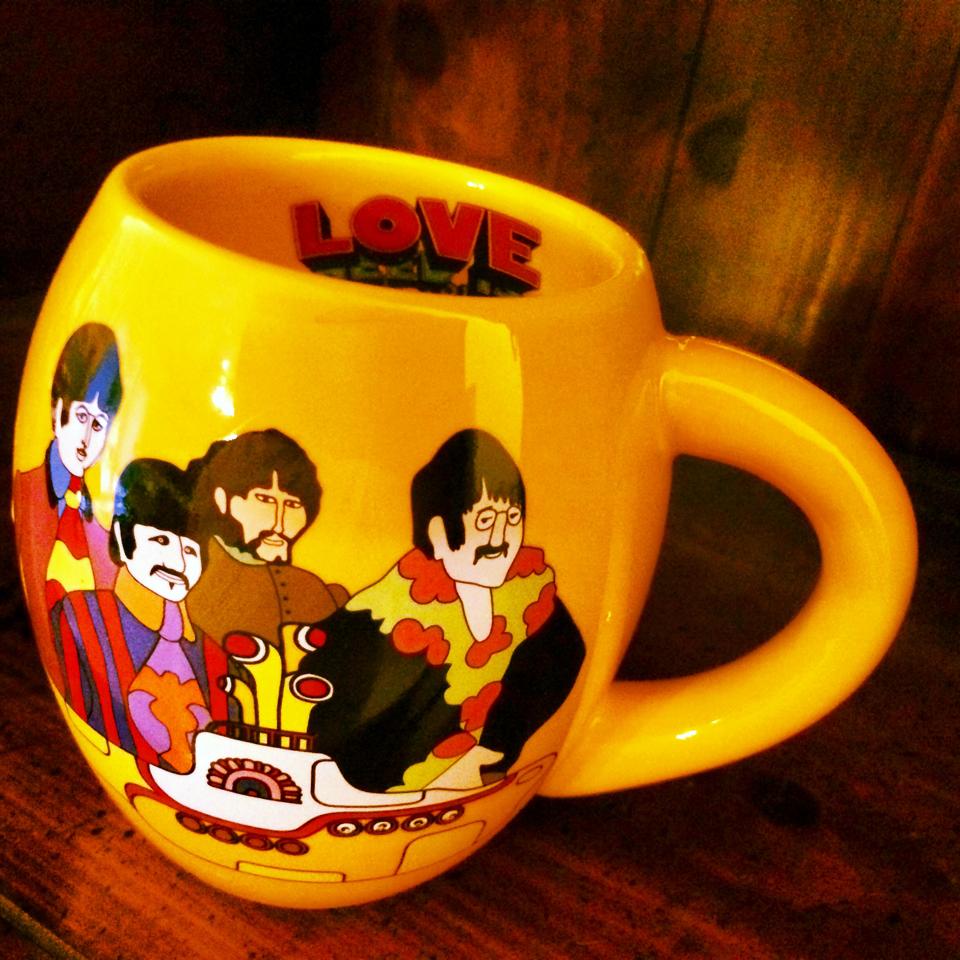
BEATLES Mug

Mug - 16My dad really likes this mug. I’ll admit, The Beatles have never been my favorite band, but I do enjoy their timelessly catchy tunes as much as the next average joe. Of course enough has already been said about them and the deep imprint they have left in the history of modern music and culture–I couldn’t possibly say anything new about all that. But for me personally, when I hear The Beatles (or drink coffee out of their yellow submarine), it brings back memories of all the music my dad and mom listened to… Especially the music they listened to when I was a kid, and the stations they would tune into during long trips in our family’s old Astro mini-van. I remember hearing as much Elvis and Creedence Clearwater Revival as I did The Beatles. Sometimes my mom would bring her cassette tapes and Amy Grant would all the sudden find herself doing an encore for The Beach Boys. I was too young to understand or care about the differences. My parents’ music all blended together. One moment we’d be listening to John Denver sing “Rocky Mountain High” and the next we would be hearing tunes from the traveling Gospel quartet who had been visiting our church a week earlier, peddling their cassette tapes along the way. My parents religiously (pun intended) bought the tapes of every person and group that came through our church–I’m not kidding. A few years ago I found a box that had close to a hundred cassettes in it–all from people who had visited our church over the years to share their music.

The point is… My parents didn’t play music, and they didn’t sing either, but they loved to listen and they loved to collect it. And they taught me to explore the art form on my own, and to discover for myself what I liked and what I didn’t. I think I was in 5th or 6th grade when I started really getting into music enough to want to own the stuff I liked. My parents would buy me blank cassettes, and then I would record stuff right off the radio. I remember hearing the DJ on 99.5 WZPL announce a song that was about to come on, and I would dash across the room so I could hit Play & Record on the tape deck. And my older cousins had tapes that they would let me copy. My cousin Toby introduced me to Bon Jovi’s “Slippery When Wet” — changed my life. That was back when Jon Bon Jovi was an actual rockstar, before someone kidnapped him and removed all the testosterone from his body.

My early musical tastes were widely diverse. By the time I was in high school I was practically in love with Amy Grant, because I had been hearing her sing since I was in kindergarten. But that didn’t stop me from listening to Soundgarden or Metallica, and REO Speedwagon when no one else was around. I remember one time I was in an IRC music store with my dad, and he was letting me pick out an album for my birthday–I chose “Appetite for Destruction” by the infamous Guns N’ Roses. He just shook his head and said, “OK, but don’t show mom.”

Like I said, my parents really let me figure the whole music thing out on my own. When I was young, I heard what they liked, and as I grew older, they gave me the freedom and independence to decide what kinds of music I liked. Just because they didn’t like something, or because some dumb televangelist like Jimmy Swaggart said it was evil, didn’t mean they would stop me from listening to it. And I’m so grateful for that now. They never bought into all the crap about “christian” music versus “secular” music, and how non-Christian music was all from the devil. My youth pastor and his wife were the opposite of my parents when it came to music. They were good people, and I learned some good things from them, but their views on music were not among the lessons I chose to retain. I always thought it was kind of funny that they cared so much about it. I mean, at the outset of every trip we took, they would assign a student to go around checking everyone’s music to make sure no one had anything non-Christian with them. It was fascist and imperial. And we all know the proper response to something imperial–(thank you, Star Wars.) So I made it my mission to sneak as much non-Christian music as I could on board the church bus. And I was successful at it too. I was a supplier for the handful of other “rebels” as well.  How did I accomplish this? How was I so great at smuggling contraband past the music police? Simple. My parents would let me use the outer cases of their Christian music CDs and cassettes to camouflage my music on the inside. When they came around to check my music, they would just see Michael W. Smith, Carmen, and of course Amy Grant… Never knowing that inside was Nirvana, Pearl Jam, and The Doors. Well, ok… Some of the Amy Grant cases actually had the Amy Grant cassettes in them.

Of course when I journeyed off to Christian college, things were on a whole new level. There was no actual rule against having non-Christian music, just a heavy fog of rampant judgmentalism toward those who did. I discovered this firsthand when the worship leader who lived next to me in the dorm almost had a stroke after seeing the Led Zeppelin poster on the outside of my door. I discovered it even more when during my second semester, my room was broken into and all the band posters (including a 6 foot Sgt. Pepper’s display) were all ripped from the walls and replaced with notes warning my roommate and I about our impending journey on the highway to Hell. But we had fun with that sort of thing. A few of my friends got together one night and did a live cover of Jimi Hendrix’s Purple Haze for the entire campus. That didn’t go over too well. But anyway… “we all want to change the world.”

And it’s great, what kind of memories a coffee mug can conjure up.

Originally posted on Instagram @ajcoffman and Facebook on December 4, 2014

TMNT Mug

Mug - 12Teenage Mutant Ninja Turtles. There was a time, nearly thirty years ago when those words sounded like utter nonsense. The first time I heard someone say them, I definitely thought so, and I was only in the fifth grade–inhabiting a world where words like Ghostbusters and He-Man were almost sacred terms. And yet, here I am, all these years later, sipping from a coffee mug that has (at least one incarnation) of the TMNT plastered upon it. There have been many versions of the Turtles since their creation by comic bookers Kevin Eastman and Peter Laird back in good ‘ol 1984. That comic, which was more adult and darker in tone, was eventually translated into a kids cartoon that ran for 10 seasons, and into a mixed bag of 5 feature films–the first in 1990, and the most recent this past summer. That’s quite a bit of longevity in a society that is constantly churning up new ideas to market, devour, and spit back onto the ash heap of pop culture relics. But the Turtles keep getting recycled, and keep capturing the imaginations of kids… And grown ups. There’s no shortage of super heroes these days, but I think, when boiled down to the core, TMNT is just re-telling a much older story, a story that finds fans across all ages and cultures–the story of ‘the team.’ And the team that isn’t perfect, but striving to be, that argues with each other, but would still die for one another, that takes the cold corners of a sewer dungeon and makes it a home, and that ultimately look to one master for acceptance and guidance. That is the story of the team that is Leonardo, Michaelangelo, Donatello, and Raphael. –I’m still talking about them, in case you forgot for a few seconds. But that’s part of what makes them awesome. As ridiculous as they may sound to some, they represent what it means to be a team–a team that loves each other. And that’s something we all yearn to be a part of, or can be thankful that we already are.
Originally posted on Instagram @ajcoffman on October 14, 2014

Mom’s Mug

Mug - 15This mug has been in my parent’s house a long time. It was my mom’s mug of choice. I remember many Saturday mornings, waking up to cinnamon rolls, and mom asking me if I would make her some coffee, always in this mug. It’s a Longaberger cup, more popular for their handwoven baskets–which my mother collected for the last 25 years of her life, slowly filling the house with baskets of all shapes and sizes. I can’t believe she’s been gone for over a year now. Watching her die was the most difficult thing I’ve ever experienced… Even knowing it was going to happen wasn’t enough to soften the impact of it.

Mom left us with a lot of stuff to sort through and box away and give away, but those are just physical things, evidence of her presence in a house that was made into a home by the kind of woman she was, and the character she had. Her kindness and her love were evident to anyone who knew her, or even heard her great laugh–a laugh that can still be heard from my Aunt Charlene–mom’s sister.

I have nothing but a brain full of great memories, and a heart full of the love she passed on to me. But when I try to pinpoint one specifically, I think back to about 15 years ago… I was in college at the time, going through a really rough patch. I had already dropped out once and then returned, but I wasn’t sure what I was supposed to do with my life, and the pressure was mounting for me to choose a path. Some people think Bible college is a safe haven of theological reflection and spiritual enlightenment. I suppose it can be that for some… But for me it was a crucible that tore me apart from the inside out and left me with more confusion and questions than clarity and answers. In the midst of one evening, feeling like I wanted to leave and drop out for a second time, I did what any boy would do in my situation… I called the one woman in the whole world who might have the answer–I called mom. And after listening to me whine and sob about the darkness and uncertainty of the world, she told me something that she never had before.

She told me that I did not belong to her. She said that when I was born, God spoke to her, and he said very simply, “this one belongs to me.” And she finished by saying that she couldn’t tell me who I was supposed to be or what I was supposed to do, because I didn’t belong to her. She just told me to ask God. And my mother did many things for me throughout my life, but telling me that was the greatest gift she ever imparted to me.

Because asking God is everything.

Originally shared on Facebook on May 8, 2014

Spider-Man Mug

Mug - 14While on a family vacation one winter (I think it was 1989) to Arizona, we had stopped at this little gas station somewhere in New Mexico. By that time we had been on the road for a couple of days, Mom, Dad, my sister Emilie and I all crammed into the Astro mini van. I had exhausted all forms of entertainment available, including the new Nintendo Gameboy I had received for an early Christmas present. Moping around that gas station/convenience store, I came across a small rack of comic books, new ones by the look of them. Dad must have noticed, because I heard him yell over to me to go ahead and pick out some to read–that it would keep me occupied. There were several to choose from, but I went instinctually for the Peter Parker: Spider-Man #6 (a Todd McFarlane reboot of the time), as well as a Batman title that was in the 300s I think… (Tim Burton’s movie had just come out that previous summer, and the Dark Knight was in the midst of a renaissance.) I had never read an actual comic book before. It was awesome. It instantly caught hold of my imagination and launched an endless desire to read more. Spider-Man was different in those comics… He wasn’t as cartoonish or as silly. The artwork was the most detailed I had ever seen, and the stories were dark–Spider-Man actually had blood on him. I’m not sure what it was that pulled me into those stories, but Peter Parker, it seemed, had been there my whole life, at least in some form, not too far away–almost like an older brother–he was, of course, always around on Saturday morning with his amazing friends, and I even had a pair of Underoos pajamas that mimicked the red and blue costume. Later on, as a teenager I saw him as a nerd, off in the corner, interested in science, not very good at sports–and boy could I find some identification in a super hero like that.

Nowadays, all these years later, we’re seeing these incarnations of the heroes that have been around for decades, being reworked and refitted for a new generation. And as I get older, I appreciate this, and I realize that fictional heroes have to change, and they have to be retold and molded to fit the times and the cultures that bring them to life. But I also realize, conversely, that the real heroes–the non fictional ones that are sometimes easier to forget–they do not change. The real heroes are always the same… Yesterday, today, and forever.

Originally shared on Facebook on May 7, 2014

Giant Mug

Mug - 11This mug is really fun, and really huge! I keep this one in my office/classroom at the church and it is usually stocked with mini Reese’s Cups for the kids. To provide some scale for this pic I put my Ninja Turtle action figure inside it–that’s good ‘ol Leonardo peeking out over the rim there.

This colossus was another gift–as you might have discovered by now, I really like coffee mugs, so people who get to know me often figure out that they make great gifts for me. This was given to me by some good friends from Taiwan who, if memory serves, found it for me while they were visiting Disney World. I met several Taiwanese friends while I was living in Findlay, many of whom were graduate students at the University of Findlay. I met a lot of students there while sailing on the U.S.S. Curry House, and while serving through the church we planted in our house–called Night Church. But looking back now, some of our closest relationships were with the Taiwanese… a couple of them even lived with us part time, unofficially… And I really miss their sense of humor, their humility, their willingness to just jump in and help us cook or do dishes or clean the house, and also the way they would take to the kitchen and display their mastery over authentic cuisine with mighty elegance. Our church even had a softball team, of which they made up about half the roster.

So this mug entry is for them… Dennis, Beck, Ya-Lan, Ching-yi, Mo, Tracy, and the others… I miss you all, and your awesomeness will not be forgotten!

Originally posted on Instagram @ajcoffman on April 23, 2014

Dad’s Mug

Mug - 10This small mug has been in the Coffman house for the last 30 years or so. It was a gift to my dad from the rest of us in the family. Being 35 now, and ministering to kids in an urban poor area of Indianapolis, many of whom do not live with or even know their dad, I realize how much of a blessing it is for me to be able to say that, in my life, the words on this mug have rang true. My dad has always been there for me, and has never failed to encourage me at my weakest points, and challenge me at my most stubborn. Of course as a kid I took him for granted, argued with him about almost everything, and probably gave him more than any man’s reasonable share of headaches, ulcers, and gray hairs. 

My dad and I did many things together as I grew up, and while I remember things like collecting basketball cards, taking trips to the comic book shop, him volunteering as a sponsor for some of my grade school class field trips, being a youth sponsor at our church, setting up our household aquariums, the fact that he let me watch and record The Simpsons on VHS tapes when they first came out (most of the other kids at church weren’t allowed to watch it) getting season tickets to the Pacers, and going fishing at the lake across the street… But what I remember most, is that my dad just spent time with me.

Now I’m not a dad myself, and I’m sure there are plenty of things I’m terribly clueless about, but I think my dad did it right, and I’m glad that he is, and always will be, my best friend.

I love you, pop!

Originally posted on Instagram @ajcoffman on April 22, 2014

Star Wars Mug

Mug - 09A long time ago, in a galaxy… Well actually it is this beautiful morning, just outside my house… with EARL GREY, hot. See what I did there? Anyway…

I was still about a year and a half from entering this world when the original Star Wars movie was released into theaters in May of 1977. When the sequel, “The Empire Strikes Back,” came out a few years later, its success and longevity in the theaters ensured it was among the first movies I have vague memories of seeing. The impact that Star Wars had on me, and millions of other kids since then, cannot be overstated. By the time I was 10, I had the original three films pretty much memorized. Because my mom and dad were both awesome, each Christmas and birthday, and trip to Children’s Palace toy store (anyone out there remember the old palace?) saw my collection of Star Wars toys grow. My imagination would run free with new adventures that I would conjure in my mind, given life through massive toy battles spread across the house. It was especially exciting when it snowed outside, and I could bundle up and go re-enact the battle of Hoth out in the backyard/frozen tundra.

Anyway, I’ve had many similar mugs like this one throughout my life, this being only the most recent, given to me by my long time friend, Seth Sharp. Star Wars still holds up for us now that we’re adults, because the underlying themes of its story resonate even louder now. In simplest terms, it is about the idea that good and evil do exist, and they are constantly at war. It is about the decisions we make, and where those decisions cause us to land on the battlefield of life. It is about how pride in our own abilities and knowledge can send us down the path that will corrupt even the purest heart, and it is conversely, about how those enslaved to the darkest evil are never beyond redemption. And it is about how R2- D2 is one cool gangsta!

Originally posted on Instagram @ajcoffman on April 21, 2014
Throwback to my original Star Wars mug from 1980…

Winebrenner Mug

Winebrenner Mug
Mug - 08As one of the previous Curry House regulars pointed out yesterday, sometimes these mugs have seen a little more than just coffee and tea. Such is definitely the case with this Winebrenner mug, which has seen its fair share of rice and curry.

It’s hard to think about my time in the curry house without also thinking about Winebrenner–together the two occupied nearly all of my time between 2008 and 2010. We were always grateful that the professors and staff at the seminary encouraged us so much, with many of them even finding occasion to come to our house themselves and share in our weekly curry night meal.

I think what is most interesting to me when I think back on curry night, is that none of it was planned. The four of us guys who lived in the first incarnation of the Curry House had already been cooking and sharing Indian food with our neighbors for years prior to us moving to Findlay. It’s just what we liked to do. It was hard to explain that at times, especially when leaders and pastors from some of the other churches in town would come to visit–always looking for the secret of our success; always wanting to figure out how to duplicate what we were doing. We always told them the same thing… The truth was that we really didn’t know what was happening most of the time, or why. I moved to Findlay so I could attend Winebrenner without having to commute four hours there and four hours back every week. I didn’t expect (none of us did) that within a few months of moving, a hundred people would be coming over to our place for dinner. It was not always that convenient, and there were many times when we didn’t think we could keep doing it (it was kind of expensive for four graduate students), but we continued on, putting ourselves into God’s hands and trusting him to provide–and of course he did. In four years we never had to call off the meal.

For those out there wondering how to do ministry… It’s not as complicated as we’ve tried to make it. It might include going to bible college or seminary, but it doesn’t have to. All you have to do is look at what God has already given to you, and then share it with those around you—for free!

Originally posted on Instagram @ajcoffman on April 18, 2014