Dailey Chapel’s Annual Basket Dinner

Dailey Chapel’s Annual Basket Dinner

This past Sunday, I decided to depart from our regularly scheduled program, to deliver a message that suited the occasion – our church’s annual celebration which we call “Basket Dinner.”

One thing that I find interesting about Basket Dinner – and this was true from the very first time I heard someone mention it. Back when I had no clue what it was… Basket Dinner has always been talked about around here, like it’s a universal event; as if it’s something that every Christian on Earth celebrates every year – like Christmas and Easter.

I remember once, asking a younger Caleb Dickey who grew up in my church, about Basket Dinner — just a few weeks after I moved out here… before I had ever been to one, and he was still in High School at the time, but he described Basket Dinner, as if it was a universal, concrete fixture of reality – something that all Christians partake of each year. And I know that he knew it wasn’t this universal Christian holiday, but that’s how he spoke about it. And it made me realize, that this was a deeply rooted part of Dailey Chapel’s history. I’ve realized that more and more with each year that I’ve been here.

Basket Dinner is a special, unique fixture of Dailey Chapel, and it’s very personal and meaningful to us, especially to all those who have celebrated it for decades, or for some – most of their lives, or whole lives. But there is also something about it, that is relatable to all churches.

So… I was thinking, this past week, about how we observe this special Sunday each year to honor those who’ve come before us, and met together in years past under the banner of Dailey Chapel – whether it was in our current building, or the previous one.

And, off course we know, that a building isn’t what makes a group of people into a church – it’s the gathering together, in fellowship, around the Lord’s table, around his word, to break bread and pray. Those are the main ingredients of church. A building isn’t necessary – it’s a blessing, and a luxury, and we enjoy having it – but the church isn’t a building.

If you ever happen to be up here, sometime after dark, by yourself, you’ll realize very quickly how different this building is when the people of the light are not gathered together in it. We’re up in the woods, and it’s a VERY scary place at night!

And at one point, in the past — as Mrs. Joanie Lunsford retells our history each year — the people of Dailey Chapel lost their building in a fire, about 84 years ago. But they didn’t lose each other, and they didn’t lose their faith. And as far as I can tell, they used the opportunity to grow stronger. And the evidence is all around us now. All those people are gone, but their church has outlived them.

It’s a feature of our existence on earth that sometimes, things have to go wrong, or something bad has to happen, in order for God to receive the glory that is due him. Sometimes, things have to go wrong, so that, they can be made right again – proving that our God is one of redemption, renewal, recovery, and restoration.

And this is nothing new. This is an old lesson – one that’s true for all of us. It’s woven into the fabric of reality itself.

And Scripture teaches us this old lesson over and over again. That things sometimes have to go wrong, before they can be made right. That things have to be broken, so that they can be put back together even stronger than they were. King David said in Psalm 30 that “there is weeping throughout the night, but joy comes in the morning.”

One of the beautiful things about the stories in Scripture, is how they capture truths that are common to all people of all times. The stories themselves are rooted in history, among real people, who really lived. But the lessons that the people in the stories learn, transcend the times and places in which they happened. In other words, the lessons that God wants us to learn are the same lessons that He has always wanted His people to learn.

And one of the biggest lessons – is that sometimes things go wrong, so that God’s people can remember their need for him, in all areas of life. And when they do, then the soil of hardship produces the fruit of victory.

That’s what we’re really commemorating each year on Basket Dinner Sunday. And as I said, it’s an old lesson – and it’s told over and over in the pages of Scripture, through the lives of many people.

We could go back to Genesis and read about Abraham for instance. A lot of things went wrong in Abraham’s life. He was constantly ending up in places he shouldn’t have been, and at times, in situations that were dangerous. And God always took care of him. God blessed him abundantly.

But the main thing on his mind was the fact that he wasn’t going to have any children to leave behind after him. So what did God do? He let Abraham and Sarah get so old, that the prospect of having children was completely hopeless from a human perspective. Sarah had presumably already gone through menopause, I think it’s safe to say – she was 90! But God allowed her to get pregnant and give birth to Isaac, through whom, she became the Mother of Nations. Hopelessness was turned into blessing.

Abraham and Sarah’s grandson Jacob, learned the same lesson. He was forced to flee his family, and leave behind his home, and everything he had – his own brother literally wanted to murder him. Everything went wrong in his life. He lost everything, just so God could get his attention.

And once God had his attention, he put Jacob’s life back together piece by piece. He blessed him with wealth and abundance, and many children, and peace with his brother who had wanted to kill him. Jacob’s life had to go completely off the rails, before it could be put on the right track.

Jacob had a son named Joseph. Joseph became the head official of the Egyptian Empire, second only to the Pharaoh. But he got to that position, only after spending years as a prisoner, sold into slavery by his own brothers because they were jealous of him.

From what we read about Joseph, he didn’t really do anything wrong. God wasn’t putting him through difficult circumstances to get his attention like he had done with his father Jacob. God already had Joseph’s attention. And because of that, he was able to use Joseph’s life as a powerful foreshadowing of Jesus. But that meant suffering, before it meant victory.

God let Joseph’s whole life go wrong on the floor of a dungeon, and then, he lifted him up out of the pit, by making him the Prime Minister of Egypt, and using his talents, and ingenuity to save millions of people from starvation, including his own brothers who had sold him into slavery.

It was those same brothers that Joseph spoke to in Genesis 50:20, saying to them, “You intended to harm me, but God intended it for good to accomplish what is now being done, the saving of many lives.” 

300 years after Joseph died, the same thing happened, on a much larger scale. All of the Hebrews were slaves in Egypt. And God used Moses to bring them out of bondage and form them into their own nation.

Then there’s the Judges and the Kings. Their were those like Samson who was strong and powerful, but had to have his strength taken from him, and his eyes burned out, and his body put in chains – all so God could show Samson and his enemies where strength and power truly come from.

I mentioned King David already. We see this pattern play out many times as we read about his life in 1st and 2nd Samuel. His life was constantly falling apart, and going wrong, and each time, he came back stronger.

When he was still a teenager, he became stronger than all the fighting men in his nation. When he was a fugitive, God sheltered him. When he sinned, God forgave him. When he lost a child, God comforted him. Whenever David lost his way, the Lord was there, to pick him up, and set him on the right path again.

It’s David who wrote, in Psalm 30:1-5, “I will exalt you, LORD, for you lifted me out of the depths and did not let my enemies gloat over me. LORD my God, I called to you for help, and you healed me.You, LORD, brought me up from the realm of the dead; you spared me from going down to the pit. Sing the praises of the LORD, you his faithful people; praise his holy name.For his anger lasts only a moment, but his favor lasts a lifetime; weeping may remain for a night, but rejoicing comes in the morning.”

Sometimes things have to go wrong, before they can go right.

Moses led the Israelites into a dead end, so God could make a new path for them through the sea.

Jonah had to be eaten by a fish, so that the people of Nineveh could be saved.

Esther was forced into the harem of King Xerxes, so that she could become the queen and save her people from genocide.

Hezekiah had to be face to face with the entire Assyrian army on his front porch, so that God could give him a front row seat to their complete annihilation by one of his angels.

Jerusalem was destroyed by Nebuchadnezzar, so that Nehemiah could rebuild it for people who learned that the Lord gives, the Lord takes away, and the Lord gives again.

That’s the whole story of Job too. The Lord allowed Satan to take everything the man had – his wealth, his family, even his health. Where most of us would probably complain to God about something like, Job only said: “The Lord gave, and the Lord has taken away; Blessed be the name of the Lord.” And then God gave it all back to him double.

We could go on identifying this same lesson in Bible stories all afternoon.

Peter denied that he knew Jesus, before realizing how much he loved him, and was willing to die for him.

Paul had to be struck blind, BEFORE he could truly see who Jesus was.

Jesus had to die in order to prove that he had authority over death. He had to sacrifice himself, so that all of us could be saved. Things had to go wrong for him, so that everything could go right for us.

It’s not easy for us to learn these kinds of lessons. We can read about them in Scripture, but it’s not until we really go through something difficult that we have the opportunity to understand them. The lessons become real. And we learn. We grow. And then we forget.

They’re easy to forget. And then we have to re-learn the lesson. It’s painful. It’s humbling. It sometimes feels like God is abandoning us.

Believe me, even as a minister, I have days where I get pretty upset with God. And when I do, I go to him with all the classic complaints. Why is this happening God? What are you doing to me? Where are you? Why does it feel like you’re not here?

And then, God reminds me that sometimes things have to go wrong, so that they can be made right again.

Every year, when we have our Basket Dinner… when we eat the fried chicken, and go listen to the music – I have my own commemoration that happens inside my thoughts.

I’ve talked about this several times before, but one of the other things Basket Dinner is about, is repetition. So, I’ll speak about it again, just for a moment.

When I first came to Dailey Chapel – 9 years go – it was not Basket Dinner Sunday. It was a few weeks later, in the last week of August. But I tend to reflect on my arrival here more, during the week of Basket Dinner, because it’s a time of thinking about what our Church is, and where it came from, and how it’s a blessing to all of us that we have this fellowship.

And as Mrs. Carmen Palma can attest – she later remarked that I was the saddest preacher she had ever met. And I certainly was very sad. I was so sad and broken down, that I have only ever told this story in small pieces over the years. That’s how I’ve processed what happened to me during the two years before I found Dailey Chapel, or Dailey Chapel found me. I’ve had to process it in small doses.

So, whenever I talk about it, it’s always in fragments. But I was very traumatized. And I know that word gets a little over-used a lot these days. But I’m pretty sure that I had some kind of post-traumatic stress, after experiencing two years at a church in Indianapolis that almost killed me.

And the stress from that had manifested physically in the fact that I was the most unhealthiest I had ever been. And a lot of that was my own fault. I wasn’t taking care of myself properly. And also, I was trying to take care of a lot of other people, and I wasn’t mature enough to handle that, or know how to set healthy boundaries. I thought I could be a hero, and I was humbled to discover, quite painfully, that I was just another person in need of saving. And eventually, I came to the realization that I could no longer serve as a minister in that church.

And when I finally made the decision to resign as the youth minister of that church, I went to the elders, and I had a good talk with them. I told them I felt that I needed to be somewhere else, where I could do something other than youth ministry, because you have to have a lot of energy to be a good youth minister.

You have to be physically capable of keeping up with the kids, and break up fights, and clean up messes, and do a lot of traveling. Some of that I couldn’t do, and some of it I just didn’t want to do anymore.

So, I went to the elders, and we agreed that I would keep working until they found someone else to replace me, or I found another job. And if nothing had happened in three months, we would reassess the situation. That was my agreement with the group of elders.

And the following week, they met in secret, without me, and decided to fire me – but they also agreed not to tell me I was fired, but just to let me keep working and figure it out when they didn’t pay me. They were banking on the fact that I would keep doing the job for free, as a volunteer.

Now, the associate minister at that time, was a friend of mine, and he knew me since I was a kid; he went to church with our family. And when he discovered the plot, he called and told me about the secret meeting and the decision of the elders, and how it was the Senior Pastor’s idea. And I was stunned. I felt betrayed.

And I did confront the Pastor about it, directly, to his face. I told him, I couldn’t believe how he was treating me that way, like I was trash, especially after all the work I had done for the church. And he didn’t say anything. He had no response at all.

And that was the end of my youth ministry career. I did still maintain my connection with a number of the high school kids, that I was closest to. I didn’t need to be paid to be friends with those kids.

But I did need another job. And I needed to get healthy. And it took me almost a year to find Dailey Chapel. In the meantime, I had an online job doing editing for a Bible software company, and I did some other stuff to get by; I was an Uber driver for a little while.

I had just bought a car the month before I lost my job. So, I had to do whatever I could. I was selling all my collectibles, my massive Star Wars collection, my comic books, my video games, and all the stuff that I had collected over the years to one day pass along to my kids – if I ever had them.

But it wasn’t enough, so I had moments where things were pretty scary.  I was struggling to make the car payments. It was repossessed once, but some friends got it back for me. A couple of my best friends, who are missionary teachers, and were in South Korea at the time, were sending me money so I could get by. A neighbor across the street who had been my grade school principal, and the super intendant of my high school, brought dinner to me one evening. He heard it through the grapevine that I was struggling, and still living in my parents’ house, which had been foreclosed. A few other people that had been close to my parents also brought food to me so I could eat. It was very humiliating, but I was so thankful for their generosity.

In short, I was barely scraping by. And I was getting really tired of life in the process.

A person can only take so much humiliation before they start to think about ending it all. And I was alone, most of the time, without anyone to talk to or encourage me. My home church was really big. And I was just another face in the crowd. I could go there and be among 500 people and never talk to anyone. But to be completely honest, I didn’t go most of the time. Because I felt like I was a failure. I felt ashamed. And no church wanted to hire me. I had a Bible college degree in Biblical Studies and Missions, and a Master’s in Theology and Church History… and a great deal of practical ministry experience. And I couldn’t get a job because I wasn’t married at the time.

So, I almost gave up. I contemplated suicide. I really gave it some thought. Now, looking back, I believe there were demonic forces attacking me pretty persistently with that kind of thinking. But, I stayed in my Bible, I kept praying – and God sent me enough life-lines to get me through each day. One day at a time.

And, by some miracle, I held on long enough for Tim Dickey (the chairman of the board, and the Commissioner Gordon of Dailey Chapel) to respond to my desperate email for a chance to be considered their next minister.

Yes… that means, that I am the Batman in this story.

And here we are, 9 years later. And I consider all that to be just as much a part of our church’s history, as all the rest of it.

Sometimes, things have to go completely wrong, before they can be made right. Basket Dinner is a time for remembering the history of our Church, and what has been given to us, through the Lord’s providence, from those who came before.

And for me personally, it’s also about remembering my own history with this church. And what I was before I found them, and what they have given me since then.

A fire had burned up just about everything in my life, except my faith. And Dailey Chapel has helped me to rebuild it, stronger than it ever was before.

Some of you are going through things now that are rough and unpleasant to say the least. Some of you have lost family, some have lost friends. Some of you have health issues that are causing you pain or making life more difficult. Others of you have people in your lives that are going through terrible suffering and you don’t know what to say to them.

And that’s to say nothing of all the chaos and confusion and hatred we see happening in the world outside.

Christ is the only answer we have. He’s the only answer we need. Keep following him. Keeping moving forward. If we are in Christ – if we belong to Him – if we stay in the vine, then there is purpose and meaning behind all of the pain and suffering and brokenness and death.

He’s already made everything right – we’re just in the process of learning it right now.

I’ll close today with Paul’s words from 2nd Corinthians 4:16-18. “Therefore we do not lose heart. Though outwardly we are wasting away, yet inwardly we are being renewed day by day. 17 For our light and momentary troubles are achieving for us an eternal glory that far outweighs them all.18 So we fix our eyes not on what is seen, but on what is unseen, since what is seen is temporary, but what is unseen is eternal.”

BREAKING NEWS: Non-Christians Behave Like Non-Christians

BREAKING NEWS: Non-Christians Behave Like Non-Christians

I want to say at the outset of this, that I intend no disrespect to my brothers and sisters in Christ – fellow pastors and teachers, or otherwise. But, I am concerned over the level of mud-slinging and stone-throwing that I’ve been seeing online over the past couple of days, in regards to the opening ceremony of the Olympics in Paris, France.

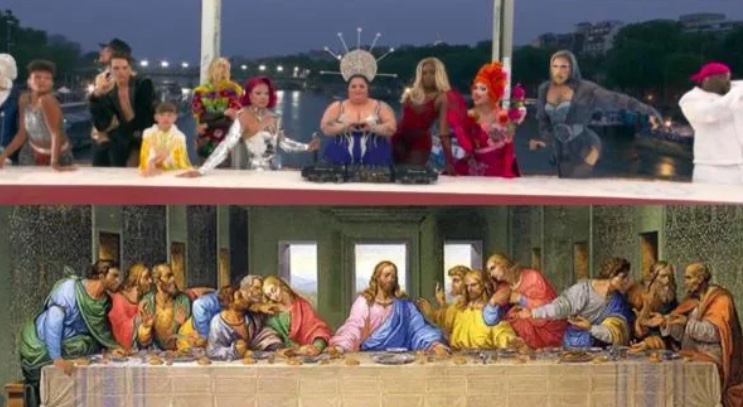
The specific part of the event in question involved an on-stage, live reenactment of what appears to be Leonardo da Vinci’s famous mural The Last Supper, painted about 500 years ago – with the obvious modification being that the “disciples” are depicted as a group of flamboyant drag queens.

Ha. Ha. Ha. Good one… You really got us.

This, somewhat ironically, reminds me of a story from the Book of Acts. I say it’s ironic, because it occurred in Chapter 17, when the Apostle Paul found himself strolling through the city of Athens – which happens to be the place where the first modern Olympic Games were held in the Spring of 1896.

As often occurred on his epic missionary journeys across the Mediterranean, Paul went directly into the most public places of town to make his plea on behalf of Christ. Paul’s method of public preaching in the open squares was not unusual, offensive, or disrespectful. It was common at the time, especially in a city like Athens, for teachers to philosophize openly among the masses to anyone willing to listen, and even to invite criticism which would lead to further discussion and debate on the topic at hand.

Make no mistake, Paul was “greatly distressed to see that the city was full of idols,” as we’re told in 17:16 [NIV]. But although this idolatry provoked him, he didn’t allow himself to be overtaken by anger and bitterness. It’s completely reasonable (for those among us who believe that Christianity is being mocked) to feel provoked, distressed, or offended by the actions of non-Christians, but it’s important that we leave those feelings at the foot of the Cross, and that OUR ACTIONS reflect Christ’s response to such things.

“To this you were called, because Christ suffered for you, leaving you an example, that you should follow in his steps. 22 “He committed no sin, and no deceit was found in his mouth.” 23 When they hurled their insults at him, he did not retaliate; when he suffered, he made no threats” (1st Peter 2:21-23 [NIV]).

That’s how Paul responded to being offended. He presented the Gospel boldly but respectfully. And in his explanation, he even used the idolatry he witnessed as an avenue to reach the hearts of those listening to him. Look at what he says to the pagan citizens of Athens in Acts 17:22-23 –

22 So Paul, standing in the midst of the Areopagus, said: “Men of Athens, I perceive that in every way you are very religious. 23 For as I passed along and observed the objects of your worship, I found also an altar with this inscription: ‘To the unknown god.’ What therefore you worship as unknown, this I proclaim to you.” [ESV]

Paul’s reaction to the idolatry in Athens led to mockery by some, further inquiry and curiosity from others, and to the conversions of a few (17:32-34).

What would the outcome have been if Paul had allowed his distress to turn into vocal outrage? When I see my fellow pastors reacting to modern paganism in such ways, I think to myself, “Come on, guys, we can do better.”

In 2nd Corinthians 4:2, Paul says that, “The god of this age has blinded the minds of unbelievers, so that they cannot see the light of the gospel that displays the glory of Christ, who is the image of God.”

And in 1st Corinthians 2:14 he says, “The person without the Spirit does not accept the things that come from the Spirit of God but considers them foolishness, and cannot understand them because they are discerned only through the Spirit.”

Taken together, the overall point is that if a person is an unbeliever they do not have the light of God’s Spirit to show them the way of life. Even if their intention is to directly mock our faith, “they know not what they do.

It’s our job to be Christ’s ambassadors in this world – to shine the light of truth, and to bring the love. We’re not living under the Old Covenant. We’re living under the New one. The “goliaths” that we have to fight are our own pride and self-righteousness.

We have to stop thinking about non-Christians in worldly terms – like it’s “us” versus “them.” There’s too many of you allowing the vitriol occurring in the political realm of this world to dictate your words and actions. Stop taking the bait. The enemy craves your outrage and your stone-throwing, because that’s what elevates his kingdom. You aren’t winning any souls by shouting about your lack of “Christian rights.” The Gospel doesn’t say we’re entitled to “Christian rights” in this world. It says we have a King, whose Kingdom “is not of this world” (John 18:36).

There’s all kinds of things in this world, and in our modern culture that are offensive to us. And these people making a parody of a painting of The Last Supper is not the worst of them. It’s actually kind of lame. Mel Brooks did a much better job of it in History of the World: Part 1 (1981).

I’m sure there were people that got upset about that one at the time too. So lastly, I’ll say this: If you’re too hurt and offended by this kind of thing, the answer is really simple: Don’t watch it.

The 39 Steps

The 39 Steps

Many years ago, when I was just a young lad with a high-pitched voice that still sounded like my sisters’ … mom and dad read me the ancient story of one of the most mightiest of manliest of men to have ever existed – King David. Of course, due to my age, they were reading from an extremely abridged and docile version of the Bible with lots of pictures… that obviously contained none of the sex and violence that’s in the real Bible. If you’ve never read the sacred tomes of the Old Testament, and in particular the books of First and Second Samuel, they are more graphic and explicit than any episode of Game of Thrones. And that is not an exaggeration, but that is another review for another time. At any rate, what those fluffy 80s picture Bibles did not leave out, was the amount of running, chasing, and hiding that dominates so much of King David’s story. David was, quite literally, in regards to Judeo-Christian literature and culture – the original ‘man on the run.’ In his early years, before he became king, David was a hunted man. He was always on the move, unjustly accused, pursued by his enemies, pursued by the reigning authorities, hiding in caves, scrounging for food, ‘making his way… the only way he knew how…’  David’s early story is about how God protects him, guides him, and empowers him during this time in his life. It’s the story of how he remained faithful under constant duress, and how he waited patiently for the day when justice would be done, and he would finally become the king. This is one of the stories I found fascinating as a kid. And it’s one of the oldest stories in existence that is still being re-told to this day, and has been re-told, re-imagined, and re-worked over and over again so many times, in so many different ways. David’s journey from shepherd to king has been extrapolated, carefully pulled up by its deepest roots, stripped down to the core of its DNA, and transplanted into so many different stories that it’s probably impossible to list them all – I’m not even going to try. It’s the original seed from which so many other orchards have been cultivated.

As an example of what I’m talking about – I first encountered this re-grafting of David’s story when I read The Lord of the Rings for the first time. The character of Aragorn has a story arc, throughout Tolkien’s sprawling epic, that is taken completely from David’s early life. Aragorn’s story is an example of what I would call a pure distillation of the source material. It’s essentially the same general premise, with fantasy elements, names, and places substituting for counterparts in the original story. And of course, because it’s a fairy tale – not real life – it leaves out all the uncomfortable parts that the Biblical narrative isn’t afraid to show us.

Now, as I’m sure most of us are aware, The Lord of the Rings was eventually made into a landmark cinematic trilogy that was released between 2001 and 2003. But way back in 1935, at around the same time that Tolkien was crafting The Hobbit novel into its final form, another Englishman by the name of Alfred J. Hitchcock was releasing a film called The 39 Steps. And just to give credit where it is due, this film was an adaptation of a book written in 1915 by John Buchan, not an original work by Hitchcock. We can, however, give credit to Hitchcock for making (as far as I can tell) the very first masterpiece that translated the ancient literary example of the hero who is hunted down, on the run for his life, trying to find justice – The King David Motif, if you will – into a cinematic formula that has since been copied, tweaked, adjusted, and re-adapted many times over. Here’s a brief list of movies that I’ve seen, which employ some variation of this formula:

Running Man, The Fugitive, Enemy of the State, Waterworld, Mission Impossible, The Jason Bourne movies, Shooter, The Island, Minority Report, and Mad Max: Fury Road… just to name a few. There are many more of course, and the whole “Spy” genre itself, as we know it in movies today, is mostly an overgrowth from that indigenous sapling planted by Hitchcock so many years ago.

Side Note: Hitchcock himself used the same formula again in his later film, North by Northwest in 1959 – one of his most successful films.

In The 39 Steps, the hero is Richard Hannay, a Canadian traveling in Britain who is unwittingly caught up in an espionage conspiracy, accused of murder, and chased up into the Scottish countryside by both the criminals and the police. Along the way (just to make things interesting) he jumps off a train, meets some odd characters up in the moors, is almost fatally shot, accidentally propelled to the front of a political rally, forced to give a public speech, and gets handcuffed to a woman named Pamela who hates him, and then eventually falls in love with him… at least, I think she falls in love with him… I mean they’re holding hands at the end, and this was 1935, so… you know. I guess, in Hitchcock’s mind, if you’re handcuffed to the same person long enough, you just eventually go with it. Actually, the relationship between Hannay and Pamela reminded me a great deal of the relationship that forms between Clark Gable and Claudette Colbert in Capra’s It Happened One Night. But that’s another review.

Perhaps most interestingly, as is often the case with these kinds of tales, there is usually either some small flourish, sweeping gesture, or over-arching plot element that indicates the presence of the divine in the midst of the hero’s struggle. These act as clues; small trails of crumbs that lead back to the original loaf of bread that started it all. If the early story of King David really is the ancient progenitor of this literary genre, and Hitchcock’s film a true echo of that, then we could expect to find the same kind of evidence in The 39 Steps. And Hitchcock, who was trained by Jesuits in Catholic school to analyze art at an early age, does not disappoint. In this case, we see the divine presence most clearly on display in the form of a church hymnal; it’s conspicuously situated snuggly in the left breast pocket of Hannay’s coat where it stops the aforementioned bullit that would have otherwise killed him. Bullseye.

Believe it or not, this was the first Hitchcock film that I’ve ever watched, and aside from the plot, which is interesting enough on its own, the thing that really makes this old movie shine is how much anxiety it’s able to convey through the screen. This is where Hitchcock’s talent as a filmmaker becomes apparent. He really makes you feel like you’re the one handcuffed to Richard Hannay as he frantically trots from one place to the next. Moreover, it’s extremely frustrating to witness how no one believes Hannay when he tries to tell them what’s happening to him, leaving him with no choice but to lie in order to get help from people! Hitchcock is indeed the legendary master of suspense that he’s been made out to be.

I’ve known about Alfred Hitchcock, and been aware of his impact on the history of filmmaking for most of my life – even having never seen one of his films. But after watching The 39 Steps, I now know why he’s considered one of the greatest directors of all time. In this movie at least, he took an ancient, timeless story that had been distilled into something that fit the time in which he was living, and crafted it into a cinematic formula that we can still appreciate 83 years later.

Winebrenner Mug

Winebrenner Mug
Mug - 08As one of the previous Curry House regulars pointed out yesterday, sometimes these mugs have seen a little more than just coffee and tea. Such is definitely the case with this Winebrenner mug, which has seen its fair share of rice and curry.

It’s hard to think about my time in the curry house without also thinking about Winebrenner–together the two occupied nearly all of my time between 2008 and 2010. We were always grateful that the professors and staff at the seminary encouraged us so much, with many of them even finding occasion to come to our house themselves and share in our weekly curry night meal.

I think what is most interesting to me when I think back on curry night, is that none of it was planned. The four of us guys who lived in the first incarnation of the Curry House had already been cooking and sharing Indian food with our neighbors for years prior to us moving to Findlay. It’s just what we liked to do. It was hard to explain that at times, especially when leaders and pastors from some of the other churches in town would come to visit–always looking for the secret of our success; always wanting to figure out how to duplicate what we were doing. We always told them the same thing… The truth was that we really didn’t know what was happening most of the time, or why. I moved to Findlay so I could attend Winebrenner without having to commute four hours there and four hours back every week. I didn’t expect (none of us did) that within a few months of moving, a hundred people would be coming over to our place for dinner. It was not always that convenient, and there were many times when we didn’t think we could keep doing it (it was kind of expensive for four graduate students), but we continued on, putting ourselves into God’s hands and trusting him to provide–and of course he did. In four years we never had to call off the meal.

For those out there wondering how to do ministry… It’s not as complicated as we’ve tried to make it. It might include going to bible college or seminary, but it doesn’t have to. All you have to do is look at what God has already given to you, and then share it with those around you—for free!

Originally posted on Instagram @ajcoffman on April 18, 2014

Jesus Christ is God

I always look forward to those rare moments that come along where a random interaction with someone leads to a deeper discussion about something serious, or when a seemingly inconsequential series of events culminates into something that is extremely important, or when something that seems insignificant in the grand scheme of things, becomes the prelude to something with fundamental purpose.

I experienced one of these occasions this past weekend when I went to my cousin’s high school graduation party. After I walked in and helped myself to a fine brunch buffet, I sat down in the living room to chat with my older sister and my dad while we watched a slide show of my cousin’s life. There were several people milling about the house, and there was nothing really out of the ordinary at all. It was pretty much what you expect each year when these types of parties roll around. But within just a few minutes of my arrival, everything changed.

As I was sitting on the couch, discussing home remodeling issues with my sister, a guy from my home church sat down in another chair across the living room. I’ve talked with Rob before, and he’s a great guy who I’ve had a few good discussions with in the past. He loves to talk about God. I could tell as I was chatting with my sis, that he was waiting for a break in our conversation so that he could engage me in a discussion. Well, sure enough, as soon as I finished talking Rob began asking me questions. He began with the usual questions about school and what I was studying at seminary. When I told him I was studying theology and church history his eyes lit up and he immediately sent what can only be described as a barrage of theological questions my way.

Rob asked me some good questions, like who is God? And what is God’s name? I proceeded with a brief discourse about the trinity, to which Rob replied by asking me where in the Bible it talked about the nature of God. I quoted a few passages and then went on to talk about some of the erroneous views of Christ, as Rob asked me some more questions. The questions kept coming and the conversation continued into the next half hour or so. After we reached a point where Rob was sufficiently satisfied that he understood what I believed about God, he then informed me with a grin on his face that he did not believe in the trinity, and that he did not believe that Jesus was God.

To say that I was shocked at this information would not do justice to my internal reaction upon hearing this from Rob. I didn’t know what to say as Rob launched into a discourse that involved his misinterpretation of key passages in the New Testament. The whole time he was speaking, I kept thinking to myself, “is this really happening?”

Knowing that Rob was an influential youth group sponsor, not to mention a member of my home church, I couldn’t resist asking him if the elders of our church knew what he believed. He informed me that they did, and that they had told him they didn’t mind as long as he still believed that Jesus was the Son of God. I went home that afternoon in a haze of confusion, unable to make any sense out of the nonsense I had just heard from this guy that I really did have some genuine respect for, and to tell you the truth, I was even a little depressed by it all.  I felt kind of like I had stumbled into the bizzaro world from Superman, where everything is the complete opposite of what it’s supposed to be.

For anyone who doesn’t know, the deity of Jesus Christ as part of the Trinity is a fundamental, basic doctrine of Christianity, and has been since the inception of the Church. This is also referred to as the Incarnation, which means that Jesus is God come into human history in the flesh. It is the foundation of our entire faith. The scriptures are not vague on this particular issue; they are in fact abundantly clear. Even the Jehovah’s Witnesses, who do not believe that Christ is God, have been forced to produce their own separate mistranslation of the Bible in an effort to avoid the point that Christ is God. If Satan was only ever able to tell one single lie, somewhere at the top of his list would be the lie that Jesus is not God. Because if Satan can get someone to believe that, he can get them to believe absolutely anything. Let’s take a look at the scriptures, shall we?

Matthew 1:22 and Isaiah 7:14
“All this took place to fulfill what the Lord had said through the prophet: ‘The virgin will be with child and will give birth to a son, and they will call him Immanuel’—which means, ‘God with us.’”

Matthew 4:10
“Jesus said to him, ‘Away from me, Satan! For it is written: Worship the Lord your God, and serve him only.’”

Matthew 28:9
“So the women hurried away from the tomb, afraid yet filled with joy, and ran to tell his disciples. Suddenly Jesus met them. “Greetings,” he said. They came to him, clasped his feet and worshiped him. Then Jesus said to them, “Do not be afraid. Go and tell my brothers to go to Galilee; there they will see me.’”

Mark 2:5-7
“When Jesus saw their faith, he said to the paralytic, ‘Son, your sins are forgiven.’
Now some teachers of the law were sitting there, thinking to themselves, ‘Why does this fellow talk like that? He’s blaspheming! Who can forgive sins but God alone?’”

John 1:1-5, 14
“In the beginning was the Word, and the Word was with God, and the Word was God. He was with God in the beginning. Through him all things were made; without him nothing was made that has been made. In him was life, and that life was the light of men. The light shines in the darkness, but the darkness has not understood it… The Word became flesh and made his dwelling among us. We have seen his glory, the glory of the One and Only, who came from the Father, full of grace and truth.”

John 5:17-23
“Jesus said to them, ‘My Father is always at his work to this very day, and I, too, am working.’ For this reason the Jews tried all the harder to kill him; not only was he breaking the Sabbath, but he was even calling God his own Father, making himself equal with God.


Jesus gave them this answer: ‘I tell you the truth, the Son can do nothing by himself; he can do only what he sees his Father doing, because whatever the Father does the Son also does. For the Father loves the Son and shows him all he does. Yes, to your amazement he will show him even greater things than these. For just as the Father raises the dead and gives them life, even so the Son gives life to whom he is pleased to give it. Moreover, the Father judges no one, but has entrusted all judgment to the Son, that all may honor the Son just as they honor the Father. He who does not honor the Son does not honor the Father, who sent him.’”

Exodus 3:13-14 and John 8:57-58
“Moses said to God, ‘Suppose I go to the Israelites and say to them, ‘The God of your fathers has sent me to you,’ and they ask me, ‘What is his name?’ Then what shall I tell them? God said to Moses, “I am who I am. This is what you are to say to the Israelites: ‘I AM has sent me to you.’”


“You are not yet fifty years old,’ the Jews said to him, ‘and you have seen Abraham!’
‘I tell you the truth,’ Jesus answered, ‘before Abraham was born, I am!’”

John 10:27-33
“My sheep listen to my voice; I know them, and they follow me. I give them eternal life, and they shall never perish; no one can snatch them out of my hand. My Father, who has given them to me, is greater than all no one can snatch them out of my Father’s hand. I and the Father are one.’ Again the Jews picked up stones to stone him, but Jesus said to them, ‘I have shown you many great miracles from the Father. For which of these do you stone me?’ ‘We are not stoning you for any of these,’ replied the Jews, ‘but for blasphemy, because you, a mere man, claim to be God.’”

John 12:44-46
“Then Jesus cried out, ‘When a man believes in me, he does not believe in me only, but in the one who sent me. When he looks at me, he sees the one who sent me. I have come into the world as a light, so that no one who believes in me should stay in darkness.’”

John 20:28-29
“A week later his disciples were in the house again, and Thomas was with them. Though the doors were locked, Jesus came and stood among them and said, ‘Peace be with you!’ Then he said to Thomas, ‘Put your finger here; see my hands. Reach out your hand and put it into my side. Stop doubting and believe.’ Thomas said to him, ‘My Lord and my God!’”

Acts 20:28
“Keep watch over yourselves and all the flock of which the Holy Spirit has made you overseers. Be shepherds of the church of God, which he bought with his own blood.”

Romans 9:5
“Theirs are the patriarchs, and from them is traced the human ancestry of Christ, who is God over all, forever praised! Amen.”

Colossians 1:15-20
“He is the image of the invisible God, the firstborn over all creation. For by him all things were created: things in heaven and on earth, visible and invisible, whether thrones or powers or rulers or authorities; all things were created by him and for him. He is before all things, and in him all things hold together. And he is the head of the body, the church; he is the beginning and the firstborn from among the dead, so that in everything he might have the supremacy. For God was pleased to have all his fullness dwell in him, and through him to reconcile to himself all things, whether things on earth or things in heaven, by making peace through his blood, shed on the cross.”

Colossians 2:8-10
“See to it that no one takes you captive through hollow and deceptive philosophy, which depends on human tradition and the basic principles of this world rather than on Christ. For in Christ all the fullness of the Deity lives in bodily form, and you have been given fullness in Christ, who is the head over every power and authority.”

Philippians 2:5-11
“Your attitude should be the same as that of Christ Jesus: Who, being in very nature God, did not consider equality with God something to be grasped, but made himself nothing, taking the very nature of a servant, being made in human likeness. And being found in appearance as a man, he humbled himself and became obedient to death—even death on a cross! Therefore God exalted him to the highest place and gave him the name that is above every name, that at the name of Jesus every knee should bow, in heaven and on earth and under the earth, and every tongue confess that Jesus Christ is Lord, to the glory of God the Father.”

1 Corinthians 8:4-6
“So then, about eating food sacrificed to idols: We know that an idol is nothing at all in the world and that there is no God but one. For even if there are so-called gods, whether in heaven or on earth (as indeed there are many “gods” and many “lords”), yet for us there is but one God, the Father, from whom all things came and for whom we live; and there is but one Lord, Jesus Christ, through whom all things came and through whom we live.”

Titus 2:11-14
“For the grace of God that brings salvation has appeared to all men. It teaches us to say ‘No’ to ungodliness and worldly passions, and to live self-controlled, upright and godly lives in this present age, while we wait for the blessed hope—the glorious appearing of our great God and Savior, Jesus Christ, who gave himself for us to redeem us from all wickedness and to purify for himself a people that are his very own, eager to do what is good.”

1 John 5:20
“We know also that the Son of God has come and has given us understanding, so that we may know him who is true. And we are in him who is true—even in his Son Jesus Christ. He is the true God and eternal life.”

Hebrews 1:8
But about the Son he says, ‘Your throne, O God, will last for ever and ever, and righteousness will be the scepter of your kingdom.’”

2 Peter 1:1
“Simon Peter, a servant and apostle of Jesus Christ, To those who through the righteousness of our God and Savior Jesus Christ have received a faith as precious as ours:”

Revelation 1:8 and 17-18
“’I am the Alpha and the Omega,’ says the Lord God, ‘who is, and who was, and who is to come, the Almighty.’”

“When I saw him, I fell at his feet as though dead. Then he placed his right hand on me and said: ‘Do not be afraid. I am the First and the Last. I am the Living One; I was dead, and behold I am alive for ever and ever! And I hold the keys of death and Hades.’”

Likewise, the following sets of verses are places where the New Testament refers to Christ by the same designation used to refer to God in the Old Testament:

First and Last
Isaiah 41:4; 44:6; 48:12 – cf. – Revelation 1:17; 2:8; 22:13

Light
Psalm 27:1 – cf. – John 1:9

Rock
Psalm 18:2; 95:1 – cf. – 1 Corinthians 10:4; 1 Peter 2:6-8

Husband” or “Bridegroom
Hosea 2:16; Isaiah 62:5 – cf. – Ephesians 5:28-33; Revelation 21:2

Shepherd
Psalm 23:1 – cf. – Hebrews 13:20

Redeemer
Hosea 13:14; Psalm 130:7 – cf. – Titus 2:14; Revelation 5:9

Savior
Isaiah 43:3 – cf. – John 4:42

Lord of Glory
Isaiah 42:8 – cf. – 1 Corinthians 2:8

In summation, there is this thing that we Christians believe called the doctrine of the Trinity, which in short means that there is one God, revealed to us as God the Father, God the Son, and God the Holy Spirit.

For anyone struggling to better understand the doctrine of the Trinity, I would recommend a reading of Mere Christianity by C.S. Lewis, wherein he devotes several chapters to the subject. His discussion of the Trinity helped me a great deal at a time when I was searching for more clarity on this doctrine.