KCU Unplugged

FeaturedKCU Unplugged

This is the transcript of my commentary at the beginning of the video. I’m going to post a link to the KCU Unplugged video below – which contains this commentary. So you can go right to watching it now, or you can read the commentary here, and then skip to the 15:45 mark in the video below.

This isn’t a sermon. It’s a story time, nostalgia kind of video, that I’m uploading for purposes of archival interest.

However, it does require a bit of context.

First of all, for those of you out there, who may be watching this, and may be tempted to take offense at it – you know who you are – I am not posting this to stir up any bad feelings, or resurrect past conflicts involving Kentucky Christian University.

I’m not trying to make a statement about anything. The short documentary style video that you’re about to see was made a little over two decades ago now – a fact that will become obvious when you see the quality of it.

So, at this point, it’s merely a trip down nostalgia avenue. I have many videos like this on my channel. I consider YouTube to be something of a time capsule in a way – and it’s time to get this puppy into the archives.

YouTube allows us the opportunity to save and share videos for easy access from anywhere – including the future. Once it’s uploaded it’s going to be out there and available until Armageddon happens.

So, that’s why I’m uploading this. I have no lingering ill will toward KCU. In fact I never really had any ill will toward the place to begin with. I just had a complex relationship with the institution, and some of the individuals running it a couple of decades ago – and the complex nature of those relationships were construed by others into the perception that I had a grudge of some kind. I didn’t then, and I don’t now.

In fact, my wife and I visited the campus in 2023 for Homecoming Weekend. We attended chapel services (voluntarily), and we mostly flew under the radar, but did say hello to some friends, and enjoyed Chinese takeout, which we took to Grayson Lake. I just wanted my wife to see the place where I had spent so many years in my twenties.

The cops were not called. The authorities were not notified. Dr. Keeran exited the chapel at the same time as us, and even smiled in our general direction. I’m sure he didn’t even recognize me.

So, that’s the first thing I want to say.

The second thing I want to do, is give a little more context on the video itself.

This was, from the very beginning, always a class project. That’s all it was.

A fellow classmate and friend, Jason Stewart and I, collaborated on the project with permission from our professor Dr. Durst who was teaching Christ and Culture during the Fall semester of 2004.

During that semester, one of the centerpieces of the curriculum was a book by Randall Balmer entitled “Mine Eyes Have Seen the Glory.” I believe we had quizzes or tests over the subject matter of this book, or a book report. And we also viewed the PBS documentary by the same name that accompanies it.

That was really the seed that gave us the idea to make a short documentary ourselves for the final class project of the semester. The assignment was just to make an art project of any kind, that expressed a Christian worldview. We had a lot of leeway to be creative.

But, Randall Balmer’s book and documentary are structured around the idea of asking questions about the specific nature of the religious tradition we’re apart of – especially if one has grown up within that tradition.

The idea is that asking questions about what we’re doing, and why we’re doing it a certain way, and what it all means in the larger context of Christianity – outside our specific branch of the tree – is valuable.

And that idea really resonated with Jason and I, so we took some inspiration from that, and put together a documentary about the nature of our environment at the time – Kentucky Christian University.

And we decided to explore that environment through asking questions, and accumulating many many hours of interview footage with various students (past and present at the time), as well as faculty, and staff, from that time.

Along with this, we interjected our own thoughts through a variety of creative ways, mostly involving short 2-3 second movie clips. We were trying to add a bit of humor to it as well.

I would like to point out, that this was a groundbreaking task at the time. It was not easy, in terms of the enormous amount of time it took to make this 18-minute video. This was well before smartphones and the era where everyone has a high-definition video camera and editing software in their pocket.

We used old, analog, 8mm tape, filmed on cameras that were out of date at the time. And as far as editing goes, there was only one computer available on the entire campus that could do that kind of thing. It was in Dr. Charlie Starr’s office. He was the Humanities Professor back then, and he allowed us to work in his office at all hours through the night. I broke his chair during editing one evening – sorry about that, Dr. Starr. Apologies to Jason as well – he got blamed for it.

But it took a lot of time, and a lot of effort. Just rendering one single, simple, visual or audio effect could take an hour or two at times, sometimes two or three times that long if there were layers of effects. These are effects that take seconds to do nowadays on our phones.

The point is, we really busted our rears – especially Jason who was an absolute master of the Adobe Premiere software that we were using. Jason knew more about using the software than any other professor or student on campus at that time. He should have been paid to teach a class on it.

Aside from all that, Jason and I had a lot of fun, as did the rest of our group of friends who were sort of creatively collaborating with us in the background.

And regardless of what happened afterward, in the subsequent months after Jason and I left campus – we got an A on the project!

I think Dr. Durst really got what we were doing, and he thought it was funny and serious at the same time, and he rewarded us for the effort that it took to create a project that was far superior to anything the other 40 students in the class did – at least in terms of time commitment.

The unfortunate epilogue to all this, is that the President of KCU eventually got his hands on a copy of the video 6 months later – and it really angered him. Jason and I were not aware of the fact that he had received a copy. We were not aware of the fact that one of our friends who had asked us for a single VHS copy, right after we showed the video in class, had taken that copy back to his home mega-church, where his youth minister had decided to make an unknown number of copies and distribute them to other churches. We had nothing to do with that. There was no social media, or YouTube at that time! We didn’t know what other people were doing with our video. Anyhow, a copy eventually got back to Keith Keeran, President of KCU, and he was not happy.

Now, Jason and I weren’t even there by that time. Neither of us had graduated yet, because we both had a few correspondence courses that we were completing. And that gave Dr. Keeran some leverage to try and apply some discipline against us, for this video, which again – was a class project, that we received an A on.

The form of discipline the president chose, was blackmail. He threatened to withhold our degrees (our $60,000 dollar degrees which we were only a few credits shy of obtaining), unless we signed a letter (of his words) saying that we were wrong for the video we made, that we had sinned against the school, and misrepresented people, and that we were very very sorry.

We were not sorry. We did not misrepresent anyone, or anything that anyone said. And we did not consider ourselves as “sinning” against the university. We were students, in good standing, completing a class project.

Now, I should point out, that the only reason President Keeran gave us this gracious option – to disavow our hard work – was because my late father – William J. Coffman, threatened to sue the university. That’s right. The initial mode of discipline was to simply not allow us to graduate at all, case closed. But, as soon as the word “lawyer,” entered the conversation, then accommodations were made.

Jason and I didn’t argue. We signed the fake apology letter that was drafted for us. And that was basically the end of it. We both graduated not long after that, and lived happily ever after.

I guess the hurtful thing, for us, and the really confusing part about all this at the time, was the extremity of the response, and the way it came out of nowhere, after so many months had passed – months where no attempt was made to talk to us, engage us in conversation, or understand the context of the video in any way.

The knee-jerk reaction to try and trash our extremely expensive, hard-earned degrees, without a moment of hesitation – well, as you can imagine – we learned some really valuable lessons from being treated like that.

The university had a great opportunity to step in, and address the questions our documentary raised. It could have been a learning opportunity for many students, both then, and in the years following. But instead, they chose to do, the 21st century equivalent of burning us at the stake – by attempting an early form of “canceling” us. 

And this is the thing that still baffles me today – the cult like response to feel the need to crush a couple of young students, just because they asked some questions, instead of trying to disciple us to a place of understanding. And it was a cult like response. That’s what cults do – they squash anything that smells the slightest bit like decent from the status quo.

True Christianity doesn’t do that. True Christianity engages with the questions, especially the difficult ones, and it does so, humbly, with the Scriptures and the Holy Spirit as a foundation for mutual understanding and agreement among believers.

There was no Scripture, and no Holy Spirit in the way we were treated. And we were just kids… kids in need of discipleship. 

I’m glad there were good men, like my dad, to stand up for us, and tell the president of KCU he had overstepped his authority. I’m sad that it only took the threat of financial loss to make the president show a small modicum of mercy.

 The ironic thing is, we were discipled to a place of understanding, just not by KCU.

We were discipled by others, who, in the following years, took the time to engage us on our questions, help us think through them, pray with us, and walk the path with us.

And Jesus picked up the rest of the slack. Jesus always picks up the slack.

So, anyway, that is the context surrounding this video.

It is very much a project of its time. The quality has diminished drastically over the years, because the initial mode of presentation and playback was VHS cassette. So, it had to survive the last 21 years by being transferred from VHS, to digital, and then through various computer files through many computers, and finally to a DVD that’s been sitting in a box for years, and from there, captured back into a computer file. As such, some of it has degraded, and it is no longer in color. It was originally in color, but now the file will only show in black and white – maybe that’s more appropriate given the fact that it’s now pretty old. I have added a few subtitles in my current edit, to provide the names of most of the interviewees that were not previously named in the video. In any case, I forgot that I even still had a copy of this sitting around on an old custom DVD, so my recent discovery of it is the reason for the timing of uploading it now, after so long.

So, again, please don’t be offended by this. The context that I’ve explained here is ancient history now. The video is not perfect, some of it is cheesy, and some of it is brash, but I do believe there’s still a good underlying message at the core of it – a message that is pure, and relevant to anyone who calls themselves followers of Jesus Christ.

Again, if you want to skip this commentary at the beginning, you can go to the 15:45 mark of the video to watch the original video.

https://youtu.be/DafzQaqM1TU?si=fyg_XD7aQmtKVVxx

An Old Christmas Story

FeaturedAn Old Christmas Story

If you prefer hearing me read this, just follow the SoundCloud link at the bottom. Otherwise, read on.

______________

The sun was sinking slowly into the darkened silhouette of the city a few miles to the west. Its red glow was casting long, stretched-out shadows over the desolate fields that lay just east of town.

Another day was nearly done.

And another year was coming to an end.

It was very cold, and Emerson Dustmire shivered beneath his sheepskin overcoat as he trudged wearily up the dirt road that wound on ahead of him. His broad, wind-burned face was determined and stoic, and only his eyes revealed the restless energy that burned underneath as they darted frantically back and forth, from north to south, scanning the horizon for any sign of danger.

He still had about two miles to cover before reaching his destination, and even though he was freezing, he would still pause every now and then to look back at the sunset behind the city.

Before too long, he would be back in that terrible place that he could only escape through either the magic of sleep—when it could be found—or whenever it was his turn to carry dispatches between the frontline, and the couriers that were lodged in the suburbs that he had just left.

It wasn’t often that something as beautiful as that sunset made itself visible to the human-beings who were wallowing in all the mud, and blood, and filth far below.

You had to appreciate these things when they came along.

The sunlight, and the small bit of warmth that still reached his face after traveling a hundred million miles through space—was, almost, the only reminder that there was something greater above it all—something untouched by the mess that man was making of things down here on the Earth.

Emerson adjusted the dense pack that was slung tightly over his shoulders, sighed heavily to himself as he turned back around, and then continued following the dirt road that was unfurling itself into the Belgian countryside.

He was a long way from home.

A long way from Oxfordshire, a long way from the University, and from people who cared about useless facts, like how many miles of space were in between the Earth and the Sun.

He was a long way from his mother’s concerned voice, and the smell of his father’s pipe after dinner on the last night he had seen them.

He was a long way from his fiancé, the love of his life that he had left behind with nothing but a promise that he would be back soon.

They were all behind him somewhere, hundreds of miles away, back in the civilized world, where men were still human.

That civilized world was slowly becoming a hazy memory as it gave way to the misery of his present living situation. He was now an inhabitant of the world where civilization disappears into the jungle. The only laws here were those of survival. The only magistrates were the rats, waiting to devour you for the slightest infraction.

The war had only begun about four months earlier, and everyone had said that it would be over by Christmas. But here it was, December the 24th, and all hope for a swift conclusion had begun to fade away with the passing of Summer, and been lost entirely with the passing of Autumn.

Emerson Dustmire was part of the 2nd Battalion of light infantry from Oxfordshire and Buckinghamshire—which made up the larger portion of the British Expeditionary Force. They had been sent to Paris at the end of August and helped save the city from being overrun by the Germans during the first week of September. From there they had marched north into the French countryside, and then up into Belgium until reaching the town of Iper.

Emerson’s days had melted into a hazy mixture of marching, digging, marching, digging, marching, digging… the monotony of it all was interrupted, here and there, by brief, but deadly skirmishes – short, battles that sprung up quickly as the Germans sought to maneuver around the French and British troops that kept meeting and repelling their advances.

Both sides kept up this senseless ballet of death with each other until they ran out of land to fight over.

With nothing but the Sea to the North, and the Alps on the southern end of the line, millions of men began digging into the earth and creating nearly impenetrable defensive positions.

Emerson’s company had received their orders to stop marching and dig in about a month earlier. So here they were, bogged down in the swampy lowlands of West Flanders, slowly sinking into the mud.

Emerson moved on, thinking of little else except putting one foot in front of the other.

Left foot, right foot, left foot, right foot.

His mind began to drift, and he found himself thinking again of his home that was so far away.

He had been led to believe that the war he was fighting was necessary to keep his home and his family safe—a final war, to end all wars and bring an everlasting peace to humanity.

Emerson knew that it was all a load of nonsense. But what choice did he have? They told him he had to go fight. So, he went.

As he crested a small rise in the terrain, the wind shifted and he was struck immediately with the reality of his situation.

Visually speaking, everything seemed in order.

He had reached the medical tents that were situated at the very back of the encampment, several hundred yards away from the trenches on the front lines. Everything was arranged in nice, neat rows, packed tightly together in perfect formation. But with the shift in the wind, the smell had reached Emerson once more—the smell that he hated more than anything.

It wasn’t the medical tents.

It wasn’t the hastily pitched horse stables, or the pig sties on the far end of the encampment.

It was, simply put, the smell of death that swirled through the air and permeated everything it touched.

It was inescapable.

Thousands of men had died in the fighting that took place between the two armies, and most of them could not be retrieved for proper burial.

And so they lay, out in the open, slowly being dissolved by the rats, and the worms, and the rain, with the muddy bacterial bogs absorbing what was left of them.

Emerson trudged on through the rows of medical tents, then began working his way past the French officers and reconnaissance units, past the artillery positions situated on the peripheral, and then finally, after another hundred yards of open field, he began a slow, steady climb up toward the back end of the fortifications that led toward the trenches.

His anxiety was beginning to build.

His heart was beating faster, he was taking larger gulps of air to catch his breath, and despite the chillness in the air, he was beginning to sweat.

It wasn’t his body that was tired and exhausted—it was his mind.

God did not design the human brain to endure the kind of sustained, perpetual waves of stress that man’s technological advances in war-making had conjured up for these modern battlefields.

The constant, sporadic, and unpredictable barrages of artillery shells from the Germans were an ever-present source of fear hovering over every human being and animal in range of their destruction.

Emerson Dustmire’s nerves, like so many others, were fraying under the strain of coping with the thought that either his life would end at any moment, or he could suffer some kind of ghastly wound that would leave him maimed for the rest of his life.

And what was it all for?

Why was all of this happening?

Was there ANY ANSWER to those two questions that could adequately justify the need for millions of Christian men to draw up battle lines against each other and commence with a kind of slaughter that the world had never seen before?

It wasn’t like this was the first time that this sort of thing had happened in human history.

The American Civil War had consisted of Christian killing Christian. Even in Europe, 400 years earlier, in the very place that Emerson now found himself, Catholic and Protestant armies had clashed with one another over theological details that no one could prove or disprove.

As bad as those conflicts were, however, they were nowhere near as devastating as this one had been in only four months of fighting.

Human beings had learned, from somewhere, how to go about killing one another with ease, efficiency, and indifference, in a way that had never happened until now.

Emerson mused to himself that he was feeling a bit like Longfellow who must have been thinking about something similar when he’d written that famous hymn: “And in despair I bowed my head: ‘There is no peace on earth,’ I said, ‘For hate is strong, and mocks the song of peace on earth, good will to men.’

As he approached the back entrance to the dugout, Emerson exchanged a brief glance and a nod with the sentry on guard duty.

“Any news from town?” the old sentry asked as Emerson moved past him.

“Yes,” Emerson replied enthusiastically, and with a sarcastic grin on his face he threw his hands in the air and exclaimed as loudly as he could – “The war is going to be over by Christmas!”

He didn’t stop to hear what the old sentry shouted back to him, but he knew it wasn’t nice, and he knew he deserved such a retort.

When he returned to his section of the great trench, he was greeted silently by two of his buddies from 3rd corps. After exchanging a few words about the weather and tossing them the two cartons of cigars that he had been tasked with retrieving, he slung off his backpack, leaned his rifle against one side of the large tree root that protruded from the side of the trench, and then sat down on a small stack of empty food crates.

He leaned his head back, and gazed up at the night sky.

The sun had finally set, leaving only the deep blue of the heavens pinpointed by millions of stars.

Finally at peace, for a few seconds, he leaned against the side of the earthen wall, pulled his coat around him as tightly as possible, stuffed his hands into his armpits and closed his eyes. Just for a few moments he thought to himself, maybe I can get a little sleep.

When he awoke from his brief slumber he was immediately aware that something was terribly wrong.

Everything was quiet.

Everything was too quiet.

There was no exploding of artillery shells, no cracking of isolated sniper bullets, no cries of men yelling back and forth along the line for ammunition, or food, or cigarettes—there was nothing at all of the normal everyday sounds that had come to define life under these conditions at all hours of the day and night.

Emerson looked around in the darkness for his squad mate Charles, and was shocked to find him halfway up the ladder, peering over the top of the trench, his head completely exposed to enemy fire.

He started to protest, but Charles quickly motioned for him to be quiet.

He leaned down toward Emerson, put a finger to his mouth, and whispered one word to him: “Listen.”

He pointed in the direction of the German lines.

Confused, and still in a daze from his nap, that wasn’t long enough, he sat quietly for a few seconds. Then he removed his helmet and tilted his head to one side.

He heard something, but what was it?

Voices, he thought… not very many voices… but someone was singing.

It was barely discernible at first, and then, slowly, it grew louder.

Then other voices joined in the singing, and a familiar harmony rose into the air above the frozen battlefield. The words sounded different, of course, but the tune was instantly recognizable—

“Stille Nacht, heilige Nacht
Alles schläft; einsam wacht”

Then, from somewhere along the British line, 20 or 30 yards away, English voices began to sing in harmony with the German voices that were now echoing across no-man’s land.

“Silent night, holy night
All is calm; all is bright”

Within minutes hundreds of men, on both sides, were singing loudly into the night sky.

First it was Silent Night, then it was Good King Wenceslas – looking out on the feast of Saint Stephen, when the snow lay round about, deep and crisp, and even.

The singing that had sprung up in the middle of this most unlikeliest of places, in this most darkest of times, continued into the night.

And before long, men had gone up the ladders, pouring over the tops of the trenches – not to exchange gunfire, but to exchange Christmas greetings, and small gifts… the Protestants exchanged tins of baked beans for chocolate bars, and the Catholics exchanged cartons of cigarettes for bottles of rum.

Candles had been lit along the German lines for as far as Emerson could see in both directions.

Men of different languages, different cultures, different countries… men who had been spilling each other’s blood for months, had found something they had in common, maybe the only thing, and it was more powerful than all of the hatred, and all of the destruction that they had leveled against each other.

Well, they had come to their senses,

if for only one night.

They had remembered their place

as people of the Light.

The killing and the dying,

it had come to an end.

In the frost and the darkness

there were no flags to defend.

There was only candlelight,

and warm greetings for those,

who had been trapped inside pits

as they shivered and froze.

They had emerged from their trenches,

like dead men from their graves…

Laying down their weapons,

and hailing the one Lord who saves.

So much evil had happened,

since they’d taken up arms.

So many had died,

since they’d left their families and farms.

If they could only go back,

if they could only return,

to the days that had passed,

before the world began to burn.

And this war to end wars –

Well it came,

and it went…

And not very much changed,

and few knew what it meant.

Those men who defied orders,

on that cold Christmas Eve…

Who left their positions in order to sing…

Most were all dead,

by the following Spring.

And millions went with them;

The death toll was profound.

But on that one night,

some Christians, created a sound…

And it’s reached us all here,

across a century that’s passed…

In our warmth and our comfort,

Having broken our fast,

It was a powerful song that was sung on that night.

It reached Satan and his demons in the depths of their Hell.

They were no longer laughing;

It had broken their spell.

The soldiers had awoken and remembered the truth;

they shared something sacred with those they called foe…

And nothing could change that,

no war far below.

This connection they shared;

It transcended men’s borders.

It was greater and stronger, than some general’s orders.

The kings they fought for, would one day fall down.

They would bow at the feet of the One with the Crown.

But this lesson remains;

For this story is true.

Most of it, that is…

Some details I made up –

but only a few.

There was a Great Christmas, so long ago…

Foretold from the moment of man’s great fall.

And it’s something to ponder

As we deck the hall.

If we ignore it, or we forget it,

Or we don’t ask, “what does it all mean?”

-we might find ourselves trapped

like the soldiers in 1914.

“I am the Light of the World.”

That’s what Jesus said.

That’s why he was tortured.

That’s why he bled.

So, we take his word,

and his teaching to heart,

each Christmas we gather

and do our best to impart –

that this Savior and His Kingdom

are greater than all others,

and the Day of his birth, is a time for sisters and brothers…

Even though we have quarrels –

Even though we all fight –

We have to forgive, and reflect His love –

and his light.

Jesus taught us to give—and to lay down our lives.

He saved us from sin and from evil desire.

And we need it,

because, each one of us, all,

are like Emerson Dustmire.

The End

Love Your Enemies

FeaturedLove Your Enemies

Last week, we looked at a passage from Luke Chapter 14, where Jesus talked about the Cost of Discipleship, – the willingness to let go of everything we have, everyone we know, and everything we care about – even our own lives – if our King should ever call upon us to do so.

This week, we’re going to focus on Luke 6:27-36.

These words of Jesus touch on one of the great pillars of God’s Kingdom – a cornerstone of the entire message of the whole Bible. It’s no exaggeration to say, that if we miss the message that Jesus gives us here in Luke 6:27-36, then we are missing the whole point of the Gospel itself.

Now, before we look at this passage in Luke, I want to go back to the Old Testament for a few moments, and talk a little about one of the more interesting characters we find there – a man, by the name of Jonah.

Now, many of us, when we think of Jonah, automatically associate him with the giant fish!

We think of Jonah and the fish, or Jonah and the whale, because we heard this story when we were still children, and to the mind of a child, that is the most memorable thing that happens in this story.

When I was a kid, it made me think of the story of Pinocchio.

And, actually, there are some overlapping themes between the story of Jonah and the fairytale of Pinocchio – both are about redemption and transformation for instance.

Pinocchio learns how to become a “real boy,” and Jonah learns how to become a “real man.”

And they both go through their transformation from one to the other while being swallowed by huge sea creatures.

So, I think – to any of us who heard both of those stories as children – it’s somewhat easy to blend them together in our memories, and maybe think of Jonah as being one of the stories in the Bible that is more for kids.

But the truth is, that Jonah’s story is really not a children’s story.

Not at all.

And the part where he gets swallowed by the fish is an important part of the book, but it’s not the most important thing that happens. The most important part of Jonah’s story, is not his encounter with the fish, but rather, his encounter with God.

And Jonah’s encounter with God was not a pleasant one.

Jonah’s relationship with God was not amicable or friendly – to say the least. In fact, the main emotion that Jonah expresses to God is ANGER.

He’s very angry at God.

Jonah had a very big problem with God, because God asked him to do something that was, in Jonah’s mind, completely unacceptable.

The story of Jonah happened at a complicated time in the history of Israel.

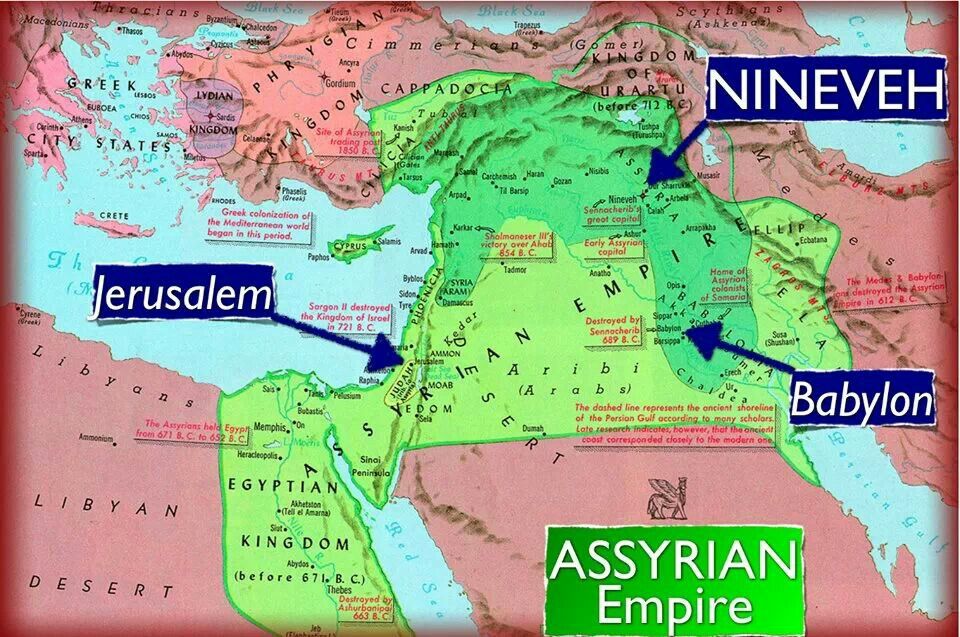
The Northern Kingdom of Israel had been dealing with foreign invasions for almost a century by then. And these invaders were from the Assyrian Empire, which today would be primarily in the countries of Iraq, Iran, and Syria. But the Assyrians were an exceedingly brutal people; their culture was built on two main principles: warfare, and building projects.

The Assyrians were constantly going to war in order to expand their empire, and plunder the people they defeated. And those they didn’t kill, they would turn into slaves, and take them back to Assyria so they could have slaves build their buildings and serve their people.

Whenever the Assyrians captured a city, they would mutilate anyone who resisted them. They would skin people alive, they would impale them on stakes and line the roads with them, they would pull their intestines out to use as burnt offerings, they would create huge piles in front of the city gates – one pile of enemy corpses, and another pile of all the heads they had decapitated from those corpses. And they didn’t just do this for the sake of being brutal – they considered it part of their religious duties – the mass murder and executions were how they made sacrifices to the demons they worshipped as gods. They were very meticulous and artistic about how they dismembered the bodies of their enemies, and who they chose to take as slaves.

That’s who the Assyrians were.

And they had been slowly making these kinds of invasions into the north of Israel for about a hundred years by the time Jonah came along, and by the time God asked Jonah to go to their capitol city, which was called Nineveh, and preach against all of their wickedness.

But Jonah had a very big problem with God asking him to go on this journey and do this.

And we might think it was because of fear; we might think Jonah was just afraid to go to Nineveh and preach against them because they would probably just kill him. But there’s really no indication in the story that Jonah was in the least bit afraid. He was not a fearful man.

He was an angry man. And the reason he had a problem with God telling him to go preach to the Assyrians of Nineveh was because HE HATED THEM.

They were the arch enemies of Jonah’s people. They had invaded his country, they had killed and enslaved his countrymen, and they were looming over Israel’s borders, so that they could continue doing these things, with no end in sight.

So, Jonah hated them.

And more than that, he believed his hatred of the Assyrians was absolutely justified.

And if we were in his shoes today, we would very likely feel the same way.

In fact, if you were to look on a map, and find where Nineveh is located – you would see the present-day city of Mosul in Iraq.

The ruins of Nineveh are right next to Mosul, and up until about a few years ago, Mosul was in ISIS occupied territory.

Of course, we’ve all heard about the atrocities of ISIS over the past decade. They’ve attempted to build their own country by conquest and bloodshed; they’ve killed and enslaved tens of thousands, they’ve carried out terrorist attacks across the Middle East, Asia, and Europe, and have publically executed almost anyone who has opposed them – including many Christians – which are, of course, in the minority in that part of the world.

If God spoke to any of us, and told us to go preach the Gospel to ISIS – how would we feel about it?

It’s probably an understatement to say that we wouldn’t want to go – and if we decided to go anyway – the people who love us would do their best to convince us that we were making a big mistake.

Well Jonah, back in his day – was told, by God, to go preach to people that were not very much different from ISIS. And he said (basically), ‘No, God,’ I’m not going to do that.’

And then, he went down to the nearest port, and hopped on the first ship available, so that he could sail as far away as possible in the OPPOSITE DIRECTION of where God told him to go.

And like I said, he didn’t refuse to go because he was afraid of the Ninevites… he refused to go because HE HATED THEM.

You may remember what happens next.

God decides not to let him off the hook so easily, and sends a storm to keep him from sailing away – and so, Jonah, partly because he doesn’t want the other people on the boat to die because of his disobedience, and partly because he thinks he can escape God by different means – has himself thrown into the sea. But even that attempt to get out of the work God was asking him to do fails – as God sends the infamous giant fish to swallow him – and actually rescue him.

And it’s there, in the belly of the fish – in that terrible, unimaginable darkness – where he’s an inch away from death – that Jonah FINALLY has a heart to heart with God about his life, and about his responsibility as one of God’s chosen people – to take the light of God into a dark place.

God uses that place of suffering and darkness to get Jonah’s attention – and when Jonah is spewed back onto dry land again – he’s ready to head to Nineveh, and preach to the Assyrians like God told him to.

He’s changed his actions from disobedience to obedience,

But, as the story continues, we discover that his heart has not changed at all – he still harbors the same hatred in his heart.

His actions have changed because of God’s discipline, but his heart stays the same.

And when he preaches to the city of Nineveh, the people do repent of their sin and their evil, and they turn to God.

And Jonah responds to their repentance like this:

This is what is says in Jonah 4:1-3

“But to Jonah this seemed very wrong, and he became angry. He prayed to the Lord, “Isn’t this what I said, Lord, when I was still at home? That is what I tried to forestall by fleeing to Tarshish. I knew that you are a gracious and compassionate God, slow to anger and abounding in love, a God who relents from sending calamity. Now, Lord, take away my life, for it is better for me to die than to live.”

This is the most successful revival on record in history – 120,000 people in Nineveh – repenting of their sin en masse – and turning to God. Jonah’s one of the most successful preachers in history. And he’s so mad at this, and so filled with hatred towards the people he’s preaching to, that he just wants God to kill him. He just wants God to end his life.

He’s had enough of God showing MERCY to his enemies.

So, as the story ends, Jonah and God have another little chat about Jonah’s attitude, and the condition of his heart, and then the story sort of abruptly ends.

And it ends with God asking a question.

And the question is directed towards Jonah – but the writer of the book, by ending it with a question – is saying that it’s really directed towards the reader.

This question is directed toward us.

And the question that God asks, is why shouldn’t I care about saving these people? These are people. They’re human beings. Why shouldn’t I care about them?

That’s what God asks.

And we might think of that question of God’s, as sort of hanging in the air like a dense fog for the next 700 years, until Jesus comes along, and clears all the fog away and says this – in Luke 6:27-36

“But to you who are listening I say: Love your enemies, do good to those who hate you, 28 bless those who curse you, pray for those who mistreat you. 29 If someone slaps you on one cheek, turn to them the other also. If someone takes your coat, do not withhold your shirt from them. 30 Give to everyone who asks you, and if anyone takes what belongs to you, do not demand it back. 31 Do to others as you would have them do to you.

32 “If you love those who love you, what credit is that to you? Even sinners love those who love them. 33 And if you do good to those who are good to you, what credit is that to you? Even sinners do that. 34 And if you lend to those from whom you expect repayment, what credit is that to you? Even sinners lend to sinners, expecting to be repaid in full.35 But love your enemies, do good to them, and lend to them without expecting to get anything back. Then your reward will be great, and you will be children of the Most High, because he is kind to the ungrateful and wicked. 36 Be merciful, just as your Father is merciful.”

Powerful words, yes?

Difficult to read.

And even more difficult to actually follow.

Jesus was the revolutionary of all revolutionaries.

No one, as far as I know, had ever said something like this before him, and if there were those who said something like this, they didn’t believe it so thoroughly and completely as he did – and follow it all the way through to the point of being executed. This kind of idea is not popular – it’s never been popular.

It’s not popular today.

We live in a world that runs completely counter to this idea.

What do we hear?

We hear people telling us who to be angry with, who to accuse, who to argue with, who to blame – who to hate.

We turn on the news, and what do we see?

Our society does not know the concept of loving one’s enemies.

The world tells us to shout them down, give ‘em what for, take ‘em to the cleaners… and then it gives us a list to choose from – pick your group… pick the group of people you want to be angry with this week.

And, unfortunately, for many of us, it’s often easy to pick a whole group of people to look down on, and be angry with, because the horrible truth about all this – the reason that these words of Jesus can sometimes sting us so much – is that we have the hardest part, not with loving the enemies that are on the TV or far away somewhere else, but with loving the enemies that are right in front of us.

Yeah, it’s hard to love people that we blame for causing the big problems in our society – but, if we’re honest, it’s even harder to love the people THAT WE KNOW – who have hurt us in some way… or spoken bad about us… or ignored us. That’s the really hard part about what Jesus says.

It’s hard for me.

Believe me, I have plenty of people that I can’t stand to be around. None of you guys here… ok… but it’s all I can do – to ask God for enough grace to not be bitter and angry at some of the people that have hurt me in the past.

There are people who have lied to me, lied about me, told me that I had no business being a minister, told me I was a loser who wasn’t worth anything – people who turned their backs on me when I needed them the most; leaders in churches who ostracized me, and kicked me out of their “church” group, because I asked them questions they didn’t know how to answer – so they just got offended and told me I was a bastard.

It’s hard to forgive that. It’s much easier to feel the emotions of anger, than to feel the emotions of pain or heartache.

It’s difficult work to let Jesus take a knife, and carve out the places of our heart that have become calloused and overgrown with bitterness.

It hurts.

But he died so that he could do that work for us.

Paul says, it like this in Romans 5:6 and Romans 5:8

“You see, at just the right time, when we were still powerless, Christ died for the ungodly….  

But God demonstrates his own love for us in this: While we were still sinners, Christ died for us.”

He’s saying, quite simply, that we were all, at one time, ENEMIES of God. And he still showed compassion on us anyway, by dying the way he did.

I’ll close this morning, with a brief historical anecdote.

This one happened in Northern Ireland, in November of 1987, when the Irish Republican Army bombed a small town called Enniskillen. If you’re not very familiar with the situation in Northern Ireland at that time, they were about 20 years into a 30-year conflict that was very messy, very violent, and, at the risk of oversimplifying things, was mainly caused by a mixture of disagreements surrounding politics and religion.

This was a conflict between Catholics and Protestants, Irish nationalists and British loyalists; the British Army against armed civilian terrorists.

And on November 8, 1987 the people of the town of Enniskillen were celebrating Remembrance Day – which is the British version of our Veteran’s Day.

It was a cold and dreary November day in Enniskillen, Northern Ireland. The town was quiet, with the sound of rain tapping against the windows of the local shops and houses. The streets were lined with colorful autumn leaves, creating a vibrant contrast against the gray skies above.

Despite the weather, the people of Enniskillen went about their daily routines. Some were out shopping for groceries, while others hurried to catch the bus to work. The town had a sense of resilience about it, a reminder of the turbulent history that had shaped this community.

As the day turned to evening, the lights of the town began to flicker on, casting a warm glow against the darkness outside. The smell of turf fires filled the air, adding a sense of coziness to the town’s atmosphere.

In a local pub, a group of friends gathered around a table, sharing stories and laughter over pints of Guinness. The sound of traditional Irish music filled the room, creating a lively and welcoming ambiance.

Despite the troubles that had plagued Northern Ireland for so long, the people of Enniskillen remained united in their resilience and sense of community. As the night went on, it was clear that this small town had a spirit that could not be dampened by any storm.

That’s when the IRA detonated a large bomb in the town square.

12 people died from that bomb, and many more were injured.

Among those caught in the blast was a man named Gordon Wilson, and his daughter Marie.

The blast did not kill them, but a building collapsed on them, and they were trapped in the rumble for several minutes waiting to be rescued.

Those minutes when they were waiting to be rescued, were the last minutes that Gordon would spend with his daughter.

He held her hand while she told him that she loved him, and then she lost consciousness and never woke up.

Within hours – hours after losing his daughter – Gordon was on BBC Television, lamenting the loss of his daughter, assuring those watching that she was a child of Christ, and he would see her again – AND – to the HORROR of many people listening to him, and discussing the tragedy on the News that day – he told those who had killed her, that he held no ill will against them, that he forgave them, and then he urged there to be no retaliation for the attack.

His words of forgiveness and grace were an earthquake that caused that entire conflict to begin crumbling.

He eventually met with the IRA leaders, publicly, and forgave them in person, and he later became a senator in Ireland, and helped to bring a final end to the 30 years of violence that had claimed his daughter.

Before all that happened, Gordon Wilson was a window treatment specialist – he made drapes for a living.

__________________________

Matthew 5:3-10:

“Blessed are the poor in spirit, for theirs is the kingdom of heaven.
Blessed are those who mourn, for they will be comforted.
Blessed are the meek, for they will inherit the earth.
Blessed are those who hunger and thirst for righteousness, for they will be filled.
Blessed are the merciful, for they will be shown mercy.
Blessed are the pure in heart, for they will see God.
Blessed are the peacemakers, for they will be called children of God.
10 Blessed are those who are persecuted because of righteousness, for theirs is the kingdom of heaven.”

Loving our enemies – forgiving those who have hurt us – does not mean that we excuse their bad behavior.

It does not mean that we have to entertain their foolishness, or their wickedness. It doesn’t mean we have to give them our trust.

IT DOES MEAN, that we have to see them as our fellow human beings who are just as much in need of God’s love and grace as we are.

And that love and grace MIGHT cause those people to change.

We hope that it does.

But that’s not our responsibility.

It’s not our job to change people.

It’s not our duty to turn people into better human beings – we can’t make other people forgive.

But we can choose to forgive them.

We can choose to ask God to change what’s in our hearts. And then, when our hearts have been changed by Him – then He can use us for something that will (as Maximus Decimus Meridius once put it) “echo into eternity.”

Enniskillen Memorial

The Cost of Being a Disciple of Jesus

FeaturedThe Cost of Being a Disciple of Jesus

DISCLAIMER: I originally wrote this sermon four years ago, in August of 2020. If you want to listen to it, I’ll embed the audio version at the bottom of this post.

But I’m trying to publish more regularly on this blog because that’s what you’re apparently supposed to do…

So, I pulled this one out of the archives, because it’s a real humdinger. And you should read it. Seriously, it’s a good one, if I do say so myself.

____________________________________

This morning, we’ll be reading through a passage from Luke 14:25-33.

But before we take a look at this passage in Luke, I want to tell you a story that’s a little bit closer to us in history. This isn’t something that happened 2,000 years ago, but much more recently.

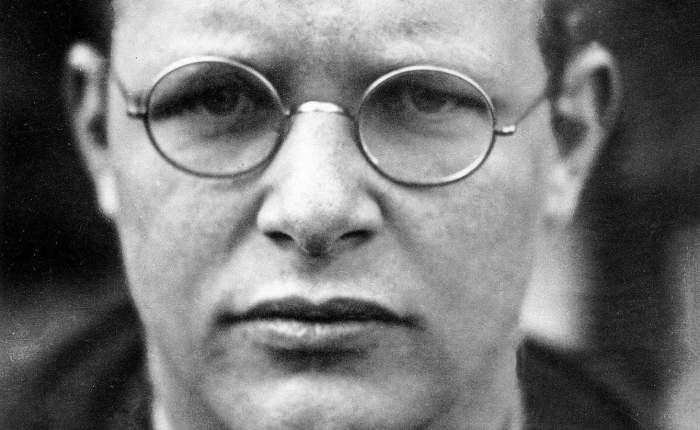
It begins about a hundred years ago, in a city called Breslau. Breslau is in the southwest of Poland today, but a hundred years ago, and up until the end of World War II, it was still a part of Germany. And that’s where this story begins – in Breslau, Germany, a hundred years ago, in 1920, when a young man by the name of Dietrich gave his life to Christ, and decided that he wanted to study the Bible and become a teacher of God’s word.

Dietrich was a very intelligent young man, very devoted to his studies; by 1927 (when he was only 21 years old) he had graduated from the University of Berlin with a doctorate in Theology. Still young, and not quite sure where his place was in the world, he decided to come here to the U.S., and ended up as a professor at Union Theological Seminary in New York City. He was only in the U.S. for one year, but while he was here, he was lovingly accepted into a Baptist church in Harlem, where he taught Sunday School classes, and where he began to encounter the societal injustices being experienced by Christian minorities – in particular, black Christians that he had become friends with. As a white man, but still an outsider, a foreigner from Germany, he had slipped in between these two segregated worlds of American Christians – black and white, rich and poor, educated and uneducated. Dietrich knew his Bible really well. In the Gospels, he read, as we have been reading, about the reality of God’s Kingdom in the here and now. And he wrestled with the contrast between what he was reading about the Church in the New Testament, and what he was seeing the Church do (and not do) in New York and other places.

How could the Church in the New Testament be so united in purpose, and the Church of modern day be so fractured and divided?

Why was the wealthy Church so pre-occupied with its own position on the highest levels of secular society, and so blind to the suffering of the poor Church just a few blocks North?

How does that happen among God’s people? How does one group of Christians become obsessed with finding a seat at the table of high society, while another group focuses on pulling people out of the gutters and giving them food, and clothing, and housing?

Why do the Christians with the most resources at their disposal, hoard their wealth, while those with just enough to get by give away everything they have? Why can’t they work together? Why can’t they find balance in the community of God’s Kingdom – the community of people saved by grace – the community that Jesus gave his life to bring into existence?

What was the answer to these questions?

What could be done about it?

Dietrich wasn’t entirely sure, but he didn’t ignore these tough questions; he wrestled with them. And this unique perspective that he had, as an outsider and foreigner, influenced him a great deal. And he took that perspective with him, when he returned to his homeland in 1931.

When he returned to Germany, he began teaching theology at the University in Berlin where he had received his doctorate four years earlier, and not long after that, he was ordained as a pastor in the Lutheran Church.

And, it was less than two years later, on January 30, 1933, that the Nazis took control of his country.

As we all know now, with our 20/20 historical hindsight, Adolph Hitler’s rise to power would eventually culminate in the horrendous disaster that we call World War II, where millions of people would perish, and where terrible things had to be done in order to stop a man that was closer to an example of the Anti-Christ than almost anyone else in history.

Have there been others like Hitler?

Yes.

Joseph Stalin probably executed more people, for instance. But Hitler did three things that really single him out:

1. He lied to the Christians in Germany that were susceptible to deception.

2. He silenced, imprisoned, and killed the Christians who were not so easily deceived.

3. He waged genocide against the Jewish people.

If Hitler had succeeded in taking over the WHOLE WORLD, he would have been THE Anti-Christ.

As it turned out, he was only one of the many little antichrists like those the Apostle John warned us about in his first epistle (1st John 2:18).

Like I said, we all know this now. It’s more or less common knowledge. But to many of the Christians throughout Germany at the time Hitler took power it wasn’t as clear. Even though it SHOULD HAVE BEEN.

Hitler’s rise to power was hailed as an act of God by the majority of church leaders in Germany at the time. They threw their support behind him completely – telling their congregations that Hitler had been sent by God to lift them out of economic depression, and restore their honor on the world stage. Some went so far as to say that Hitler spoke on God’s behalf, and that the fulfillment of God’s Kingdom was embodied in the person of Adolph Hitler. Churches that had been firmly established and rooted in place for centuries, wasted no time in allowing Hitler to steam roll his way through them. In fact, they stepped aside as he removed Pastors, Bishops, and Elders who were not “pure-bloods” of Aryan descent. They remained silent when he demanded that he, the Fuhrer be recognized as head of the Church (rather than Jesus Christ), and they supported efforts made to remove the Old Testament from the Bible – because of its pro-Jewish agenda. These were not things that happened overnight. They were ideas that Hitler had been preaching for months BEFORE he was in power. There was plenty of opportunity for the churches in Germany to at least try to prevent his ascension to power – by speaking out against him. But those with the most influence in their society, remained silent. Or they openly supported him.

But not everyone.

There were small groupings of Christians in Germany, in the middle of all that madness, who refused to bow down and worship that man.

And the hero of this particular story – Dietrich – was among them.

Just a couple of days after Hitler became Chancellor, Dietrich was able to get onto a radio station in Berlin and sound the alarm.

Before they cut him off mid-sermon, he denounced Hitler and everything he stood for – and he rebuked every Christian who followed him for their idolatry to the “cult of the fuhrer.”

In the months and years that followed, he began organizing the minority groups of Christians who didn’t follow Hitler, by helping to create a network of churches dedicated to voicing opposition to him, as well as to rendering aid to their Jewish neighbors who were already under attack. He was putting into practice what he had learned when he was in New York – that he couldn’t just talk about the Gospel – he had to live in its reality. He couldn’t just stand around and do nothing while so much evil was taking place around him. He had to actually do something about it.

So, he did.

Between 1933 and 1939, he helped organize and lead an underground seminary where he taught his students that the cost of being a modern disciple of Jesus was complete loyalty to the King and His Kingdom, above all else. –Even if it meant losing your friends, losing your family, or losing your country.

And for this, Dietrich was branded an enemy of the state, his coalition of churches and his seminary were deemed illegal by Heinrich Himmler, and Dietrich himself was exiled from the city of Berlin.

Dietrich’s friends in New York City urged him to flee the country, and he did in the Summer of 1939. But he did not stay in the United States for very long. In a letter to one of his former professors at Union Seminary, this is what he wrote, shortly before returning to Germany:

“I have come to the conclusion that I made a mistake in coming to America. I must live through this difficult period in our national history with the people of Germany. I will have no right to participate in the reconstruction of Christian life in Germany after the war if I do not share the trials of this time with my people … Christians in Germany will have to face the terrible alternative of either willing the defeat of their nation in order that Christian civilization may survive or willing the victory of their nation and thereby destroying civilization. I know which of these alternatives I must choose but I cannot make that choice from security.”

It wasn’t long after his return home, that because of close trusted contacts within the German military, he first became aware of concentration camps where Jews were being systematically exterminated. And that put Dietrich in the position of finally having to choose, definitively, which of his two kingdoms he would betray.

Would he become a traitor to Germany? Or would he become a traitor to God’s Kingdom, by looking the other way as his neighbors were being murdered? He chose God’s Kingdom over the kingdom he had been born into.

When asked by a Dutch colleague of his at the time, “what he was praying for these days?” Dietrich told him, “If you want to know the truth, I pray for the defeat of my nation.”

And that’s when Dietrich became a spy.

He began working within the Abwehr – the German Military Intelligence network –which was not yet under the control of the SS. There were many German officers in the Abwehr, already functioning as allied spies against Hitler. They recruited Dietrich with the understanding that he would use his contacts in Europe and the United States to smuggle intelligence to the Allies, and to help Jews escape from Germany. And that’s what he did for the next few years…

Before he was eventually caught and arrested in the Spring of 1943.

Dietrich spent two years in prison for treason, during which time he was the pastor for his fellow prisoners, and even some of his prison guards.

On April 4, 1945 Hitler personally ordered Dietrich’s execution, and he was hung that same week at Flossenburg Concentration Camp.

Two weeks later, the U.S. 90th and 97th Infantry Divisions liberated that camp.

A week after that, the Soviets took Berlin.

Hitler committed suicide at the end of the month, and Germany surrendered on May 7th.

Dietrich’s prayers for the defeat of his nation came to pass. But he himself, had already gone home to his real country.

The doctor who saw Dietrich’s hanging described his final moments like this:

“I saw [the] Pastor … kneeling on the floor praying fervently to God. I was most deeply moved by the way this lovable man prayed, so devout and so certain that God heard his prayer. At the place of execution, he again said a short prayer and then climbed the few steps to the gallows, brave and composed. His death ensued after a few seconds. In the almost fifty years that I worked as a doctor, I have hardly ever seen a man die so entirely submissive to the will of God.”

And that brings, the story of Dietrich Bonhoeffer to a close.

Now… why am I telling you all of this? Why is this story an important one?

Well, let’s finally get to Luke 14:25-33, and you’ll see why…

“Large crowds were traveling with Jesus, and turning to them he said: 26 “If anyone comes to me and does not hate father and mother, wife and children, brothers and sisters—yes, even their own life—such a person cannot be my disciple. 27 And whoever does not carry their cross and follow me cannot be my disciple.

28 “Suppose one of you wants to build a tower. Won’t you first sit down and estimate the cost to see if you have enough money to complete it? 29 For if you lay the foundation and are not able to finish it, everyone who sees it will ridicule you, 30 saying, ‘This person began to build and wasn’t able to finish.’

31 “Or suppose a king is about to go to war against another king. Won’t he first sit down and consider whether he is able with ten thousand men to oppose the one coming against him with twenty thousand? 32 If he is not able, he will send a delegation while the other is still a long way off and will ask for terms of peace. 33 In the same way, those of you who do not give up everything you have cannot be my disciples.”

Now, those are some harsh sounding words, are they not?

There’s a huge crowd following Jesus, and instead of reveling in all of his many followers, it’s almost as if he’s trying to get rid of them. He tells them they can’t follow him unless they hate everyone else… that they even have to hate their own life! Now, he doesn’t mean this literally – that they have to hate. After all, this is Jesus – he teaches us to love everyone, even our enemies.

So, he’s not literally telling us we have to hate ourselves and our families. He’s saying that His Kingdom always comes first. The Kingdom always takes precedence. He’s saying that our love for Him has to be total. Our loyalty to Him has to be complete. He’s saying, if you really want to follow me, you might have to say goodbye to the people you care about. He’s saying: If you say ‘yes’ to me, you might have to say ‘no’ to the people you love.

Jesus is using this allegorical language about building towers and going to war, which might all sound a little strange to us. But he’s pointing out the natural human tendency to look ahead. If we’re being wise, then we think before we make a major decision about something; we think about what that decision is going to mean, and whether or not it’s going to be good or bad, and we think about what we’re going to have to give up, or let go of.

We have to estimate what it’s all going to cost.

How much money to build that building?

How many troops to win that war?

Well, we don’t have to estimate what it costs to follow Jesus; he tells us EXACTLY what it costs – it costs EVERYTHING.

Dietrich knew that. He knew it really well. He knew that we can’t just hide in the comforting glow of God’s grace – that to do so, cheapens the sacrifice that Jesus made. We have to go into the darkness with the light that we have.

We have to do something.

And whatever that is – it might cost us everything.

It MIGHT cost us family; It MIGHT cost us friends; It MIGHT cost us our country.

And if so, that’s ok.

That’s what it means to pick up YOUR CROSS and FOLLOW HIM.

In John 15:18-19, Jesus said quite clearly: “If the world hates you, keep in mind that it hated me first. 19 If you belonged to the world, it would love you as its own. As it is, you do not belong to the world, but I have chosen you out of the world…”

Let’s remember these words of Jesus in the coming months.

Let’s hold tightly to them, as the rhetoric in the world around us becomes louder, and the nonsense becomes overwhelming. Our job is still the same: To love our neighbors, to love our enemies, and to love God the most.

The kingdom we’re living in is temporary; it is crumbling. But the Kingdom we belong to is eternal, and it will never fall.

There won’t be any Democrats or Republicans in Heaven, my friends.

“Then the sovereignty, power and greatness of all the kingdoms under heaven will be handed over to the holy people of the Most High. His kingdom will be an everlasting kingdom, and all rulers will worship and obey him.” – Daniel 7:27

BEATLES Mug

Mug - 16My dad really likes this mug. I’ll admit, The Beatles have never been my favorite band, but I do enjoy their timelessly catchy tunes as much as the next average joe. Of course enough has already been said about them and the deep imprint they have left in the history of modern music and culture–I couldn’t possibly say anything new about all that. But for me personally, when I hear The Beatles (or drink coffee out of their yellow submarine), it brings back memories of all the music my dad and mom listened to… Especially the music they listened to when I was a kid, and the stations they would tune into during long trips in our family’s old Astro mini-van. I remember hearing as much Elvis and Creedence Clearwater Revival as I did The Beatles. Sometimes my mom would bring her cassette tapes and Amy Grant would all the sudden find herself doing an encore for The Beach Boys. I was too young to understand or care about the differences. My parents’ music all blended together. One moment we’d be listening to John Denver sing “Rocky Mountain High” and the next we would be hearing tunes from the traveling Gospel quartet who had been visiting our church a week earlier, peddling their cassette tapes along the way. My parents religiously (pun intended) bought the tapes of every person and group that came through our church–I’m not kidding. A few years ago I found a box that had close to a hundred cassettes in it–all from people who had visited our church over the years to share their music.

The point is… My parents didn’t play music, and they didn’t sing either, but they loved to listen and they loved to collect it. And they taught me to explore the art form on my own, and to discover for myself what I liked and what I didn’t. I think I was in 5th or 6th grade when I started really getting into music enough to want to own the stuff I liked. My parents would buy me blank cassettes, and then I would record stuff right off the radio. I remember hearing the DJ on 99.5 WZPL announce a song that was about to come on, and I would dash across the room so I could hit Play & Record on the tape deck. And my older cousins had tapes that they would let me copy. My cousin Toby introduced me to Bon Jovi’s “Slippery When Wet” — changed my life. That was back when Jon Bon Jovi was an actual rockstar, before someone kidnapped him and removed all the testosterone from his body.

My early musical tastes were widely diverse. By the time I was in high school I was practically in love with Amy Grant, because I had been hearing her sing since I was in kindergarten. But that didn’t stop me from listening to Soundgarden or Metallica, and REO Speedwagon when no one else was around. I remember one time I was in an IRC music store with my dad, and he was letting me pick out an album for my birthday–I chose “Appetite for Destruction” by the infamous Guns N’ Roses. He just shook his head and said, “OK, but don’t show mom.”

Like I said, my parents really let me figure the whole music thing out on my own. When I was young, I heard what they liked, and as I grew older, they gave me the freedom and independence to decide what kinds of music I liked. Just because they didn’t like something, or because some dumb televangelist like Jimmy Swaggart said it was evil, didn’t mean they would stop me from listening to it. And I’m so grateful for that now. They never bought into all the crap about “christian” music versus “secular” music, and how non-Christian music was all from the devil. My youth pastor and his wife were the opposite of my parents when it came to music. They were good people, and I learned some good things from them, but their views on music were not among the lessons I chose to retain. I always thought it was kind of funny that they cared so much about it. I mean, at the outset of every trip we took, they would assign a student to go around checking everyone’s music to make sure no one had anything non-Christian with them. It was fascist and imperial. And we all know the proper response to something imperial–(thank you, Star Wars.) So I made it my mission to sneak as much non-Christian music as I could on board the church bus. And I was successful at it too. I was a supplier for the handful of other “rebels” as well.  How did I accomplish this? How was I so great at smuggling contraband past the music police? Simple. My parents would let me use the outer cases of their Christian music CDs and cassettes to camouflage my music on the inside. When they came around to check my music, they would just see Michael W. Smith, Carmen, and of course Amy Grant… Never knowing that inside was Nirvana, Pearl Jam, and The Doors. Well, ok… Some of the Amy Grant cases actually had the Amy Grant cassettes in them.

Of course when I journeyed off to Christian college, things were on a whole new level. There was no actual rule against having non-Christian music, just a heavy fog of rampant judgmentalism toward those who did. I discovered this firsthand when the worship leader who lived next to me in the dorm almost had a stroke after seeing the Led Zeppelin poster on the outside of my door. I discovered it even more when during my second semester, my room was broken into and all the band posters (including a 6 foot Sgt. Pepper’s display) were all ripped from the walls and replaced with notes warning my roommate and I about our impending journey on the highway to Hell. But we had fun with that sort of thing. A few of my friends got together one night and did a live cover of Jimi Hendrix’s Purple Haze for the entire campus. That didn’t go over too well. But anyway… “we all want to change the world.”

And it’s great, what kind of memories a coffee mug can conjure up.

Originally posted on Instagram @ajcoffman and Facebook on December 4, 2014

Winebrenner Mug

Winebrenner Mug
Mug - 08As one of the previous Curry House regulars pointed out yesterday, sometimes these mugs have seen a little more than just coffee and tea. Such is definitely the case with this Winebrenner mug, which has seen its fair share of rice and curry.

It’s hard to think about my time in the curry house without also thinking about Winebrenner–together the two occupied nearly all of my time between 2008 and 2010. We were always grateful that the professors and staff at the seminary encouraged us so much, with many of them even finding occasion to come to our house themselves and share in our weekly curry night meal.

I think what is most interesting to me when I think back on curry night, is that none of it was planned. The four of us guys who lived in the first incarnation of the Curry House had already been cooking and sharing Indian food with our neighbors for years prior to us moving to Findlay. It’s just what we liked to do. It was hard to explain that at times, especially when leaders and pastors from some of the other churches in town would come to visit–always looking for the secret of our success; always wanting to figure out how to duplicate what we were doing. We always told them the same thing… The truth was that we really didn’t know what was happening most of the time, or why. I moved to Findlay so I could attend Winebrenner without having to commute four hours there and four hours back every week. I didn’t expect (none of us did) that within a few months of moving, a hundred people would be coming over to our place for dinner. It was not always that convenient, and there were many times when we didn’t think we could keep doing it (it was kind of expensive for four graduate students), but we continued on, putting ourselves into God’s hands and trusting him to provide–and of course he did. In four years we never had to call off the meal.

For those out there wondering how to do ministry… It’s not as complicated as we’ve tried to make it. It might include going to bible college or seminary, but it doesn’t have to. All you have to do is look at what God has already given to you, and then share it with those around you—for free!

Originally posted on Instagram @ajcoffman on April 18, 2014

Russian Espresso Cup

Mug - 07This cup is really different from the others I’ve talked about. It’s not a traditional mug by any means, but I have had coffee and tea in it before, and it is the perfect size for an espresso shot. I bought this little tumbler at a factory that produces all sorts of similar goods. It was in an old Russian town called Semyonov, which was a few hours from Nizhny Novgorod — where I was studying for the semester.

It is hard for me to believe that was just over 10 years ago now. When I see the way Russia is often characterized in the news, whether because of the Olympics or because of the actions of its government, I just think to myself–that’s not the Russia I remember.  Those aren’t the people who brought me into their lives, into their homes, who took care of me like I was one of them.

Experiencing Russia was a life changing endeavor for me. It challenged me in several ways. Just living in a city was a new experience for me. It’s really too much to go into for a small post such as this, but I have written about it much more extensively before. If you follow this link, or type it into your browser, it will take you to the chapter of a book I finished writing in 2008 about my time in college. This particular chapter can be read apart from the rest of the book, and is a stand-alone story about the time I spent in Russia.

http://crossing-kcu.com/10-walking-in-russia/

Anyway, that’s all for today’s installment. As they say in Russia, “paca.” Until next time.

Originally posted on Instagram @ajcoffman on April 17, 2014

Laura’s Mug

Laura’s Mug
Laura's MugI really love this mug. There is none other exactly like it on planet Earth. It was a gift from my friend Laura, a.k.a. @sweetlauralai (she also painted it herself, which makes it even more awesome). I met Laura at Kentucky Christian University back in 2002. I was skeptical at first. My bros and I were a close knit group. To be honest, there weren’t very many girls that you could just have fun hanging out with on the campus back then. They were either the kind who looked down at you for listening to ‘non-Christian’ music, watching rated R movies, and wearing jeans to chapel services–or they were the kind who just wanted to graduate with their MRS degree. There were some exceptions of course. Laura was one of the exceptions. I realized that when she was hanging out with us dudes one night, and during a conversation she just lifted her leg up and farted really loud–then went on like nothing happened. We were buddies after that. I think Laura was only at KCU for about a year or so before transferring to Johnson Bible College (now Johnson University), but we still stayed in contact and whenever our larger group of friends would come to my parent’s house to visit in Indiana, she was usually there. These days, I haven’t talked to her for quite awhile, but I still remember how fun it was to hang out with such a great sister, and I especially miss those times we would have long talks and pray together. I’m also really happy that this mug has survived all these years intact. I still have plenty more to talk about, and I’ve enjoyed sharing the others so far, but I think this one is my favorite.
Originally posted on Instagram @ajcoffman on April 16, 2014

Jesus Christ is God

I always look forward to those rare moments that come along where a random interaction with someone leads to a deeper discussion about something serious, or when a seemingly inconsequential series of events culminates into something that is extremely important, or when something that seems insignificant in the grand scheme of things, becomes the prelude to something with fundamental purpose.

I experienced one of these occasions this past weekend when I went to my cousin’s high school graduation party. After I walked in and helped myself to a fine brunch buffet, I sat down in the living room to chat with my older sister and my dad while we watched a slide show of my cousin’s life. There were several people milling about the house, and there was nothing really out of the ordinary at all. It was pretty much what you expect each year when these types of parties roll around. But within just a few minutes of my arrival, everything changed.

As I was sitting on the couch, discussing home remodeling issues with my sister, a guy from my home church sat down in another chair across the living room. I’ve talked with Rob before, and he’s a great guy who I’ve had a few good discussions with in the past. He loves to talk about God. I could tell as I was chatting with my sis, that he was waiting for a break in our conversation so that he could engage me in a discussion. Well, sure enough, as soon as I finished talking Rob began asking me questions. He began with the usual questions about school and what I was studying at seminary. When I told him I was studying theology and church history his eyes lit up and he immediately sent what can only be described as a barrage of theological questions my way.

Rob asked me some good questions, like who is God? And what is God’s name? I proceeded with a brief discourse about the trinity, to which Rob replied by asking me where in the Bible it talked about the nature of God. I quoted a few passages and then went on to talk about some of the erroneous views of Christ, as Rob asked me some more questions. The questions kept coming and the conversation continued into the next half hour or so. After we reached a point where Rob was sufficiently satisfied that he understood what I believed about God, he then informed me with a grin on his face that he did not believe in the trinity, and that he did not believe that Jesus was God.

To say that I was shocked at this information would not do justice to my internal reaction upon hearing this from Rob. I didn’t know what to say as Rob launched into a discourse that involved his misinterpretation of key passages in the New Testament. The whole time he was speaking, I kept thinking to myself, “is this really happening?”

Knowing that Rob was an influential youth group sponsor, not to mention a member of my home church, I couldn’t resist asking him if the elders of our church knew what he believed. He informed me that they did, and that they had told him they didn’t mind as long as he still believed that Jesus was the Son of God. I went home that afternoon in a haze of confusion, unable to make any sense out of the nonsense I had just heard from this guy that I really did have some genuine respect for, and to tell you the truth, I was even a little depressed by it all.  I felt kind of like I had stumbled into the bizzaro world from Superman, where everything is the complete opposite of what it’s supposed to be.

For anyone who doesn’t know, the deity of Jesus Christ as part of the Trinity is a fundamental, basic doctrine of Christianity, and has been since the inception of the Church. This is also referred to as the Incarnation, which means that Jesus is God come into human history in the flesh. It is the foundation of our entire faith. The scriptures are not vague on this particular issue; they are in fact abundantly clear. Even the Jehovah’s Witnesses, who do not believe that Christ is God, have been forced to produce their own separate mistranslation of the Bible in an effort to avoid the point that Christ is God. If Satan was only ever able to tell one single lie, somewhere at the top of his list would be the lie that Jesus is not God. Because if Satan can get someone to believe that, he can get them to believe absolutely anything. Let’s take a look at the scriptures, shall we?

Matthew 1:22 and Isaiah 7:14
“All this took place to fulfill what the Lord had said through the prophet: ‘The virgin will be with child and will give birth to a son, and they will call him Immanuel’—which means, ‘God with us.’”

Matthew 4:10
“Jesus said to him, ‘Away from me, Satan! For it is written: Worship the Lord your God, and serve him only.’”

Matthew 28:9
“So the women hurried away from the tomb, afraid yet filled with joy, and ran to tell his disciples. Suddenly Jesus met them. “Greetings,” he said. They came to him, clasped his feet and worshiped him. Then Jesus said to them, “Do not be afraid. Go and tell my brothers to go to Galilee; there they will see me.’”

Mark 2:5-7
“When Jesus saw their faith, he said to the paralytic, ‘Son, your sins are forgiven.’
Now some teachers of the law were sitting there, thinking to themselves, ‘Why does this fellow talk like that? He’s blaspheming! Who can forgive sins but God alone?’”

John 1:1-5, 14
“In the beginning was the Word, and the Word was with God, and the Word was God. He was with God in the beginning. Through him all things were made; without him nothing was made that has been made. In him was life, and that life was the light of men. The light shines in the darkness, but the darkness has not understood it… The Word became flesh and made his dwelling among us. We have seen his glory, the glory of the One and Only, who came from the Father, full of grace and truth.”

John 5:17-23
“Jesus said to them, ‘My Father is always at his work to this very day, and I, too, am working.’ For this reason the Jews tried all the harder to kill him; not only was he breaking the Sabbath, but he was even calling God his own Father, making himself equal with God.


Jesus gave them this answer: ‘I tell you the truth, the Son can do nothing by himself; he can do only what he sees his Father doing, because whatever the Father does the Son also does. For the Father loves the Son and shows him all he does. Yes, to your amazement he will show him even greater things than these. For just as the Father raises the dead and gives them life, even so the Son gives life to whom he is pleased to give it. Moreover, the Father judges no one, but has entrusted all judgment to the Son, that all may honor the Son just as they honor the Father. He who does not honor the Son does not honor the Father, who sent him.’”

Exodus 3:13-14 and John 8:57-58
“Moses said to God, ‘Suppose I go to the Israelites and say to them, ‘The God of your fathers has sent me to you,’ and they ask me, ‘What is his name?’ Then what shall I tell them? God said to Moses, “I am who I am. This is what you are to say to the Israelites: ‘I AM has sent me to you.’”


“You are not yet fifty years old,’ the Jews said to him, ‘and you have seen Abraham!’
‘I tell you the truth,’ Jesus answered, ‘before Abraham was born, I am!’”

John 10:27-33
“My sheep listen to my voice; I know them, and they follow me. I give them eternal life, and they shall never perish; no one can snatch them out of my hand. My Father, who has given them to me, is greater than all no one can snatch them out of my Father’s hand. I and the Father are one.’ Again the Jews picked up stones to stone him, but Jesus said to them, ‘I have shown you many great miracles from the Father. For which of these do you stone me?’ ‘We are not stoning you for any of these,’ replied the Jews, ‘but for blasphemy, because you, a mere man, claim to be God.’”

John 12:44-46
“Then Jesus cried out, ‘When a man believes in me, he does not believe in me only, but in the one who sent me. When he looks at me, he sees the one who sent me. I have come into the world as a light, so that no one who believes in me should stay in darkness.’”

John 20:28-29
“A week later his disciples were in the house again, and Thomas was with them. Though the doors were locked, Jesus came and stood among them and said, ‘Peace be with you!’ Then he said to Thomas, ‘Put your finger here; see my hands. Reach out your hand and put it into my side. Stop doubting and believe.’ Thomas said to him, ‘My Lord and my God!’”

Acts 20:28
“Keep watch over yourselves and all the flock of which the Holy Spirit has made you overseers. Be shepherds of the church of God, which he bought with his own blood.”

Romans 9:5
“Theirs are the patriarchs, and from them is traced the human ancestry of Christ, who is God over all, forever praised! Amen.”

Colossians 1:15-20
“He is the image of the invisible God, the firstborn over all creation. For by him all things were created: things in heaven and on earth, visible and invisible, whether thrones or powers or rulers or authorities; all things were created by him and for him. He is before all things, and in him all things hold together. And he is the head of the body, the church; he is the beginning and the firstborn from among the dead, so that in everything he might have the supremacy. For God was pleased to have all his fullness dwell in him, and through him to reconcile to himself all things, whether things on earth or things in heaven, by making peace through his blood, shed on the cross.”

Colossians 2:8-10
“See to it that no one takes you captive through hollow and deceptive philosophy, which depends on human tradition and the basic principles of this world rather than on Christ. For in Christ all the fullness of the Deity lives in bodily form, and you have been given fullness in Christ, who is the head over every power and authority.”

Philippians 2:5-11
“Your attitude should be the same as that of Christ Jesus: Who, being in very nature God, did not consider equality with God something to be grasped, but made himself nothing, taking the very nature of a servant, being made in human likeness. And being found in appearance as a man, he humbled himself and became obedient to death—even death on a cross! Therefore God exalted him to the highest place and gave him the name that is above every name, that at the name of Jesus every knee should bow, in heaven and on earth and under the earth, and every tongue confess that Jesus Christ is Lord, to the glory of God the Father.”

1 Corinthians 8:4-6
“So then, about eating food sacrificed to idols: We know that an idol is nothing at all in the world and that there is no God but one. For even if there are so-called gods, whether in heaven or on earth (as indeed there are many “gods” and many “lords”), yet for us there is but one God, the Father, from whom all things came and for whom we live; and there is but one Lord, Jesus Christ, through whom all things came and through whom we live.”

Titus 2:11-14
“For the grace of God that brings salvation has appeared to all men. It teaches us to say ‘No’ to ungodliness and worldly passions, and to live self-controlled, upright and godly lives in this present age, while we wait for the blessed hope—the glorious appearing of our great God and Savior, Jesus Christ, who gave himself for us to redeem us from all wickedness and to purify for himself a people that are his very own, eager to do what is good.”

1 John 5:20
“We know also that the Son of God has come and has given us understanding, so that we may know him who is true. And we are in him who is true—even in his Son Jesus Christ. He is the true God and eternal life.”

Hebrews 1:8
But about the Son he says, ‘Your throne, O God, will last for ever and ever, and righteousness will be the scepter of your kingdom.’”

2 Peter 1:1
“Simon Peter, a servant and apostle of Jesus Christ, To those who through the righteousness of our God and Savior Jesus Christ have received a faith as precious as ours:”

Revelation 1:8 and 17-18
“’I am the Alpha and the Omega,’ says the Lord God, ‘who is, and who was, and who is to come, the Almighty.’”

“When I saw him, I fell at his feet as though dead. Then he placed his right hand on me and said: ‘Do not be afraid. I am the First and the Last. I am the Living One; I was dead, and behold I am alive for ever and ever! And I hold the keys of death and Hades.’”

Likewise, the following sets of verses are places where the New Testament refers to Christ by the same designation used to refer to God in the Old Testament:

First and Last
Isaiah 41:4; 44:6; 48:12 – cf. – Revelation 1:17; 2:8; 22:13

Light
Psalm 27:1 – cf. – John 1:9

Rock
Psalm 18:2; 95:1 – cf. – 1 Corinthians 10:4; 1 Peter 2:6-8

Husband” or “Bridegroom
Hosea 2:16; Isaiah 62:5 – cf. – Ephesians 5:28-33; Revelation 21:2

Shepherd
Psalm 23:1 – cf. – Hebrews 13:20

Redeemer
Hosea 13:14; Psalm 130:7 – cf. – Titus 2:14; Revelation 5:9

Savior
Isaiah 43:3 – cf. – John 4:42

Lord of Glory
Isaiah 42:8 – cf. – 1 Corinthians 2:8

In summation, there is this thing that we Christians believe called the doctrine of the Trinity, which in short means that there is one God, revealed to us as God the Father, God the Son, and God the Holy Spirit.

For anyone struggling to better understand the doctrine of the Trinity, I would recommend a reading of Mere Christianity by C.S. Lewis, wherein he devotes several chapters to the subject. His discussion of the Trinity helped me a great deal at a time when I was searching for more clarity on this doctrine.

John Maxwell’s 21 Irrefutable Laws – Refuted

Several years ago I was helping a friend of mine clean out his dorm room at the end of the school year. We were finishing up another year at Kentucky Christian University, and I was just concluding my first year as a resident assistant. Being an RA that year was my introduction to the world of formal/vocational ministry, and as fleeting a role as it was, it turned out to be an important experience for me. I was faced with many challenges during that time, not the least of which was learning to follow Christ even when my employers and supervisors were telling me to do the opposite. Throughout that year, and on into the next, I learned one of the most difficult but important lessons that I have ever learned… that Christ’s way of leading people is radically different from anything else that this world terms as leadership, that it is extremely challenging to follow Christ’s example in this area, and that at some point those attempting to follow his example will meet with opposition. Sadly, the opposition will usually come from other Christian leaders who have a warped understanding of what it means to lead.

So as my friend Jeff and I were cleaning out his dorm room that spring, I noticed a pile of books he was getting rid of and started to thumb through them. Among them was a book that caught my attention called The 21 Irrefutable Laws of Leadership, with the interesting subtitle, Follow Them and People Will Follow You. I asked Jeff about it and he replied that he had never read it, but it was a book that he had been assigned for a preaching class he had taken that semester. I thought it seemed like an extremely interesting, if not extremely boastful title, and since the idea of leadership was fresh in my mind, I thought I would take a look. I mean, this book had been assigned reading for all the preaching majors, so there had to be something about it that was helpful to those in leadership. Or so I thought.

Well, that was several years ago now, but ever since then I have occasionally been reminded of the fact that it was, and still is, one of the worst books I have ever read. It not only epitomizes everything that is wrong with church leadership in this country, but it also sticks out as a perfect example of the kind of pride, arrogance, and self-righteousness that plagues so many Christian leaders today. Yes, just in case there is any doubt as to what I’m saying, this book is straight from the darkest pit of Hell.

To say that I’m going against the grain on this sentiment would be a gross understatement. The author, John C. Maxwell is considered by the masses (including those in church leadership around the country) to be the foremost authority on the topic of leadership alive today. The 21 Irrefutable Laws is considered to be Maxwell’s cornerstone book, and has sold over 1 million copies by itself. Maxwell is a former preacher turned leadership guru, and has been quite successful as the founder of several leadership organizations and consulting firms that cater to millions of people all over the world. His latest release, Leadership Gold, joins his other works that number over two dozen and have collectively sold more than 13 million copies. Despite whatever anyone might say to criticize the guy, his leadership philosophy will no doubt continue to amass the worship of millions for years to come.

With that said, I’m going to take a stab at this book. The 21 Irrefutable Laws, which provide the basis for Maxwell’s entire leadership philosophy, is probably, in my opinion, one of the most deceptive titles out there. In all seriousness, it could more accurately be described as, “The 21 utterly refutable illusions of witchcraft.” That probably sounds really harsh, but it is the unfortunate truth. If this was a purely secular book, and Maxwell was not a Christian leader, I would have no problem with the book at all. However, the main consumers of Maxwell’s ideology are Christian leaders and those in Church ministry; a fact that continues to perplex me beyond all reason, and compels me to say something, even if no one is listening.

First and foremost (to begin with the most obvious flaw), this book contains absolutely no mention of Jesus Christ at all. Not at all. I would submit, that any book claiming to deal with irrefutable leadership principles, should probably somewhere make mention of the greatest leader of all time – God. Considering the author is a Christian, I don’t think that’s unreasonable. I don’t buy in to this idea that not mentioning Christ is a way to reach the unbelieving world… that’s just stupid. Getting a book about leadership, that makes no mention of Jesus Christ, from a Christian leader, is the same as getting a hamburger with no meat.

Second, I would point out that the very definition of witchcraft—not bubble gum witchcraft that conjures images of jack-o-lanterns, broomsticks, and all that Harry Potter kind of stuff—but real witchcraft, in its most basic form, is simply nothing more than the art of learning how to influence, control, and manipulate people… or in Maxwell’s more digestive language, “getting people to follow you.”

Getting people to follow you has absolutely nothing at all to do with what it means to be a Christian, which by definition means being a follower of Christ alone. Moreover, the New Testament does not contain a single teaching about how to influence people and get them to follow you. It’s simply not a concern of the New Testament writers at all. The goal, the mission, the mandate, for anyone claiming to be a follower and disciple of Jesus Christ, especially those in ministry and leadership positions within the Church, should always be to point the way to Christ and help people learn what it means to follow Him. Any book, philosophy, teacher, or lecturer which offers a way for you to learn how to get other people to follow you, is by its very nature, completely pagan.

To illustrate my point, I’ll proceed with a brief breakdown of the chapters in the book, the essence of what each one is teaching, and what the Bible has to say in contrast.

1: Law of the Lid – Leadership ability determines a person’s level of effectiveness

According to Romans 12:8, leadership is a gift from God, nothing more, and nothing less. With that said, a person’s level of effectiveness, in any endeavor, is directly the result of whether or not they are acting in accordance with God’s will. For the Christian, there is really no such thing as effectiveness; there is obedience, and there is disobedience.

“For by the grace given me I say to every one of you: Do not think of yourself more highly than you ought, but rather think of yourself with sober judgment, in accordance with the measure of faith God has given you. Just as each of us has one body with many members, and these members do not all have the same function, so in Christ we who are many form one body, and each member belongs to all the others. We have different gifts, according to the grace given us. If a man’s gift is prophesying, let him use it in proportion to his faith. If it is serving, let him serve; if it is teaching, let him teach; if it is encouraging, let him encourage; if it is contributing to the needs of others, let him give generously; if it is leadership, let him govern diligently; if it is showing mercy, let him do it cheerfully.” –Romans 12:3-8

2: Law of Influence – The true measure of leadership is influence

The measure of pagan leadership might be influence, but Christian leadership is different. In this chapter Maxwell quotes one of his favorite personal proverbs saying, “He that thinketh he leadeth, and hath no one following him, is only taking a walk.” My immediate response would be that Maxwell isn’t familiar with the Old Testament prophets, and especially the story of Jeremiah, who ministered and prophesied faithfully and obediently for somewhere around 40 years, with no one listening or responding to him in any significant way. The measure of a Christian leader is determined by how willing you are to obey God and serve others, no matter what it means, or what it might cost you.

3: Law of Process – Leadership develops daily, not in a day

Maxwell expounds upon this with the underlying thought that leadership is attained through goal-setting, and must be worked toward. This doesn’t line up with scripture either. God is the one who chooses and develops leaders, not through their own efforts at completing goals they’ve set for themselves, but through God’s grace and discipline. God may take years to develop someone into a leader, but it is his work, not ours, and he usually accomplishes this through suffering.

“During the days of Jesus’ life on earth, he offered up prayers and petitions with loud cries and tears to the one who could save him from death, and he was heard because of his reverent submission. Although he was a son, he learned obedience from what he suffered and, once made perfect, he became the source of eternal salvation for all who obey him…” –Hebrews 5:7-9

4: Law of Navigation – Anyone can steer the ship, but it takes a leader to chart the course

I submit that Christ is both the captain and the navigator, and it is our privilege to be members of his crew.

5: Law of Addition – Leaders add value by serving others

This is a recent revision that Maxwell has made, attempting to accommodate something resembling servanthood. However, again there is no mention of Christ. From Christ’s point of view, the purpose of serving others is to show them who Christ is.

“You call me `Teacher’ and `Lord,’ and rightly so, for that is what I am. Now that I, your Lord and Teacher, have washed your feet, you also should wash one another’s feet. I have set you an example that you should do as I have done for you.” –John 13:13-15

6: Law of Solid Ground – Trust is the foundation of leadership

“For no one can lay any foundation other than the one already laid, which is Jesus Christ.” -1st Corinthians 3:11

7: Law of Respect – People naturally follow leaders stronger than themselves

In this chapter Maxwell generates the idea that leadership can be measured according to different levels. In other words, he says that there are level one leaders, and level two leaders, and so on, and that your position on this number scale determines who will follow you and who will not. The underlying insinuation that goes along with this kind of thinking is that our goal in Christian ministry is to engage in the pagan ritual of jockeying for a better position on the proverbial ladder so we can get above everyone else and have more people under us. This whole way of thinking is dangerous for any Christian. The result of following this kind of teaching is that a person develops a constant concern with how “strong” they are, and they inevitably begin to compare themselves with others. The Apostle Paul, in defense of his own ministry says, “We do not dare to classify or compare ourselves with some who commend themselves. When they measure themselves by themselves and compare themselves with themselves, they are not wise.” –2nd Corinthians 10:12. He later concludes, “For it is not the one who commends himself who is approved, but the one whom the Lord commends.” -2nd Corinthians 10:18

8: Law of Intuition – Leaders evaluate everything with a leadership bias

This is another good place to restate the point that Maxwell’s idea of leadership is not Christ’s idea of leadership. Christ’s definition of leadership is serving others with the knowledge that Christ is the leader. In that sense, anyone who leads from a Christian perspective must evaluate everything according to what God has said in the Bible and through prayer.

9: Law of Magnetism – Who you are, is who you attract

Again, it is a pagan idea that attracting people to us has anything to do with what it means to be a Christian, let alone a leader in the Church. Our mission is to attract people to Christ, which God does through us.

“But thanks be to God, who always leads us in triumphal procession in Christ and through us spreads everywhere the fragrance of the knowledge of him. For we are to God the aroma of Christ among those who are being saved and those who are perishing. To the one we are the smell of death; to the other, the fragrance of life. And who is equal to such a task? Unlike so many, we do not peddle the word of God for profit. On the contrary, in Christ we speak before God with sincerity, like men sent from God.” –2Corinthians 2:14-17

10: Law of Connection – Leaders touch a heart before they ask for a hand

The problem with an idea like this is that you can’t really reach a person’s heart if your purpose in doing so is to get them to follow you. That’s called manipulation. It’s like saying to yourself, “Hey, I’m going to serve and love this person, so they will do what I say.” It may be true, that if you serve and love someone, they will be more inclined to listen to you, but the whole point is getting people to listen to God.

11: Law of the Inner Circle – A leader’s potential is determined by those closest to him

Well, this almost sounds like it could be true, and that’s what makes it so deceptive. Think about Christ again. Was Christ’s potential determined by his 12 disciples? Of course not.

12: Law of Empowerment – only secure leaders give power to others

Wow. There’s some strong wording here: power. Maxwell is telling me that I actually have some kind of power, and that if I’m secure in my power, I can actually allow others to share my power.

“For we do not preach ourselves, but Jesus Christ as Lord, and ourselves as your servants for Jesus’ sake. For God, who said, “Let light shine out of darkness,” made his light shine in our hearts to give us the light of the knowledge of the glory of God in the face of Christ. But we have this treasure in jars of clay to show that this all-surpassing power is from God and not from us.” –2nd Corinthians 4:5-7

13: Law of the Picture – people do what people see

This is sometimes true, but not always. If I’m attempting to memorize a set of principles on how to get people to follow me, and those people start following me, then it is possible that they might, in turn, begin to memorize the same rules so people will follow them. I could be in trouble if that happened, because then they might go up on the leadership scale and stop following me.

14: Law of Buy-in – people buy into the leader, then the vision

God have mercy on me if I ever start to think that people need to “buy-in” to me.

“May I never boast except in the cross of our Lord Jesus Christ, through which the world has been crucified to me, and I to the world.” –Galatians 6:14

15: Law of Victory – leaders find a way for the team to win

I’m not sure that this can be construed in any way to apply to Christianity, but if it were, and the team was say, the Church, then victory has already been achieved for us through Christ’s death and resurrection. If I’m a Christian leader, and I’m seeking a way for the people I’m serving to “win,” my only course of action is obedience to God. I have to do what God tells me to do, and I have to encourage others to do what God tells them to do. But from a Biblical perspective, obedience to God often looks a lot more like losing than winning, at least in a fleshly sense. In this chapter Maxwell makes the statement that it is the job of a leader to make things better for the people. But Christ is our leader, and he says to us, “If anyone would come after me, he must deny himself and take up his cross and follow me. For whoever wants to save his life will lose it, but whoever loses his life for me and for the gospel will save it. What good is it for a man to gain the whole world, yet forfeit his soul?” –Mark 8:34-36

16: Law of the Big Mo – momentum is a leader’s best friend

Maxwell’s main point here in this chapter is that momentum exaggerates things in positive ways. My question is this: if I’m a Christian leader, why would I want to exaggerate whatever it is that I’m doing? Why would I want to mislead people in any way? I’m not even sure what momentum means in terms of Christian ministry and leadership, and I’m definitely not sure about how momentum can be my “best friend.” It sounds to me like this is another way of saying, “If we’re growing, it makes me look better.”

17: Law of Priorities – leaders understand that activity is not necessarily accomplishment

In this chapter Maxwell states his own personal code for deciding what a priority to him is. He sums it up this way: Requirements, Returns, and Rewards… what he is required to do, what gives him the greatest return, and what is most rewarding. For the Christian, priorities are determined by God, and what it means for us to be obedient to him. I cannot imagine being in ministry, and thinking that my main priorities should be related to what I can get out of my position as a leader.

18: Law of Sacrifice – leaders must give up to go up

Sacrifice is an important part of being a Christian. But again there is no mention of Christ here. But also troubling in this statement is the notion that sacrifice is something I should do when it is beneficial to me.

19: Law of Timing – When to lead is as important as what to do and where to go

20: Law of Explosive Growth – to add growth, lead followers, to multiply, lead leaders

21: Law of Legacy – a leader’s lasting value is measured by succession

These last three laws finish up Maxwell’s formula for trying to be a leader. In the corporate business world, or in government, or in sports, these all might actually work… In fact, his whole philosophy is probably great for those sorts of things. But when it comes to the Christian faith, it is completely incompatible. And it burns me up to think that so many Christian ministers and Church leaders are buying into this crap. In the 21st Law, Maxwell states that, “there is no success without a successor.” There is no way you can apply that to Christianity. Christ doesn’t have a successor. And this just reinforces the idea that if you make any attempt to apply these “irrefutable laws” to the Christian faith, ministry, and Church leadership in general, what you end up with is a formula for replacing Christ’s role as head of the Church. While some of these principles might work, from a physical point of view, what are you really accomplishing as a follower of Christ, if all you’re doing is figuring out how to get people to follow you?

“Jesus called them together and said, ‘You know that those who are regarded as rulers of the Gentiles lord it over them, and their high officials exercise authority over them. Not so with you. Instead, whoever wants to become great among you must be your servant, and whoever wants to be first must be slave of all.’” –Mark 10:42-44