Dailey Chapel’s Annual Basket Dinner

Dailey Chapel’s Annual Basket Dinner

This past Sunday, I decided to depart from our regularly scheduled program, to deliver a message that suited the occasion – our church’s annual celebration which we call “Basket Dinner.”

One thing that I find interesting about Basket Dinner – and this was true from the very first time I heard someone mention it. Back when I had no clue what it was… Basket Dinner has always been talked about around here, like it’s a universal event; as if it’s something that every Christian on Earth celebrates every year – like Christmas and Easter.

I remember once, asking a younger Caleb Dickey who grew up in my church, about Basket Dinner — just a few weeks after I moved out here… before I had ever been to one, and he was still in High School at the time, but he described Basket Dinner, as if it was a universal, concrete fixture of reality – something that all Christians partake of each year. And I know that he knew it wasn’t this universal Christian holiday, but that’s how he spoke about it. And it made me realize, that this was a deeply rooted part of Dailey Chapel’s history. I’ve realized that more and more with each year that I’ve been here.

Basket Dinner is a special, unique fixture of Dailey Chapel, and it’s very personal and meaningful to us, especially to all those who have celebrated it for decades, or for some – most of their lives, or whole lives. But there is also something about it, that is relatable to all churches.

So… I was thinking, this past week, about how we observe this special Sunday each year to honor those who’ve come before us, and met together in years past under the banner of Dailey Chapel – whether it was in our current building, or the previous one.

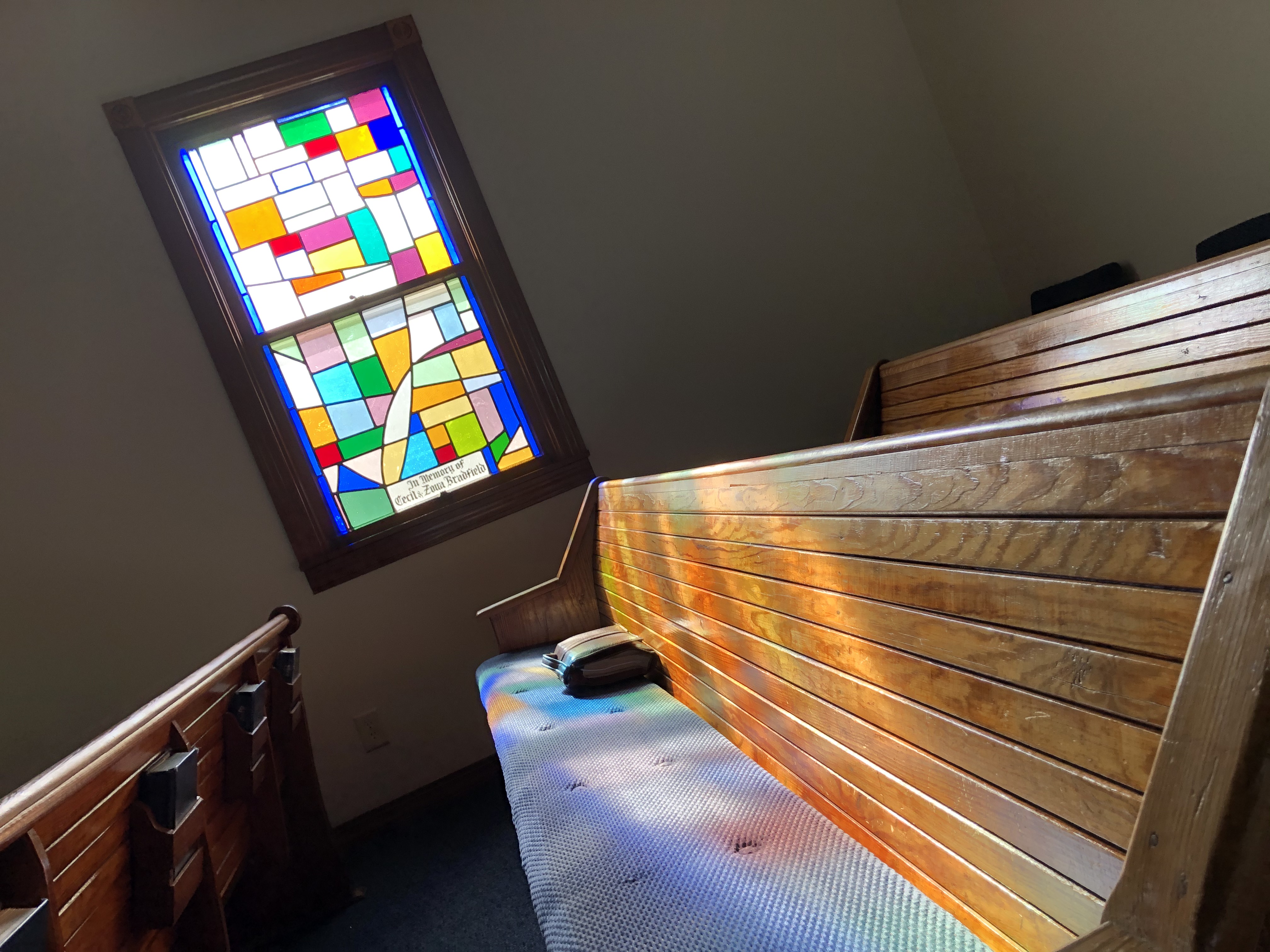
And, off course we know, that a building isn’t what makes a group of people into a church – it’s the gathering together, in fellowship, around the Lord’s table, around his word, to break bread and pray. Those are the main ingredients of church. A building isn’t necessary – it’s a blessing, and a luxury, and we enjoy having it – but the church isn’t a building.

If you ever happen to be up here, sometime after dark, by yourself, you’ll realize very quickly how different this building is when the people of the light are not gathered together in it. We’re up in the woods, and it’s a VERY scary place at night!

And at one point, in the past — as Mrs. Joanie Lunsford retells our history each year — the people of Dailey Chapel lost their building in a fire, about 84 years ago. But they didn’t lose each other, and they didn’t lose their faith. And as far as I can tell, they used the opportunity to grow stronger. And the evidence is all around us now. All those people are gone, but their church has outlived them.

It’s a feature of our existence on earth that sometimes, things have to go wrong, or something bad has to happen, in order for God to receive the glory that is due him. Sometimes, things have to go wrong, so that, they can be made right again – proving that our God is one of redemption, renewal, recovery, and restoration.

And this is nothing new. This is an old lesson – one that’s true for all of us. It’s woven into the fabric of reality itself.

And Scripture teaches us this old lesson over and over again. That things sometimes have to go wrong, before they can be made right. That things have to be broken, so that they can be put back together even stronger than they were. King David said in Psalm 30 that “there is weeping throughout the night, but joy comes in the morning.”

One of the beautiful things about the stories in Scripture, is how they capture truths that are common to all people of all times. The stories themselves are rooted in history, among real people, who really lived. But the lessons that the people in the stories learn, transcend the times and places in which they happened. In other words, the lessons that God wants us to learn are the same lessons that He has always wanted His people to learn.

And one of the biggest lessons – is that sometimes things go wrong, so that God’s people can remember their need for him, in all areas of life. And when they do, then the soil of hardship produces the fruit of victory.

That’s what we’re really commemorating each year on Basket Dinner Sunday. And as I said, it’s an old lesson – and it’s told over and over in the pages of Scripture, through the lives of many people.

We could go back to Genesis and read about Abraham for instance. A lot of things went wrong in Abraham’s life. He was constantly ending up in places he shouldn’t have been, and at times, in situations that were dangerous. And God always took care of him. God blessed him abundantly.

But the main thing on his mind was the fact that he wasn’t going to have any children to leave behind after him. So what did God do? He let Abraham and Sarah get so old, that the prospect of having children was completely hopeless from a human perspective. Sarah had presumably already gone through menopause, I think it’s safe to say – she was 90! But God allowed her to get pregnant and give birth to Isaac, through whom, she became the Mother of Nations. Hopelessness was turned into blessing.

Abraham and Sarah’s grandson Jacob, learned the same lesson. He was forced to flee his family, and leave behind his home, and everything he had – his own brother literally wanted to murder him. Everything went wrong in his life. He lost everything, just so God could get his attention.

And once God had his attention, he put Jacob’s life back together piece by piece. He blessed him with wealth and abundance, and many children, and peace with his brother who had wanted to kill him. Jacob’s life had to go completely off the rails, before it could be put on the right track.

Jacob had a son named Joseph. Joseph became the head official of the Egyptian Empire, second only to the Pharaoh. But he got to that position, only after spending years as a prisoner, sold into slavery by his own brothers because they were jealous of him.

From what we read about Joseph, he didn’t really do anything wrong. God wasn’t putting him through difficult circumstances to get his attention like he had done with his father Jacob. God already had Joseph’s attention. And because of that, he was able to use Joseph’s life as a powerful foreshadowing of Jesus. But that meant suffering, before it meant victory.

God let Joseph’s whole life go wrong on the floor of a dungeon, and then, he lifted him up out of the pit, by making him the Prime Minister of Egypt, and using his talents, and ingenuity to save millions of people from starvation, including his own brothers who had sold him into slavery.

It was those same brothers that Joseph spoke to in Genesis 50:20, saying to them, “You intended to harm me, but God intended it for good to accomplish what is now being done, the saving of many lives.” 

300 years after Joseph died, the same thing happened, on a much larger scale. All of the Hebrews were slaves in Egypt. And God used Moses to bring them out of bondage and form them into their own nation.

Then there’s the Judges and the Kings. Their were those like Samson who was strong and powerful, but had to have his strength taken from him, and his eyes burned out, and his body put in chains – all so God could show Samson and his enemies where strength and power truly come from.

I mentioned King David already. We see this pattern play out many times as we read about his life in 1st and 2nd Samuel. His life was constantly falling apart, and going wrong, and each time, he came back stronger.

When he was still a teenager, he became stronger than all the fighting men in his nation. When he was a fugitive, God sheltered him. When he sinned, God forgave him. When he lost a child, God comforted him. Whenever David lost his way, the Lord was there, to pick him up, and set him on the right path again.

It’s David who wrote, in Psalm 30:1-5, “I will exalt you, LORD, for you lifted me out of the depths and did not let my enemies gloat over me. LORD my God, I called to you for help, and you healed me.You, LORD, brought me up from the realm of the dead; you spared me from going down to the pit. Sing the praises of the LORD, you his faithful people; praise his holy name.For his anger lasts only a moment, but his favor lasts a lifetime; weeping may remain for a night, but rejoicing comes in the morning.”

Sometimes things have to go wrong, before they can go right.

Moses led the Israelites into a dead end, so God could make a new path for them through the sea.

Jonah had to be eaten by a fish, so that the people of Nineveh could be saved.

Esther was forced into the harem of King Xerxes, so that she could become the queen and save her people from genocide.

Hezekiah had to be face to face with the entire Assyrian army on his front porch, so that God could give him a front row seat to their complete annihilation by one of his angels.

Jerusalem was destroyed by Nebuchadnezzar, so that Nehemiah could rebuild it for people who learned that the Lord gives, the Lord takes away, and the Lord gives again.

That’s the whole story of Job too. The Lord allowed Satan to take everything the man had – his wealth, his family, even his health. Where most of us would probably complain to God about something like, Job only said: “The Lord gave, and the Lord has taken away; Blessed be the name of the Lord.” And then God gave it all back to him double.

We could go on identifying this same lesson in Bible stories all afternoon.

Peter denied that he knew Jesus, before realizing how much he loved him, and was willing to die for him.

Paul had to be struck blind, BEFORE he could truly see who Jesus was.

Jesus had to die in order to prove that he had authority over death. He had to sacrifice himself, so that all of us could be saved. Things had to go wrong for him, so that everything could go right for us.

It’s not easy for us to learn these kinds of lessons. We can read about them in Scripture, but it’s not until we really go through something difficult that we have the opportunity to understand them. The lessons become real. And we learn. We grow. And then we forget.

They’re easy to forget. And then we have to re-learn the lesson. It’s painful. It’s humbling. It sometimes feels like God is abandoning us.

Believe me, even as a minister, I have days where I get pretty upset with God. And when I do, I go to him with all the classic complaints. Why is this happening God? What are you doing to me? Where are you? Why does it feel like you’re not here?

And then, God reminds me that sometimes things have to go wrong, so that they can be made right again.

Every year, when we have our Basket Dinner… when we eat the fried chicken, and go listen to the music – I have my own commemoration that happens inside my thoughts.

I’ve talked about this several times before, but one of the other things Basket Dinner is about, is repetition. So, I’ll speak about it again, just for a moment.

When I first came to Dailey Chapel – 9 years go – it was not Basket Dinner Sunday. It was a few weeks later, in the last week of August. But I tend to reflect on my arrival here more, during the week of Basket Dinner, because it’s a time of thinking about what our Church is, and where it came from, and how it’s a blessing to all of us that we have this fellowship.

And as Mrs. Carmen Palma can attest – she later remarked that I was the saddest preacher she had ever met. And I certainly was very sad. I was so sad and broken down, that I have only ever told this story in small pieces over the years. That’s how I’ve processed what happened to me during the two years before I found Dailey Chapel, or Dailey Chapel found me. I’ve had to process it in small doses.

So, whenever I talk about it, it’s always in fragments. But I was very traumatized. And I know that word gets a little over-used a lot these days. But I’m pretty sure that I had some kind of post-traumatic stress, after experiencing two years at a church in Indianapolis that almost killed me.

And the stress from that had manifested physically in the fact that I was the most unhealthiest I had ever been. And a lot of that was my own fault. I wasn’t taking care of myself properly. And also, I was trying to take care of a lot of other people, and I wasn’t mature enough to handle that, or know how to set healthy boundaries. I thought I could be a hero, and I was humbled to discover, quite painfully, that I was just another person in need of saving. And eventually, I came to the realization that I could no longer serve as a minister in that church.

And when I finally made the decision to resign as the youth minister of that church, I went to the elders, and I had a good talk with them. I told them I felt that I needed to be somewhere else, where I could do something other than youth ministry, because you have to have a lot of energy to be a good youth minister.

You have to be physically capable of keeping up with the kids, and break up fights, and clean up messes, and do a lot of traveling. Some of that I couldn’t do, and some of it I just didn’t want to do anymore.

So, I went to the elders, and we agreed that I would keep working until they found someone else to replace me, or I found another job. And if nothing had happened in three months, we would reassess the situation. That was my agreement with the group of elders.

And the following week, they met in secret, without me, and decided to fire me – but they also agreed not to tell me I was fired, but just to let me keep working and figure it out when they didn’t pay me. They were banking on the fact that I would keep doing the job for free, as a volunteer.

Now, the associate minister at that time, was a friend of mine, and he knew me since I was a kid; he went to church with our family. And when he discovered the plot, he called and told me about the secret meeting and the decision of the elders, and how it was the Senior Pastor’s idea. And I was stunned. I felt betrayed.

And I did confront the Pastor about it, directly, to his face. I told him, I couldn’t believe how he was treating me that way, like I was trash, especially after all the work I had done for the church. And he didn’t say anything. He had no response at all.

And that was the end of my youth ministry career. I did still maintain my connection with a number of the high school kids, that I was closest to. I didn’t need to be paid to be friends with those kids.

But I did need another job. And I needed to get healthy. And it took me almost a year to find Dailey Chapel. In the meantime, I had an online job doing editing for a Bible software company, and I did some other stuff to get by; I was an Uber driver for a little while.

I had just bought a car the month before I lost my job. So, I had to do whatever I could. I was selling all my collectibles, my massive Star Wars collection, my comic books, my video games, and all the stuff that I had collected over the years to one day pass along to my kids – if I ever had them.

But it wasn’t enough, so I had moments where things were pretty scary.  I was struggling to make the car payments. It was repossessed once, but some friends got it back for me. A couple of my best friends, who are missionary teachers, and were in South Korea at the time, were sending me money so I could get by. A neighbor across the street who had been my grade school principal, and the super intendant of my high school, brought dinner to me one evening. He heard it through the grapevine that I was struggling, and still living in my parents’ house, which had been foreclosed. A few other people that had been close to my parents also brought food to me so I could eat. It was very humiliating, but I was so thankful for their generosity.

In short, I was barely scraping by. And I was getting really tired of life in the process.

A person can only take so much humiliation before they start to think about ending it all. And I was alone, most of the time, without anyone to talk to or encourage me. My home church was really big. And I was just another face in the crowd. I could go there and be among 500 people and never talk to anyone. But to be completely honest, I didn’t go most of the time. Because I felt like I was a failure. I felt ashamed. And no church wanted to hire me. I had a Bible college degree in Biblical Studies and Missions, and a Master’s in Theology and Church History… and a great deal of practical ministry experience. And I couldn’t get a job because I wasn’t married at the time.

So, I almost gave up. I contemplated suicide. I really gave it some thought. Now, looking back, I believe there were demonic forces attacking me pretty persistently with that kind of thinking. But, I stayed in my Bible, I kept praying – and God sent me enough life-lines to get me through each day. One day at a time.

And, by some miracle, I held on long enough for Tim Dickey (the chairman of the board, and the Commissioner Gordon of Dailey Chapel) to respond to my desperate email for a chance to be considered their next minister.

Yes… that means, that I am the Batman in this story.

And here we are, 9 years later. And I consider all that to be just as much a part of our church’s history, as all the rest of it.

Sometimes, things have to go completely wrong, before they can be made right. Basket Dinner is a time for remembering the history of our Church, and what has been given to us, through the Lord’s providence, from those who came before.

And for me personally, it’s also about remembering my own history with this church. And what I was before I found them, and what they have given me since then.

A fire had burned up just about everything in my life, except my faith. And Dailey Chapel has helped me to rebuild it, stronger than it ever was before.

Some of you are going through things now that are rough and unpleasant to say the least. Some of you have lost family, some have lost friends. Some of you have health issues that are causing you pain or making life more difficult. Others of you have people in your lives that are going through terrible suffering and you don’t know what to say to them.

And that’s to say nothing of all the chaos and confusion and hatred we see happening in the world outside.

Christ is the only answer we have. He’s the only answer we need. Keep following him. Keeping moving forward. If we are in Christ – if we belong to Him – if we stay in the vine, then there is purpose and meaning behind all of the pain and suffering and brokenness and death.

He’s already made everything right – we’re just in the process of learning it right now.

I’ll close today with Paul’s words from 2nd Corinthians 4:16-18. “Therefore we do not lose heart. Though outwardly we are wasting away, yet inwardly we are being renewed day by day. 17 For our light and momentary troubles are achieving for us an eternal glory that far outweighs them all.18 So we fix our eyes not on what is seen, but on what is unseen, since what is seen is temporary, but what is unseen is eternal.”

BREAKING NEWS: Non-Christians Behave Like Non-Christians

BREAKING NEWS: Non-Christians Behave Like Non-Christians

I want to say at the outset of this, that I intend no disrespect to my brothers and sisters in Christ – fellow pastors and teachers, or otherwise. But, I am concerned over the level of mud-slinging and stone-throwing that I’ve been seeing online over the past couple of days, in regards to the opening ceremony of the Olympics in Paris, France.

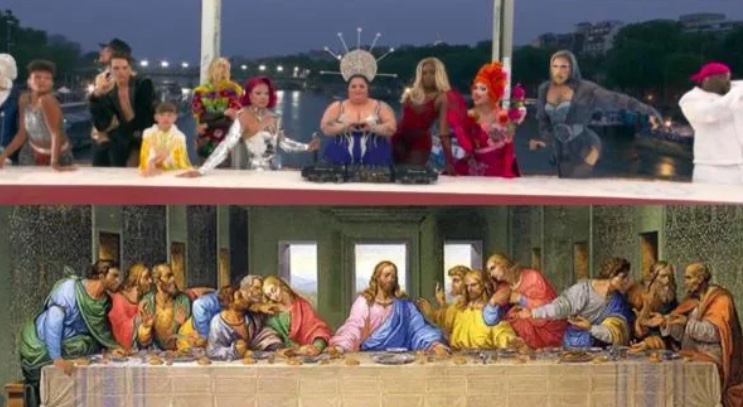
The specific part of the event in question involved an on-stage, live reenactment of what appears to be Leonardo da Vinci’s famous mural The Last Supper, painted about 500 years ago – with the obvious modification being that the “disciples” are depicted as a group of flamboyant drag queens.

Ha. Ha. Ha. Good one… You really got us.

This, somewhat ironically, reminds me of a story from the Book of Acts. I say it’s ironic, because it occurred in Chapter 17, when the Apostle Paul found himself strolling through the city of Athens – which happens to be the place where the first modern Olympic Games were held in the Spring of 1896.

As often occurred on his epic missionary journeys across the Mediterranean, Paul went directly into the most public places of town to make his plea on behalf of Christ. Paul’s method of public preaching in the open squares was not unusual, offensive, or disrespectful. It was common at the time, especially in a city like Athens, for teachers to philosophize openly among the masses to anyone willing to listen, and even to invite criticism which would lead to further discussion and debate on the topic at hand.

Make no mistake, Paul was “greatly distressed to see that the city was full of idols,” as we’re told in 17:16 [NIV]. But although this idolatry provoked him, he didn’t allow himself to be overtaken by anger and bitterness. It’s completely reasonable (for those among us who believe that Christianity is being mocked) to feel provoked, distressed, or offended by the actions of non-Christians, but it’s important that we leave those feelings at the foot of the Cross, and that OUR ACTIONS reflect Christ’s response to such things.

“To this you were called, because Christ suffered for you, leaving you an example, that you should follow in his steps. 22 “He committed no sin, and no deceit was found in his mouth.” 23 When they hurled their insults at him, he did not retaliate; when he suffered, he made no threats” (1st Peter 2:21-23 [NIV]).

That’s how Paul responded to being offended. He presented the Gospel boldly but respectfully. And in his explanation, he even used the idolatry he witnessed as an avenue to reach the hearts of those listening to him. Look at what he says to the pagan citizens of Athens in Acts 17:22-23 –

22 So Paul, standing in the midst of the Areopagus, said: “Men of Athens, I perceive that in every way you are very religious. 23 For as I passed along and observed the objects of your worship, I found also an altar with this inscription: ‘To the unknown god.’ What therefore you worship as unknown, this I proclaim to you.” [ESV]

Paul’s reaction to the idolatry in Athens led to mockery by some, further inquiry and curiosity from others, and to the conversions of a few (17:32-34).

What would the outcome have been if Paul had allowed his distress to turn into vocal outrage? When I see my fellow pastors reacting to modern paganism in such ways, I think to myself, “Come on, guys, we can do better.”

In 2nd Corinthians 4:2, Paul says that, “The god of this age has blinded the minds of unbelievers, so that they cannot see the light of the gospel that displays the glory of Christ, who is the image of God.”

And in 1st Corinthians 2:14 he says, “The person without the Spirit does not accept the things that come from the Spirit of God but considers them foolishness, and cannot understand them because they are discerned only through the Spirit.”

Taken together, the overall point is that if a person is an unbeliever they do not have the light of God’s Spirit to show them the way of life. Even if their intention is to directly mock our faith, “they know not what they do.

It’s our job to be Christ’s ambassadors in this world – to shine the light of truth, and to bring the love. We’re not living under the Old Covenant. We’re living under the New one. The “goliaths” that we have to fight are our own pride and self-righteousness.

We have to stop thinking about non-Christians in worldly terms – like it’s “us” versus “them.” There’s too many of you allowing the vitriol occurring in the political realm of this world to dictate your words and actions. Stop taking the bait. The enemy craves your outrage and your stone-throwing, because that’s what elevates his kingdom. You aren’t winning any souls by shouting about your lack of “Christian rights.” The Gospel doesn’t say we’re entitled to “Christian rights” in this world. It says we have a King, whose Kingdom “is not of this world” (John 18:36).

There’s all kinds of things in this world, and in our modern culture that are offensive to us. And these people making a parody of a painting of The Last Supper is not the worst of them. It’s actually kind of lame. Mel Brooks did a much better job of it in History of the World: Part 1 (1981).

I’m sure there were people that got upset about that one at the time too. So lastly, I’ll say this: If you’re too hurt and offended by this kind of thing, the answer is really simple: Don’t watch it.

The Churchmare Before Christmas

It was the night before Christmas, when up at the church,
the preacher had arrived for a midnight search.

In his office among all the books and the notes,
he’d stashed his old sermons in some small plastic totes.

Christmas Sunday was tomorrow, it was almost here,
and the preacher was taken by that preacherly fear…

That he had no sermon for that Christmas Day,
that he had no words, and nothing special to say.

So he’d gone to the church in the middle of the night
despite the dark and the risk of frostbite,

to find and old story that he’d written a few years before…
It was about Silent Night during the First World War.

But he just couldn’t find it, in all of his files.
It wasn’t in his computer or in his office stockpiles.

Defeated and tired he looked at the clock; what would he do?
He had no sermon, and it was half past two.

And so, disappointed he sat down, in his brown leather chair,
and he bowed his head to say a desperate prayer.

But the church was dark, and it was warm and quite cozy,
and before he knew it, he was feeling a bit dozy.

As sometimes happens, when we last resort to pray,
we happen to fall asleep and wake up the next day.

And thus away he went into Never Never Land,
and lost several more hours in a way he hadn’t planned.

When he finally woke up and regained his sense,
he discovered that Sunday service was about to commence…

Everything seemed normal; the lights were all on, and all was in place.
So he just rose from his chair, and put on his best poker-face.

Then he took a look around, and he surveyed the room.
It was no longer dark and shrouded like a tomb.

It was full of brightness; it was calm and serene.
Annette and Carson had swept up the dust, and made it all clean.

There was the hand sanitizer placed by the foyer with care—
since the Spring of 2020 it was the same bottle that had been there.

The children had gone with Karlie and Kloe down the stairs,
to learn about Jesus, and to say their prayers.

Ben Jackson was there nestled, all snug in his pew,
after arriving at church early, to make good use of the loo.

But something was still missing, something was still wrong—
the thing that had made the Preacher, pry himself out of bed hours before dawn…

He had no sermon, so what would he say?
This was no ordinary service, this was on Christmas Day!

Well, Doctor Nicholas and the Wheats could tell with one look,
that the Preacher was sweating when he opened the good book.

The Nepotes, and Lunsfords, the Natale’s, and Sandy, and Alicia too,
the preacher looked at them and wondered, if they could tell… if they knew…

And what about all the others? He glanced all around,
but he was only humbled by all the smiles he found.

Mary Kay and Sarah were right where they always sat.
Vicki and Julia – across the aisle from where the Engle’s used to sit beside Pat.

At the piano was one of five people – (I didn’t know when I wrote this story)
if it was gonna be Grant, Terri, Carmen, Judy, or Lori.

Roseann was all ready to call out the first song,
as Jerry once did for the congregation to sing along.

George was smiling, with a twinkle in his eye,
I think he knew what was up, but he was too kind to ask why.

The Harpolds were there, in the second row on the right…
wondering if the Preacher was feeling alright.

They said hello, and they smiled as they usually did,
just like Karen, and the Cox’s, and Carson the kid.

Michael, Angie, and the Dickeys were all there in their pew,
as patient and faithful as Farmer Shew.

And back in the back like Ebenezer’s Stone,
sat Mr. Chet – sometimes with Kailynn, but never alone.

There was the Jukes’, and Ginni, and Jalen too,
and let’s not forget little Sylvie, the Christmas pooh.

But where was Jordan? He’d been here before…
we all missed him and his track suit of soft red velour.

But we also missed others, like old Jim Trout,
and some that were still with us, but they were out and about.

Where had they gone, what had taken them away?
Well, I don’t really know, but maybe we’ll see them again on Easter Sunday.

But, even though some were gone, new ones had come along—
little ones that to our Lord belong; they are weak, but he is strong!

There was the Methenys, and the Kelleys, and the Overpecks, and their brood—
who always came prepared with toys, and with food.

The Preacher was thankful for all of the people,
because to really have church you didn’t need a building or a steeple.

They had the main things – faith, hope, and love.
And they were thankful for all of their blessings from above.

But the time had arrived for the preacher to speak,
and with no message to give, he hung his head low, and was feeling quite bleak…


Then all of the sudden, from out in the parking lot, there arose such a clatter
that he sprang from the pulpit to see what was the matter!

Away to the window… (he didn’t fly, let’s be honest) he went slow…
This Preacher moves like a tortoise, as by now you all know.

But the sun was shining, and there was a sheen of fallen snow,
that gave the gloss of mid-day to the tombstones below.

When, what to his wondering ears did he hear?
It was Farmer Seth arriving on a brand new John-Deere!

He rushed to his pew, so lively and quick,
and right behind him, through the door came the 3rd Domenic.

But they weren’t the only ones arriving at church
causing Rhonda, and Brenda to jump aside with a lurch.

‘Here they come!’ Yelled Sue Weber, as she chuckled and smiled
at the little ones who ran up the stairs fast and wild.

Up out of the basement, like reindeer they came,
as Tim and Lori whistled, and shouted, and called them by name:

Now, Cadence. Now, Leila. Now, Raegan. Now, Norah and Avery,
Tate, Jack, George, Henry, Hazel and Maizee…


But, in all the excitement, the Preacher had almost forgot
that he had no message… or so he thought…

And that’s when, without warning, he woke up and he found
that he had slipped out of his chair, and was lying on the ground.

The whole thing was a dream, thank the Lord for his mercy,
he had just fallen asleep and there was no need for controversy!

So, he picked himself up, and walked to the door,
but before he left, he looked back, and he thought once more…

How it made him feel dreary, and it made him feel bad,
but it was true; without people – this building could be really sad.

And more than that, it could sometimes be really scary—
in the dark, with the shadows, and the old cemetery.

It was the people who made this, into a place that was bright.
And without them here, even with lamps, there would be no light.

For the Lord to be here, it takes only a few.
That’s what he said, in the 18th Chapter of Matthew.

That was the message that this preacher would stress
when Christmas morning arrived in a few hours or less.

That Christ is with us, when we gather together, and invoke his name.
And it’s the Spirit that ignites, within us, a flame.

Whether it’s Christmas, or Easter, or Halloween,
or any of the other days that fall in between…

The Lord has come, he has died, he has risen again—
And all the host of heaven, has declared AMEN!

And this is the message we have all heard the same:
If we walk in His light, we are cleansed from our shame.

But if we ignore him, and decide to walk elsewhere,
The day will come; we’ll wake up, but we’ll be inside a nightmare.

And so that was the message, he’d preach on Christmas morn—
The story of Christ’s death, not just when he was born.

Then the Preacher went home, and he wrote it all down…
And he got up the next morning and he drove out of town.

He went back to the Church on that Christmas Day,
and his sermon had everything, he wanted to say.


Now, that sermon, was not the story I tell.
That message came from a much deeper well.

This poem is nothing much more than a tribute,
and I beg your pardon as I attempt to distribute…

But that is the story of just one Christmas, up on this hill.
There were many before, and there may be many still, if the Lord tarries, and if, it be His will.

You can also listen to this poem on Soundcloud:

Field of Dreams

Field of Dreams

It was the summer of 1987. All the stories about baseball seem to begin with reminiscing about what year it was, so I figure I’ll start with that. It was the summer of 1987, and the Hazelwood Hoosiers baseball team were celebrating their championship victory over the Pee Wee League. My dad was one of the coaches which makes it especially sentimental when I think back on it now. We had gone undefeated at 15-0 and quickly swept the tourney. Having reached the end of my three years in the league, and about to turn the grizzled old age of 10, there was nothing left for this right-fielder to achieve. So I decided to retire while I was at the peak of my career. For the next several years I just kicked back and enjoyed watching occasional games with my dad, or going to see the minor league Indianapolis Indians play at the old Bush Stadium from time to time. I even had a decent collection of cards and a Colorado Rockies cap. In a time when DVR recording wasn’t yet invented, the World Series always took precedence on our living room television set during evenings in the Fall. My memories of those times are all mingled together with campfires and the Charle Brown Halloween special. Even as I grew into my teenage years baseball was still magical.

Adam027

Then The Strike happened. The Major League Baseball strike of August 1994 became the longest strike in MLB history, and it killed the postseason and the World Series – something that had not happened in 90 years. It was all about money of course… Millionaire players and millionaire owners were fighting over who was going to have just a little bit more. It was a disgusting display of greed that played out over months and laid bare an ugliness that had been festering below the surface of the game for some time I suppose. Eventually it was settled so everyone could go back to being millionaires again. But the damage had been done, and for me, there was no going back. When that summer was over, and the dust had settled, my love of baseball had been shattered. What was sacred had been profaned, trampled upon, and broken beyond repair. There was no longer any magic in it for me. Maybe I took it too personal, but I felt as if something had been stolen from me. That’s what greed does to things that are beautiful – it takes them away. It destroys them.

Then I saw The Sandlot one morning and a part of that magic found its way back into my heart. It was like uncovering an old treasure to discover that there were some movies out there about baseball that were somehow able to capture and contain the essence of the game – the purity that exists underneath when all the other stuff is pealed away. These films are idealizations of the values, history, and sentiments that baseball conjures up for us. There was one in particular that my 10th grade English teacher showed to us in class the year following the end of The Strike – Field of Dreams – and it is, perhaps, the purest and most elegant example of this.

Field of Dreams told me a story about what baseball really was at its core – not a sport – but a religious experience.

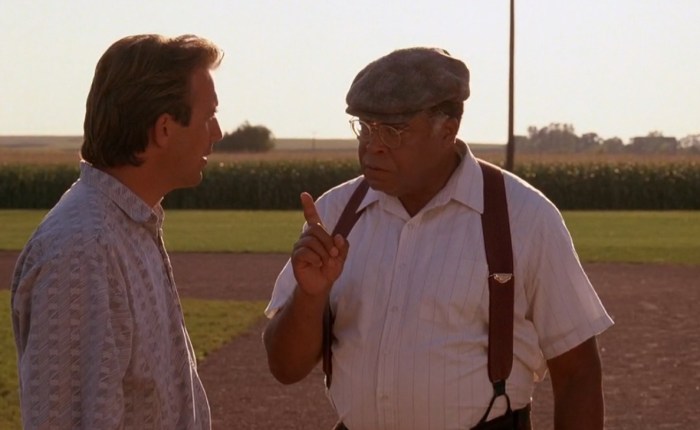
The film opens with Kevin Costner’s character Ray Kinsella standing in the middle of his Iowa cornfield hearing a voice. You probably already know what the voice said to him. It’s been echoing in my mind all week. “If you build it, he will come.” Sometimes, my mind likes to play puzzles and alter the words for me, so I end up hearing things like, “if you put it in the fridge, it will get cold,” or, “if you do the laundry now, you don’t have to do it tomorrow,” and my personal favorite, “if you let the dog poo in the park when no one is looking, you don’t have to pick it up.” But anyway, I’m getting off track a little bit. Back to Field of Dreams… It’s interesting to note that the morning after Ray first hears “the voice” he walks into the kitchen to discover that his daughter is watching an old black and white movie. We catch a brief glimpse of James Stewart from 1950, insisting that he’s talking to an invisible six foot rabbit named Harvey. Ray shuts the movie off, insisting to his daughter that it’s no laughing matter to hear something invisible talking to you. Eventually Ray has a vision that instructs him to build a baseball diamond in his cornfield. He proceeds to do so with the support of his wife and daughter, provoking the ire of the townsfolk and his brother-in-law in the process. Once completed, the field becomes a sanctuary in which players of the past come to find redemption and peace. You can interpret all this in many ways I suppose, but I like to think of Ray as a prophet of sorts, listening to the voice of God and obediently carrying out his instructions. The Bible is full of people hearing God’s voice, doing what He says even though it sounds crazy, and causing the people who are watching on the sidelines to lose their minds. As Ray says during the opening monologue, “Until I heard the voice, I’d never done a crazy thing in my whole life.” Along the way he hears a few other things from “the voice,” and it leads him to find James Earl Jones and Burt Lancaster – both playing the roles of aging acolytes in search of redemption themselves.

The beauty of the allegory here is that it’s not just in the film – it’s in baseball itself – and the movie is just a parable that’s showing us what has always been there. The ball field is like a church building. There’s the stands, the outfield, the infield, and there’s home base. These all mirror the essential parts of temples going back to ancient times. Solomon’s temple in Jerusalem once had an outer court, an inner court, and a Holy Place – and a Most Holy Place. Many of our churches today have a parking lot, a foyer, a sanctuary, and a communion table and baptistry at the center. In these places of worship, as on the ball field, people, friends, and families from the community gather together to participate in the same experience. There’s a structure to it all. There’s a rhythm. There is a set of rules that have been agreed upon – and there are guidelines that have been handed down to us from previous generations to show us how to follow them. There are emblems that give meaning, focus, form, and provide function for what is happening. In baseball we call these emblems the ball, the bat, the bases, the gloves. In the Church they are the Cross on the wall, the trays that hold the Communion Bread, the cups that contain the juice. Everyone has their place. Everyone has their own position to play. Everyone participates in some way. There’s the pitcher, the catcher, the batter, the basemen, the shortstop, the outfielders, the coaches, and the Ump. No one messes with the Ump. Even the spectators who aren’t directly playing in the game are invested in its outcome. There’s an energy to it all, an invisible force that pulls everyone together and puts them all on the same page for a few hours or so. It’s a spiritual experience. In its purest form there is no competition – only camaraderie, fellowship, and sharing time together – that’s the original intent anyway. It’s not really a game. It’s a sacred dance of worship. And in these sacred places, in the midst of the experience, encapsulated by memories, is an awareness of our connection to those who were here before us – those who shared time together and observed the rituals faithfully… those who found redemption on the field.

Like Ray Kinsella with his baseball field, we participate in our rituals as a means of re-connecting with our Father as well. And we do it to try and better understand what redemption really is, what it means, and how it will, in the end, take us all back to home base.

BEATLES Mug

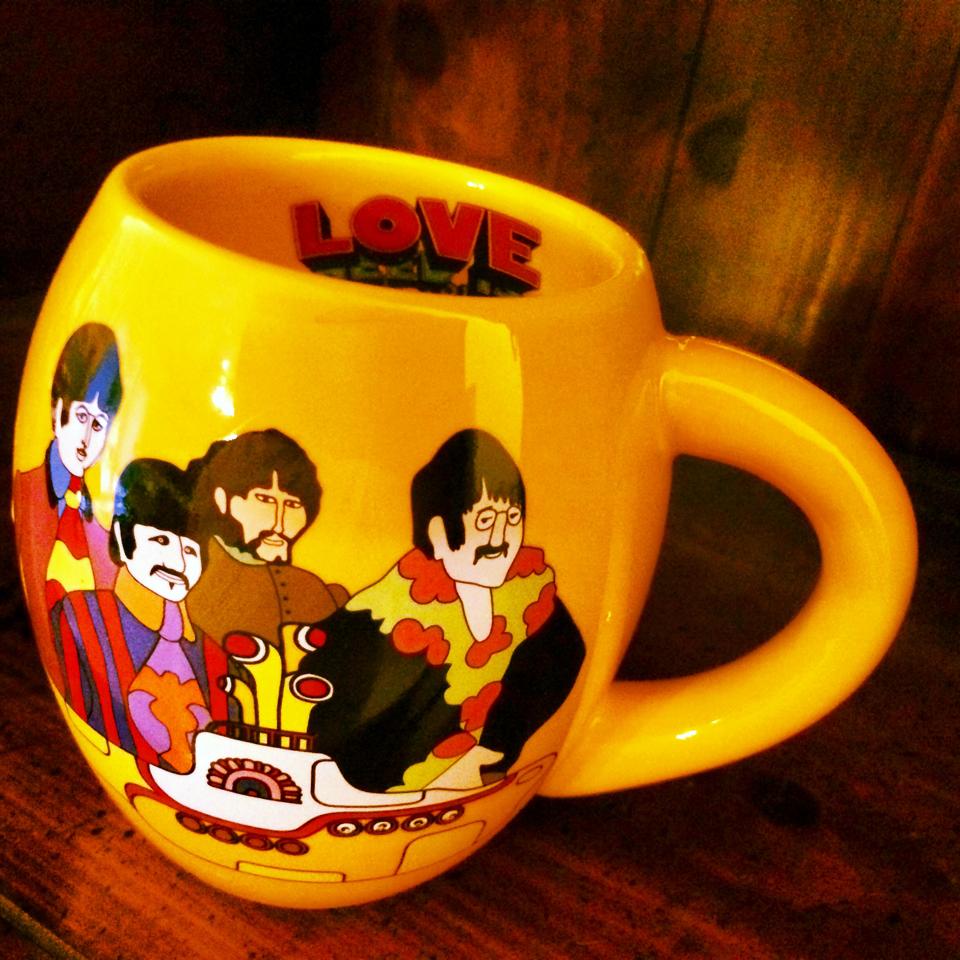
Mug - 16My dad really likes this mug. I’ll admit, The Beatles have never been my favorite band, but I do enjoy their timelessly catchy tunes as much as the next average joe. Of course enough has already been said about them and the deep imprint they have left in the history of modern music and culture–I couldn’t possibly say anything new about all that. But for me personally, when I hear The Beatles (or drink coffee out of their yellow submarine), it brings back memories of all the music my dad and mom listened to… Especially the music they listened to when I was a kid, and the stations they would tune into during long trips in our family’s old Astro mini-van. I remember hearing as much Elvis and Creedence Clearwater Revival as I did The Beatles. Sometimes my mom would bring her cassette tapes and Amy Grant would all the sudden find herself doing an encore for The Beach Boys. I was too young to understand or care about the differences. My parents’ music all blended together. One moment we’d be listening to John Denver sing “Rocky Mountain High” and the next we would be hearing tunes from the traveling Gospel quartet who had been visiting our church a week earlier, peddling their cassette tapes along the way. My parents religiously (pun intended) bought the tapes of every person and group that came through our church–I’m not kidding. A few years ago I found a box that had close to a hundred cassettes in it–all from people who had visited our church over the years to share their music.

The point is… My parents didn’t play music, and they didn’t sing either, but they loved to listen and they loved to collect it. And they taught me to explore the art form on my own, and to discover for myself what I liked and what I didn’t. I think I was in 5th or 6th grade when I started really getting into music enough to want to own the stuff I liked. My parents would buy me blank cassettes, and then I would record stuff right off the radio. I remember hearing the DJ on 99.5 WZPL announce a song that was about to come on, and I would dash across the room so I could hit Play & Record on the tape deck. And my older cousins had tapes that they would let me copy. My cousin Toby introduced me to Bon Jovi’s “Slippery When Wet” — changed my life. That was back when Jon Bon Jovi was an actual rockstar, before someone kidnapped him and removed all the testosterone from his body.

My early musical tastes were widely diverse. By the time I was in high school I was practically in love with Amy Grant, because I had been hearing her sing since I was in kindergarten. But that didn’t stop me from listening to Soundgarden or Metallica, and REO Speedwagon when no one else was around. I remember one time I was in an IRC music store with my dad, and he was letting me pick out an album for my birthday–I chose “Appetite for Destruction” by the infamous Guns N’ Roses. He just shook his head and said, “OK, but don’t show mom.”

Like I said, my parents really let me figure the whole music thing out on my own. When I was young, I heard what they liked, and as I grew older, they gave me the freedom and independence to decide what kinds of music I liked. Just because they didn’t like something, or because some dumb televangelist like Jimmy Swaggart said it was evil, didn’t mean they would stop me from listening to it. And I’m so grateful for that now. They never bought into all the crap about “christian” music versus “secular” music, and how non-Christian music was all from the devil. My youth pastor and his wife were the opposite of my parents when it came to music. They were good people, and I learned some good things from them, but their views on music were not among the lessons I chose to retain. I always thought it was kind of funny that they cared so much about it. I mean, at the outset of every trip we took, they would assign a student to go around checking everyone’s music to make sure no one had anything non-Christian with them. It was fascist and imperial. And we all know the proper response to something imperial–(thank you, Star Wars.) So I made it my mission to sneak as much non-Christian music as I could on board the church bus. And I was successful at it too. I was a supplier for the handful of other “rebels” as well.  How did I accomplish this? How was I so great at smuggling contraband past the music police? Simple. My parents would let me use the outer cases of their Christian music CDs and cassettes to camouflage my music on the inside. When they came around to check my music, they would just see Michael W. Smith, Carmen, and of course Amy Grant… Never knowing that inside was Nirvana, Pearl Jam, and The Doors. Well, ok… Some of the Amy Grant cases actually had the Amy Grant cassettes in them.

Of course when I journeyed off to Christian college, things were on a whole new level. There was no actual rule against having non-Christian music, just a heavy fog of rampant judgmentalism toward those who did. I discovered this firsthand when the worship leader who lived next to me in the dorm almost had a stroke after seeing the Led Zeppelin poster on the outside of my door. I discovered it even more when during my second semester, my room was broken into and all the band posters (including a 6 foot Sgt. Pepper’s display) were all ripped from the walls and replaced with notes warning my roommate and I about our impending journey on the highway to Hell. But we had fun with that sort of thing. A few of my friends got together one night and did a live cover of Jimi Hendrix’s Purple Haze for the entire campus. That didn’t go over too well. But anyway… “we all want to change the world.”

And it’s great, what kind of memories a coffee mug can conjure up.

Originally posted on Instagram @ajcoffman and Facebook on December 4, 2014

Giant Mug

Mug - 11This mug is really fun, and really huge! I keep this one in my office/classroom at the church and it is usually stocked with mini Reese’s Cups for the kids. To provide some scale for this pic I put my Ninja Turtle action figure inside it–that’s good ‘ol Leonardo peeking out over the rim there.

This colossus was another gift–as you might have discovered by now, I really like coffee mugs, so people who get to know me often figure out that they make great gifts for me. This was given to me by some good friends from Taiwan who, if memory serves, found it for me while they were visiting Disney World. I met several Taiwanese friends while I was living in Findlay, many of whom were graduate students at the University of Findlay. I met a lot of students there while sailing on the U.S.S. Curry House, and while serving through the church we planted in our house–called Night Church. But looking back now, some of our closest relationships were with the Taiwanese… a couple of them even lived with us part time, unofficially… And I really miss their sense of humor, their humility, their willingness to just jump in and help us cook or do dishes or clean the house, and also the way they would take to the kitchen and display their mastery over authentic cuisine with mighty elegance. Our church even had a softball team, of which they made up about half the roster.

So this mug entry is for them… Dennis, Beck, Ya-Lan, Ching-yi, Mo, Tracy, and the others… I miss you all, and your awesomeness will not be forgotten!

Originally posted on Instagram @ajcoffman on April 23, 2014

Winebrenner Mug

Winebrenner Mug
Mug - 08As one of the previous Curry House regulars pointed out yesterday, sometimes these mugs have seen a little more than just coffee and tea. Such is definitely the case with this Winebrenner mug, which has seen its fair share of rice and curry.

It’s hard to think about my time in the curry house without also thinking about Winebrenner–together the two occupied nearly all of my time between 2008 and 2010. We were always grateful that the professors and staff at the seminary encouraged us so much, with many of them even finding occasion to come to our house themselves and share in our weekly curry night meal.

I think what is most interesting to me when I think back on curry night, is that none of it was planned. The four of us guys who lived in the first incarnation of the Curry House had already been cooking and sharing Indian food with our neighbors for years prior to us moving to Findlay. It’s just what we liked to do. It was hard to explain that at times, especially when leaders and pastors from some of the other churches in town would come to visit–always looking for the secret of our success; always wanting to figure out how to duplicate what we were doing. We always told them the same thing… The truth was that we really didn’t know what was happening most of the time, or why. I moved to Findlay so I could attend Winebrenner without having to commute four hours there and four hours back every week. I didn’t expect (none of us did) that within a few months of moving, a hundred people would be coming over to our place for dinner. It was not always that convenient, and there were many times when we didn’t think we could keep doing it (it was kind of expensive for four graduate students), but we continued on, putting ourselves into God’s hands and trusting him to provide–and of course he did. In four years we never had to call off the meal.

For those out there wondering how to do ministry… It’s not as complicated as we’ve tried to make it. It might include going to bible college or seminary, but it doesn’t have to. All you have to do is look at what God has already given to you, and then share it with those around you—for free!

Originally posted on Instagram @ajcoffman on April 18, 2014

Russian Espresso Cup

Mug - 07This cup is really different from the others I’ve talked about. It’s not a traditional mug by any means, but I have had coffee and tea in it before, and it is the perfect size for an espresso shot. I bought this little tumbler at a factory that produces all sorts of similar goods. It was in an old Russian town called Semyonov, which was a few hours from Nizhny Novgorod — where I was studying for the semester.

It is hard for me to believe that was just over 10 years ago now. When I see the way Russia is often characterized in the news, whether because of the Olympics or because of the actions of its government, I just think to myself–that’s not the Russia I remember.  Those aren’t the people who brought me into their lives, into their homes, who took care of me like I was one of them.

Experiencing Russia was a life changing endeavor for me. It challenged me in several ways. Just living in a city was a new experience for me. It’s really too much to go into for a small post such as this, but I have written about it much more extensively before. If you follow this link, or type it into your browser, it will take you to the chapter of a book I finished writing in 2008 about my time in college. This particular chapter can be read apart from the rest of the book, and is a stand-alone story about the time I spent in Russia.

http://crossing-kcu.com/10-walking-in-russia/

Anyway, that’s all for today’s installment. As they say in Russia, “paca.” Until next time.

Originally posted on Instagram @ajcoffman on April 17, 2014

Laura’s Mug

Laura’s Mug
Laura's MugI really love this mug. There is none other exactly like it on planet Earth. It was a gift from my friend Laura, a.k.a. @sweetlauralai (she also painted it herself, which makes it even more awesome). I met Laura at Kentucky Christian University back in 2002. I was skeptical at first. My bros and I were a close knit group. To be honest, there weren’t very many girls that you could just have fun hanging out with on the campus back then. They were either the kind who looked down at you for listening to ‘non-Christian’ music, watching rated R movies, and wearing jeans to chapel services–or they were the kind who just wanted to graduate with their MRS degree. There were some exceptions of course. Laura was one of the exceptions. I realized that when she was hanging out with us dudes one night, and during a conversation she just lifted her leg up and farted really loud–then went on like nothing happened. We were buddies after that. I think Laura was only at KCU for about a year or so before transferring to Johnson Bible College (now Johnson University), but we still stayed in contact and whenever our larger group of friends would come to my parent’s house to visit in Indiana, she was usually there. These days, I haven’t talked to her for quite awhile, but I still remember how fun it was to hang out with such a great sister, and I especially miss those times we would have long talks and pray together. I’m also really happy that this mug has survived all these years intact. I still have plenty more to talk about, and I’ve enjoyed sharing the others so far, but I think this one is my favorite.
Originally posted on Instagram @ajcoffman on April 16, 2014

Taizé Mug

Taizé MugThis particular cup is very unique. It comes from an old monastery in the middle of France known as Taize. A description from their website reads:

“Today, the Taizé Community is made up of over a hundred brothers, Catholics and from various Protestant backgrounds, coming from around thirty nations. By its very existence, the community is a “parable of community” that wants its life to be a sign of reconciliation between divided Christians and between separated peoples.”

I think it sounds like a pretty neat place, and it must be, because every year thousands of people visit the 74 year old Taizé community which was founded during WWII by a man named Brother Roger. Brother Roger himself was stabbed to death in 2005 at the age of 90 while leading the evening prayer service.

If you’re like me, I had never even heard of this place until I was told about it several years ago by a friend who had visited and in the process had acquired this coffee cup for me. The cup holds a great deal of meaning for me, and it harbors a great deal of irony as well. Sometimes, in this journey of life, we become alienated and separated from those we were once very close with… Sometimes, good friends can even become bitter enemies. Sometimes it’s our fault, and sometimes it just happens–and there is nothing we can do about it. But it always hurts. The friend who gave me this cup from Taizé has been long gone from my life, though he was once a very close brother. And even though we were deeply alienated from each other many years ago, I have kept this cup as a reminder of my friend–there is a hope there, however small, and I think of him whenever I drink from this coffee cup — made by the hands of people who have devoted their entire lives to Brother Roger’s vision of bringing together and reconciling Christians who have been divided.

Originally posted on Instagram @ajcoffman on April 15, 2014