The Three Israels – Part 3: Modern Israel

The Three Israels – Part 3: Modern Israel

In light of current events, it seems pertinent to share a set of three sermons I preached during the Autumn of 2023, on the Biblical, Historical, and Modern meanings of the name “Israel.”

This is the third and final message dealing with “Modern Israel.”

Part 1: Biblical Israel, can be found HERE.

Part 2: Historical Israel, can be found HERE.

If you prefer – the audio of this sermon can be found at the following SoundCloud link:

This audio version was originally written and preached for Dailey Chapel Christian Church, on October 29, 2023. The following transcript has been minimally updated since then.

_____________________

Our message for today, begins with a story. It’s a story that I never knew about, until almost a year ago, so I’ve been waiting to tell it for a while. Almost two years ago, after church one morning, Mike Lunsford handed me a really thick book. It was a thousand-pager. And he challenged me to read it before I got done preaching through the Book of Romans.

I said, “Challenge accepted.”

I was probably only in Chapter 2 or 3 of Romans at the time, so I don’t know if Mike realized this then, but it was easy for me to accept his challenge, because I knew it was going to be a few years before we would even be close to getting all the way through Romans. I had some time to procrastinate, so the book sat on my shelf for quite a while before I cracked it open.

Then, when Nelly and I were dating, we read it together. I would read a chapter and record it on my phone, and then email her the file, so she could listen to the audio on her earbuds while she was at work. And sometimes she would do that on her off time as well – read and send me the audio.

We’ve been doing that ever since. And we’ve gone through several books this way, including, eventually, this thousand-pager that Lunsford provided. So, anyway, I have to give credit where it is due – if it wasn’t for Mike, we probably would have never picked this particular book to read, and we wouldn’t have discovered this amazing story that it contains.

It’s a story about a 33-year-old farmer from Missouri – a Baptist, born in the grain belt, who would one day change the whole world. That was the hook that got me past the first 20-30 pages of this book. Some of my favorite stories are ones about farmers that change the world, or even save the galaxy – that’s what Star WarsThe Lord of the Rings, and even Superman are all about you know – they’re all about farmers that do amazing things. And that’s what this story is about as well. Except this story is a true one, about a true man.

Now, this particular farmer from Missouri was born way back in 1884. So, by the time he was 33 it was 1917. And, if you didn’t sleep through your High School history class, then you know that 1917 was a pivotal year on planet Earth – it was a difficult time. So that Summer, this farmer left the fields behind, and reported for duty at the National Guard. Like many Americans at the time, he was answering the call of President Woodrow Wilson, to go fight in Europe – to win “the war to end all wars,” and make the world safe for democracy.

But, before this farmer went off to France, he had to go through training first, so they sent him to Camp Doniphan, on the wind-swept plains of Oklahoma. Back in those days, officers were elected by the men in their companies, and he was very popular, and well liked, so as soon as he enlisted, he was elected to be first lieutenant. The farmer had become a soldier 

He was Harry S. Truman of the 129th Field Artillery of the 60th Brigade attached to the 35th Division of the United States Army.

And at camp Doniphan, his commanding officer put this bright young man, with an aptitude for organization and detail – in charge of the canteen

Now, army canteens back then were ways for the troops to purchase items that were not part of their standard issued supplies – things like paper, and smokes, and soda, and candy and that kind of stuff – non-essential items that troops could buy if they had someone in charge of the canteen who was good at keeping it stocked and organized and running smoothly.

And this is the kind of thing that Truman excelled at. He was great at looking at things that were in a state of disorder, or not running as efficiently as they could be, sizing them up accurately, and implementing plans to improve them, or put them in order. And he was also good at finding the right people to help him execute his plans.

So, he utilized all his innate talent in running the army canteen. It was, by no means a prestigious position – but it’s what he was assigned to, so he gave it everything he had. He quickly discovered, that army canteens could actually be quite profitable if the right person was running them, because it was like being a middle man between the civilian suppliers of goods, and the soldiers who had money to spend. The guy running the canteen could buy things cheap, mark things up a little, and make some profit.

To do this, Lieutenant Truman brought on a partner to help with the finances. He was Sergeant Edward Jacobson. Jacobson, you can probably tell from his last name, was a Jew. He was from New York, but his family had moved to Missouri in 1905 – that’s how he ended up in the same army camp as Truman.

I hope no one takes this as racist, but Truman recognized what all of us know – that Jews tend to be pretty good at making money. I don’t think that’s a bad thing. In fact, I’m of the opinion that it’s one of the gifts that God bestowed on them as a people, so that they would be able to survive and thrive as foreigners and strangers among the nations of the world.

So anyway, Truman appreciated this quality, and he partnered up with Jacobson, and the two not only became extremely successful business partners, but life-long friends as well. By all accounts, Jacobson was Truman’s best friend, they were like brothers, and they remained so until Jacobson’s death in 1955.

It’s this deep bond of friendship, between the Baptist Farmer and the Jewish Businessman, and more specifically, the respect and trust they had for one another, that lies at the center of this story, and which would eventually have an impact on world history about 30 years after it had an impact on the quality of canteen supplies at Camp Doniphan.

Now, we’re going to come back to Truman and Jacobson in just a bit, but for now, we need to talk about something else that was happening, in the meantime, as 1917 progressed into 1918 and WWI began grinding to a halt. But before we talk about that, so we can get back to Truman and Jacobson, we need to briefly address why we’re talking about this subject at all.

The last couple of weeks, as we’ve been working through Romans Chapter 11, we’ve been talking about the name Israel a lot. Israel being the main subject matter of Romans 9, 10, and 11. And so, as we’ve been working our way toward the end of this middle section of Romans, we’ve been examining what exactly the name Israel means. This name Israel is used in three different ways – I call them the Three Israels: Biblical Israel, Historical Israel, and Modern Israel. Two weeks ago, we started this topic by defining the name Israel from a purely Biblical perspective.

What’s Israel mean in the Bible?

In the Old Testament, it was the people that God chose for Himself out of all nations on the Earth, to lead into the Promised Land through Moses. God built a physical kingdom and named it Israel, after the name He gave to Jacob, the grandson of Abraham.

When Jesus arrived, centuries later, and made a New Covenant. His death and resurrection re-defined the name Israel to include people of all nations who put their faith in him. His sacrifice tore the veil in the Temple apart, and made access to God available to all people who believe in Jesus – and ONLY to people who put their faith and trust in him and follow him.

That’s Biblical Israel – the Israel that we have been transplanted into as citizens of God’s Kingdom, the Israel that will never end and extend into eternity.

But what about those from the people of Israel who didn’t accept Jesus as the Christ? What about them? This is what Paul is addressing in this whole section of Romans – what about the Jews who reject Christ? This is the Israel that we talked about last week, in part two of this three-part sub-series. This is what I call Historical Israel.

They are the Israel that Paul says, was pruned out of the Olive Tree. They took a different path through history, but have none-the-less kept their racial identity, kept their loyalty to the Old Testament (to varying degrees, depending on which specific Jewish denomination they belong to), and they are the Israel that has survived being hunted, corralled, persecuted, and nearly made extinct throughout the last 2,000 years, beginning with the Roman destruction of Jerusalem in A.D. 70. It’s Historical Israel whose history we surveyed, and I summarized very briefly last week, even though, that was kind of a long sermon.

It’s historical Israel that Jesus prophesied about in Luke 21:20-24:

That’s Jesus prophesying about the path of Historical Israel – from the Roman destruction of Jerusalem onward, down through the ages. This prophesy has been repeating itself over and over throughout the history of the Jews. The Romans did terrible things to them and trampled on Jerusalem 30 or 40 years after Jesus said this, but many other countries have done these things as well in the intervening centuries. Just as Jesus said, Jerusalem was given over to the Gentiles…

It was given over to the Gentiles, until recently in world history. Now, we’re treading on shaky ground here, because the Jews are in charge of Jerusalem again, but even though they technically have the city, there is still a mosque and a Muslim shrine sitting on the Temple Mount. So, the Gentiles still have a little bit of a foothold, but it’s a close call.

And this brings us to what I call the third manifestation of Israel – the Israel we are talking about today in part three – the modern State of Israel which exists on the Earth today, and which we hear about in the news on a daily basis. Where did it come from? Between the year 70, and the year 1948 there was, technically speaking, no country on the world map called Israel. So, how did it re-appear after so many centuries?

Was the nation of Israel created in 1948 or was it re-created?

Is this Israel the same Israel that was there before, or is it something different?

Was it brought about by the will of God, or the decisions and actions of human beings, or both?

Does the fact that the Jews are almost completely in charge of Jerusalem mean that the times of the Gentiles are almost fulfilled?

The answers to these questions are an endless topic of debate, even among Christian scholars. They’re ultimately a matter of belief.

Many Jews would say that this Israel today is the same one that existed when Joshua led the Israelites over the Jordan River three or four thousand years ago. Many Christians would agree with them. However, many other Christians would not agree with them. It’s a matter of debate and belief, and whatever one believes about this specific topic, it should not be something to ever break fellowship over. The Church has, over the centuries, become too divided already over opinions that are non-essential to the truth of the Gospel. So, it’s OK to have different opinions and convictions about this particular subject, because there is still an element of mystery to it.

But whatever we believe about it – we still have to deal with the fact that there is a very real country on this globe, with the name Israel, and it is governed by, and primarily populated with, Jewish people.

It’s populated with Jewish people who can trace their collective ancestry, back through history, back to the people who once lived in the land of Judea when Jesus walked the Earth, and further back to their ancestors like King David who ruled in Jerusalem, and further back to those who crossed the Jordan River, and further back to Abraham, Isaac, and Jacob.

So, how did this modern nation, this political entity baring the name Israel – a name that conjures up all this rich Biblical and extra-biblical history – come to exist?

Well, it goes back to what happened at the end of WWI. At the end of WWI, the British, having defeated the Ottoman Empire (if you want to know how that happened you can watch Lawrence of Arabia). But the British defeated the Ottoman Turks, who had been allied with Germany. And that brought to an end, 400 years of Turkish Muslim rule over the land that had been known as Israel at one time. 

It wasn’t called Israel anymore, and hadn’t been for almost 2,000 years. The Romans had renamed it Syria-Palestine, when they drove the Jews out in the second century. And the name stuck. By the way, if you’ve ever wondered where they got the name Palestine, it’s just the Latin for Philistine.

There were Jews and “Philistinians fighting in Gaza 3,000 years ago. David killed Goliath on the border of Israel and Gaza. The people living there today are not the same people that lived back then, and we can’t lump all Palestinians together, or all Israelis together either. There are Christian Palestinians, and Christian Israelis, just like there are Christian Texans and Christian Mexicans (for example). The conflict is much more complicated than just cowboys and Indians – good guys and bad guys. But still, the fighting over that particular piece of land is nothing new. As King Solomon wrote in Ecclesiastes 1:9, “What has been will be again, what has been done will be done again; there is nothing new under the sun.”

In any case, back to WWI…

By that time, Israel/Palestine had been through the hands of several Muslim empires, known as caliphates, ever since about A.D. 635. During which time, smaller communities of Jews had been slowly migrating back into the region, and back to Jerusalem, just as there were other groups of Jews migrating to other places, and settling in other countries across the Mediterranean, Middle East, and Europe.

The Jews who migrated back to Palestine, and those living under Islamic caliphates, were generally well treated by the Muslim kingdoms they lived in, and that was no different with the Ottoman Empire. The Ottoman Empire rose to power in 1299, took over rule of Palestine in the early 1500s, and they had controlled it ever since, until the end of WWI.

By 1900, the Ottoman Empire was huge, and it controlled a vast area of the Middle East. And when it was defeated along with the rest of the Central Powers in WWI, the British and the French took control of all that territory, and with the help of Woodrow Wilson, they carved up the Middle East like a Thanksgiving turkey without any regard for the local inhabitants of places like Iran, Iraq, Jordan, Syria, Lebanon, and Palestine.

All the tribes in these places, had lived in relative peace for centuries under Ottoman rule. That was no longer the case when Britian, France, and the U.S started running the ballgame.

Most of the problems that exist in the Middle East today, can be traced directly to the creation of all these artificial state boundaries that never existed before, and which completely disregarded the culture of the people living in those places.

Imagine it like this. Say that we have a chili-cook off here at church, and every family brings in their own pot of chili…

I use chili for this analogy because, when it comes to chili, everyone has their own recipes and individual styles. If 20 people make chili, we’ll have 21 different kinds of chili. So, say we have 20 pots of chili simmering in crock-pots all nice and neat, in the social room here at church.

And then, while we’re all having church, Big Bad Dom Nepote wanders off into the social room, pulls out a huge hundred-gallon pot, and proceeds to dump everyone’s chili into that, stir it all together, and then put it all back into the crock-pots, and come back and sit down as if nothing happened.

That’s what our government, along with the British and the French did to the Middle East after WWI. They were trying to make everything equal, and they were trying to create order out of a cultural situation that they didn’t understand – that looked like chaos, but it wasn’t. That caused them to rip apart the centuries of order and structure that were already there. So, they ended up creating disorder and chaos instead.

They couldn’t fathom the idea, that some people don’t like corn in their chili.

Some people don’t like beans in it.

Some like it spicy, and some don’t.

Texas makes chili one way, and Cincinnati makes it another.

So, the British and the French, thinking that all chili was the same thing, made a big chaotic stew that the people living in the Middle East – whether they happen to be Christian, Muslim, or Jew – have been trying to pick through ever since.

Now, what about the Jews? That’s the group we’re primarily concerned with at present. Well, the Jews, or Historical Israel as I refer to them, and as we surveyed last week, had been persecuted in just about every country of Eastern and Western Europe and Russia for almost 2,000 years.

So, in the late 1800s they were finally fed up, and they formed a peaceful, political movement, called the World Zionist Organization, whose stated intention was “to establish a home for the Jewish people in Palestine secured under public law.”[1]

They wanted to go back to the land of Israel, and form it into a modern nation. But they needed help to do this.

And after WWI, they had the British to help them. The British government was sympathetic to the Zionist movement, so after they took control of the land previously ruled by the Ottomans, including Palestine, they began laying the foundation for the establishment of a Jewish State.

But if this was going to happen, it was going to happen slowly. They weren’t very careful with the creation of the other Middle Eastern states, but they knew with this one, they had to be precise, and there was a lot of disagreement about it, even within Parliament. The British wanted to help, but they dragged their feet on it.

Then WWII happened, and when the whole world saw what the Nazis had done to the Jews, the process of creating a Jewish state was expedited. But by that time, it wasn’t solely a British decision any longer. After WWII it was in the hands of the newly formed United Nations. And the United Nations, at that time, looked to the United States for guidance and leadership.

So, that meant, that the creation of a Jewish state, was in the hands of an international organization that was looking, not just to the United States, but to the Executive Branch of the United States government for guidance and direction about what to do, and about whether or not to do it at all. If this new country was going to be formed, it couldn’t survive without support from the United States, and the President in particular.

Back to the story I started at the beginning of all this.

In all the intervening years between 1917 and 1947, when the U.N. was set to decide this matter – farmer, soldier, Harry S. Truman, had become President Truman. And President Truman wanted nothing to do with being involved in a such a monumental, world-altering decision. He believed it was right for the Jews to have their own country, but there was too much pressure on him to make a decision, in terms of he being the main guy to make it a reality.

He had pressure on him from the Arabs in the region who didn’t want a Jewish State, he had pressure from his own State Department that didn’t want us involved in creating a Jewish State. He had pressure from the British, pressure from the Jews, and pressure from the Christians in our country who supported the Jews.

By late 1947, Truman had been lobbied so vigorously and rudely by all these different groups, including prominent Jewish leaders, that he basically washed his hands of the whole thing, and told the U.N. to do whatever they wanted. He had become completely unapproachable on the issue of a Jewish homeland, and he would not take a single meeting with anyone who wanted to talk about it. Which meant, without U.S. leadership, it probably wouldn’t happen. 

And so, knowing they were nearly doomed, in a last-ditch effort, the most prominent Jewish leader alive at the time, the man with the most influence, who would become Israel’s first President – his name was Dr. Chaim Weizmann – he flew to America to talk to the President.

And Truman knew this man really well, and respected him, but he refused to talk, even to him.

There was only one person in the world that could talk to Harry Truman about this, in that crucial moment of all moments for the Jews, and it was his old friend Eddie Jacobson.

So, one morning, Jacobson flew in from Kansas City, and as the story goes, he walked into the Oval Office, completely unannounced – as only he could – and he had an honest chat with his friend.

At this point, there’s a lot more details that I don’t have time to tell, but when it was all said and done, his friend had convinced him to meet the Jewish leader Chaim Weizmann, and afterwards, the President made it known to the entire world, with all the authority of his office, that he would support the establishment of a Jewish State in Palestine, and that it would have the full backing of the United States.

The U.N. voted, and passed the resolution in November of 1947, and on May 14, 1948, Israel declared its sovereignty. 12 minutes later, the United States became the first nation to recognize them, and a few minutes after that, the other world superpower – the Soviet Union – recognized them as well. At that point, it was a done deal, at least for the Jews.

The modern State of Israel, though primarily populated with “historical Israel,” cannot be exactly the same, because there are non-Jewish people also living within its borders. And it’s definitely not the same thing as Biblical Israel – as part one of this series outlines very carefully.

Unfortunately, this modern manifestation of Israel has had nothing but war and terrorism ever since it’s formation.

And, if we take the prophecies in the Bible seriously, then the indication from Scripture, is that, that particular piece of land will continue to have war, and terrorism until the day, when a remnant of the Jewish people living there, will choose to call on the Son of God, the one whom their ancestors pierced on the hill of Golgotha outside of Jerusalem.

Those aren’t my words.

That’s not my prediction.

That comes from the prophet Zechariah, who wrote of a time, long in his future, a time that the world has still never seen – a time when the armies of the whole world would surround Jerusalem to finally see it destroyed. And when they do, he says:

There will be peace one day in Jerusalem. But only when the King Returns. That’s how Zechariah puts it.

Paul says it like this, in Romans 11:25-29:

Now, as we close this topic today, and as we close this section of Romans out, I’m not going to pretend that I understand what all this means. I don’t. Paul calls it a “mystery,” and seems to indicate that when our time is over – when there are no more Gentile Christians left on the earth – when we’ve all been hunted down and killed by the Beast… then, somehow, God will bring the survivors of Historical Israel, and the inhabitants of Modern Israel at that time, back into the Olive Tree of Biblical Israel.

There’s all manner of theories about that, but we don’t know for sure.

That seems to be what Paul is saying, in Romans 11. But, full disclosure, I don’t know for sure what he means. I’m patching together a series of different verses to come to that conclusion, but I don’t know for sure. I want to be clear about that. This is a really difficult topic to understand, even with Paul talking about it so much. And even so, I wish he’d given us just a little bit more. But I guess he said what he was supposed to say, and what God wanted him to say.

What we can be sure of, is what Zechariah boils down for us in verse 9 of that 14th Chapter:

As important as the name Israel is – as important as it is for us to understand what it means and how it’s used and what it really refers to… As much as we, as the Church, cannot escape our connection to the name Israel – Israel is not the name we revere above all other names.

Jesus Christ is the one we give that honor to.

To him, and him alone, be all the glory in Heaven, and on Earth.

I think that’s how we conclude this topic the best – by saying, whatever happens, however it goes down, whatever God has in mind for the Jews… Jesus is still the King. And that’s how Paul closes this subject as well – with a doxology, a praise to God, in the final verses of Chapter 11…


[1] See, “Zionism: World Zionist Organization (WZO),” at Jewish Virtual Library –

(www.jewishvirtuallibrary.org/world-zionist-organization-wzo)

All three of these chapters can be found in the second volume of Totally Righteous: 150 Sermons from Paul’s Letter to the Romans

The Three Israels – Part 1: Biblical Israel

The Three Israels – Part 1: Biblical Israel

In light of current events, (and the overwhelming ignorance of certain politicians in our country who claim to be Bible-believing Christians) it seems pertinent to share a set of three sermons I preached during the Autumn of 2023, on the Biblical, Historical, and Modern meanings of the name “Israel.”

As the title suggests, this first message deals with “Biblical Israel.”

If you prefer – the audio of this sermon can be found at the following SoundCloud link:

This audio version was originally written and preached for Dailey Chapel Christian Church, on October 15, 2023. The following transcript has been minimally updated since then.

_____________________

Last week when Nelly and I arrived at church, we were not aware of the horrific situation that had been unfolding in Israel since the day before – October the 7th. And that’s my fault. Over the past few years, I have intentionally cultivated the habit of not watching the news very often.

And that’s just been a personal decision for me, since I discovered a few years ago that listening to, or watching the news, on a regular basis, was adding more anxiety to my life than I wanted to manage. But we do watch the news, at times, if we really want to.

We don’t have network television or satellite TV in our house. We get everything we watch through streaming services, so that makes it really easy to not even accidentally watch the news – because we’re not flipping through channels. And last Saturday night, we had gone to the music festival out at the Wheat Ranch, and then we came home and ended up watching Back to the Future III before going to bed. So, we didn’t know what happened in Israel until it was mentioned during prayer request time here in church the next morning.

And even then, we didn’t know the scope of it, until we left church and looked it up online. We only knew what was said – that there was a terrorist attack in Israel.

And, not to be callous, but I just figured it was business as usual, before we looked it up. Terrorist attacks are part of the cultural environment over in that part of the world – they happen all the time, and they are always terrible, but we weren’t expecting it to be anything as bad as it actually was and is.

So anyway, I bring all this up, for a couple reasons. The first one, is that when this kind of violence occurs in the Middle East, and brings the State of Israel into the forefront of the news cycle, it tends to generate some questions and maybe even a little apprehension among us – and rightly so. A handful of us were already talking about it in Bible Study this past Wednesday.

As Christians who study the word of God, and believe the history that we have in the Bible, we know and recognize that just the name “Israel,” itself, is an important name. So, when the whole world is talking about Israel, we’re going to be talking about it, or at least thinking about it as well. As followers of Jesus Christ, we cannot escape our connection to the name Israel.

Secondly, the reason I bring this up, is because the particular section of Romans that we’ve been working through these past few months, mentions the name Israel repeatedly. The name Israel appears twelve times in chapters 9, 10, and 11 – and if we include pronouns referring to Israel, or related terms and synonyms as Paul uses them – such as “Israelite” and “Jew” – then it’s more like 30 times, or more, that Israel is mentioned. As we already know by now, Israel is the main subject of this middle section of Romans.

So, for these reasons, and because of the terrible events that have occurred over the last week, and which I’m sure will continue to unfold into the foreseeable future – I think it would be prudent of me to spend some time defining exactly who and what we are talking about when we read about Israel in the Bible, as well as when we hear about Israel on the news, or when we bring up the name Israel in conversation.

It’s extremely important for us to understand. It’s a complicated name – it’s an emotional trigger word (both good and bad) for millions of people in the world, in the three big monotheistic religions – Christianity, Judaism, and Islam. And it’s important for us to understand how the name Israel is used in the context of the Bible, how it’s used in the context of history, and how it’s used in the context of current events that are taking place.

So that’s what we’re going to talk about today. We will begin talking about it. It’s a little too large of a subject for just one Sunday morning. But over these next few weeks, we’re going to talk about what I call – the Three Israels.

I’m sure there are professional historians who would lambaste me for making these three distinctions, in this way. There’s a lot of Jews who would probably take issue with these labels as well. But this is how I think of them, based on what I’ve learned, and I think it’s an easy way to keep them categorized for the purposes of discussion – especially while we’re unpacking the conclusion of Paul’s discourse in Romans 9, 10, and 11.

The Three Israels are: Biblical Israel, Historical Israel, and Modern Israel.

Are they all the same? Are they all different? Can each of these manifestations of Israel be completely separated from the others, or are they inseparably tied together? That’s what we’re going to explore.

And, believe it or not, the text of Romans Chapter 11, just so happens to be, a great place to explore these questions. So, we’ll be working Romans 11 into this discussion of the Three Israels as well, which will have the added bonus of moving us along in our study of the letter, and concluding this second volume of Totally Righteous.

A hardback of Totally Righteous: Volume Two, can be purchased on Amazon by clicking on the picture below…

Let’s begin with Biblical Israel.

This is the Israel that we should all be pretty familiar with already. We talk about it every week in church. Anytime we read the Bible we’re dealing with Biblical Israel, because that’s who God revealed the Scriptures to – from beginning to end.

Biblical Israel is first mentioned in the Book of Genesis, Chapter 32, verse 28. Israel was originally the name of one man. His name was Jacob. He was the grandson of Abraham, a man defined by his faith, who God handpicked to be the father of many nations. God made an agreement with Abraham to bless him, to bless his descendants after him, and to one day, bless all the nations of the earth through his family bloodline.

That promise carried over to Abraham’s son Isaac, and then to his grandson Jacob. Each of these men, father, son, and grandson, all had defining moments in their lives, and Jacob’s defining moment was when God changed his name to Israel.

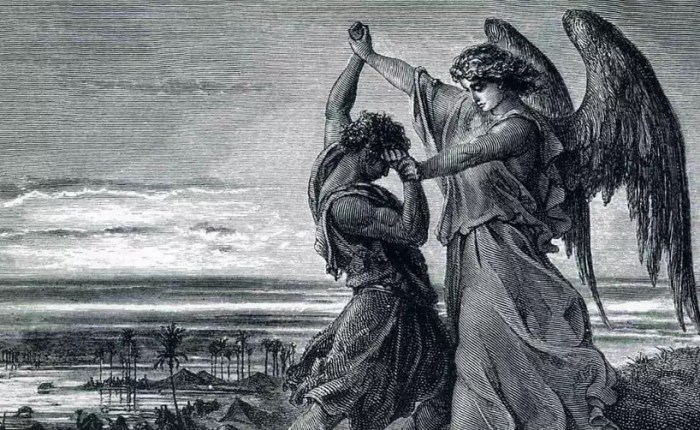
God came down to earth, took on the form of a man, wrestled with Jacob face to face, and then pronounced that his name was no longer Jacob, but Israel – which means: “he who struggles with God.” God seared this new name into this man’s mind by creating an experience for him whereby he actually physically struggled with God.

However, the name change was not just reflective of his immediate situation, but it was also an appropriate summary of Jacob’s whole life, and how he had spent years struggling with God relationally.

And that pattern that was characteristic of Jacob’s – now Israel’s – life, would also come to define the pattern of his descendants as well. God chose that name for His people, knowing that they would have an ongoing struggle with Him, relationally speaking. Every generation born from the house of Israel would have to struggle with their collective relationship to God. We’ve talked about this pattern before – it’s the cycle that we see unfold through the rest of the Old Testament, as one generation after another is born, takes their place in the history of God’s people, and is ultimately defined by their relationship to God.

They followed that revolving cycle of peace and prosperity in God’s grace, followed by idolatry and immorality and turning away from God, followed by God’s judgment and discipline, followed by humility and repentance, and then followed by God’s restoration and redemption for them. That’s their collective struggling with God happening over and over again, through the pages of the Old Testament and into the New.

Despite this struggle, or perhaps because they continued to struggle WITH HIM, rather than WITHOUT HIM – God blessed them, guided them, delivered them from slavery, and protected them as a nation of people. Even when they were almost completely wiped out, He preserved those who were faithful to Him. Even when they were forcibly ripped away from their homeland, He kept them alive, and He brought them back and re-planted them in their own piece of land.

Even in their darkest hours, when it seemed like there was no hope, God gave them hope. He sent them prophets to tell them that He had a plan. That there was always hope. Their suffering was only temporary. One day, He would send them a Son – the Prince of Peace, the King of Kings, the Lord of Lords – to establish a perfectly just and righteous Kingdom for all eternity. One day, God would fulfill His promise to Abraham to bless all nations of the world through him and his descendants.

When the story of Biblical Israel transitions from the Old Testament into the New Testament, it’s because the King had finally arrived. And one of his closest disciples and friends – the Apostle John – writes this about him, and says, in that famous passage of John Chapter 1:

He came to establish a Kingdom that would last forever. The story of Biblical Israel does not end when Jesus goes back to Heaven after his death and resurrection. The story of Biblical Israel doesn’t end, even when the credits roll in the Book of Revelation. The promises that God made to Israel extend for all eternity through those who believe in Jesus Christ, and will live forever. The promises that God made to Israel extend beyond the boundaries of this temporary life, and beyond the boundaries of Abraham’s bloodline.

This is what Paul says in Galatians 3:26-29:

It’s the same thing Paul says in Romans 9:6-9. To summarize and paraphrase – Not all those who are descended from Israel are Israel. Not all of Abraham’s descendants are his children. Abraham’s offspring, God’s chosen people, Israel, are those who have faith in Jesus Christ as Lord and Savior.

So, what’s that mean for this particular discussion? Well, it means that ever since Christ came to Earth and inaugurated his Kingdom; ever since he died, and rose again, and ascended to heaven, ever since the time when the Apostles were writing the New Testament, the scope of who can be accurately called by the name “Israel,” as defined in the Bible, has been changed.

The definition of Biblical Israel has been, in some ways, narrowed to include only those who follow Jesus. But in another way, it has been widened to include all those who enter into God’s spiritual kingdom through Jesus, no matter what race they are from – Jew or non-Jew. That is the definition of Biblical Israel.

Biblical Israel was founded physically under the Old Covenant, fulfilled spiritually in the New Covenant, and when Christ returns, the physical and spiritual will come together into one, and ripple out into all eternity. This is the Israel made up of all Jews and non-Jews who put their faith in Christ.

But this brings us to the next manifestation of Israel. What I call “Historical Israel.” There may be a better name for it. Paul would probably call them Unfaithful Israel, but we’ll stick with Historical Israel. In any case, since the birth of the Church, there has been another Israel, made up of those who did not put their faith in the Messiah.

One of the things that makes Paul a little hard to follow at times, in Romans 9, 10, and 11, is that in the midst of his theological discussion about Israel, he is going back and forth between these two Israels. He doesn’t refer to them specifically as two different Israels, but that’s what he’s describing – the idea of a faithful, Biblical Israel, and an unfaithful Historical Israel.

Historical Israel is the nation of Jewish people that continued on after the birth of the Church, the vast majority of whom had rejected Christ. That’s the problem that Paul is unpacking in this section of Romans. So many of his fellow Israelites had failed to live up to their full potential because they rejected Jesus, and Paul, as an Israelite who had accepted Christ, was greatly disturbed by this tragedy.

In Romans Chapter 11, after addressing the root of the issue in the previous two chapters – which is faith verses unbelief to summarize it as concisely as possible – Paul then addresses both faithful and unfaithful (Biblical and Historical Israel) at the same time. And this is what he says to them, and about them, in Romans 11:7-10:

So, this is Paul stating, by the use of Old Testament references, that there is a difference between Biblical Israel and Historical Israel. The elect that he mentions are those who we could call Biblical Israel – those who received salvation through faith in Christ.

The rest, are Historical Israel – those who rejected the New Covenant, and sought salvation through human effort, which is not possible. They rejected Christ, and because of that, they called down a curse upon themselves.

Paul references this curse by quoting Deuteronomy, Isaiah, and Psalms here in Romans 11:8-10. He mixes three Old Testament verses together to refer to their collective blindness and suffering. But this idea of them receiving a curse for their rejection of Christ is, perhaps, a little more viscerally communicated in Matthew Chapter 27.

It was at the end of Jesus’ trials, just before he was crucified. Pontius Pilate was looking for any excuse he could find to release Jesus, without causing a riot in Jerusalem. Even his own wife told him to let Jesus go. But he was caught between a rock and hard place, so to speak.

So, in verses 22-25 of Matthew 27, Pilate brings Jesus out in front of the crowd and lets them decide. He says:

That is one of the most chilling verses in the Bible. The Jewish people in Jerusalem, yelling for Jesus their Savior to be executed, and so sure of their righteousness in doing so, that they were willing to call a curse down upon themselves and their children in the process.

Now, this curse that they called on themselves has been used, throughout history, by some, as a justification for anti-Semitism. So, I just want to say, emphatically, that it should never be taken that way. There is no justification for anti-Semitism, and any so-called Christian who has ever condoned violence and persecution and discrimination against the Jewish people, is not a real Christian.

As Christians, it is our duty to show Christ to all people through love and service. God still desires the reconciliation, of the historical people of Israel – and this is what Paul communicates as Romans 11 continues.

In Romans 11:11-12 he says:

He’s saying that there is still hope for those who belong to the historical people of Israel descended from Abraham – even as there is hope for all nations of people; for every person who calls on the name of Christ. They did not stumble beyond recovery. 

Redemption is still available. Historical Israel can still be folded back into Biblical Israel, if they accept Christ. And many countless individual Jews throughout history have done so.

Then, in the next set of verses, Paul talks to the Gentile Christians that he was writing to in the city of Rome. As far as we know, the Gentiles outnumbered the Jews in the Roman church, and some scholars think that the Gentile Christians needed to be reminded, and encouraged to not view themselves as superior to the Jewish Christians. Some scholars surmise that the Gentiles were getting a bit of a chip on their shoulder, and that they needed to have any notion of anti-Semitism squashed completely, before it could grow into something destructive. Which is why Paul says what he says in verses 13-21:

He goes on in verses 22-24 to summarize his whole train of thought:

There is still a chance for them. But unless, and until, they accept Christ, then they remain under the curse of their ancestors. Christ is the only way out of the curse, not just for them, but for all people. So, until they accept him, Historical Israel is not the same as Biblical Israel.

Biblical Israel is any Jew or Gentile that has put their faith in Jesus Christ as Lord and Savior. Historical Israel are the Jews who were cut out of the tree, but still exist, and for whom Paul had hope that some of them would still accept Christ and be saved as he had been.

So, there’s a branching off that occurred at that point in history when the Church was born. There were two Israels from that point on. So, the question is, what happened to Historical Israel after that time? What happened to the branches that were pruned off, and yet survived and carried on?

Well, we’ll talk about this more next week, and I mentioned it back at the beginning of this series, but just a handful of verses later, in Romans 11:28-29 Paul says about Historical Israel, that:

So, even though they rejected Christ in the first century, as a nation of people, they have persisted and thrived, despite being one of the most persecuted people to ever exist on planet Earth. Even though they may be enemies of the Gospel message, God loves them, on account of Abraham, Isaac, and Jacob, and He has not left them high and dry. So, what happened to them after the first century?

Well, to put it as simply as possible – they survived. They survived many hardships as a people group, in spite of incredible odds. Some of the history we know. Some of you have been around long enough to have seen some of the more recent history of the Jewish people. The rest of us learned about it in school when we were kids. But there’s a lot more than just what we know as the immediate history of the Jews. A lot happened in between the first century, and 1948 when a large portion of Historical Israel, coalesced into the third manifestation of Israel – the modern State of Israel.

I told you at the begging of this message we would talk about Biblical Israel, Historical Israel, and Modern Israel. And we will, but we just don’t have time to go into all of it today. Biblical Israel we’ve talked about, and I think everyone understands that this is the Israel we talk about every Sunday, or in every Bible study. This is the Israel that we are a part of – the olive tree that we’ve been grafted into as the Church.

Historical Israel, then, even though we’ve briefly defined it today, as Scripture defines it, as Paul defines it – there’s a lot more to say. As I said, there is a lot more history that many of us are not as familiar with, and I don’t want to brush over all that too quickly. It needs to be properly surveyed and discussed, because understanding Historical Israel, will help us understand how we get to Modern Israel, or the modern State of Israel.

And understanding how each of these three Israels are tied together, and how they diverge from one another, might help us make a little more sense out of the terrible things we see happening on the news – or at least help us understand what the name Israel means, and how different groups of people use this same name. The name Israel is important.

I said this at the beginning of the message, and I’ll say it again as I close: As followers of Jesus Christ, we cannot escape our connection to the name Israel. As those who have been grafted into the Olive Tree of Israel, we now carry with us the promise that God made to Abraham thousands of years ago. The Church is a part of what God views as His people Israel.

That means, that just as the name Israel was applicable to Jacob, and to his descendants, it’s also applicable to us as well. Who among us, can say with absolute honesty and certainty and sincerity that we NEVER struggle with God? I hope none of us say that.

We can still believe in Him, and remain faithful to Him, and still be obedient to Him, but also struggle with Him. He wants us to wrestle with Him. He wants us to go to Him with our problems and our anxieties, and our griefs and our confusion over things that happen in life. He wants us to go to Him with questions about why bad things happen.

He wants us to grab hold of Him and not let go until we get a blessing – the way Jacob did. Of course, Jacob’s blessing was a dislocated hip, but still, even that was a blessing that reminded him of his personal encounter with Almighty God. It reminded him of his name – HIS IDENTITY.

And we need to be reminded of our name, and our identity in Christ as well. Everyday. We’re all going to struggle. God wants us to struggle with Him, rather than struggling without Him.

If you’ve given up struggling with God. Now is the time to go back to Him.

The time is short. The days are evil.

But the Lord is reaching out and ready to receive all who call on his name.

If you’ve never believed in Jesus Christ, never put your faith in him, he is willing to meet you where you are.

_______

To Canonize or Demonize

To Canonize or Demonize

About nine or ten years ago, I remember slowly making my way through the second season of the F/X series Fargo, when I was shocked by something one of the characters was looking at in Episode 8.

There is much to be shocked by in this series, but it wasn’t the spontaneous murdering, unexpected twists, or random alien spacecraft that caused me to rewind and hit pause. It was a sign hanging on the brick wall outside of a bar – a plaque that said, “HERE WERE HANGED 22 SIOUX INDIANS MAY 25th 1882.” The character looking at the plaque is Native American, so it’s a subtle tie-in to his story arc.

Fargo is a very well written series, for the most part, in terms of anthological crime dramas. But one of the things about it that has always bugged me a little, is the opening claim that “THIS IS A TRUE STORY.”

As it turns out, none of the stories are true – at least, not in any way that can be corroborated. They’re not even “based on” true stories. They are entirely fictitious. And more than that, even actual historical references are often made up. I don’t know why the show writers and runners make this claim, but I think it has something to do with the idea that it adds dramatic weight to the stories – for people who don’t care to check. And for people who do care, the show gives them something interesting to research. I don’t know though. Either way, the “true story” claim always bothered me a little. But being aware of the gimmick, I was able to look past it. After all, there’s been plenty of other shows and movies during the last decade that have made use of the whole “alternate history,” “multiple universes,” trope.

In any case, being the student of history that I am, I couldn’t let the zoom-in on this plaque about Native Americans being hung in 1882 pass by without some research. So I was immediately on a mission to find out if this was true, as I had never heard about it.

And the truth that I ran into, as I did my Google searches and subsequent article reading, was actually more shocking than the fictionalized plaque in the television show.

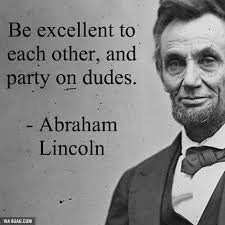
As far as I was able to discover, the closest, real historical event, to the one referenced in the show, was the hanging of 38 Sioux men in southern Minnesota, in 1862, on the orders of Abraham Lincoln. The executions took place at the end of the Dakota War, also known as the Sioux Uprising – which was a rebellion that occurred after decades of unjust treatment, false treaties, and systematic starvation at the hands of the United States military.

I don’t know if this is what the writers of Fargo wanted me to discover while researching their bogus history, but that’s what I found. 

Unfortunately, none of the Native American persecution I read about was surprising.

The surprising part was seeing Abraham Lincoln’s name attached to the story as the overseer of the executions. 

It was an unexpected blow to my image of a man whose reputation for truth, justice, honor, dignity, and sacrifice, had been carefully crafted by an unknown number of lessons, by many trusted teachers, scattered throughout my childhood, and into early adulthood. 

I was every bit as shocked and upset as Luke Skywalker, when he found out that his mentor Obi-Wan Kenobi had withheld the truth from him – the full, gut-wrenching truth, that Darth Vader was his father. “Ben, why didn’t you tell me!?” – Insert the names of my elementary teachers in place of Ben, and that’s what I was whispering in my mind for days. “Mrs. Johnson, Mr. Sowers, Mr. Clunie, Dr. Damron… why didn’t you tell me?”

Every time I see an opportunity to interject a Star Wars metaphor, I can’t resist.

Well, anyway, that’s the way reality is – much more complicated than we realize most of the time, and even more so with historical events. Even this situation with Lincoln and the hangings is much more complicated than what I’ve just now said about it. So I’ll come back to that in a moment

But for now, I want to talk about Donald Trump.

Those who know me well, have heard me say, on more than one occasion, that I’m not really into politics.

I never really have been.

My parents weren’t into politics, and neither were my grandparents – at least not in any way that was noticeable.

So, maybe that’s why I grew up, not really caring about it all that much. I was usually aware of what was going on, and I know my family members, parents and grandparents included, had their opinions. But it was never something that dominated our interactions, or influenced our conversations in any way. It was just something going on in the background, behind other things that were more important – like Church, and family, and school. That’s just the way it was in our family.

So, back in 2015, when I first heard that Donald Trump was running for President of the United States, I remember having two thoughts, one right after the other…

First thought: It’s some kind of joke. 

Second thought: It makes sense. 

I was pretty convinced, by 2015, that our political system is basically an elaborate game that rich people get to play, and since Donald Trump’s name had been (in my mind) associated with money and the Monopoly Man, since I was a kid – it made sense that he would try getting into the politics game.

I honestly didn’t see him as being fundamentally different than anyone else running for President on either side.

Sure, he was different in terms of his loud, obnoxious tone, his rude rhetoric, juvenile name calling, and reputation for licentious language and behavior.

That makes his outward persona a lot different.

But I didn’t think he was really going to be any different indoors, in terms of how presidents act and operate the Executive Branch. I thought he was just putting on a show to get attention, because getting attention is how people win elections. 

A lot of people probably think I’m an idiot for thinking that, but I’m just being honest.

I confess…. sincerely…

…that in 2015…

I was truly more concerned, with whether or not the old Muppet Babies cartoons were going to be released on DVD or Blu-ray, than about what Donald Trump or Hillary Clinton were saying in the news.

And then he won the election. 

And then….

I had to… 

::::with a heavy, decade long sigh::::

…begin forming an actual opinion about what I thought.

Part of being a minister, in my opinion, is noticing how people react to things.

Another part of being a minister, is watching other people react to things, without reacting to things yourself. Or at least taking some time, and thinking and praying through what your reaction is going to be.

The fact that I had never really felt personally invested in politics helped me a great deal in this regard, when it came to formulating an opinion and reaction to Trump – both 1.0 and 2.0.

I’m not saying that I’ve never been aware, or that I didn’t care at all, or that I was uninformed, or even that my life wasn’t affected by political decisions.

I was aware, I was informed, I did care (a little bit), and I know that my life has been affected.

If Obama hadn’t done what he did for health care in our country I would have died without insurance and proper medical care when I was in my mid-30s.

That’s a fact.

That Obama was also responsible for the deaths of hundreds of innocent men, women, and children, in covert drone strikes is also a fact. The only dispute is how many hundreds. 

The point is, these conversations are complicated, multi-faceted, and can be very emotionally triggering for a lot of people.

I’m not above being emotionally triggered. But I have had a lot of practice in being disciplined about my reactions.

The Trump-Biden Era (if we can call it that) has caused a level of division across our society that is reality bending.

I mean that quite literally.

There are people in our country, in our workplaces, in our schools, in our churches, and in our families, who are all seeing the same things, and perceiving two (or sometimes more than two) very different realities. 

These two realities seem to hinge on a single conclusion-making rubric for a lot of people.

Whether we’re talking about Trump, Biden, Harris, Obama, Musk, or really anyone else, at any level, including the neighbor with a sign on their lawn – the process of coming to a conclusion about any given issue or set of circumstances, seems to begin and end, with the labeling of everything someone says and does – and everyone who supports anything they say or do – as being worthy of DEMONIZATION or CANONIZATION

What I mean is… for too many people, it often sounds like the last ten years, our country has either been run by Satan, or it’s been run by Jesus, depending on who was President, and how someone defines Jesus and Satan in their personal, culturally defined, theology.

I say “culturally defined,” because that’s what most of it is – as opposed to biblically defined theology. This manifests in a tendency, by both sides, to attach definitive labels of either glorification or damnation (to use biblical language) to the people they support or condemn. 

I’m not judging anyone for this. I’ve found myself being tempted to do the same at times. But I think we can do better. It’s lazy to just slap a Jesus or Satan sticker on everything and call it a term. It’s harder to actually dig deeper into issues, with an open mind. 

And look, here’s the deal – after looking at, thinking about, scrutinizing, and researching, it may be possible to come to the conclusion, in good faith, that everything a political figure has said and done is either all evil, or all good. That may be possible. I think that’s rarely the case, but it is a possibility. 

Regardless, what I’m asking here, and what I’m hoping for – is that, even if you come to one of those two conclusions – that Trump is either Satan or Jesus – everyone will stop short of applying the same judgment to the people who voted for and/or support him (or any other candidate/official that you think is Satan – or Jesus).

Nothing good, wholesome, constructive, or redemptive, is going to come from aiming rhetoric and vitriol at those who voted for a particular person. Say what you want to about the official in office, or running for office, and whatever they are doing – that’s fine, that’s what they signed up for – judgment by the electorate.

But your neighbor across the street, your cousin at Easter dinner, your barber, your doctor, your granny, the person sitting on the other end of your pew, the person praying with you at church on Wednesday night, the clerk at Dollar General who helped you carry the enormous sack of dogfood to the car, and the nurse who will wipe your butt without complaining when you’re in the hospital, are all just people with different opinions. And their opinions might be different than yours, but they are still worthy of respect – as human beings created in God’s image. 

But opinions are being bought and sold for pennies on the dollar these days. 

There are numerous combinations of sources that contribute, individually, to how every person consumes information and form their opinions. 

There’s legacy media, independent journalists, cable news, network news, Instagram and Facebook reels, podcast interviews, newspapers and magazines (mostly online now), links that people you know send to you, and probably a few dozen YouTube channels (and growing) that are at the professional level with millions of regular viewers. -And thousands of smaller channels as well that people watch.

And there is also “THE ALGORITHM.”

THE ALGORITHM,” which is more and more being run entirely by artificial intelligence programs, (i.e. not actual human beings) is what DECIDES which stories, videos, posts, links, and opinions appear in every individual’s “FEED.”

For example, if (for some hypothetical reason) you one day find yourself watching episodes of Mork and Mindy on YouTube – your viewing of said late 70s early 80s sitcom will be duly noted, and the next time you open your YouTube feed, you will have more episodes of Mork and Mindy waiting for you. And if you watch a few more of those, then that will be duly noted as well, and the next time you open YouTube, you will be presented with similar shows like Happy Days or Laverne and Shirley.

In other words, “THE ALGORITHM” will attempt to fill your “FEED” with things that it thinks you want to see, while gradually filtering out, things which it thinks you don’t want to see. 

Facebook works the same way. Whatever you watch, click, or comment on, will dictate more of what you are presented with.

THE ALGORITHM” keeps track of everything – what you’re clicking on, what you’re buying from Amazon, whose profile you looked at, what post you gave a 👍 to, what post you gave a ❤️ to, what you got at Walmart yesterday (or a year ago), what music you downloaded, what you’re watching on Netflix, and which podcast you listened to while you were in the shower. It knows when you are sleeping. It knows when you’re awake. It knows if you’ve been bad or good, so… you know.

If you click on a story by Rachel Maddow, or a clip of the Tucker Carlson Show somehow, either intentionally, or by accident, “THE ALGORITHM” will also take THAT click into consideration.

The point is, every person’s individual clicks – whether intentional, or on a whim, in between cracking a few eggs into a skillet one morning, or when you’re waiting for a train to pass at your local railroad stop, or on a break at work, or even if it’s accidental while you’re sitting on the pot one afternoon – “THE ALGORITHM” will take note of it, and attempt to adjust and generate your “FEED,” accordingly.

And again, it will show you more and more of what it thinks you want to see. Over the past several years, this has created individualized, on demand news, for a lot of people. And it has all but destroyed objectivity in reporting.

What I’m saying is, the sources of information that everyone sees and hears – is – and will be, increasingly individual – because what every person clicks on is individual. No human being is standing over you, to see what you click on when you’re taking a dump on Monday morning. It’s just you… and God… and “THE ALGORITHM.”

There are computers watching you, ALL THE TIME.

Allow me to repeat and emphasize – They see EVERYTHING YOU ARE CLICKING ON.

And the people next door, or down the street, or in the pew next to you, may not be clicking on the same things, or seeing the same news sources that you are.

What I’m saying is, our passive exposure to information is chaotic, varied, and intentionally subjective.

Now this has obviously created, and will continue to create a lot of problems in our society. Think of the whole George Floyd issue… Everyone saw the same thing, but depending on what mixture of news sources you consumed afterwards – you interpreted what you saw one of two completely different ways. The same thing happens with EVERY OTHER STORY in the news now.

This is a big challenge for those of us in the Church. The Church is supposed to be a place of unity. Well, I know that went out the window centuries ago, but the plague of disunity is still very much virulent, and we don’t have to keep feeding it. We have to counteract it. And we can do so with humility, love, and grace. And by focusing our minds on the truth of Scripture.

So, please, have some grace for the people who don’t think the way you do, or agree with your opinions.

Try to see them as human beings, instead of pawns in the political machinery that you’re demonizing, and that you’re so angry about.

They are probably getting different information than you are.

And besides that, it’s all going to change one day.

Donald Trump I’m 100% sure, is not Jesus, (about 95% sure he isn’t Satan) and that means his administration will eventually end, and another one will take its place, and then another, and another, until the real Jesus comes back.

Those of us who claim to be followers of Christ should know all this, and we should have a perspective that is aligned with God’s eternal Kingdom. We have to rise above the politics of this world. We’re citizens of another Kingdom (Philippians 3:20); a Kingdom that is not of this world (John 18:36). We’re citizens of an eternal Kingdom that will still be standing, eons after all the kingdoms of this world have crumbled into dust.

It could all change tomorrow, or next week, or in four years.

But, eventually, it will all change. And the real Kingdom will come.

We should be acting like citizens of that Kingdom now. Our perspective should be eternal, rather than just temporal. And Scripture teaches us about what that kind of perspective looks like…

When the Apostle Paul was in a Roman prison, awaiting his imminent execution, he wrote a letter to his faithful protégé Timothy, urging him “that supplications, prayers, intercessions, and thanksgivings be made for all people, for kings and all who are in high positions, that we may lead a peaceful and quiet life, godly and dignified in every way. This is good, and it is pleasing in the sight of God our Savior, who desires all people to be saved and to come to the knowledge of the truth” (1st Timothy 2:1-4, NIV).

Paul, who was about to have his head removed by Roman authorities, asked Timothy to pray for them, rather than curse them. And Paul wasn’t the only Christian being persecuted by the authorities – the whole Church was being run to ground at the time.

That should tell us something about what our own attitudes should be toward those who are committing atrocities, and acting in ways that we think are unjust and destructive. Cursing them and theirs is not the attitude of Christ, and it doesn’t actually accomplish anything. The only people seeing your angry Facebook post (for the most part) are people that already agree with you. The people you’re trying to convince aren’t going to respond to your condescending condemnation of them, and most of them probably aren’t even seeing or hearing what you say and post. So try something else.

Try praying.

Praying is the most powerful thing we can do.

And finally, back now to Abraham Lincoln and the hanging of 38 Sioux men in 1862.

As I said earlier, the situation was more complicated than what a single pass over the surface of it can reveal, or what a single episode of a fictional television show could allude to.

Abraham Lincoln did sign off on the execution of those 38 Native Americans. But he only did so, after commuting the sentences of 265 other men who were condemned to die as well. The man was a lawyer at heart. He examined every case, looked into all the details, pardoned all those who were innocent of charges worthy of death, and affirmed the sentences of those who had committed the worst offenses – rape and murder of innocent people. Moreover, Lincoln did so against the advice of his fellow Republicans in Minnesota, who wanted all of them to hang to set an example.

Even so, there were still two innocent men that were executed by accident, due to language barriers, miscommunication, and being in the wrong place at the wrong time.

Politics are messy.

Politics are complicated.

Politics are fickle.

And our perceptions are also messy, complicated, and fickle.

That’s why we need to have grace

That’s why we need to ask the Lord for grace and mercy, and justice, rather than condemnation, and damnation.

No government on Earth is perfectly righteous, because there are no human beings that are perfectly righteous. Only Jesus Christ is perfectly righteous. His coming Kingdom is the only one that will be righteous. 

Right now, those of us who believe in him and his Kingdom, have to live like it’s real.

If we really believe his kingdom is real, we will follow his teachings, and his commands – like the command to, “love your enemies and pray for those who persecute you, 45 that you may be children of your Father in heaven. He causes his sun to rise on the evil and the good, and sends rain on the righteous and the unrighteous. 46 If you love those who love you, what reward will you get?” (Matthew 5:44-46, NIV).

Love those who wouldn’t love you.

Love those who don’t think like you.

Love those who didn’t vote like you.

Love those who watch different news than you. 

And…

The Origin of Totally Righteous

FeaturedThe Origin of Totally Righteous

I’m sure many people these days have stories to tell about their experience during 2020, and how that year changed things in their lives, or how it shaped their perceptions of things like the size of the world, the capabilities of the government, and the way that news is reported (or not reported). Some people lost jobs, and many people lost family members – both during the pandemic, and in the aftermath of it. There’s a lot of debate about this, still today… I think that’s because our individual experiences of what happened are all somewhat unique, despite the same set of general circumstances being unexpectedly hoisted on everyone at the same time. People responded differently to the global, national, and regional circumstances, based on their own set of personal circumstances. What I mean is, people in New York City were compelled to respond a certain way, given the number of people there, the population density, and the fact that it’s an international hub of travel, trade, and commerce, on the northeastern border of the country. People in Los Angeles were compelled to respond another way, for similar reasons. And people in the small town of Clinton, Indiana, responded a completely different way.

Sure, there were elderly people, those with other serious health issues, those with compromised immune systems, and so on, who took extra precautions. But still, I remember quite vividly, going out to get gas on the first day of the “lock down,” (partly because I thought the price of gas might skyrocket, and partly because I was curious about what other people were doing) and realizing on that sunny, breezy day in mid-March, whilst waiting for my tank to fill and looking around, that absolutely nothing was different in the middle of town.

The same stuff was happening that day that would naturally be happening on any day in Clinton with that kind of weather – people walking their dogs, young couples walking down the sidewalk hand-in-hand, mothers strolling their babies, drunks stumbling in and out of the liquor store, the IGA buzzing with activity, the Dairy Queen drive-thru at full capacity, and the smell of carne asada wafting through the air from Taco Tequila’s. Nothing was really different, at least outside in the open air. But of course, indoors, everyone’s lives were still changed in some way, or at least impacted – either temporarily or permanently.

And my life changed a little bit too. But not in a bad way.

I was in my fifth year as the preacher for my small, country church – Dailey Chapel Christian Church. And that was the year I finally realized how to preach a halfway decent sermon. I have a lot of people to thank for this realization, the Lord most of all, of course. But the pandemic actually helped me in this regard too.

I had an epiphany of sorts, that Spring.

You see, despite having degrees from Bible college and seminary, I had never taken preaching classes, because I didn’t want to be a preacher. I had explored a few other areas of vocational ministry prior to serving Dailey Chapel, but nothing lasted. But God slowly closed all the other doors I was trying to walk through, until preaching behind a pulpit was the only one still open.

So, quite reluctantly, I walked through that door, and began the process of stumbling and bumbling my way through one sermon after another, in front of my congregation. Dailey Chapel proved, immediately, to be a group of people that, despite my difficulties and struggles, were willing to encourage me, support me, love me, and allow me the time and space to learn.

And eventually, in the Spring of 2020, I realized something about preaching that is probably quite obvious to most other preachers… I could actually write my entire sermon out, word for word. Moreover, I also learned that there is even a name for this style of preaching – “manuscript style.” I’d always been a decent writer, but not that good of a speaker. And having grown up watching other preachers, and seeing other preachers on TV or on podcasts, I thought I had to have a basic outline of what I was going to say, and then just “let the Spirit speak through me.” But that never seemed to work. God’s Spirit grants all Christians specific gifts, and one of mine is writing… once I realized I could preach what I wrote, everything changed.

2020 helped me figure that out.

Our church responded to the COVID lock downs by having people stay outside in the parking lot, while I preached from the side porch of the church building. But even so, I still wanted to reach people that weren’t going to be there at all, and we weren’t interested (like many other churches) in doing a video livestream. But I did discover that I could record the audio of my sermons, and upload them to a website called SoundCloud – which would enable me to post links to the sermon on our church’s Facebook page, or even send the links to individuals via text message. But the prospect of recording my sermons, caused me to realize that I had to have them all written out beforehand – every single word. You can’t say, “um” a lot, or have long pauses………………….. when you’re recording something. Thus, I began using my writing gift to craft sermons.

About a year later, as I was struggling to come to terms with a new set of medical circumstances in my life – a condition known as atrial fibrillation – which is relatively common among people over the age of 60, but less so for those in my age range, I was compelled to start thinking of my longer term plans in regards to preaching. When your heart starts to beat wonky, and they put the paddles on you to shock you back into normal heart rhythm… well, that tends to cause a person to think about their mortality, and what they are going to leave behind when the Lord calls them home. Well, that’s what I started thinking about a lot more anyway. What was I doing with my life, and how was I doing it, and how could I do it better by utilizing the gifts that God has given me?

I had always been teaching through individual books of the Bible, since first coming to Dailey Chapel. And I wanted to continue doing that. But having just finished Matthew’s Gospel at the time, I was ready to look ahead, and begin a new sermons series. For this one, I would be starting fresh. It was while preaching through the last four chapters of Matthew that I had begun writing out my sermons. Whatever new series I began, with a new book of the Bible, would have completely written out sermons from the get go.

After praying about which book of the Bible to preach through, I felt a strong pull toward Paul’s letter to the Romans. I had read through Romans several times, since my early 20s, and of course, there are many great one-liners in the letter which I had heard many many times since I was a kid:

“…there is now no condemnation for those who are in Christ Jesus” (8:1). “The Spirit himself testifies with our spirit that we are God’s children” (8:16). “…our present sufferings are not worth comparing with the glory that will be revealed in us” (8:18). “And we know that in all things God works for the good of those who love him, who have been called according to his purpose” (8:28). “…If God is for us, who can be against us?” (8:31). “…we are more than conquerors through him who loved us." "For I am convinced that neither death nor life, neither angels nor demons, neither the present nor the future, nor any powers, neither height nor depth, nor anything else in all creation, will be able to separate us from the love of God that is in Christ Jesus our Lord” (8:37-39).

And that’s just from Chapter 8!

But I really wanted to go through the entire letter, verse by verse, and understand it in its entirety, while sharing the fruits of my study, with the congregation that has given me so much over the years.

And well, it took about three and a half years – nearly four – but I eventually made it all the way through Romans, by the Lord’s grace.

And now, I have published the first volume of these sermons, which total 150.

This is the first of a three-volume series comprising these 150 expository sermons on the Letter of Romans.

Again, these are fully written, manuscript style messages, that I delivered to my congregation – Dailey Chapel Christian Church – over the course of almost four years.

Volume One contains the first 49 sermons and covers Romans 1 through 4, with significant detours into the Book of Genesis.

I’m currently editing the next two volumes, which will be available in the coming months. But Volume One is available here, in hardback and Kindle ebook:

https://a.co/d/am7InFr

An Old Christmas Story

FeaturedAn Old Christmas Story

If you prefer hearing me read this, just follow the SoundCloud link at the bottom. Otherwise, read on.

______________

The sun was sinking slowly into the darkened silhouette of the city a few miles to the west. Its red glow was casting long, stretched-out shadows over the desolate fields that lay just east of town.

Another day was nearly done.

And another year was coming to an end.

It was very cold, and Emerson Dustmire shivered beneath his sheepskin overcoat as he trudged wearily up the dirt road that wound on ahead of him. His broad, wind-burned face was determined and stoic, and only his eyes revealed the restless energy that burned underneath as they darted frantically back and forth, from north to south, scanning the horizon for any sign of danger.

He still had about two miles to cover before reaching his destination, and even though he was freezing, he would still pause every now and then to look back at the sunset behind the city.

Before too long, he would be back in that terrible place that he could only escape through either the magic of sleep—when it could be found—or whenever it was his turn to carry dispatches between the frontline, and the couriers that were lodged in the suburbs that he had just left.

It wasn’t often that something as beautiful as that sunset made itself visible to the human-beings who were wallowing in all the mud, and blood, and filth far below.

You had to appreciate these things when they came along.

The sunlight, and the small bit of warmth that still reached his face after traveling a hundred million miles through space—was, almost, the only reminder that there was something greater above it all—something untouched by the mess that man was making of things down here on the Earth.

Emerson adjusted the dense pack that was slung tightly over his shoulders, sighed heavily to himself as he turned back around, and then continued following the dirt road that was unfurling itself into the Belgian countryside.

He was a long way from home.

A long way from Oxfordshire, a long way from the University, and from people who cared about useless facts, like how many miles of space were in between the Earth and the Sun.

He was a long way from his mother’s concerned voice, and the smell of his father’s pipe after dinner on the last night he had seen them.

He was a long way from his fiancé, the love of his life that he had left behind with nothing but a promise that he would be back soon.

They were all behind him somewhere, hundreds of miles away, back in the civilized world, where men were still human.

That civilized world was slowly becoming a hazy memory as it gave way to the misery of his present living situation. He was now an inhabitant of the world where civilization disappears into the jungle. The only laws here were those of survival. The only magistrates were the rats, waiting to devour you for the slightest infraction.

The war had only begun about four months earlier, and everyone had said that it would be over by Christmas. But here it was, December the 24th, and all hope for a swift conclusion had begun to fade away with the passing of Summer, and been lost entirely with the passing of Autumn.

Emerson Dustmire was part of the 2nd Battalion of light infantry from Oxfordshire and Buckinghamshire—which made up the larger portion of the British Expeditionary Force. They had been sent to Paris at the end of August and helped save the city from being overrun by the Germans during the first week of September. From there they had marched north into the French countryside, and then up into Belgium until reaching the town of Iper.

Emerson’s days had melted into a hazy mixture of marching, digging, marching, digging, marching, digging… the monotony of it all was interrupted, here and there, by brief, but deadly skirmishes – short, battles that sprung up quickly as the Germans sought to maneuver around the French and British troops that kept meeting and repelling their advances.

Both sides kept up this senseless ballet of death with each other until they ran out of land to fight over.

With nothing but the Sea to the North, and the Alps on the southern end of the line, millions of men began digging into the earth and creating nearly impenetrable defensive positions.

Emerson’s company had received their orders to stop marching and dig in about a month earlier. So here they were, bogged down in the swampy lowlands of West Flanders, slowly sinking into the mud.

Emerson moved on, thinking of little else except putting one foot in front of the other.

Left foot, right foot, left foot, right foot.

His mind began to drift, and he found himself thinking again of his home that was so far away.

He had been led to believe that the war he was fighting was necessary to keep his home and his family safe—a final war, to end all wars and bring an everlasting peace to humanity.

Emerson knew that it was all a load of nonsense. But what choice did he have? They told him he had to go fight. So, he went.

As he crested a small rise in the terrain, the wind shifted and he was struck immediately with the reality of his situation.

Visually speaking, everything seemed in order.

He had reached the medical tents that were situated at the very back of the encampment, several hundred yards away from the trenches on the front lines. Everything was arranged in nice, neat rows, packed tightly together in perfect formation. But with the shift in the wind, the smell had reached Emerson once more—the smell that he hated more than anything.

It wasn’t the medical tents.

It wasn’t the hastily pitched horse stables, or the pig sties on the far end of the encampment.

It was, simply put, the smell of death that swirled through the air and permeated everything it touched.

It was inescapable.

Thousands of men had died in the fighting that took place between the two armies, and most of them could not be retrieved for proper burial.

And so they lay, out in the open, slowly being dissolved by the rats, and the worms, and the rain, with the muddy bacterial bogs absorbing what was left of them.

Emerson trudged on through the rows of medical tents, then began working his way past the French officers and reconnaissance units, past the artillery positions situated on the peripheral, and then finally, after another hundred yards of open field, he began a slow, steady climb up toward the back end of the fortifications that led toward the trenches.

His anxiety was beginning to build.

His heart was beating faster, he was taking larger gulps of air to catch his breath, and despite the chillness in the air, he was beginning to sweat.

It wasn’t his body that was tired and exhausted—it was his mind.

God did not design the human brain to endure the kind of sustained, perpetual waves of stress that man’s technological advances in war-making had conjured up for these modern battlefields.

The constant, sporadic, and unpredictable barrages of artillery shells from the Germans were an ever-present source of fear hovering over every human being and animal in range of their destruction.

Emerson Dustmire’s nerves, like so many others, were fraying under the strain of coping with the thought that either his life would end at any moment, or he could suffer some kind of ghastly wound that would leave him maimed for the rest of his life.

And what was it all for?

Why was all of this happening?

Was there ANY ANSWER to those two questions that could adequately justify the need for millions of Christian men to draw up battle lines against each other and commence with a kind of slaughter that the world had never seen before?

It wasn’t like this was the first time that this sort of thing had happened in human history.

The American Civil War had consisted of Christian killing Christian. Even in Europe, 400 years earlier, in the very place that Emerson now found himself, Catholic and Protestant armies had clashed with one another over theological details that no one could prove or disprove.

As bad as those conflicts were, however, they were nowhere near as devastating as this one had been in only four months of fighting.

Human beings had learned, from somewhere, how to go about killing one another with ease, efficiency, and indifference, in a way that had never happened until now.

Emerson mused to himself that he was feeling a bit like Longfellow who must have been thinking about something similar when he’d written that famous hymn: “And in despair I bowed my head: ‘There is no peace on earth,’ I said, ‘For hate is strong, and mocks the song of peace on earth, good will to men.’

As he approached the back entrance to the dugout, Emerson exchanged a brief glance and a nod with the sentry on guard duty.

“Any news from town?” the old sentry asked as Emerson moved past him.

“Yes,” Emerson replied enthusiastically, and with a sarcastic grin on his face he threw his hands in the air and exclaimed as loudly as he could – “The war is going to be over by Christmas!”

He didn’t stop to hear what the old sentry shouted back to him, but he knew it wasn’t nice, and he knew he deserved such a retort.

When he returned to his section of the great trench, he was greeted silently by two of his buddies from 3rd corps. After exchanging a few words about the weather and tossing them the two cartons of cigars that he had been tasked with retrieving, he slung off his backpack, leaned his rifle against one side of the large tree root that protruded from the side of the trench, and then sat down on a small stack of empty food crates.

He leaned his head back, and gazed up at the night sky.

The sun had finally set, leaving only the deep blue of the heavens pinpointed by millions of stars.

Finally at peace, for a few seconds, he leaned against the side of the earthen wall, pulled his coat around him as tightly as possible, stuffed his hands into his armpits and closed his eyes. Just for a few moments he thought to himself, maybe I can get a little sleep.

When he awoke from his brief slumber he was immediately aware that something was terribly wrong.

Everything was quiet.

Everything was too quiet.

There was no exploding of artillery shells, no cracking of isolated sniper bullets, no cries of men yelling back and forth along the line for ammunition, or food, or cigarettes—there was nothing at all of the normal everyday sounds that had come to define life under these conditions at all hours of the day and night.

Emerson looked around in the darkness for his squad mate Charles, and was shocked to find him halfway up the ladder, peering over the top of the trench, his head completely exposed to enemy fire.

He started to protest, but Charles quickly motioned for him to be quiet.

He leaned down toward Emerson, put a finger to his mouth, and whispered one word to him: “Listen.”

He pointed in the direction of the German lines.

Confused, and still in a daze from his nap, that wasn’t long enough, he sat quietly for a few seconds. Then he removed his helmet and tilted his head to one side.

He heard something, but what was it?

Voices, he thought… not very many voices… but someone was singing.

It was barely discernible at first, and then, slowly, it grew louder.

Then other voices joined in the singing, and a familiar harmony rose into the air above the frozen battlefield. The words sounded different, of course, but the tune was instantly recognizable—

“Stille Nacht, heilige Nacht
Alles schläft; einsam wacht”

Then, from somewhere along the British line, 20 or 30 yards away, English voices began to sing in harmony with the German voices that were now echoing across no-man’s land.

“Silent night, holy night
All is calm; all is bright”

Within minutes hundreds of men, on both sides, were singing loudly into the night sky.

First it was Silent Night, then it was Good King Wenceslas – looking out on the feast of Saint Stephen, when the snow lay round about, deep and crisp, and even.

The singing that had sprung up in the middle of this most unlikeliest of places, in this most darkest of times, continued into the night.

And before long, men had gone up the ladders, pouring over the tops of the trenches – not to exchange gunfire, but to exchange Christmas greetings, and small gifts… the Protestants exchanged tins of baked beans for chocolate bars, and the Catholics exchanged cartons of cigarettes for bottles of rum.

Candles had been lit along the German lines for as far as Emerson could see in both directions.

Men of different languages, different cultures, different countries… men who had been spilling each other’s blood for months, had found something they had in common, maybe the only thing, and it was more powerful than all of the hatred, and all of the destruction that they had leveled against each other.

Well, they had come to their senses,

if for only one night.

They had remembered their place

as people of the Light.

The killing and the dying,

it had come to an end.

In the frost and the darkness

there were no flags to defend.

There was only candlelight,

and warm greetings for those,

who had been trapped inside pits

as they shivered and froze.

They had emerged from their trenches,

like dead men from their graves…

Laying down their weapons,

and hailing the one Lord who saves.

So much evil had happened,

since they’d taken up arms.

So many had died,

since they’d left their families and farms.

If they could only go back,

if they could only return,

to the days that had passed,

before the world began to burn.

And this war to end wars –

Well it came,

and it went…

And not very much changed,

and few knew what it meant.

Those men who defied orders,

on that cold Christmas Eve…

Who left their positions in order to sing…

Most were all dead,

by the following Spring.

And millions went with them;

The death toll was profound.

But on that one night,

some Christians, created a sound…

And it’s reached us all here,

across a century that’s passed…

In our warmth and our comfort,

Having broken our fast,

It was a powerful song that was sung on that night.

It reached Satan and his demons in the depths of their Hell.

They were no longer laughing;

It had broken their spell.

The soldiers had awoken and remembered the truth;

they shared something sacred with those they called foe…

And nothing could change that,

no war far below.

This connection they shared;

It transcended men’s borders.

It was greater and stronger, than some general’s orders.

The kings they fought for, would one day fall down.

They would bow at the feet of the One with the Crown.

But this lesson remains;

For this story is true.

Most of it, that is…

Some details I made up –

but only a few.

There was a Great Christmas, so long ago…

Foretold from the moment of man’s great fall.

And it’s something to ponder

As we deck the hall.

If we ignore it, or we forget it,

Or we don’t ask, “what does it all mean?”

-we might find ourselves trapped

like the soldiers in 1914.

“I am the Light of the World.”

That’s what Jesus said.

That’s why he was tortured.

That’s why he bled.

So, we take his word,

and his teaching to heart,

each Christmas we gather

and do our best to impart –

that this Savior and His Kingdom

are greater than all others,

and the Day of his birth, is a time for sisters and brothers…

Even though we have quarrels –

Even though we all fight –

We have to forgive, and reflect His love –

and his light.

Jesus taught us to give—and to lay down our lives.

He saved us from sin and from evil desire.

And we need it,

because, each one of us, all,

are like Emerson Dustmire.

The End

The Theology of Pulp Fiction

The Theology of Pulp Fiction

One of the good things about getting older is being able to look back and see things from the past with a little more clarity than I did the first time around. I think this is often how we learn things in life. I suppose it’s similar to the difference between walking around in the middle of a city, and then driving away from it and being able to see the whole place from a distance, even as it fades into the rearview. That’s one of the reasons I like to re-watch movies I’ve seen several times before—especially those that I first saw a long time ago. The passage of time seems to create enough distance for me to see the same films with a completely different perspective.

In regards to the movies that I’ve enjoyed the most over the years, this change in my perspective is most notable in Quentin Tarantino’s 1994 classic, Pulp Fiction. It won an Oscar for best screenplay the following year, launched Tarantino out of relative obscurity, and made him one of the best-known directors in Hollywood. I didn’t know any of this at the time, nor did I care in the least bit. I’ve made mention before of all the great movies that came out of 1994—The Shawshank Redemption, Forrest Gump, Speed, Reality Bites, Dumb and Dumber, and many others—but Pulp Fiction didn’t ping my radar that year. I saw it for the first time a few years later, just around the time I graduated from high school, and even then, I can’t say that I was particularly blown away by it.

That’s not to say it wasn’t mesmerizing in a strange sort of way. The dialogue between the characters in Pulp Fiction was without parallel when it came out. I had never heard anything like it in a movie before, and I don’t believe I have heard conversations done that way in any other film since. Tarantino himself, though landing closer to the mark than any other screenwriter, still hasn’t managed to completely reproduce the same kind of discourse to the same degree in his subsequent films (this is only my opinion of course). It’s the kind of language that is extremely mundane, disgustingly appalling at times, intentionally offensive, and still a masterful work of unparalleled artistic genius—all at the same time. I picked up on this a little bit as a teenager, but I lacked the perspective needed at the time to really appreciate it for what it was.

Along with the aforementioned dialogue, I should probably say something as well about the unusual sequencing of the film. Pulp Fiction has four separate stories that are interwoven with one another, and yet it’s cut and edited in a way that presents these stories to the viewer out of chronological order. What’s more, is that there is nothing overtly obvious within the film itself to let us know that the chronology has been doctored in such a way. Each section of the movie presents a title card before it commences, but there is nothing on any of them to denote what order we’re watching them in. You have to pick up on this entirely from the context of the story itself. The first time I saw it I wasn’t even aware of this cinematic jigsaw puzzle until halfway through the movie, and even then, it took a few more viewings until I was able to piece all of it together properly.

Anyway, I suppose I’m not writing about Pulp Fiction now because of the intriguing dialogue and unusual sequencing… those were obvious innovations in filmmaking that I noticed back in the day. Even then, I appreciated the conversations about the serious nature of foot massages, McDonalds restaurants in Europe, and captured American pilots in Vietnamese prison camps hiding precious family heirlooms inside their anal cavities to avoid confiscation. Nope… I’m writing about Pulp Fiction now, because somehow, in the middle of all that other stuff, I managed to miss the central message of the film entirely.

Pulp Fiction is one of the most theologically engaging spectacles I have ever seen. It took me 20 years (and a MA degree in Theology) to realize this, mostly because it’s not anywhere near the type of movie in which you might remotely expect to find an intense examination of theological concepts—but there it is: a glaring discourse about God—sitting squarely at its center, amidst a maze of vignettes, characters, and language that would turn away anyone who might naturally be looking for this type of thing in a Hollywood film. I’ve been in the Church my whole life, and I can say with an unrestrained amount of certainty, that most of the Church folks I’ve known would never watch this film all the way through. Which is perfectly ok… it’s just a movie after all and I completely understand that sentiment. I think many Christians, even after making it past the R-rating, would be immediately turned off by the first exchange of dialogue and the dozen or so F-bombs that would be waiting eagerly to greet them within the first 10 minutes. But this is the great paradox of Pulp Fiction—that in the middle of all the nastiness and human depravity on full, unapologetic display—it has something to say about God, forgiveness, redemption, and divine judgment, that is profoundly Christian to its very core.

Among the four separate stories being portrayed in Pulp Fiction, there is one situated at the theological center of the movie—this is the story about the two hitmen—Vincent played by John Travolta, and Jules played by Samuel L. Jackson. These two guys are brutal, violent, loathsome individuals. It’s obvious from the opening sequence of the movie that they have been murdering people for a living long enough to be completely numb to what they’re doing, and that they perhaps even enjoy it. None-the-less, these guys are professionals through and through. They have business to conduct, and they do it ruthlessly, without the slightest bit of hesitation or remorse.

Near the beginning of the film Jules and Vincent experience something that sets up the theological debate that we see them engaging in as the story progresses. We’re not supposed to like these kinds of people at all, and yet, this experience they share, and their conflicting interpretations of what it means, makes us extremely interested in what happens to them afterwards.

The dialogue between Jules and Vincent, from that point forward, is a debate about the significance of what they’ve experienced together. Jules interprets the experience as a miraculous, direct intervention from God himself. Vincent, on the other hand, interprets it as a random freak occurrence. The two of them eventually part ways over the incident, because Jules decides that he has experienced God’s grace so thoroughly that it demands a response from him. And his response is to leave behind his life as a vile hitman and follow a different path. At the end of the film we see actual proof that Jules has decided to lead a different kind of life—that his encounter with God is genuine. He knows that God has given him a way out of the path of destruction he’s been on for so long. And he proves that he has accepted God’s grace by, in turn, extending grace to the couple in the diner who try to rob him. After successfully disarming the man and getting the woman to surrender, he gives them all the money he has anyway. Then he lets them go in peace. This is the beginning of his life lived in a state of redemption. His story goes on to places and people we don’t see. We don’t know what exactly happens to him after that.

Vincent, however, is a completely different story. We know exactly what happens to Vincent, because the film, in its out-of-sequence order has already shown us his fate. He concludes that nothing about his life needs to change. He sees no evidence of God, and thus, no need to repent of his life of murder and drug addiction. He goes right on living the same life as if nothing happened. Moreover, and in perfect harmony with the overall theme of grace, after he makes this decision he goes on to witness a similar thing happen to someone else in the character of Mia Wallace (played by Uma Thurman)—who is miraculously delivered from the jaws of certain death when Vincent plunges a syringe full of adrenaline into her heart to save her from a drug overdose. Yet even this second experience is not enough to wake him up. He will go on being a hitman, and this fateful decision will eventually lead him directly to his own death. Sorry for the spoilers.

I don’t really feel like going into as much detail concerning Bruce Willis’s character Butch, but the vignette involving him is an additional example of how grace is a powerful antidote to hatred and contempt, even among bitter enemies. When faced with the opportunity to leave the man trying to kill him in the midst of torture and death, he instead chooses to go back and save him. This act of grace provides him with the chance at a completely new life, just as it did with Jules.

Anyway, those are my thoughts on this old classic from Tarantino. The director has never, to my knowledge, made mention of any personal faith that he may or may not have, and in the 25 years since its release, I’ve never heard anyone else talk about this aspect of Pulp Fiction, but it’s obvious that this was the intended message of the film. Grace, when experienced, demands a response, and our choice of response, whether to extend grace to others, or to recoil further into our natural state of moral filthiness, determines the kind of life we will live, and what we leave behind us as we go.

This, my friends, is an echo of the message that Jesus left us. Christ has provided and demonstrated a stunning act of divine forgiveness and grace for all human beings. The only question is how we respond to it.

Hammering this theme home is the final (chronologically last) shot of the film which literally spells it out for us:

grace

Field of Dreams

Field of Dreams

It was the summer of 1987. All the stories about baseball seem to begin with reminiscing about what year it was, so I figure I’ll start with that. It was the summer of 1987, and the Hazelwood Hoosiers baseball team were celebrating their championship victory over the Pee Wee League. My dad was one of the coaches which makes it especially sentimental when I think back on it now. We had gone undefeated at 15-0 and quickly swept the tourney. Having reached the end of my three years in the league, and about to turn the grizzled old age of 10, there was nothing left for this right-fielder to achieve. So I decided to retire while I was at the peak of my career. For the next several years I just kicked back and enjoyed watching occasional games with my dad, or going to see the minor league Indianapolis Indians play at the old Bush Stadium from time to time. I even had a decent collection of cards and a Colorado Rockies cap. In a time when DVR recording wasn’t yet invented, the World Series always took precedence on our living room television set during evenings in the Fall. My memories of those times are all mingled together with campfires and the Charle Brown Halloween special. Even as I grew into my teenage years baseball was still magical.

Adam027

Then The Strike happened. The Major League Baseball strike of August 1994 became the longest strike in MLB history, and it killed the postseason and the World Series – something that had not happened in 90 years. It was all about money of course… Millionaire players and millionaire owners were fighting over who was going to have just a little bit more. It was a disgusting display of greed that played out over months and laid bare an ugliness that had been festering below the surface of the game for some time I suppose. Eventually it was settled so everyone could go back to being millionaires again. But the damage had been done, and for me, there was no going back. When that summer was over, and the dust had settled, my love of baseball had been shattered. What was sacred had been profaned, trampled upon, and broken beyond repair. There was no longer any magic in it for me. Maybe I took it too personal, but I felt as if something had been stolen from me. That’s what greed does to things that are beautiful – it takes them away. It destroys them.

Then I saw The Sandlot one morning and a part of that magic found its way back into my heart. It was like uncovering an old treasure to discover that there were some movies out there about baseball that were somehow able to capture and contain the essence of the game – the purity that exists underneath when all the other stuff is pealed away. These films are idealizations of the values, history, and sentiments that baseball conjures up for us. There was one in particular that my 10th grade English teacher showed to us in class the year following the end of The Strike – Field of Dreams – and it is, perhaps, the purest and most elegant example of this.

Field of Dreams told me a story about what baseball really was at its core – not a sport – but a religious experience.

The film opens with Kevin Costner’s character Ray Kinsella standing in the middle of his Iowa cornfield hearing a voice. You probably already know what the voice said to him. It’s been echoing in my mind all week. “If you build it, he will come.” Sometimes, my mind likes to play puzzles and alter the words for me, so I end up hearing things like, “if you put it in the fridge, it will get cold,” or, “if you do the laundry now, you don’t have to do it tomorrow,” and my personal favorite, “if you let the dog poo in the park when no one is looking, you don’t have to pick it up.” But anyway, I’m getting off track a little bit. Back to Field of Dreams… It’s interesting to note that the morning after Ray first hears “the voice” he walks into the kitchen to discover that his daughter is watching an old black and white movie. We catch a brief glimpse of James Stewart from 1950, insisting that he’s talking to an invisible six foot rabbit named Harvey. Ray shuts the movie off, insisting to his daughter that it’s no laughing matter to hear something invisible talking to you. Eventually Ray has a vision that instructs him to build a baseball diamond in his cornfield. He proceeds to do so with the support of his wife and daughter, provoking the ire of the townsfolk and his brother-in-law in the process. Once completed, the field becomes a sanctuary in which players of the past come to find redemption and peace. You can interpret all this in many ways I suppose, but I like to think of Ray as a prophet of sorts, listening to the voice of God and obediently carrying out his instructions. The Bible is full of people hearing God’s voice, doing what He says even though it sounds crazy, and causing the people who are watching on the sidelines to lose their minds. As Ray says during the opening monologue, “Until I heard the voice, I’d never done a crazy thing in my whole life.” Along the way he hears a few other things from “the voice,” and it leads him to find James Earl Jones and Burt Lancaster – both playing the roles of aging acolytes in search of redemption themselves.

The beauty of the allegory here is that it’s not just in the film – it’s in baseball itself – and the movie is just a parable that’s showing us what has always been there. The ball field is like a church building. There’s the stands, the outfield, the infield, and there’s home base. These all mirror the essential parts of temples going back to ancient times. Solomon’s temple in Jerusalem once had an outer court, an inner court, and a Holy Place – and a Most Holy Place. Many of our churches today have a parking lot, a foyer, a sanctuary, and a communion table and baptistry at the center. In these places of worship, as on the ball field, people, friends, and families from the community gather together to participate in the same experience. There’s a structure to it all. There’s a rhythm. There is a set of rules that have been agreed upon – and there are guidelines that have been handed down to us from previous generations to show us how to follow them. There are emblems that give meaning, focus, form, and provide function for what is happening. In baseball we call these emblems the ball, the bat, the bases, the gloves. In the Church they are the Cross on the wall, the trays that hold the Communion Bread, the cups that contain the juice. Everyone has their place. Everyone has their own position to play. Everyone participates in some way. There’s the pitcher, the catcher, the batter, the basemen, the shortstop, the outfielders, the coaches, and the Ump. No one messes with the Ump. Even the spectators who aren’t directly playing in the game are invested in its outcome. There’s an energy to it all, an invisible force that pulls everyone together and puts them all on the same page for a few hours or so. It’s a spiritual experience. In its purest form there is no competition – only camaraderie, fellowship, and sharing time together – that’s the original intent anyway. It’s not really a game. It’s a sacred dance of worship. And in these sacred places, in the midst of the experience, encapsulated by memories, is an awareness of our connection to those who were here before us – those who shared time together and observed the rituals faithfully… those who found redemption on the field.

Like Ray Kinsella with his baseball field, we participate in our rituals as a means of re-connecting with our Father as well. And we do it to try and better understand what redemption really is, what it means, and how it will, in the end, take us all back to home base.

Mom’s Mug

Mug - 15This mug has been in my parent’s house a long time. It was my mom’s mug of choice. I remember many Saturday mornings, waking up to cinnamon rolls, and mom asking me if I would make her some coffee, always in this mug. It’s a Longaberger cup, more popular for their handwoven baskets–which my mother collected for the last 25 years of her life, slowly filling the house with baskets of all shapes and sizes. I can’t believe she’s been gone for over a year now. Watching her die was the most difficult thing I’ve ever experienced… Even knowing it was going to happen wasn’t enough to soften the impact of it.

Mom left us with a lot of stuff to sort through and box away and give away, but those are just physical things, evidence of her presence in a house that was made into a home by the kind of woman she was, and the character she had. Her kindness and her love were evident to anyone who knew her, or even heard her great laugh–a laugh that can still be heard from my Aunt Charlene–mom’s sister.

I have nothing but a brain full of great memories, and a heart full of the love she passed on to me. But when I try to pinpoint one specifically, I think back to about 15 years ago… I was in college at the time, going through a really rough patch. I had already dropped out once and then returned, but I wasn’t sure what I was supposed to do with my life, and the pressure was mounting for me to choose a path. Some people think Bible college is a safe haven of theological reflection and spiritual enlightenment. I suppose it can be that for some… But for me it was a crucible that tore me apart from the inside out and left me with more confusion and questions than clarity and answers. In the midst of one evening, feeling like I wanted to leave and drop out for a second time, I did what any boy would do in my situation… I called the one woman in the whole world who might have the answer–I called mom. And after listening to me whine and sob about the darkness and uncertainty of the world, she told me something that she never had before.

She told me that I did not belong to her. She said that when I was born, God spoke to her, and he said very simply, “this one belongs to me.” And she finished by saying that she couldn’t tell me who I was supposed to be or what I was supposed to do, because I didn’t belong to her. She just told me to ask God. And my mother did many things for me throughout my life, but telling me that was the greatest gift she ever imparted to me.

Because asking God is everything.

Originally shared on Facebook on May 8, 2014

Winebrenner Mug

Winebrenner Mug
Mug - 08As one of the previous Curry House regulars pointed out yesterday, sometimes these mugs have seen a little more than just coffee and tea. Such is definitely the case with this Winebrenner mug, which has seen its fair share of rice and curry.

It’s hard to think about my time in the curry house without also thinking about Winebrenner–together the two occupied nearly all of my time between 2008 and 2010. We were always grateful that the professors and staff at the seminary encouraged us so much, with many of them even finding occasion to come to our house themselves and share in our weekly curry night meal.

I think what is most interesting to me when I think back on curry night, is that none of it was planned. The four of us guys who lived in the first incarnation of the Curry House had already been cooking and sharing Indian food with our neighbors for years prior to us moving to Findlay. It’s just what we liked to do. It was hard to explain that at times, especially when leaders and pastors from some of the other churches in town would come to visit–always looking for the secret of our success; always wanting to figure out how to duplicate what we were doing. We always told them the same thing… The truth was that we really didn’t know what was happening most of the time, or why. I moved to Findlay so I could attend Winebrenner without having to commute four hours there and four hours back every week. I didn’t expect (none of us did) that within a few months of moving, a hundred people would be coming over to our place for dinner. It was not always that convenient, and there were many times when we didn’t think we could keep doing it (it was kind of expensive for four graduate students), but we continued on, putting ourselves into God’s hands and trusting him to provide–and of course he did. In four years we never had to call off the meal.

For those out there wondering how to do ministry… It’s not as complicated as we’ve tried to make it. It might include going to bible college or seminary, but it doesn’t have to. All you have to do is look at what God has already given to you, and then share it with those around you—for free!

Originally posted on Instagram @ajcoffman on April 18, 2014

Laura’s Mug

Laura’s Mug
Laura's MugI really love this mug. There is none other exactly like it on planet Earth. It was a gift from my friend Laura, a.k.a. @sweetlauralai (she also painted it herself, which makes it even more awesome). I met Laura at Kentucky Christian University back in 2002. I was skeptical at first. My bros and I were a close knit group. To be honest, there weren’t very many girls that you could just have fun hanging out with on the campus back then. They were either the kind who looked down at you for listening to ‘non-Christian’ music, watching rated R movies, and wearing jeans to chapel services–or they were the kind who just wanted to graduate with their MRS degree. There were some exceptions of course. Laura was one of the exceptions. I realized that when she was hanging out with us dudes one night, and during a conversation she just lifted her leg up and farted really loud–then went on like nothing happened. We were buddies after that. I think Laura was only at KCU for about a year or so before transferring to Johnson Bible College (now Johnson University), but we still stayed in contact and whenever our larger group of friends would come to my parent’s house to visit in Indiana, she was usually there. These days, I haven’t talked to her for quite awhile, but I still remember how fun it was to hang out with such a great sister, and I especially miss those times we would have long talks and pray together. I’m also really happy that this mug has survived all these years intact. I still have plenty more to talk about, and I’ve enjoyed sharing the others so far, but I think this one is my favorite.
Originally posted on Instagram @ajcoffman on April 16, 2014