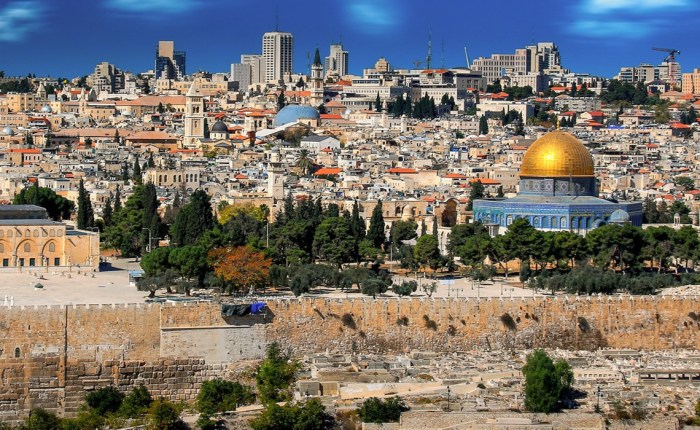
In light of current events, it seems pertinent to share a set of three sermons I preached during the Autumn of 2023, on the Biblical, Historical, and Modern meanings of the name “Israel.”
This is the third and final message dealing with “Modern Israel.”
Part 1: Biblical Israel, can be found HERE.
Part 2: Historical Israel, can be found HERE.
If you prefer – the audio of this sermon can be found at the following SoundCloud link:
This audio version was originally written and preached for Dailey Chapel Christian Church, on October 29, 2023. The following transcript has been minimally updated since then.
_____________________
Our message for today, begins with a story. It’s a story that I never knew about, until almost a year ago, so I’ve been waiting to tell it for a while. Almost two years ago, after church one morning, Mike Lunsford handed me a really thick book. It was a thousand-pager. And he challenged me to read it before I got done preaching through the Book of Romans.
I said, “Challenge accepted.”
I was probably only in Chapter 2 or 3 of Romans at the time, so I don’t know if Mike realized this then, but it was easy for me to accept his challenge, because I knew it was going to be a few years before we would even be close to getting all the way through Romans. I had some time to procrastinate, so the book sat on my shelf for quite a while before I cracked it open.
Then, when Nelly and I were dating, we read it together. I would read a chapter and record it on my phone, and then email her the file, so she could listen to the audio on her earbuds while she was at work. And sometimes she would do that on her off time as well – read and send me the audio.
We’ve been doing that ever since. And we’ve gone through several books this way, including, eventually, this thousand-pager that Lunsford provided. So, anyway, I have to give credit where it is due – if it wasn’t for Mike, we probably would have never picked this particular book to read, and we wouldn’t have discovered this amazing story that it contains.
It’s a story about a 33-year-old farmer from Missouri – a Baptist, born in the grain belt, who would one day change the whole world. That was the hook that got me past the first 20-30 pages of this book. Some of my favorite stories are ones about farmers that change the world, or even save the galaxy – that’s what Star Wars, The Lord of the Rings, and even Superman are all about you know – they’re all about farmers that do amazing things. And that’s what this story is about as well. Except this story is a true one, about a true man.
Now, this particular farmer from Missouri was born way back in 1884. So, by the time he was 33 it was 1917. And, if you didn’t sleep through your High School history class, then you know that 1917 was a pivotal year on planet Earth – it was a difficult time. So that Summer, this farmer left the fields behind, and reported for duty at the National Guard. Like many Americans at the time, he was answering the call of President Woodrow Wilson, to go fight in Europe – to win “the war to end all wars,” and make the world safe for democracy.
But, before this farmer went off to France, he had to go through training first, so they sent him to Camp Doniphan, on the wind-swept plains of Oklahoma. Back in those days, officers were elected by the men in their companies, and he was very popular, and well liked, so as soon as he enlisted, he was elected to be first lieutenant. The farmer had become a soldier
He was Harry S. Truman of the 129th Field Artillery of the 60th Brigade attached to the 35th Division of the United States Army.
And at camp Doniphan, his commanding officer put this bright young man, with an aptitude for organization and detail – in charge of the canteen.
Now, army canteens back then were ways for the troops to purchase items that were not part of their standard issued supplies – things like paper, and smokes, and soda, and candy and that kind of stuff – non-essential items that troops could buy if they had someone in charge of the canteen who was good at keeping it stocked and organized and running smoothly.
And this is the kind of thing that Truman excelled at. He was great at looking at things that were in a state of disorder, or not running as efficiently as they could be, sizing them up accurately, and implementing plans to improve them, or put them in order. And he was also good at finding the right people to help him execute his plans.
So, he utilized all his innate talent in running the army canteen. It was, by no means a prestigious position – but it’s what he was assigned to, so he gave it everything he had. He quickly discovered, that army canteens could actually be quite profitable if the right person was running them, because it was like being a middle man between the civilian suppliers of goods, and the soldiers who had money to spend. The guy running the canteen could buy things cheap, mark things up a little, and make some profit.
To do this, Lieutenant Truman brought on a partner to help with the finances. He was Sergeant Edward Jacobson. Jacobson, you can probably tell from his last name, was a Jew. He was from New York, but his family had moved to Missouri in 1905 – that’s how he ended up in the same army camp as Truman.
I hope no one takes this as racist, but Truman recognized what all of us know – that Jews tend to be pretty good at making money. I don’t think that’s a bad thing. In fact, I’m of the opinion that it’s one of the gifts that God bestowed on them as a people, so that they would be able to survive and thrive as foreigners and strangers among the nations of the world.
So anyway, Truman appreciated this quality, and he partnered up with Jacobson, and the two not only became extremely successful business partners, but life-long friends as well. By all accounts, Jacobson was Truman’s best friend, they were like brothers, and they remained so until Jacobson’s death in 1955.
It’s this deep bond of friendship, between the Baptist Farmer and the Jewish Businessman, and more specifically, the respect and trust they had for one another, that lies at the center of this story, and which would eventually have an impact on world history about 30 years after it had an impact on the quality of canteen supplies at Camp Doniphan.
Now, we’re going to come back to Truman and Jacobson in just a bit, but for now, we need to talk about something else that was happening, in the meantime, as 1917 progressed into 1918 and WWI began grinding to a halt. But before we talk about that, so we can get back to Truman and Jacobson, we need to briefly address why we’re talking about this subject at all.
The last couple of weeks, as we’ve been working through Romans Chapter 11, we’ve been talking about the name Israel a lot. Israel being the main subject matter of Romans 9, 10, and 11. And so, as we’ve been working our way toward the end of this middle section of Romans, we’ve been examining what exactly the name Israel means. This name Israel is used in three different ways – I call them the Three Israels: Biblical Israel, Historical Israel, and Modern Israel. Two weeks ago, we started this topic by defining the name Israel from a purely Biblical perspective.
What’s Israel mean in the Bible?
In the Old Testament, it was the people that God chose for Himself out of all nations on the Earth, to lead into the Promised Land through Moses. God built a physical kingdom and named it Israel, after the name He gave to Jacob, the grandson of Abraham.
When Jesus arrived, centuries later, and made a New Covenant. His death and resurrection re-defined the name Israel to include people of all nations who put their faith in him. His sacrifice tore the veil in the Temple apart, and made access to God available to all people who believe in Jesus – and ONLY to people who put their faith and trust in him and follow him.
That’s Biblical Israel – the Israel that we have been transplanted into as citizens of God’s Kingdom, the Israel that will never end and extend into eternity.
But what about those from the people of Israel who didn’t accept Jesus as the Christ? What about them? This is what Paul is addressing in this whole section of Romans – what about the Jews who reject Christ? This is the Israel that we talked about last week, in part two of this three-part sub-series. This is what I call Historical Israel.
They are the Israel that Paul says, was pruned out of the Olive Tree. They took a different path through history, but have none-the-less kept their racial identity, kept their loyalty to the Old Testament (to varying degrees, depending on which specific Jewish denomination they belong to), and they are the Israel that has survived being hunted, corralled, persecuted, and nearly made extinct throughout the last 2,000 years, beginning with the Roman destruction of Jerusalem in A.D. 70. It’s Historical Israel whose history we surveyed, and I summarized very briefly last week, even though, that was kind of a long sermon.
It’s historical Israel that Jesus prophesied about in Luke 21:20-24:
“When you see Jerusalem being surrounded by armies, you will know that its desolation is near. Then let those who are in Judea flee to the mountains, let those in the city get out, and let those in the country not enter the city. For this is the time of punishment in fulfillment of all that has been written. How dreadful it will be in those days for pregnant women and nursing mothers! There will be great distress in the land and wrath against this people. They will fall by the sword and will be taken as prisoners to all the nations. Jerusalem will be trampled on by the Gentiles until the times of the Gentiles are fulfilled.”
That’s Jesus prophesying about the path of Historical Israel – from the Roman destruction of Jerusalem onward, down through the ages. This prophesy has been repeating itself over and over throughout the history of the Jews. The Romans did terrible things to them and trampled on Jerusalem 30 or 40 years after Jesus said this, but many other countries have done these things as well in the intervening centuries. Just as Jesus said, Jerusalem was given over to the Gentiles…
It was given over to the Gentiles, until recently in world history. Now, we’re treading on shaky ground here, because the Jews are in charge of Jerusalem again, but even though they technically have the city, there is still a mosque and a Muslim shrine sitting on the Temple Mount. So, the Gentiles still have a little bit of a foothold, but it’s a close call.
And this brings us to what I call the third manifestation of Israel – the Israel we are talking about today in part three – the modern State of Israel which exists on the Earth today, and which we hear about in the news on a daily basis. Where did it come from? Between the year 70, and the year 1948 there was, technically speaking, no country on the world map called Israel. So, how did it re-appear after so many centuries?
Was the nation of Israel created in 1948 or was it re-created?
Is this Israel the same Israel that was there before, or is it something different?
Was it brought about by the will of God, or the decisions and actions of human beings, or both?
Does the fact that the Jews are almost completely in charge of Jerusalem mean that the times of the Gentiles are almost fulfilled?
The answers to these questions are an endless topic of debate, even among Christian scholars. They’re ultimately a matter of belief.
Many Jews would say that this Israel today is the same one that existed when Joshua led the Israelites over the Jordan River three or four thousand years ago. Many Christians would agree with them. However, many other Christians would not agree with them. It’s a matter of debate and belief, and whatever one believes about this specific topic, it should not be something to ever break fellowship over. The Church has, over the centuries, become too divided already over opinions that are non-essential to the truth of the Gospel. So, it’s OK to have different opinions and convictions about this particular subject, because there is still an element of mystery to it.
But whatever we believe about it – we still have to deal with the fact that there is a very real country on this globe, with the name Israel, and it is governed by, and primarily populated with, Jewish people.
It’s populated with Jewish people who can trace their collective ancestry, back through history, back to the people who once lived in the land of Judea when Jesus walked the Earth, and further back to their ancestors like King David who ruled in Jerusalem, and further back to those who crossed the Jordan River, and further back to Abraham, Isaac, and Jacob.
So, how did this modern nation, this political entity baring the name Israel – a name that conjures up all this rich Biblical and extra-biblical history – come to exist?
Well, it goes back to what happened at the end of WWI. At the end of WWI, the British, having defeated the Ottoman Empire (if you want to know how that happened you can watch Lawrence of Arabia). But the British defeated the Ottoman Turks, who had been allied with Germany. And that brought to an end, 400 years of Turkish Muslim rule over the land that had been known as Israel at one time.
It wasn’t called Israel anymore, and hadn’t been for almost 2,000 years. The Romans had renamed it Syria-Palestine, when they drove the Jews out in the second century. And the name stuck. By the way, if you’ve ever wondered where they got the name Palestine, it’s just the Latin for Philistine.
There were Jews and “Philistinians” fighting in Gaza 3,000 years ago. David killed Goliath on the border of Israel and Gaza. The people living there today are not the same people that lived back then, and we can’t lump all Palestinians together, or all Israelis together either. There are Christian Palestinians, and Christian Israelis, just like there are Christian Texans and Christian Mexicans (for example). The conflict is much more complicated than just cowboys and Indians – good guys and bad guys. But still, the fighting over that particular piece of land is nothing new. As King Solomon wrote in Ecclesiastes 1:9, “What has been will be again, what has been done will be done again; there is nothing new under the sun.”
In any case, back to WWI…
By that time, Israel/Palestine had been through the hands of several Muslim empires, known as caliphates, ever since about A.D. 635. During which time, smaller communities of Jews had been slowly migrating back into the region, and back to Jerusalem, just as there were other groups of Jews migrating to other places, and settling in other countries across the Mediterranean, Middle East, and Europe.
The Jews who migrated back to Palestine, and those living under Islamic caliphates, were generally well treated by the Muslim kingdoms they lived in, and that was no different with the Ottoman Empire. The Ottoman Empire rose to power in 1299, took over rule of Palestine in the early 1500s, and they had controlled it ever since, until the end of WWI.
By 1900, the Ottoman Empire was huge, and it controlled a vast area of the Middle East. And when it was defeated along with the rest of the Central Powers in WWI, the British and the French took control of all that territory, and with the help of Woodrow Wilson, they carved up the Middle East like a Thanksgiving turkey without any regard for the local inhabitants of places like Iran, Iraq, Jordan, Syria, Lebanon, and Palestine.
All the tribes in these places, had lived in relative peace for centuries under Ottoman rule. That was no longer the case when Britian, France, and the U.S started running the ballgame.
Most of the problems that exist in the Middle East today, can be traced directly to the creation of all these artificial state boundaries that never existed before, and which completely disregarded the culture of the people living in those places.
Imagine it like this. Say that we have a chili-cook off here at church, and every family brings in their own pot of chili…
I use chili for this analogy because, when it comes to chili, everyone has their own recipes and individual styles. If 20 people make chili, we’ll have 21 different kinds of chili. So, say we have 20 pots of chili simmering in crock-pots all nice and neat, in the social room here at church.
And then, while we’re all having church, Big Bad Dom Nepote wanders off into the social room, pulls out a huge hundred-gallon pot, and proceeds to dump everyone’s chili into that, stir it all together, and then put it all back into the crock-pots, and come back and sit down as if nothing happened.
That’s what our government, along with the British and the French did to the Middle East after WWI. They were trying to make everything equal, and they were trying to create order out of a cultural situation that they didn’t understand – that looked like chaos, but it wasn’t. That caused them to rip apart the centuries of order and structure that were already there. So, they ended up creating disorder and chaos instead.
They couldn’t fathom the idea, that some people don’t like corn in their chili.
Some people don’t like beans in it.
Some like it spicy, and some don’t.
Texas makes chili one way, and Cincinnati makes it another.
So, the British and the French, thinking that all chili was the same thing, made a big chaotic stew that the people living in the Middle East – whether they happen to be Christian, Muslim, or Jew – have been trying to pick through ever since.
Now, what about the Jews? That’s the group we’re primarily concerned with at present. Well, the Jews, or Historical Israel as I refer to them, and as we surveyed last week, had been persecuted in just about every country of Eastern and Western Europe and Russia for almost 2,000 years.
So, in the late 1800s they were finally fed up, and they formed a peaceful, political movement, called the World Zionist Organization, whose stated intention was “to establish a home for the Jewish people in Palestine secured under public law.”[1]
They wanted to go back to the land of Israel, and form it into a modern nation. But they needed help to do this.
And after WWI, they had the British to help them. The British government was sympathetic to the Zionist movement, so after they took control of the land previously ruled by the Ottomans, including Palestine, they began laying the foundation for the establishment of a Jewish State.
But if this was going to happen, it was going to happen slowly. They weren’t very careful with the creation of the other Middle Eastern states, but they knew with this one, they had to be precise, and there was a lot of disagreement about it, even within Parliament. The British wanted to help, but they dragged their feet on it.
Then WWII happened, and when the whole world saw what the Nazis had done to the Jews, the process of creating a Jewish state was expedited. But by that time, it wasn’t solely a British decision any longer. After WWII it was in the hands of the newly formed United Nations. And the United Nations, at that time, looked to the United States for guidance and leadership.
So, that meant, that the creation of a Jewish state, was in the hands of an international organization that was looking, not just to the United States, but to the Executive Branch of the United States government for guidance and direction about what to do, and about whether or not to do it at all. If this new country was going to be formed, it couldn’t survive without support from the United States, and the President in particular.
Back to the story I started at the beginning of all this.
In all the intervening years between 1917 and 1947, when the U.N. was set to decide this matter – farmer, soldier, Harry S. Truman, had become President Truman. And President Truman wanted nothing to do with being involved in a such a monumental, world-altering decision. He believed it was right for the Jews to have their own country, but there was too much pressure on him to make a decision, in terms of he being the main guy to make it a reality.
He had pressure on him from the Arabs in the region who didn’t want a Jewish State, he had pressure from his own State Department that didn’t want us involved in creating a Jewish State. He had pressure from the British, pressure from the Jews, and pressure from the Christians in our country who supported the Jews.
By late 1947, Truman had been lobbied so vigorously and rudely by all these different groups, including prominent Jewish leaders, that he basically washed his hands of the whole thing, and told the U.N. to do whatever they wanted. He had become completely unapproachable on the issue of a Jewish homeland, and he would not take a single meeting with anyone who wanted to talk about it. Which meant, without U.S. leadership, it probably wouldn’t happen.
And so, knowing they were nearly doomed, in a last-ditch effort, the most prominent Jewish leader alive at the time, the man with the most influence, who would become Israel’s first President – his name was Dr. Chaim Weizmann – he flew to America to talk to the President.
And Truman knew this man really well, and respected him, but he refused to talk, even to him.
There was only one person in the world that could talk to Harry Truman about this, in that crucial moment of all moments for the Jews, and it was his old friend Eddie Jacobson.
So, one morning, Jacobson flew in from Kansas City, and as the story goes, he walked into the Oval Office, completely unannounced – as only he could – and he had an honest chat with his friend.
At this point, there’s a lot more details that I don’t have time to tell, but when it was all said and done, his friend had convinced him to meet the Jewish leader Chaim Weizmann, and afterwards, the President made it known to the entire world, with all the authority of his office, that he would support the establishment of a Jewish State in Palestine, and that it would have the full backing of the United States.
The U.N. voted, and passed the resolution in November of 1947, and on May 14, 1948, Israel declared its sovereignty. 12 minutes later, the United States became the first nation to recognize them, and a few minutes after that, the other world superpower – the Soviet Union – recognized them as well. At that point, it was a done deal, at least for the Jews.
The modern State of Israel, though primarily populated with “historical Israel,” cannot be exactly the same, because there are non-Jewish people also living within its borders. And it’s definitely not the same thing as Biblical Israel – as part one of this series outlines very carefully.
Unfortunately, this modern manifestation of Israel has had nothing but war and terrorism ever since it’s formation.
And, if we take the prophecies in the Bible seriously, then the indication from Scripture, is that, that particular piece of land will continue to have war, and terrorism until the day, when a remnant of the Jewish people living there, will choose to call on the Son of God, the one whom their ancestors pierced on the hill of Golgotha outside of Jerusalem.
Those aren’t my words.
That’s not my prediction.
That comes from the prophet Zechariah, who wrote of a time, long in his future, a time that the world has still never seen – a time when the armies of the whole world would surround Jerusalem to finally see it destroyed. And when they do, he says:
“Then the LORD will go out and fight against those nations, as he fights on a day of battle. On that day his feet will stand on the Mount of Olives, east of Jerusalem, and the Mount of Olives will be split in two from east to west, forming a great valley, with half of the mountain moving north and half moving south. You will flee by my mountain valley, for it will extend to Azel. You will flee as you fled from the earthquake in the days of Uzziah king of Judah. Then the LORD my God will come, and all the holy ones with him. On that day there will be neither sunlight nor cold, frosty darkness. It will be a unique day—a day known only to the LORD—with no distinction between day and night. When evening comes, there will be light. On that day living water will flow out from Jerusalem, half of it east to the Dead Sea and half of it west to the Mediterranean Sea, in summer and in winter. The LORD will be king over the whole earth. On that day there will be one LORD, and his name the only name” (Zechariah 14:3-9, NIV).
There will be peace one day in Jerusalem. But only when the King Returns. That’s how Zechariah puts it.
Paul says it like this, in Romans 11:25-29:
“I do not want you to be ignorant of this mystery, brothers and sisters, so that you may not be conceited: Israel has experienced a hardening in part until the full number of the Gentiles has come in, and in this way all Israel will be saved. As it is written: ‘The deliverer will come from Zion; he will turn godlessness away from Jacob. And this is my covenant with them when I take away their sins.’ As far as the gospel is concerned, they are enemies for your sake; but as far as election is concerned, they are loved on account of the patriarchs, for God’s gifts and his call are irrevocable.”
Now, as we close this topic today, and as we close this section of Romans out, I’m not going to pretend that I understand what all this means. I don’t. Paul calls it a “mystery,” and seems to indicate that when our time is over – when there are no more Gentile Christians left on the earth – when we’ve all been hunted down and killed by the Beast… then, somehow, God will bring the survivors of Historical Israel, and the inhabitants of Modern Israel at that time, back into the Olive Tree of Biblical Israel.
There’s all manner of theories about that, but we don’t know for sure.
That seems to be what Paul is saying, in Romans 11. But, full disclosure, I don’t know for sure what he means. I’m patching together a series of different verses to come to that conclusion, but I don’t know for sure. I want to be clear about that. This is a really difficult topic to understand, even with Paul talking about it so much. And even so, I wish he’d given us just a little bit more. But I guess he said what he was supposed to say, and what God wanted him to say.
What we can be sure of, is what Zechariah boils down for us in verse 9 of that 14th Chapter:
“The LORD will be king over the whole earth. On that day there will be one LORD, and his name the only name.”
As important as the name Israel is – as important as it is for us to understand what it means and how it’s used and what it really refers to… As much as we, as the Church, cannot escape our connection to the name Israel – Israel is not the name we revere above all other names.
Jesus Christ is the one we give that honor to.
To him, and him alone, be all the glory in Heaven, and on Earth.
I think that’s how we conclude this topic the best – by saying, whatever happens, however it goes down, whatever God has in mind for the Jews… Jesus is still the King. And that’s how Paul closes this subject as well – with a doxology, a praise to God, in the final verses of Chapter 11…
“Oh, the depth of the riches of the wisdom and knowledge of God! How unsearchable his judgments, and his paths beyond tracing out! ‘Who has known the mind of the Lord? Or who has been his counselor?’ ‘Who has ever given to God, that God should repay them?’ For from him and through him and for him are all things. To him be the glory forever! Amen” (Romans 11:33-36, NIV).
[1] See, “Zionism: World Zionist Organization (WZO),” at Jewish Virtual Library –
(www.jewishvirtuallibrary.org/world-zionist-organization-wzo)
All three of these chapters can be found in the second volume of Totally Righteous: 150 Sermons from Paul’s Letter to the Romans…


 The Basmati House Review