
Last week, we looked at a passage from Luke Chapter 14, where Jesus talked about the ‘Cost of Discipleship,’ – the willingness to let go of everything we have, everyone we know, and everything we care about – even our own lives – if our King should ever call upon us to do so.
This week, we’re going to focus on Luke 6:27-36.
These words of Jesus touch on one of the great pillars of God’s Kingdom – a cornerstone of the entire message of the whole Bible. It’s no exaggeration to say, that if we miss the message that Jesus gives us here in Luke 6:27-36, then we are missing the whole point of the Gospel itself.
Now, before we look at this passage in Luke, I want to go back to the Old Testament for a few moments, and talk a little about one of the more interesting characters we find there – a man, by the name of Jonah.
Now, many of us, when we think of Jonah, automatically associate him with the giant fish!
We think of Jonah and the fish, or Jonah and the whale, because we heard this story when we were still children, and to the mind of a child, that is the most memorable thing that happens in this story.

When I was a kid, it made me think of the story of Pinocchio.
And, actually, there are some overlapping themes between the story of Jonah and the fairytale of Pinocchio – both are about redemption and transformation for instance.
Pinocchio learns how to become a “real boy,” and Jonah learns how to become a “real man.”

And they both go through their transformation from one to the other while being swallowed by huge sea creatures.
So, I think – to any of us who heard both of those stories as children – it’s somewhat easy to blend them together in our memories, and maybe think of Jonah as being one of the stories in the Bible that is more for kids.
But the truth is, that Jonah’s story is really not a children’s story.
Not at all.
And the part where he gets swallowed by the fish is an important part of the book, but it’s not the most important thing that happens. The most important part of Jonah’s story, is not his encounter with the fish, but rather, his encounter with God.
And Jonah’s encounter with God was not a pleasant one.
Jonah’s relationship with God was not amicable or friendly – to say the least. In fact, the main emotion that Jonah expresses to God is ANGER.
He’s very angry at God.
Jonah had a very big problem with God, because God asked him to do something that was, in Jonah’s mind, completely unacceptable.
The story of Jonah happened at a complicated time in the history of Israel.
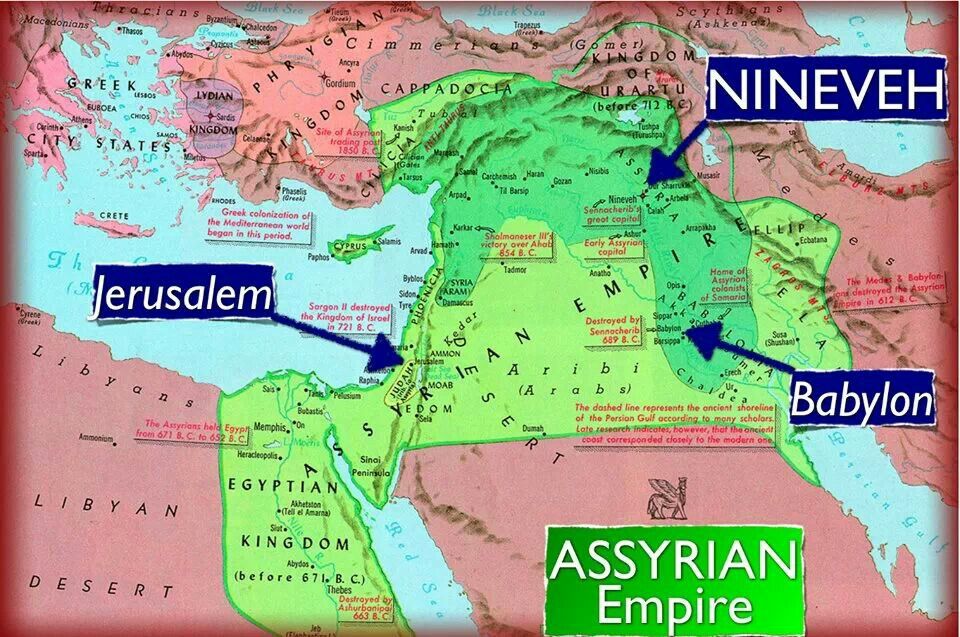
The Northern Kingdom of Israel had been dealing with foreign invasions for almost a century by then. And these invaders were from the Assyrian Empire, which today would be primarily in the countries of Iraq, Iran, and Syria. But the Assyrians were an exceedingly brutal people; their culture was built on two main principles: warfare, and building projects.
The Assyrians were constantly going to war in order to expand their empire, and plunder the people they defeated. And those they didn’t kill, they would turn into slaves, and take them back to Assyria so they could have slaves build their buildings and serve their people.
Whenever the Assyrians captured a city, they would mutilate anyone who resisted them. They would skin people alive, they would impale them on stakes and line the roads with them, they would pull their intestines out to use as burnt offerings, they would create huge piles in front of the city gates – one pile of enemy corpses, and another pile of all the heads they had decapitated from those corpses. And they didn’t just do this for the sake of being brutal – they considered it part of their religious duties – the mass murder and executions were how they made sacrifices to the demons they worshipped as gods. They were very meticulous and artistic about how they dismembered the bodies of their enemies, and who they chose to take as slaves.
That’s who the Assyrians were.
And they had been slowly making these kinds of invasions into the north of Israel for about a hundred years by the time Jonah came along, and by the time God asked Jonah to go to their capitol city, which was called Nineveh, and preach against all of their wickedness.
But Jonah had a very big problem with God asking him to go on this journey and do this.
And we might think it was because of fear; we might think Jonah was just afraid to go to Nineveh and preach against them because they would probably just kill him. But there’s really no indication in the story that Jonah was in the least bit afraid. He was not a fearful man.
He was an angry man. And the reason he had a problem with God telling him to go preach to the Assyrians of Nineveh was because HE HATED THEM.
They were the arch enemies of Jonah’s people. They had invaded his country, they had killed and enslaved his countrymen, and they were looming over Israel’s borders, so that they could continue doing these things, with no end in sight.
So, Jonah hated them.
And more than that, he believed his hatred of the Assyrians was absolutely justified.
And if we were in his shoes today, we would very likely feel the same way.
In fact, if you were to look on a map, and find where Nineveh is located – you would see the present-day city of Mosul in Iraq.
The ruins of Nineveh are right next to Mosul, and up until about a few years ago, Mosul was in ISIS occupied territory.
Of course, we’ve all heard about the atrocities of ISIS over the past decade. They’ve attempted to build their own country by conquest and bloodshed; they’ve killed and enslaved tens of thousands, they’ve carried out terrorist attacks across the Middle East, Asia, and Europe, and have publically executed almost anyone who has opposed them – including many Christians – which are, of course, in the minority in that part of the world.
If God spoke to any of us, and told us to go preach the Gospel to ISIS – how would we feel about it?
It’s probably an understatement to say that we wouldn’t want to go – and if we decided to go anyway – the people who love us would do their best to convince us that we were making a big mistake.
Well Jonah, back in his day – was told, by God, to go preach to people that were not very much different from ISIS. And he said (basically), ‘No, God,’ I’m not going to do that.’
And then, he went down to the nearest port, and hopped on the first ship available, so that he could sail as far away as possible in the OPPOSITE DIRECTION of where God told him to go.
And like I said, he didn’t refuse to go because he was afraid of the Ninevites… he refused to go because HE HATED THEM.
You may remember what happens next.
God decides not to let him off the hook so easily, and sends a storm to keep him from sailing away – and so, Jonah, partly because he doesn’t want the other people on the boat to die because of his disobedience, and partly because he thinks he can escape God by different means – has himself thrown into the sea. But even that attempt to get out of the work God was asking him to do fails – as God sends the infamous giant fish to swallow him – and actually rescue him.
And it’s there, in the belly of the fish – in that terrible, unimaginable darkness – where he’s an inch away from death – that Jonah FINALLY has a heart to heart with God about his life, and about his responsibility as one of God’s chosen people – to take the light of God into a dark place.
God uses that place of suffering and darkness to get Jonah’s attention – and when Jonah is spewed back onto dry land again – he’s ready to head to Nineveh, and preach to the Assyrians like God told him to.
He’s changed his actions from disobedience to obedience,
But, as the story continues, we discover that his heart has not changed at all – he still harbors the same hatred in his heart.
His actions have changed because of God’s discipline, but his heart stays the same.
And when he preaches to the city of Nineveh, the people do repent of their sin and their evil, and they turn to God.
And Jonah responds to their repentance like this:
This is what is says in Jonah 4:1-3 –
“But to Jonah this seemed very wrong, and he became angry. 2 He prayed to the Lord, “Isn’t this what I said, Lord, when I was still at home? That is what I tried to forestall by fleeing to Tarshish. I knew that you are a gracious and compassionate God, slow to anger and abounding in love, a God who relents from sending calamity. 3 Now, Lord, take away my life, for it is better for me to die than to live.”
This is the most successful revival on record in history – 120,000 people in Nineveh – repenting of their sin en masse – and turning to God. Jonah’s one of the most successful preachers in history. And he’s so mad at this, and so filled with hatred towards the people he’s preaching to, that he just wants God to kill him. He just wants God to end his life.
He’s had enough of God showing MERCY to his enemies.
So, as the story ends, Jonah and God have another little chat about Jonah’s attitude, and the condition of his heart, and then the story sort of abruptly ends.
And it ends with God asking a question.
And the question is directed towards Jonah – but the writer of the book, by ending it with a question – is saying that it’s really directed towards the reader.
This question is directed toward us.
And the question that God asks, is why shouldn’t I care about saving these people? These are people. They’re human beings. Why shouldn’t I care about them?
That’s what God asks.
And we might think of that question of God’s, as sort of hanging in the air like a dense fog for the next 700 years, until Jesus comes along, and clears all the fog away and says this – in Luke 6:27-36…
“But to you who are listening I say: Love your enemies, do good to those who hate you, 28 bless those who curse you, pray for those who mistreat you. 29 If someone slaps you on one cheek, turn to them the other also. If someone takes your coat, do not withhold your shirt from them. 30 Give to everyone who asks you, and if anyone takes what belongs to you, do not demand it back. 31 Do to others as you would have them do to you.
32 “If you love those who love you, what credit is that to you? Even sinners love those who love them. 33 And if you do good to those who are good to you, what credit is that to you? Even sinners do that. 34 And if you lend to those from whom you expect repayment, what credit is that to you? Even sinners lend to sinners, expecting to be repaid in full.35 But love your enemies, do good to them, and lend to them without expecting to get anything back. Then your reward will be great, and you will be children of the Most High, because he is kind to the ungrateful and wicked. 36 Be merciful, just as your Father is merciful.”
Powerful words, yes?
Difficult to read.
And even more difficult to actually follow.
Jesus was the revolutionary of all revolutionaries.
No one, as far as I know, had ever said something like this before him, and if there were those who said something like this, they didn’t believe it so thoroughly and completely as he did – and follow it all the way through to the point of being executed. This kind of idea is not popular – it’s never been popular.
It’s not popular today.
We live in a world that runs completely counter to this idea.
What do we hear?
We hear people telling us who to be angry with, who to accuse, who to argue with, who to blame – who to hate.
We turn on the news, and what do we see?

Our society does not know the concept of loving one’s enemies.
The world tells us to shout them down, give ‘em what for, take ‘em to the cleaners… and then it gives us a list to choose from – pick your group… pick the group of people you want to be angry with this week.
And, unfortunately, for many of us, it’s often easy to pick a whole group of people to look down on, and be angry with, because the horrible truth about all this – the reason that these words of Jesus can sometimes sting us so much – is that we have the hardest part, not with loving the enemies that are on the TV or far away somewhere else, but with loving the enemies that are right in front of us.
Yeah, it’s hard to love people that we blame for causing the big problems in our society – but, if we’re honest, it’s even harder to love the people THAT WE KNOW – who have hurt us in some way… or spoken bad about us… or ignored us. That’s the really hard part about what Jesus says.
It’s hard for me.
Believe me, I have plenty of people that I can’t stand to be around. None of you guys here… ok… but it’s all I can do – to ask God for enough grace to not be bitter and angry at some of the people that have hurt me in the past.
There are people who have lied to me, lied about me, told me that I had no business being a minister, told me I was a loser who wasn’t worth anything – people who turned their backs on me when I needed them the most; leaders in churches who ostracized me, and kicked me out of their “church” group, because I asked them questions they didn’t know how to answer – so they just got offended and told me I was a bastard.
It’s hard to forgive that. It’s much easier to feel the emotions of anger, than to feel the emotions of pain or heartache.
It’s difficult work to let Jesus take a knife, and carve out the places of our heart that have become calloused and overgrown with bitterness.
It hurts.
But he died so that he could do that work for us.
Paul says, it like this in Romans 5:6 and Romans 5:8
“You see, at just the right time, when we were still powerless, Christ died for the ungodly….
But God demonstrates his own love for us in this: While we were still sinners, Christ died for us.”
He’s saying, quite simply, that we were all, at one time, ENEMIES of God. And he still showed compassion on us anyway, by dying the way he did.
I’ll close this morning, with a brief historical anecdote.
This one happened in Northern Ireland, in November of 1987, when the Irish Republican Army bombed a small town called Enniskillen. If you’re not very familiar with the situation in Northern Ireland at that time, they were about 20 years into a 30-year conflict that was very messy, very violent, and, at the risk of oversimplifying things, was mainly caused by a mixture of disagreements surrounding politics and religion.
This was a conflict between Catholics and Protestants, Irish nationalists and British loyalists; the British Army against armed civilian terrorists.
And on November 8, 1987 the people of the town of Enniskillen were celebrating Remembrance Day – which is the British version of our Veteran’s Day.
It was a cold and dreary November day in Enniskillen, Northern Ireland. The town was quiet, with the sound of rain tapping against the windows of the local shops and houses. The streets were lined with colorful autumn leaves, creating a vibrant contrast against the gray skies above.
Despite the weather, the people of Enniskillen went about their daily routines. Some were out shopping for groceries, while others hurried to catch the bus to work. The town had a sense of resilience about it, a reminder of the turbulent history that had shaped this community.
As the day turned to evening, the lights of the town began to flicker on, casting a warm glow against the darkness outside. The smell of turf fires filled the air, adding a sense of coziness to the town’s atmosphere.
In a local pub, a group of friends gathered around a table, sharing stories and laughter over pints of Guinness. The sound of traditional Irish music filled the room, creating a lively and welcoming ambiance.
Despite the troubles that had plagued Northern Ireland for so long, the people of Enniskillen remained united in their resilience and sense of community. As the night went on, it was clear that this small town had a spirit that could not be dampened by any storm.
That’s when the IRA detonated a large bomb in the town square.
12 people died from that bomb, and many more were injured.
Among those caught in the blast was a man named Gordon Wilson, and his daughter Marie.
The blast did not kill them, but a building collapsed on them, and they were trapped in the rumble for several minutes waiting to be rescued.
Those minutes when they were waiting to be rescued, were the last minutes that Gordon would spend with his daughter.
He held her hand while she told him that she loved him, and then she lost consciousness and never woke up.
Within hours – hours after losing his daughter – Gordon was on BBC Television, lamenting the loss of his daughter, assuring those watching that she was a child of Christ, and he would see her again – AND – to the HORROR of many people listening to him, and discussing the tragedy on the News that day – he told those who had killed her, that he held no ill will against them, that he forgave them, and then he urged there to be no retaliation for the attack.
His words of forgiveness and grace were an earthquake that caused that entire conflict to begin crumbling.
He eventually met with the IRA leaders, publicly, and forgave them in person, and he later became a senator in Ireland, and helped to bring a final end to the 30 years of violence that had claimed his daughter.
Before all that happened, Gordon Wilson was a window treatment specialist – he made drapes for a living.
__________________________
Matthew 5:3-10:
“Blessed are the poor in spirit, for theirs is the kingdom of heaven.
4 Blessed are those who mourn, for they will be comforted.
5 Blessed are the meek, for they will inherit the earth.
6 Blessed are those who hunger and thirst for righteousness, for they will be filled.
7 Blessed are the merciful, for they will be shown mercy.
8 Blessed are the pure in heart, for they will see God.
9 Blessed are the peacemakers, for they will be called children of God.
10 Blessed are those who are persecuted because of righteousness, for theirs is the kingdom of heaven.”
Loving our enemies – forgiving those who have hurt us – does not mean that we excuse their bad behavior.
It does not mean that we have to entertain their foolishness, or their wickedness. It doesn’t mean we have to give them our trust.
IT DOES MEAN, that we have to see them as our fellow human beings who are just as much in need of God’s love and grace as we are.
And that love and grace MIGHT cause those people to change.
We hope that it does.
But that’s not our responsibility.
It’s not our job to change people.
It’s not our duty to turn people into better human beings – we can’t make other people forgive.
But we can choose to forgive them.
We can choose to ask God to change what’s in our hearts. And then, when our hearts have been changed by Him – then He can use us for something that will (as Maximus Decimus Meridius once put it) “echo into eternity.”

 The Basmati House Review
You, sir, are a wonderful storyteller. And as all storytellers know, the best stories carry everylasting truths with them. Thanks, Adam.
Thank you, Mike. I really appreciate that.