The Three Israels – Part 3: Modern Israel

The Three Israels – Part 3: Modern Israel

In light of current events, it seems pertinent to share a set of three sermons I preached during the Autumn of 2023, on the Biblical, Historical, and Modern meanings of the name “Israel.”

This is the third and final message dealing with “Modern Israel.”

Part 1: Biblical Israel, can be found HERE.

Part 2: Historical Israel, can be found HERE.

If you prefer – the audio of this sermon can be found at the following SoundCloud link:

This audio version was originally written and preached for Dailey Chapel Christian Church, on October 29, 2023. The following transcript has been minimally updated since then.

_____________________

Our message for today, begins with a story. It’s a story that I never knew about, until almost a year ago, so I’ve been waiting to tell it for a while. Almost two years ago, after church one morning, Mike Lunsford handed me a really thick book. It was a thousand-pager. And he challenged me to read it before I got done preaching through the Book of Romans.

I said, “Challenge accepted.”

I was probably only in Chapter 2 or 3 of Romans at the time, so I don’t know if Mike realized this then, but it was easy for me to accept his challenge, because I knew it was going to be a few years before we would even be close to getting all the way through Romans. I had some time to procrastinate, so the book sat on my shelf for quite a while before I cracked it open.

Then, when Nelly and I were dating, we read it together. I would read a chapter and record it on my phone, and then email her the file, so she could listen to the audio on her earbuds while she was at work. And sometimes she would do that on her off time as well – read and send me the audio.

We’ve been doing that ever since. And we’ve gone through several books this way, including, eventually, this thousand-pager that Lunsford provided. So, anyway, I have to give credit where it is due – if it wasn’t for Mike, we probably would have never picked this particular book to read, and we wouldn’t have discovered this amazing story that it contains.

It’s a story about a 33-year-old farmer from Missouri – a Baptist, born in the grain belt, who would one day change the whole world. That was the hook that got me past the first 20-30 pages of this book. Some of my favorite stories are ones about farmers that change the world, or even save the galaxy – that’s what Star WarsThe Lord of the Rings, and even Superman are all about you know – they’re all about farmers that do amazing things. And that’s what this story is about as well. Except this story is a true one, about a true man.

Now, this particular farmer from Missouri was born way back in 1884. So, by the time he was 33 it was 1917. And, if you didn’t sleep through your High School history class, then you know that 1917 was a pivotal year on planet Earth – it was a difficult time. So that Summer, this farmer left the fields behind, and reported for duty at the National Guard. Like many Americans at the time, he was answering the call of President Woodrow Wilson, to go fight in Europe – to win “the war to end all wars,” and make the world safe for democracy.

But, before this farmer went off to France, he had to go through training first, so they sent him to Camp Doniphan, on the wind-swept plains of Oklahoma. Back in those days, officers were elected by the men in their companies, and he was very popular, and well liked, so as soon as he enlisted, he was elected to be first lieutenant. The farmer had become a soldier 

He was Harry S. Truman of the 129th Field Artillery of the 60th Brigade attached to the 35th Division of the United States Army.

And at camp Doniphan, his commanding officer put this bright young man, with an aptitude for organization and detail – in charge of the canteen

Now, army canteens back then were ways for the troops to purchase items that were not part of their standard issued supplies – things like paper, and smokes, and soda, and candy and that kind of stuff – non-essential items that troops could buy if they had someone in charge of the canteen who was good at keeping it stocked and organized and running smoothly.

And this is the kind of thing that Truman excelled at. He was great at looking at things that were in a state of disorder, or not running as efficiently as they could be, sizing them up accurately, and implementing plans to improve them, or put them in order. And he was also good at finding the right people to help him execute his plans.

So, he utilized all his innate talent in running the army canteen. It was, by no means a prestigious position – but it’s what he was assigned to, so he gave it everything he had. He quickly discovered, that army canteens could actually be quite profitable if the right person was running them, because it was like being a middle man between the civilian suppliers of goods, and the soldiers who had money to spend. The guy running the canteen could buy things cheap, mark things up a little, and make some profit.

To do this, Lieutenant Truman brought on a partner to help with the finances. He was Sergeant Edward Jacobson. Jacobson, you can probably tell from his last name, was a Jew. He was from New York, but his family had moved to Missouri in 1905 – that’s how he ended up in the same army camp as Truman.

I hope no one takes this as racist, but Truman recognized what all of us know – that Jews tend to be pretty good at making money. I don’t think that’s a bad thing. In fact, I’m of the opinion that it’s one of the gifts that God bestowed on them as a people, so that they would be able to survive and thrive as foreigners and strangers among the nations of the world.

So anyway, Truman appreciated this quality, and he partnered up with Jacobson, and the two not only became extremely successful business partners, but life-long friends as well. By all accounts, Jacobson was Truman’s best friend, they were like brothers, and they remained so until Jacobson’s death in 1955.

It’s this deep bond of friendship, between the Baptist Farmer and the Jewish Businessman, and more specifically, the respect and trust they had for one another, that lies at the center of this story, and which would eventually have an impact on world history about 30 years after it had an impact on the quality of canteen supplies at Camp Doniphan.

Now, we’re going to come back to Truman and Jacobson in just a bit, but for now, we need to talk about something else that was happening, in the meantime, as 1917 progressed into 1918 and WWI began grinding to a halt. But before we talk about that, so we can get back to Truman and Jacobson, we need to briefly address why we’re talking about this subject at all.

The last couple of weeks, as we’ve been working through Romans Chapter 11, we’ve been talking about the name Israel a lot. Israel being the main subject matter of Romans 9, 10, and 11. And so, as we’ve been working our way toward the end of this middle section of Romans, we’ve been examining what exactly the name Israel means. This name Israel is used in three different ways – I call them the Three Israels: Biblical Israel, Historical Israel, and Modern Israel. Two weeks ago, we started this topic by defining the name Israel from a purely Biblical perspective.

What’s Israel mean in the Bible?

In the Old Testament, it was the people that God chose for Himself out of all nations on the Earth, to lead into the Promised Land through Moses. God built a physical kingdom and named it Israel, after the name He gave to Jacob, the grandson of Abraham.

When Jesus arrived, centuries later, and made a New Covenant. His death and resurrection re-defined the name Israel to include people of all nations who put their faith in him. His sacrifice tore the veil in the Temple apart, and made access to God available to all people who believe in Jesus – and ONLY to people who put their faith and trust in him and follow him.

That’s Biblical Israel – the Israel that we have been transplanted into as citizens of God’s Kingdom, the Israel that will never end and extend into eternity.

But what about those from the people of Israel who didn’t accept Jesus as the Christ? What about them? This is what Paul is addressing in this whole section of Romans – what about the Jews who reject Christ? This is the Israel that we talked about last week, in part two of this three-part sub-series. This is what I call Historical Israel.

They are the Israel that Paul says, was pruned out of the Olive Tree. They took a different path through history, but have none-the-less kept their racial identity, kept their loyalty to the Old Testament (to varying degrees, depending on which specific Jewish denomination they belong to), and they are the Israel that has survived being hunted, corralled, persecuted, and nearly made extinct throughout the last 2,000 years, beginning with the Roman destruction of Jerusalem in A.D. 70. It’s Historical Israel whose history we surveyed, and I summarized very briefly last week, even though, that was kind of a long sermon.

It’s historical Israel that Jesus prophesied about in Luke 21:20-24:

That’s Jesus prophesying about the path of Historical Israel – from the Roman destruction of Jerusalem onward, down through the ages. This prophesy has been repeating itself over and over throughout the history of the Jews. The Romans did terrible things to them and trampled on Jerusalem 30 or 40 years after Jesus said this, but many other countries have done these things as well in the intervening centuries. Just as Jesus said, Jerusalem was given over to the Gentiles…

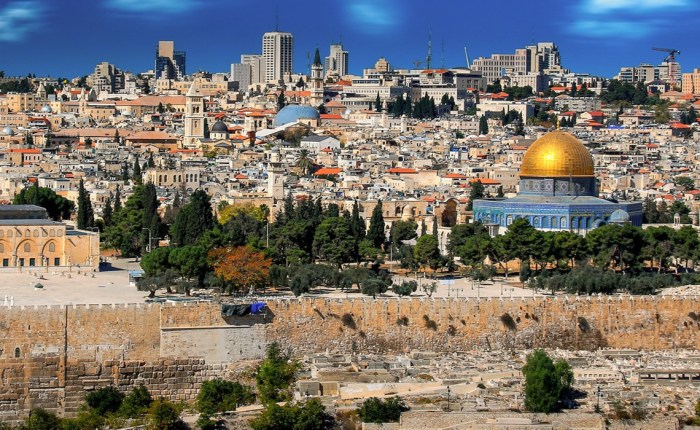
It was given over to the Gentiles, until recently in world history. Now, we’re treading on shaky ground here, because the Jews are in charge of Jerusalem again, but even though they technically have the city, there is still a mosque and a Muslim shrine sitting on the Temple Mount. So, the Gentiles still have a little bit of a foothold, but it’s a close call.

And this brings us to what I call the third manifestation of Israel – the Israel we are talking about today in part three – the modern State of Israel which exists on the Earth today, and which we hear about in the news on a daily basis. Where did it come from? Between the year 70, and the year 1948 there was, technically speaking, no country on the world map called Israel. So, how did it re-appear after so many centuries?

Was the nation of Israel created in 1948 or was it re-created?

Is this Israel the same Israel that was there before, or is it something different?

Was it brought about by the will of God, or the decisions and actions of human beings, or both?

Does the fact that the Jews are almost completely in charge of Jerusalem mean that the times of the Gentiles are almost fulfilled?

The answers to these questions are an endless topic of debate, even among Christian scholars. They’re ultimately a matter of belief.

Many Jews would say that this Israel today is the same one that existed when Joshua led the Israelites over the Jordan River three or four thousand years ago. Many Christians would agree with them. However, many other Christians would not agree with them. It’s a matter of debate and belief, and whatever one believes about this specific topic, it should not be something to ever break fellowship over. The Church has, over the centuries, become too divided already over opinions that are non-essential to the truth of the Gospel. So, it’s OK to have different opinions and convictions about this particular subject, because there is still an element of mystery to it.

But whatever we believe about it – we still have to deal with the fact that there is a very real country on this globe, with the name Israel, and it is governed by, and primarily populated with, Jewish people.

It’s populated with Jewish people who can trace their collective ancestry, back through history, back to the people who once lived in the land of Judea when Jesus walked the Earth, and further back to their ancestors like King David who ruled in Jerusalem, and further back to those who crossed the Jordan River, and further back to Abraham, Isaac, and Jacob.

So, how did this modern nation, this political entity baring the name Israel – a name that conjures up all this rich Biblical and extra-biblical history – come to exist?

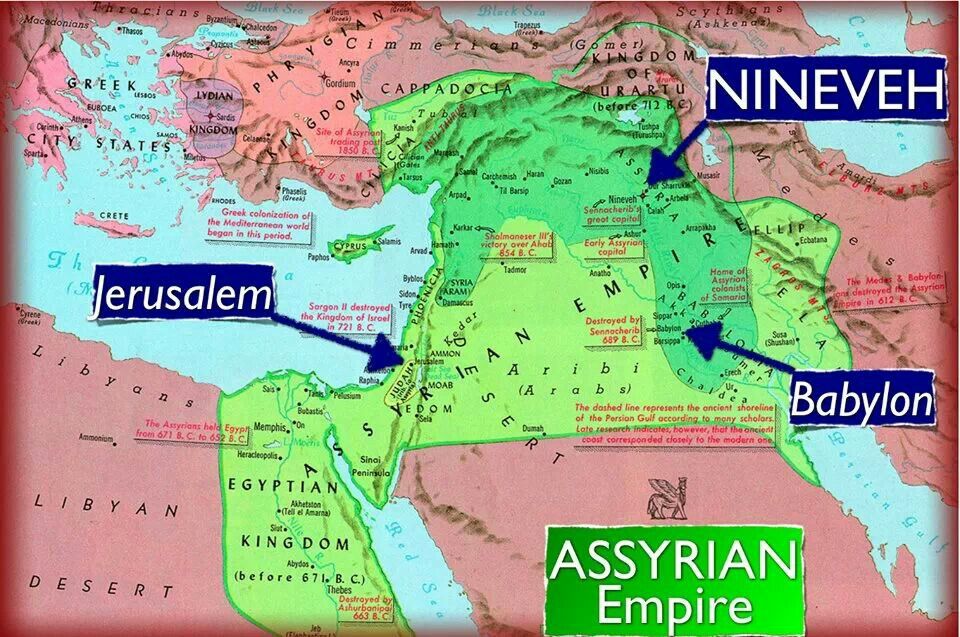
Well, it goes back to what happened at the end of WWI. At the end of WWI, the British, having defeated the Ottoman Empire (if you want to know how that happened you can watch Lawrence of Arabia). But the British defeated the Ottoman Turks, who had been allied with Germany. And that brought to an end, 400 years of Turkish Muslim rule over the land that had been known as Israel at one time. 

It wasn’t called Israel anymore, and hadn’t been for almost 2,000 years. The Romans had renamed it Syria-Palestine, when they drove the Jews out in the second century. And the name stuck. By the way, if you’ve ever wondered where they got the name Palestine, it’s just the Latin for Philistine.

There were Jews and “Philistinians fighting in Gaza 3,000 years ago. David killed Goliath on the border of Israel and Gaza. The people living there today are not the same people that lived back then, and we can’t lump all Palestinians together, or all Israelis together either. There are Christian Palestinians, and Christian Israelis, just like there are Christian Texans and Christian Mexicans (for example). The conflict is much more complicated than just cowboys and Indians – good guys and bad guys. But still, the fighting over that particular piece of land is nothing new. As King Solomon wrote in Ecclesiastes 1:9, “What has been will be again, what has been done will be done again; there is nothing new under the sun.”

In any case, back to WWI…

By that time, Israel/Palestine had been through the hands of several Muslim empires, known as caliphates, ever since about A.D. 635. During which time, smaller communities of Jews had been slowly migrating back into the region, and back to Jerusalem, just as there were other groups of Jews migrating to other places, and settling in other countries across the Mediterranean, Middle East, and Europe.

The Jews who migrated back to Palestine, and those living under Islamic caliphates, were generally well treated by the Muslim kingdoms they lived in, and that was no different with the Ottoman Empire. The Ottoman Empire rose to power in 1299, took over rule of Palestine in the early 1500s, and they had controlled it ever since, until the end of WWI.

By 1900, the Ottoman Empire was huge, and it controlled a vast area of the Middle East. And when it was defeated along with the rest of the Central Powers in WWI, the British and the French took control of all that territory, and with the help of Woodrow Wilson, they carved up the Middle East like a Thanksgiving turkey without any regard for the local inhabitants of places like Iran, Iraq, Jordan, Syria, Lebanon, and Palestine.

All the tribes in these places, had lived in relative peace for centuries under Ottoman rule. That was no longer the case when Britian, France, and the U.S started running the ballgame.

Most of the problems that exist in the Middle East today, can be traced directly to the creation of all these artificial state boundaries that never existed before, and which completely disregarded the culture of the people living in those places.

Imagine it like this. Say that we have a chili-cook off here at church, and every family brings in their own pot of chili…

I use chili for this analogy because, when it comes to chili, everyone has their own recipes and individual styles. If 20 people make chili, we’ll have 21 different kinds of chili. So, say we have 20 pots of chili simmering in crock-pots all nice and neat, in the social room here at church.

And then, while we’re all having church, Big Bad Dom Nepote wanders off into the social room, pulls out a huge hundred-gallon pot, and proceeds to dump everyone’s chili into that, stir it all together, and then put it all back into the crock-pots, and come back and sit down as if nothing happened.

That’s what our government, along with the British and the French did to the Middle East after WWI. They were trying to make everything equal, and they were trying to create order out of a cultural situation that they didn’t understand – that looked like chaos, but it wasn’t. That caused them to rip apart the centuries of order and structure that were already there. So, they ended up creating disorder and chaos instead.

They couldn’t fathom the idea, that some people don’t like corn in their chili.

Some people don’t like beans in it.

Some like it spicy, and some don’t.

Texas makes chili one way, and Cincinnati makes it another.

So, the British and the French, thinking that all chili was the same thing, made a big chaotic stew that the people living in the Middle East – whether they happen to be Christian, Muslim, or Jew – have been trying to pick through ever since.

Now, what about the Jews? That’s the group we’re primarily concerned with at present. Well, the Jews, or Historical Israel as I refer to them, and as we surveyed last week, had been persecuted in just about every country of Eastern and Western Europe and Russia for almost 2,000 years.

So, in the late 1800s they were finally fed up, and they formed a peaceful, political movement, called the World Zionist Organization, whose stated intention was “to establish a home for the Jewish people in Palestine secured under public law.”[1]

They wanted to go back to the land of Israel, and form it into a modern nation. But they needed help to do this.

And after WWI, they had the British to help them. The British government was sympathetic to the Zionist movement, so after they took control of the land previously ruled by the Ottomans, including Palestine, they began laying the foundation for the establishment of a Jewish State.

But if this was going to happen, it was going to happen slowly. They weren’t very careful with the creation of the other Middle Eastern states, but they knew with this one, they had to be precise, and there was a lot of disagreement about it, even within Parliament. The British wanted to help, but they dragged their feet on it.

Then WWII happened, and when the whole world saw what the Nazis had done to the Jews, the process of creating a Jewish state was expedited. But by that time, it wasn’t solely a British decision any longer. After WWII it was in the hands of the newly formed United Nations. And the United Nations, at that time, looked to the United States for guidance and leadership.

So, that meant, that the creation of a Jewish state, was in the hands of an international organization that was looking, not just to the United States, but to the Executive Branch of the United States government for guidance and direction about what to do, and about whether or not to do it at all. If this new country was going to be formed, it couldn’t survive without support from the United States, and the President in particular.

Back to the story I started at the beginning of all this.

In all the intervening years between 1917 and 1947, when the U.N. was set to decide this matter – farmer, soldier, Harry S. Truman, had become President Truman. And President Truman wanted nothing to do with being involved in a such a monumental, world-altering decision. He believed it was right for the Jews to have their own country, but there was too much pressure on him to make a decision, in terms of he being the main guy to make it a reality.

He had pressure on him from the Arabs in the region who didn’t want a Jewish State, he had pressure from his own State Department that didn’t want us involved in creating a Jewish State. He had pressure from the British, pressure from the Jews, and pressure from the Christians in our country who supported the Jews.

By late 1947, Truman had been lobbied so vigorously and rudely by all these different groups, including prominent Jewish leaders, that he basically washed his hands of the whole thing, and told the U.N. to do whatever they wanted. He had become completely unapproachable on the issue of a Jewish homeland, and he would not take a single meeting with anyone who wanted to talk about it. Which meant, without U.S. leadership, it probably wouldn’t happen. 

And so, knowing they were nearly doomed, in a last-ditch effort, the most prominent Jewish leader alive at the time, the man with the most influence, who would become Israel’s first President – his name was Dr. Chaim Weizmann – he flew to America to talk to the President.

And Truman knew this man really well, and respected him, but he refused to talk, even to him.

There was only one person in the world that could talk to Harry Truman about this, in that crucial moment of all moments for the Jews, and it was his old friend Eddie Jacobson.

So, one morning, Jacobson flew in from Kansas City, and as the story goes, he walked into the Oval Office, completely unannounced – as only he could – and he had an honest chat with his friend.

At this point, there’s a lot more details that I don’t have time to tell, but when it was all said and done, his friend had convinced him to meet the Jewish leader Chaim Weizmann, and afterwards, the President made it known to the entire world, with all the authority of his office, that he would support the establishment of a Jewish State in Palestine, and that it would have the full backing of the United States.

The U.N. voted, and passed the resolution in November of 1947, and on May 14, 1948, Israel declared its sovereignty. 12 minutes later, the United States became the first nation to recognize them, and a few minutes after that, the other world superpower – the Soviet Union – recognized them as well. At that point, it was a done deal, at least for the Jews.

The modern State of Israel, though primarily populated with “historical Israel,” cannot be exactly the same, because there are non-Jewish people also living within its borders. And it’s definitely not the same thing as Biblical Israel – as part one of this series outlines very carefully.

Unfortunately, this modern manifestation of Israel has had nothing but war and terrorism ever since it’s formation.

And, if we take the prophecies in the Bible seriously, then the indication from Scripture, is that, that particular piece of land will continue to have war, and terrorism until the day, when a remnant of the Jewish people living there, will choose to call on the Son of God, the one whom their ancestors pierced on the hill of Golgotha outside of Jerusalem.

Those aren’t my words.

That’s not my prediction.

That comes from the prophet Zechariah, who wrote of a time, long in his future, a time that the world has still never seen – a time when the armies of the whole world would surround Jerusalem to finally see it destroyed. And when they do, he says:

There will be peace one day in Jerusalem. But only when the King Returns. That’s how Zechariah puts it.

Paul says it like this, in Romans 11:25-29:

Now, as we close this topic today, and as we close this section of Romans out, I’m not going to pretend that I understand what all this means. I don’t. Paul calls it a “mystery,” and seems to indicate that when our time is over – when there are no more Gentile Christians left on the earth – when we’ve all been hunted down and killed by the Beast… then, somehow, God will bring the survivors of Historical Israel, and the inhabitants of Modern Israel at that time, back into the Olive Tree of Biblical Israel.

There’s all manner of theories about that, but we don’t know for sure.

That seems to be what Paul is saying, in Romans 11. But, full disclosure, I don’t know for sure what he means. I’m patching together a series of different verses to come to that conclusion, but I don’t know for sure. I want to be clear about that. This is a really difficult topic to understand, even with Paul talking about it so much. And even so, I wish he’d given us just a little bit more. But I guess he said what he was supposed to say, and what God wanted him to say.

What we can be sure of, is what Zechariah boils down for us in verse 9 of that 14th Chapter:

As important as the name Israel is – as important as it is for us to understand what it means and how it’s used and what it really refers to… As much as we, as the Church, cannot escape our connection to the name Israel – Israel is not the name we revere above all other names.

Jesus Christ is the one we give that honor to.

To him, and him alone, be all the glory in Heaven, and on Earth.

I think that’s how we conclude this topic the best – by saying, whatever happens, however it goes down, whatever God has in mind for the Jews… Jesus is still the King. And that’s how Paul closes this subject as well – with a doxology, a praise to God, in the final verses of Chapter 11…


[1] See, “Zionism: World Zionist Organization (WZO),” at Jewish Virtual Library –

(www.jewishvirtuallibrary.org/world-zionist-organization-wzo)

All three of these chapters can be found in the second volume of Totally Righteous: 150 Sermons from Paul’s Letter to the Romans

The Three Israels – Part 2: Historical Israel

The Three Israels – Part 2: Historical Israel

In light of current events, it seems pertinent to share a set of three sermons I preached during the Autumn of 2023, on the Biblical, Historical, and Modern meanings of the name “Israel.”

As the title suggests, this second message deals with “Historical Israel.”

If you prefer – the audio of this sermon can be found at the following SoundCloud link:

This audio version was originally written and preached for Dailey Chapel Christian Church, on October 22, 2023. The following transcript has been minimally updated since then.

_____________________

Over the past couple of weeks, we’ve been working through Romans Chapter 11 together. Chapter 11 is the last of the three middle chapters of Romans, where the Apostle Paul engages in an emotional discussion concerning the tragedy of the majority of the people of Israel rejecting and condemning the Messiah, who God had promised to them and their ancestors.

Because Israel is the main subject matter of this middle section of Romans, and because the name Israel is so important in the Bible, I actually decided several months ago when I was loosely outlining the sermons for this section, that I would devote some time to unpacking what the name Israel means – both how it is used within the Bible, as well as in history outside of Scripture, and how it’s used in the context of our modern world.

I had planned the overall topics of these messages well in advance of the tragic circumstances that occurred in the country of Israel, over the last couple of weeks. And, even though I would have been preaching about this subject anyway, if those terrible things had not occurred, I can still definitely say, that these events, even as they continue to unfold in front of the whole world, have certainly underscored the importance of talking about this subject, and reminded me of the necessity for us Christians to understand what the name Israel means.

I said this last week a couple of times – as Christians, we cannot escape our connection to the name Israel. One of the main points of New Testament theology, is that the Church has been spiritually grafted into the “Olive Tree,” which is Paul’s metaphor for Israel in Romans Chapter 11. 

Even though Israel was the name of God’s Kingdom in the Old Testament period that applied specifically to the Jewish people, the New Testament redefines the name Israel to include people of all nations and races who follow Jesus Christ as Lord and Savior. And it also redefines the name Israel to exclude all the Jews who rejected Christ as the Messiah. This is what Paul discusses in Romans Chapter 11, but this idea is not limited to just Paul’s writings. 

This is why, for instance, when James opens his letter to the Church, he addresses it: “To the twelve tribes scattered among the nations…” 

This is why Peter addresses the Church in his 1st Letter, by applying to us the same blessing that God spoke to the Israelites through Moses on Mount Sinai – telling the Church that we are:

As Christians, we cannot escape our connection to the name Israel, because through Christ, we have become a part of what the New Testament defines as the people of Israel.

So, the Biblical definition of Israel, as I said last week, has been narrowed in one sense, to include only those who are saved through Jesus Christ, but also, in another way, widened to include people of all tribes, nations, and languages who accept him. 

This narrowing and widening, together, have made God’s grace and mercy more accessible to people – and whoever does accept it, is part of what we call Biblical Israel. Now, I also said last week, that Biblical Israel is only one definition of the name Israel, and that there are actually three definitions of what constitutes Israel. 

I refer to them as Biblical Israel, Historical Israel, and Modern Israel. These are three different manifestations of Israel, each of them a separate entity, and yet, inescapably tied together in some very real ways that cannot be denied.

Last week, I spent the majority of time discussing Biblical Israel – which is what I just briefly summarized. Biblical Israel was the physical kingdom of the Jewish people in the Old Testament, that was ultimately fulfilled through the death and resurrection of Jesus – and now includes anyone who has put their faith him as Lord and Savior. 

Biblical Israel are the people who inhabit God’s Kingdom, which is a spiritual reality that exists in the world todayOn this side of the grave, the Kingdom is invisible. But it becomes visible and tangible through the people of God, through Biblical Israel, when we live according to the example and teachings of Christ and the Apostles. 

But that’s not the only definition of Israel. Paul talks about another Israel in Romans 9, 10, and 11. This is what I call, for the purposes of our discussion, Historical Israel. Paul doesn’t label them the same way; he calls both Biblical and Historical Israel – Israel. Which makes his whole discourse in Romans 9, 10, and 11 a little confusing for us if we’re not paying close attention to what he’s saying. But what he’s saying constitutes a description of two Israels. 

There is a vast majority of unfaithful Jews who rejected Christ, and then there is the Church which includes a minority of faithful Jews which are referred to as the remnant. These are the two Israels that Paul talks about in this middle section of the letter, even though he calls them both Israel. So, the unfaithful majority that Paul describes, is what I call Historical Israel. 

This is what we’re going to talk about for most of this message. It’s this Israel, the people who rejected Christ, that Paul is so torn up about in this middle section of Romans. In 9:3-5 he says:

In the first verse of Chapter 10, Paul goes on to say that his:

So, Paul has some hope for his people, even though in the first century, by rejecting Christ, many of them were pruned off from Biblical Israel, and began a long dark journey down another road, through history. And as we survey their history down that dark road, we should try to do so, with Paul’s attitude in mind – with hope, that there is a light at the end of their darkness.

It’s with this attitude in mind, that Paul encourages the Gentiles he’s writing to in Romans 11 to not be arrogant about their acceptance of Christ, and to not have an attitude of superiority toward the Jews who rejected Christ. He says in 11:30-31 that:

This is the kind of attitude we should have, as we survey Jewish history. The proper Christian attitude toward the Jews has always been, and should always remain, an attitude of humility and mercy. Unfortunately, it took the Church some time to learn this, historically speaking.

For much of Jewish history, sadly, they did not have the mercy and humility of the Church on their side. Many times, they had the opposite. Many times, they badly needed the mercy of Christians, and it was nowhere to be found. That’s something to keep in mind as well. The Jews have a deep memory, and they are well aware of the terrible things that were done to them in the past, by so-called “Christians.” 

As Christians today – we should know the darkness of Church history, and how that history has often been antagonistic to the Jews, rather than sympathetic. We need to be aware of that, so that we can separate Christian history, from so-called “Christian” history. Both for ourselves, and for other people who don’t understand these distinctions.

Now, the history that we’re going to survey today is just a short summary, but it’s the best I can do, with the amount of time we have together. And I’m going to start with the history of the Jews after the events recorded in the Gospels, and after the birth of the Church.

Judea as the land of Israel was known at the time of Jesus, was still under Roman occupation while the New Testament was being written, and it would remain that way for about 600 years until the first Muslim armies conquered the area.

But during that 600-year period, and in particular the first 200 years after the birth of the Church, the Jews had an extremely tumultuous relationship with Rome. They fought three wars with the Romans in the first two centuries.

The first war began in A.D. 66, and lasted for eight years. There was a corrupt governor in charge of the region of Judea, who was way out of his league, didn’t understand the precarious nature of the relationship between the Jews and Romans, thought the Romans were superior to the Jews, and because of this he made some terrible blunders in his governance of the Jews.

His name was Gessius Florus, and he is one of the great political idiots of history. Definitely not the last. He levied unjust taxes, he seized money from the Temple treasury, and he arrested any Jewish leaders who he considered to be political opponents. Herod Agrippa II was the puppet king in charge of the Jewish monarchy at the time, but he wasn’t thought of as a political opponent, because he didn’t do anything except sit by and watch all the corruption, while stuffing his own pockets with whatever fell out of the coin purses of the Romans.

Incidentally, this is the same Herod that Paul shared the Gospel with in Acts chapters 25 and 26. But in any case, Agrippa didn’t intervene against Roman corruption which had gotten so bad by 66, that the Jews formed an armed resistance, stormed the Roman garrison in Jerusalem, and defeated them, causing Agrippa, the Roman governor, and the other officials to flee the city.

After that, the Romans tried to quell the rebellion by sending one of their top generals down from Syria with his army, which included the Roman 12th Legion, and they were all ambushed and completely annihilated. The Jews killed 6,000 Romans, and took the Roman Eagle – the Aquila— and destroyed it. This was a huge embarrassment to Rome. The 12th Legion was an elite unit, they had a very prestigious history and reputation, and were founded originally by Julius Caesar. The 12th Legion was like Seal Team Six. Getting destroyed by Jewish rebels would have been like Seal Team Six getting wrecked by a tribe of aborigines in the outback. So, when word got back to the emperor (who happened to be the infamous Nero at the time) that the 12th Legion was destroyed and the Eagle taken, he took it very personal.

In response to the uprising, Nero sent General Vespasian into Judea with four more legions, and even though Nero died before the conquest was completed, Vespasian and his son carried on the war, and by the end of it, Jerusalem was destroyed, the Temple was in ruins, and the persecution of both Jews and Christians had become completely acceptable in the Empire. As far as we know, both Peter and Paul were executed by the Romans during this time.

So then, after the destruction of the Temple, in the next 60 years, there were two more revolts by the Jews. Both of them were more widespread, throughout the Empire, both ended badly for the Jews, and by the time those were put down, there was virtually nothing left of Jerusalem at all.

Emperor Hadrian who was emperor during the third revolt known as the Bar Kokba Revolt, basically bulldozed Jerusalem, renamed it, and started a new colony there. At least half a million Jews were killed under Hadrian’s rule, and those who survived were forced to completely leave all the larger cities and towns. Hadrian also had the entire Sanhedrin crucified, along with many prominent rabbis. He outlawed the Torah, made circumcision illegal, and did everything he could possibly do to erase the Jews from existence.

He obviously failed. But in the wake of his genocide, which is often considered to be the first holocaust – the Jews were almost completely, but not entirely pushed out of the land of Israel. They migrated toward the edges of the country, as well as to neighboring countries, and even to places like Persia (which is modern day Iraq and part of Iran) where there had been a sizeable Jewish community for hundreds of years – since the Babylonian Exile.

But, long story short, the Jews spread out – they went North, South, East, and West. As they had already learned to do for centuries, having been a displaced people for the majority of their history, they established thriving communities everywhere they went, they kept their racial identity together with very strict cultural guidelines based on the Old Testament Law, and they made the religion of Judaism extremely portable by establishing synagogues.

As the centuries progressed, and the western Roman empire disintegrated, there were various Jewish communities all around the Mediterranean and North Africa, all over Europe, and into Asia. And by the early Middle Ages, these communities, depending on exactly where they were located, fell under the dominion of two large civilizations – one controlled by Christendom, and the other by Islam.

I use the term “Christendom” here instead of Christianity, because much of what has been recorded in the history books about Christianity in the Middle Ages is not very Christian at all. It’s Christendom – which is the name for Christianity when it is completely disconnected from the spiritual reality of God’s Kingdom, and gets so intertwined with earthly government that it becomes just another type of empire. That’s what started happening to Christianity in the fourth century, when it was grafted into the Roman Empire as the official state religion.

And by the Middle Ages, Christendom was fully developed, and it was extremely destructive. We’re talking about forced conversions, outlawing of Scripture that wasn’t written in Latin, complete imperial hegemony by the Roman Catholic Church – and corruption of all varieties from the top down. Anyone who wasn’t Christian, living under that authority, didn’t have much of a choice.

The Church’s position was to kill or convert anyone who didn’t go with the flow, even if they were just smaller groups of Christians who believed different things about the Lord’s Supper, or the Bible, or Baptism.

That kind of power and corruption by Roman Catholicism wasn’t really checked sufficiently until the 1500s and 1600s, when individual European states began to get powerful enough to push back.

Anyway, that’s Christendom. What about the Islamic empires that existed at the time? Well, the Muslims were pretty destructive in the Middle Ages as well, but here’s the irony – Jewish communities living under Islamic rule, aside from just a few exceptions, were treated extremely well. They were considered to be second class citizens, but there was no genocide carried out against them by the Islamic states they were living under.

That was not the case for Jewish communities of Western Europe living under Christendom. As the Roman Catholic Church became more and more powerful, it also became increasingly hostile toward the Jews, and the false teaching that Jews were dirty, filthy, Christ-killers worthy of extinction – spread like a virus across Europe.

By the time the Crusades began to unfold in 1095, Jews were viewed predominantly as enemies of Christianity. So, as the Crusader armies were marching across Europe to the Middle East to kill Muslims, they used any Jewish village they encountered along the way as practice. 

None of the historians know for sure how many Jews died at the hands of the Crusaders, but there are some well documented mass genocides that took place in areas where there were larger communities of Jews, especially in France. By the time the Crusaders reached the Holy Land, Jews were actually fighting alongside Muslims because it was better to fight than just be executed.

It’s hard for us to imagine this, but people who professed to be Christians were being led astray, in vast numbers, by the leaders of the organized Church at the time. And, in the midst of that poisonous stew of power, the teaching that Jews were the enemies of Christianity, proliferated. And it spread all over the European world.

The Jews became the scapegoats of anything bad that happened that couldn’t be logically or scientifically explained. And the Dark Ages are called the Dark Ages, because logic and science and rational human thought processes were hard to come by. So, when things like the Black Plague came along in the 1300s – the Jews were blamed for it.

Jewish communities were very clean places. They followed the cleanliness and hygiene laws of the Old Testament, so diseases didn’t spread and devastate their communities as much as in non-Jewish communities. But the superstitious thinking of the European population led them to view this as evidence that the Jews were causing things like the Black Plague – and that just led to more wholesale slaughtering of Jewish communities.

Anyway, we could go on and on about this. The suffering of the Jews throughout history has been unimaginable. They were persecuted, in some way, everywhere they went throughout the Middle Ages, and into the Renaissance era. 

There were massacres and expulsions of Jews in almost every Western European country, including England, Germany, France, Italy, Spain, the Netherlands, and so on. Through the 1600s, 1700s, and 1800s large numbers of Jews were driven into Eastern Europe and Russia, looking for safe havens, which they never found. They were persecuted, driven out, or corralled into tiny slums, and massacred in Eastern Europe and Russia as well.

None of this stopped until the late 1940s. It took WWII, and the aftermath of it, to end state sponsored genocide of Jewish communities. One of the big takeaways from all this history, is that the anti-Semitism of Adolf Hitler in the 1930s and 40s actually began almost two thousand years earlier, and just kept repeating itself. Nazi Germany was the culmination of it.

What Hitler did to the Jews was not a new thing in their history – it was the largest and most devastating holocaust, but there were many holocausts before that – going all the way back to the first century with the Romans.

Despite this; despite this two-thousand-year attempt by Satan to influence the thinking of human beings and to wield the authority of human empires in his attempt to destroy the Jewish people, he has failed. No matter how many millions he has killed, there have always been survivors who’ve slipped out of his grasp. And they have continued to thrive.

Why?

Paul says it right there in Romans 11:29 – “God’s gifts and his call are irrevocable.”

Even though they rejected eternal saving grace in Jesus Christ, none-the-less, the residual favor, and some form of God’s grace has remained on them as a people. That cannot be denied. They are loved on account of God’s relationship thousands of years ago, with Abraham, Isaac, and Jacob.

The path of Historical Israel down through the ages, is a story of remarkable and miraculous resilience and survival. And even though they’ve been persecuted at various times in history by nearly all the nations they’ve migrated to in the last two-thousand years, there is, most curiously, one nation – one empire – on this Earth, that has not followed that pattern.

And believe me, I looked. I scoured the histories for any example of violence against, or the condoning of violence against Jews by the United States government, and there was nothing. Nothing of state sponsored persecution against Jews. Maybe it’s because our country was born so late in the game, after Christendom had been put in check. It’s not as though our country wasn’t capable of it. We have committed mass genocide in our history.

It is documented that Hitler himself, found inspiration and guidance from the American decimation of the Native American population, when he was trying to plan his destruction of the Jews. I just bring that up, so we don’t get too high on our own sense of self-righteousness as Americans. We have some darkness in our past that has never been fully reconciled, and it still lives on the open-air prison camps (called reservations) that our government designed in the 1800s.

And, likewise, there has been plenty of anti-Semitism in the United States, as well as some violence – such as the shooting that occurred in a synagogue in Pittsburgh a few years back. But, even so, tragedies like that have all been done by individuals, and there haven’t been a lot of them – nothing like what we find in other countries going back through history. We are an anomaly in the history of the Jewish people.

The United States has a special relationship with the historical people of Israel. That cannot be denied any more than their miraculous resilience as a people can be ignored or dismissed. In fact, it was largely due to the decision of one individual Christian American, and his best friend – a Jew – that helped pave the way for the third manifestation of Israel – the Modern State of Israel. More on that story, next week.

For now, in closing, we should ask the question: What can we take away from this? What’s this have to do with us? 

Well, even though we are not a part of physical, historical Israel – we are a part of God’s chosen people. We are a part of spiritual Israel, and we are linked to them. As Paul says in verse 18 of this chapter – “we don’t support the root; the root supports us.” The Law of Moses, the Prophets, the history and the heritage that all led to our Savior, that’s the root – Jesus is the vine, we’re the branches. So, I’ll say it again, we cannot escape our connection to the name Israel, and we also cannot escape our connection to the history of Israel. 

The Jewish people have a very specific legacy. We see it in their history, even back in the Old Testament. It’s the legacy of wandering through this world as foreigners and strangers, always trying to get back to their home, and never giving up their way of life in the process, no matter what has happened to them.

And that’s our legacy too, just in a different way. Peter says as much, in 1st Peter 2:11-12:

That legacy of physical Israel, has been passed on to us, in a spiritual way. As the Church, we are the foreigners and strangers in this world, making our way to our heavenly home. And until we get there, we have to keep that home in sight, and live here in a way that reflects the reality of the Kingdom that we’re a part of.

And we do that, as Peter says, by abstaining from sinful desires, by living a good life with integrity, and, as Paul says – by passing along the mercy that God has given to us.

We looked at those verses really quickly a bit earlier, but we’ll wrap this up with that thought again, from Romans 11:30-32. And just a side note, if you’re paying close attention, you’ll notice that I’ve skipped over some verses here in Romans 11, but don’t worry, we’ll get to those. For now, Romans 11:30-32:

That’s the other big idea to take away from this, as we close today: God’s mercy. We are the inheritors of God’s great mercy, and it is our obligation, our calling, to pass that mercy along to others, no matter who they are. And not just His mercy, but the truth of where it comes from.

Sympathy, compassion, forgiveness, truth, love.

These are things that change people’s hearts. These are the things that change people’s lives. These are the things that truly dispel the darkness that this world creates and celebrates and worships. And these are things we have to leave behind us, as we make our way home.

_______

Part 3: Modern Israel – next time.

The Three Israels – Part 1: Biblical Israel

The Three Israels – Part 1: Biblical Israel

In light of current events, (and the overwhelming ignorance of certain politicians in our country who claim to be Bible-believing Christians) it seems pertinent to share a set of three sermons I preached during the Autumn of 2023, on the Biblical, Historical, and Modern meanings of the name “Israel.”

As the title suggests, this first message deals with “Biblical Israel.”

If you prefer – the audio of this sermon can be found at the following SoundCloud link:

This audio version was originally written and preached for Dailey Chapel Christian Church, on October 15, 2023. The following transcript has been minimally updated since then.

_____________________

Last week when Nelly and I arrived at church, we were not aware of the horrific situation that had been unfolding in Israel since the day before – October the 7th. And that’s my fault. Over the past few years, I have intentionally cultivated the habit of not watching the news very often.

And that’s just been a personal decision for me, since I discovered a few years ago that listening to, or watching the news, on a regular basis, was adding more anxiety to my life than I wanted to manage. But we do watch the news, at times, if we really want to.

We don’t have network television or satellite TV in our house. We get everything we watch through streaming services, so that makes it really easy to not even accidentally watch the news – because we’re not flipping through channels. And last Saturday night, we had gone to the music festival out at the Wheat Ranch, and then we came home and ended up watching Back to the Future III before going to bed. So, we didn’t know what happened in Israel until it was mentioned during prayer request time here in church the next morning.

And even then, we didn’t know the scope of it, until we left church and looked it up online. We only knew what was said – that there was a terrorist attack in Israel.

And, not to be callous, but I just figured it was business as usual, before we looked it up. Terrorist attacks are part of the cultural environment over in that part of the world – they happen all the time, and they are always terrible, but we weren’t expecting it to be anything as bad as it actually was and is.

So anyway, I bring all this up, for a couple reasons. The first one, is that when this kind of violence occurs in the Middle East, and brings the State of Israel into the forefront of the news cycle, it tends to generate some questions and maybe even a little apprehension among us – and rightly so. A handful of us were already talking about it in Bible Study this past Wednesday.

As Christians who study the word of God, and believe the history that we have in the Bible, we know and recognize that just the name “Israel,” itself, is an important name. So, when the whole world is talking about Israel, we’re going to be talking about it, or at least thinking about it as well. As followers of Jesus Christ, we cannot escape our connection to the name Israel.

Secondly, the reason I bring this up, is because the particular section of Romans that we’ve been working through these past few months, mentions the name Israel repeatedly. The name Israel appears twelve times in chapters 9, 10, and 11 – and if we include pronouns referring to Israel, or related terms and synonyms as Paul uses them – such as “Israelite” and “Jew” – then it’s more like 30 times, or more, that Israel is mentioned. As we already know by now, Israel is the main subject of this middle section of Romans.

So, for these reasons, and because of the terrible events that have occurred over the last week, and which I’m sure will continue to unfold into the foreseeable future – I think it would be prudent of me to spend some time defining exactly who and what we are talking about when we read about Israel in the Bible, as well as when we hear about Israel on the news, or when we bring up the name Israel in conversation.

It’s extremely important for us to understand. It’s a complicated name – it’s an emotional trigger word (both good and bad) for millions of people in the world, in the three big monotheistic religions – Christianity, Judaism, and Islam. And it’s important for us to understand how the name Israel is used in the context of the Bible, how it’s used in the context of history, and how it’s used in the context of current events that are taking place.

So that’s what we’re going to talk about today. We will begin talking about it. It’s a little too large of a subject for just one Sunday morning. But over these next few weeks, we’re going to talk about what I call – the Three Israels.

I’m sure there are professional historians who would lambaste me for making these three distinctions, in this way. There’s a lot of Jews who would probably take issue with these labels as well. But this is how I think of them, based on what I’ve learned, and I think it’s an easy way to keep them categorized for the purposes of discussion – especially while we’re unpacking the conclusion of Paul’s discourse in Romans 9, 10, and 11.

The Three Israels are: Biblical Israel, Historical Israel, and Modern Israel.

Are they all the same? Are they all different? Can each of these manifestations of Israel be completely separated from the others, or are they inseparably tied together? That’s what we’re going to explore.

And, believe it or not, the text of Romans Chapter 11, just so happens to be, a great place to explore these questions. So, we’ll be working Romans 11 into this discussion of the Three Israels as well, which will have the added bonus of moving us along in our study of the letter, and concluding this second volume of Totally Righteous.

A hardback of Totally Righteous: Volume Two, can be purchased on Amazon by clicking on the picture below…

Let’s begin with Biblical Israel.

This is the Israel that we should all be pretty familiar with already. We talk about it every week in church. Anytime we read the Bible we’re dealing with Biblical Israel, because that’s who God revealed the Scriptures to – from beginning to end.

Biblical Israel is first mentioned in the Book of Genesis, Chapter 32, verse 28. Israel was originally the name of one man. His name was Jacob. He was the grandson of Abraham, a man defined by his faith, who God handpicked to be the father of many nations. God made an agreement with Abraham to bless him, to bless his descendants after him, and to one day, bless all the nations of the earth through his family bloodline.

That promise carried over to Abraham’s son Isaac, and then to his grandson Jacob. Each of these men, father, son, and grandson, all had defining moments in their lives, and Jacob’s defining moment was when God changed his name to Israel.

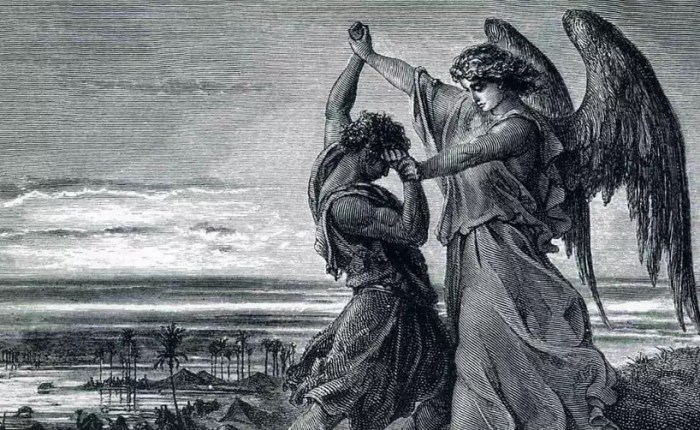
God came down to earth, took on the form of a man, wrestled with Jacob face to face, and then pronounced that his name was no longer Jacob, but Israel – which means: “he who struggles with God.” God seared this new name into this man’s mind by creating an experience for him whereby he actually physically struggled with God.

However, the name change was not just reflective of his immediate situation, but it was also an appropriate summary of Jacob’s whole life, and how he had spent years struggling with God relationally.

And that pattern that was characteristic of Jacob’s – now Israel’s – life, would also come to define the pattern of his descendants as well. God chose that name for His people, knowing that they would have an ongoing struggle with Him, relationally speaking. Every generation born from the house of Israel would have to struggle with their collective relationship to God. We’ve talked about this pattern before – it’s the cycle that we see unfold through the rest of the Old Testament, as one generation after another is born, takes their place in the history of God’s people, and is ultimately defined by their relationship to God.

They followed that revolving cycle of peace and prosperity in God’s grace, followed by idolatry and immorality and turning away from God, followed by God’s judgment and discipline, followed by humility and repentance, and then followed by God’s restoration and redemption for them. That’s their collective struggling with God happening over and over again, through the pages of the Old Testament and into the New.

Despite this struggle, or perhaps because they continued to struggle WITH HIM, rather than WITHOUT HIM – God blessed them, guided them, delivered them from slavery, and protected them as a nation of people. Even when they were almost completely wiped out, He preserved those who were faithful to Him. Even when they were forcibly ripped away from their homeland, He kept them alive, and He brought them back and re-planted them in their own piece of land.

Even in their darkest hours, when it seemed like there was no hope, God gave them hope. He sent them prophets to tell them that He had a plan. That there was always hope. Their suffering was only temporary. One day, He would send them a Son – the Prince of Peace, the King of Kings, the Lord of Lords – to establish a perfectly just and righteous Kingdom for all eternity. One day, God would fulfill His promise to Abraham to bless all nations of the world through him and his descendants.

When the story of Biblical Israel transitions from the Old Testament into the New Testament, it’s because the King had finally arrived. And one of his closest disciples and friends – the Apostle John – writes this about him, and says, in that famous passage of John Chapter 1:

He came to establish a Kingdom that would last forever. The story of Biblical Israel does not end when Jesus goes back to Heaven after his death and resurrection. The story of Biblical Israel doesn’t end, even when the credits roll in the Book of Revelation. The promises that God made to Israel extend for all eternity through those who believe in Jesus Christ, and will live forever. The promises that God made to Israel extend beyond the boundaries of this temporary life, and beyond the boundaries of Abraham’s bloodline.

This is what Paul says in Galatians 3:26-29:

It’s the same thing Paul says in Romans 9:6-9. To summarize and paraphrase – Not all those who are descended from Israel are Israel. Not all of Abraham’s descendants are his children. Abraham’s offspring, God’s chosen people, Israel, are those who have faith in Jesus Christ as Lord and Savior.

So, what’s that mean for this particular discussion? Well, it means that ever since Christ came to Earth and inaugurated his Kingdom; ever since he died, and rose again, and ascended to heaven, ever since the time when the Apostles were writing the New Testament, the scope of who can be accurately called by the name “Israel,” as defined in the Bible, has been changed.

The definition of Biblical Israel has been, in some ways, narrowed to include only those who follow Jesus. But in another way, it has been widened to include all those who enter into God’s spiritual kingdom through Jesus, no matter what race they are from – Jew or non-Jew. That is the definition of Biblical Israel.

Biblical Israel was founded physically under the Old Covenant, fulfilled spiritually in the New Covenant, and when Christ returns, the physical and spiritual will come together into one, and ripple out into all eternity. This is the Israel made up of all Jews and non-Jews who put their faith in Christ.

But this brings us to the next manifestation of Israel. What I call “Historical Israel.” There may be a better name for it. Paul would probably call them Unfaithful Israel, but we’ll stick with Historical Israel. In any case, since the birth of the Church, there has been another Israel, made up of those who did not put their faith in the Messiah.

One of the things that makes Paul a little hard to follow at times, in Romans 9, 10, and 11, is that in the midst of his theological discussion about Israel, he is going back and forth between these two Israels. He doesn’t refer to them specifically as two different Israels, but that’s what he’s describing – the idea of a faithful, Biblical Israel, and an unfaithful Historical Israel.

Historical Israel is the nation of Jewish people that continued on after the birth of the Church, the vast majority of whom had rejected Christ. That’s the problem that Paul is unpacking in this section of Romans. So many of his fellow Israelites had failed to live up to their full potential because they rejected Jesus, and Paul, as an Israelite who had accepted Christ, was greatly disturbed by this tragedy.

In Romans Chapter 11, after addressing the root of the issue in the previous two chapters – which is faith verses unbelief to summarize it as concisely as possible – Paul then addresses both faithful and unfaithful (Biblical and Historical Israel) at the same time. And this is what he says to them, and about them, in Romans 11:7-10:

So, this is Paul stating, by the use of Old Testament references, that there is a difference between Biblical Israel and Historical Israel. The elect that he mentions are those who we could call Biblical Israel – those who received salvation through faith in Christ.

The rest, are Historical Israel – those who rejected the New Covenant, and sought salvation through human effort, which is not possible. They rejected Christ, and because of that, they called down a curse upon themselves.

Paul references this curse by quoting Deuteronomy, Isaiah, and Psalms here in Romans 11:8-10. He mixes three Old Testament verses together to refer to their collective blindness and suffering. But this idea of them receiving a curse for their rejection of Christ is, perhaps, a little more viscerally communicated in Matthew Chapter 27.

It was at the end of Jesus’ trials, just before he was crucified. Pontius Pilate was looking for any excuse he could find to release Jesus, without causing a riot in Jerusalem. Even his own wife told him to let Jesus go. But he was caught between a rock and hard place, so to speak.

So, in verses 22-25 of Matthew 27, Pilate brings Jesus out in front of the crowd and lets them decide. He says:

That is one of the most chilling verses in the Bible. The Jewish people in Jerusalem, yelling for Jesus their Savior to be executed, and so sure of their righteousness in doing so, that they were willing to call a curse down upon themselves and their children in the process.

Now, this curse that they called on themselves has been used, throughout history, by some, as a justification for anti-Semitism. So, I just want to say, emphatically, that it should never be taken that way. There is no justification for anti-Semitism, and any so-called Christian who has ever condoned violence and persecution and discrimination against the Jewish people, is not a real Christian.

As Christians, it is our duty to show Christ to all people through love and service. God still desires the reconciliation, of the historical people of Israel – and this is what Paul communicates as Romans 11 continues.

In Romans 11:11-12 he says:

He’s saying that there is still hope for those who belong to the historical people of Israel descended from Abraham – even as there is hope for all nations of people; for every person who calls on the name of Christ. They did not stumble beyond recovery. 

Redemption is still available. Historical Israel can still be folded back into Biblical Israel, if they accept Christ. And many countless individual Jews throughout history have done so.

Then, in the next set of verses, Paul talks to the Gentile Christians that he was writing to in the city of Rome. As far as we know, the Gentiles outnumbered the Jews in the Roman church, and some scholars think that the Gentile Christians needed to be reminded, and encouraged to not view themselves as superior to the Jewish Christians. Some scholars surmise that the Gentiles were getting a bit of a chip on their shoulder, and that they needed to have any notion of anti-Semitism squashed completely, before it could grow into something destructive. Which is why Paul says what he says in verses 13-21:

He goes on in verses 22-24 to summarize his whole train of thought:

There is still a chance for them. But unless, and until, they accept Christ, then they remain under the curse of their ancestors. Christ is the only way out of the curse, not just for them, but for all people. So, until they accept him, Historical Israel is not the same as Biblical Israel.

Biblical Israel is any Jew or Gentile that has put their faith in Jesus Christ as Lord and Savior. Historical Israel are the Jews who were cut out of the tree, but still exist, and for whom Paul had hope that some of them would still accept Christ and be saved as he had been.

So, there’s a branching off that occurred at that point in history when the Church was born. There were two Israels from that point on. So, the question is, what happened to Historical Israel after that time? What happened to the branches that were pruned off, and yet survived and carried on?

Well, we’ll talk about this more next week, and I mentioned it back at the beginning of this series, but just a handful of verses later, in Romans 11:28-29 Paul says about Historical Israel, that:

So, even though they rejected Christ in the first century, as a nation of people, they have persisted and thrived, despite being one of the most persecuted people to ever exist on planet Earth. Even though they may be enemies of the Gospel message, God loves them, on account of Abraham, Isaac, and Jacob, and He has not left them high and dry. So, what happened to them after the first century?

Well, to put it as simply as possible – they survived. They survived many hardships as a people group, in spite of incredible odds. Some of the history we know. Some of you have been around long enough to have seen some of the more recent history of the Jewish people. The rest of us learned about it in school when we were kids. But there’s a lot more than just what we know as the immediate history of the Jews. A lot happened in between the first century, and 1948 when a large portion of Historical Israel, coalesced into the third manifestation of Israel – the modern State of Israel.

I told you at the begging of this message we would talk about Biblical Israel, Historical Israel, and Modern Israel. And we will, but we just don’t have time to go into all of it today. Biblical Israel we’ve talked about, and I think everyone understands that this is the Israel we talk about every Sunday, or in every Bible study. This is the Israel that we are a part of – the olive tree that we’ve been grafted into as the Church.

Historical Israel, then, even though we’ve briefly defined it today, as Scripture defines it, as Paul defines it – there’s a lot more to say. As I said, there is a lot more history that many of us are not as familiar with, and I don’t want to brush over all that too quickly. It needs to be properly surveyed and discussed, because understanding Historical Israel, will help us understand how we get to Modern Israel, or the modern State of Israel.

And understanding how each of these three Israels are tied together, and how they diverge from one another, might help us make a little more sense out of the terrible things we see happening on the news – or at least help us understand what the name Israel means, and how different groups of people use this same name. The name Israel is important.

I said this at the beginning of the message, and I’ll say it again as I close: As followers of Jesus Christ, we cannot escape our connection to the name Israel. As those who have been grafted into the Olive Tree of Israel, we now carry with us the promise that God made to Abraham thousands of years ago. The Church is a part of what God views as His people Israel.

That means, that just as the name Israel was applicable to Jacob, and to his descendants, it’s also applicable to us as well. Who among us, can say with absolute honesty and certainty and sincerity that we NEVER struggle with God? I hope none of us say that.

We can still believe in Him, and remain faithful to Him, and still be obedient to Him, but also struggle with Him. He wants us to wrestle with Him. He wants us to go to Him with our problems and our anxieties, and our griefs and our confusion over things that happen in life. He wants us to go to Him with questions about why bad things happen.

He wants us to grab hold of Him and not let go until we get a blessing – the way Jacob did. Of course, Jacob’s blessing was a dislocated hip, but still, even that was a blessing that reminded him of his personal encounter with Almighty God. It reminded him of his name – HIS IDENTITY.

And we need to be reminded of our name, and our identity in Christ as well. Everyday. We’re all going to struggle. God wants us to struggle with Him, rather than struggling without Him.

If you’ve given up struggling with God. Now is the time to go back to Him.

The time is short. The days are evil.

But the Lord is reaching out and ready to receive all who call on his name.

If you’ve never believed in Jesus Christ, never put your faith in him, he is willing to meet you where you are.

_______

The Origin of Totally Righteous

FeaturedThe Origin of Totally Righteous

I’m sure many people these days have stories to tell about their experience during 2020, and how that year changed things in their lives, or how it shaped their perceptions of things like the size of the world, the capabilities of the government, and the way that news is reported (or not reported). Some people lost jobs, and many people lost family members – both during the pandemic, and in the aftermath of it. There’s a lot of debate about this, still today… I think that’s because our individual experiences of what happened are all somewhat unique, despite the same set of general circumstances being unexpectedly hoisted on everyone at the same time. People responded differently to the global, national, and regional circumstances, based on their own set of personal circumstances. What I mean is, people in New York City were compelled to respond a certain way, given the number of people there, the population density, and the fact that it’s an international hub of travel, trade, and commerce, on the northeastern border of the country. People in Los Angeles were compelled to respond another way, for similar reasons. And people in the small town of Clinton, Indiana, responded a completely different way.

Sure, there were elderly people, those with other serious health issues, those with compromised immune systems, and so on, who took extra precautions. But still, I remember quite vividly, going out to get gas on the first day of the “lock down,” (partly because I thought the price of gas might skyrocket, and partly because I was curious about what other people were doing) and realizing on that sunny, breezy day in mid-March, whilst waiting for my tank to fill and looking around, that absolutely nothing was different in the middle of town.

The same stuff was happening that day that would naturally be happening on any day in Clinton with that kind of weather – people walking their dogs, young couples walking down the sidewalk hand-in-hand, mothers strolling their babies, drunks stumbling in and out of the liquor store, the IGA buzzing with activity, the Dairy Queen drive-thru at full capacity, and the smell of carne asada wafting through the air from Taco Tequila’s. Nothing was really different, at least outside in the open air. But of course, indoors, everyone’s lives were still changed in some way, or at least impacted – either temporarily or permanently.

And my life changed a little bit too. But not in a bad way.

I was in my fifth year as the preacher for my small, country church – Dailey Chapel Christian Church. And that was the year I finally realized how to preach a halfway decent sermon. I have a lot of people to thank for this realization, the Lord most of all, of course. But the pandemic actually helped me in this regard too.

I had an epiphany of sorts, that Spring.

You see, despite having degrees from Bible college and seminary, I had never taken preaching classes, because I didn’t want to be a preacher. I had explored a few other areas of vocational ministry prior to serving Dailey Chapel, but nothing lasted. But God slowly closed all the other doors I was trying to walk through, until preaching behind a pulpit was the only one still open.

So, quite reluctantly, I walked through that door, and began the process of stumbling and bumbling my way through one sermon after another, in front of my congregation. Dailey Chapel proved, immediately, to be a group of people that, despite my difficulties and struggles, were willing to encourage me, support me, love me, and allow me the time and space to learn.

And eventually, in the Spring of 2020, I realized something about preaching that is probably quite obvious to most other preachers… I could actually write my entire sermon out, word for word. Moreover, I also learned that there is even a name for this style of preaching – “manuscript style.” I’d always been a decent writer, but not that good of a speaker. And having grown up watching other preachers, and seeing other preachers on TV or on podcasts, I thought I had to have a basic outline of what I was going to say, and then just “let the Spirit speak through me.” But that never seemed to work. God’s Spirit grants all Christians specific gifts, and one of mine is writing… once I realized I could preach what I wrote, everything changed.

2020 helped me figure that out.

Our church responded to the COVID lock downs by having people stay outside in the parking lot, while I preached from the side porch of the church building. But even so, I still wanted to reach people that weren’t going to be there at all, and we weren’t interested (like many other churches) in doing a video livestream. But I did discover that I could record the audio of my sermons, and upload them to a website called SoundCloud – which would enable me to post links to the sermon on our church’s Facebook page, or even send the links to individuals via text message. But the prospect of recording my sermons, caused me to realize that I had to have them all written out beforehand – every single word. You can’t say, “um” a lot, or have long pauses………………….. when you’re recording something. Thus, I began using my writing gift to craft sermons.

About a year later, as I was struggling to come to terms with a new set of medical circumstances in my life – a condition known as atrial fibrillation – which is relatively common among people over the age of 60, but less so for those in my age range, I was compelled to start thinking of my longer term plans in regards to preaching. When your heart starts to beat wonky, and they put the paddles on you to shock you back into normal heart rhythm… well, that tends to cause a person to think about their mortality, and what they are going to leave behind when the Lord calls them home. Well, that’s what I started thinking about a lot more anyway. What was I doing with my life, and how was I doing it, and how could I do it better by utilizing the gifts that God has given me?

I had always been teaching through individual books of the Bible, since first coming to Dailey Chapel. And I wanted to continue doing that. But having just finished Matthew’s Gospel at the time, I was ready to look ahead, and begin a new sermons series. For this one, I would be starting fresh. It was while preaching through the last four chapters of Matthew that I had begun writing out my sermons. Whatever new series I began, with a new book of the Bible, would have completely written out sermons from the get go.

After praying about which book of the Bible to preach through, I felt a strong pull toward Paul’s letter to the Romans. I had read through Romans several times, since my early 20s, and of course, there are many great one-liners in the letter which I had heard many many times since I was a kid:

“…there is now no condemnation for those who are in Christ Jesus” (8:1). “The Spirit himself testifies with our spirit that we are God’s children” (8:16). “…our present sufferings are not worth comparing with the glory that will be revealed in us” (8:18). “And we know that in all things God works for the good of those who love him, who have been called according to his purpose” (8:28). “…If God is for us, who can be against us?” (8:31). “…we are more than conquerors through him who loved us." "For I am convinced that neither death nor life, neither angels nor demons, neither the present nor the future, nor any powers, neither height nor depth, nor anything else in all creation, will be able to separate us from the love of God that is in Christ Jesus our Lord” (8:37-39).

And that’s just from Chapter 8!

But I really wanted to go through the entire letter, verse by verse, and understand it in its entirety, while sharing the fruits of my study, with the congregation that has given me so much over the years.

And well, it took about three and a half years – nearly four – but I eventually made it all the way through Romans, by the Lord’s grace.

And now, I have published the first volume of these sermons, which total 150.

This is the first of a three-volume series comprising these 150 expository sermons on the Letter of Romans.

Again, these are fully written, manuscript style messages, that I delivered to my congregation – Dailey Chapel Christian Church – over the course of almost four years.

Volume One contains the first 49 sermons and covers Romans 1 through 4, with significant detours into the Book of Genesis.

I’m currently editing the next two volumes, which will be available in the coming months. But Volume One is available here, in hardback and Kindle ebook:

https://a.co/d/am7InFr

An Old Christmas Story

FeaturedAn Old Christmas Story

If you prefer hearing me read this, just follow the SoundCloud link at the bottom. Otherwise, read on.

______________

The sun was sinking slowly into the darkened silhouette of the city a few miles to the west. Its red glow was casting long, stretched-out shadows over the desolate fields that lay just east of town.

Another day was nearly done.

And another year was coming to an end.

It was very cold, and Emerson Dustmire shivered beneath his sheepskin overcoat as he trudged wearily up the dirt road that wound on ahead of him. His broad, wind-burned face was determined and stoic, and only his eyes revealed the restless energy that burned underneath as they darted frantically back and forth, from north to south, scanning the horizon for any sign of danger.

He still had about two miles to cover before reaching his destination, and even though he was freezing, he would still pause every now and then to look back at the sunset behind the city.

Before too long, he would be back in that terrible place that he could only escape through either the magic of sleep—when it could be found—or whenever it was his turn to carry dispatches between the frontline, and the couriers that were lodged in the suburbs that he had just left.

It wasn’t often that something as beautiful as that sunset made itself visible to the human-beings who were wallowing in all the mud, and blood, and filth far below.

You had to appreciate these things when they came along.

The sunlight, and the small bit of warmth that still reached his face after traveling a hundred million miles through space—was, almost, the only reminder that there was something greater above it all—something untouched by the mess that man was making of things down here on the Earth.

Emerson adjusted the dense pack that was slung tightly over his shoulders, sighed heavily to himself as he turned back around, and then continued following the dirt road that was unfurling itself into the Belgian countryside.

He was a long way from home.

A long way from Oxfordshire, a long way from the University, and from people who cared about useless facts, like how many miles of space were in between the Earth and the Sun.

He was a long way from his mother’s concerned voice, and the smell of his father’s pipe after dinner on the last night he had seen them.

He was a long way from his fiancé, the love of his life that he had left behind with nothing but a promise that he would be back soon.

They were all behind him somewhere, hundreds of miles away, back in the civilized world, where men were still human.

That civilized world was slowly becoming a hazy memory as it gave way to the misery of his present living situation. He was now an inhabitant of the world where civilization disappears into the jungle. The only laws here were those of survival. The only magistrates were the rats, waiting to devour you for the slightest infraction.

The war had only begun about four months earlier, and everyone had said that it would be over by Christmas. But here it was, December the 24th, and all hope for a swift conclusion had begun to fade away with the passing of Summer, and been lost entirely with the passing of Autumn.

Emerson Dustmire was part of the 2nd Battalion of light infantry from Oxfordshire and Buckinghamshire—which made up the larger portion of the British Expeditionary Force. They had been sent to Paris at the end of August and helped save the city from being overrun by the Germans during the first week of September. From there they had marched north into the French countryside, and then up into Belgium until reaching the town of Iper.

Emerson’s days had melted into a hazy mixture of marching, digging, marching, digging, marching, digging… the monotony of it all was interrupted, here and there, by brief, but deadly skirmishes – short, battles that sprung up quickly as the Germans sought to maneuver around the French and British troops that kept meeting and repelling their advances.

Both sides kept up this senseless ballet of death with each other until they ran out of land to fight over.

With nothing but the Sea to the North, and the Alps on the southern end of the line, millions of men began digging into the earth and creating nearly impenetrable defensive positions.

Emerson’s company had received their orders to stop marching and dig in about a month earlier. So here they were, bogged down in the swampy lowlands of West Flanders, slowly sinking into the mud.

Emerson moved on, thinking of little else except putting one foot in front of the other.

Left foot, right foot, left foot, right foot.

His mind began to drift, and he found himself thinking again of his home that was so far away.

He had been led to believe that the war he was fighting was necessary to keep his home and his family safe—a final war, to end all wars and bring an everlasting peace to humanity.

Emerson knew that it was all a load of nonsense. But what choice did he have? They told him he had to go fight. So, he went.

As he crested a small rise in the terrain, the wind shifted and he was struck immediately with the reality of his situation.

Visually speaking, everything seemed in order.

He had reached the medical tents that were situated at the very back of the encampment, several hundred yards away from the trenches on the front lines. Everything was arranged in nice, neat rows, packed tightly together in perfect formation. But with the shift in the wind, the smell had reached Emerson once more—the smell that he hated more than anything.

It wasn’t the medical tents.

It wasn’t the hastily pitched horse stables, or the pig sties on the far end of the encampment.

It was, simply put, the smell of death that swirled through the air and permeated everything it touched.

It was inescapable.

Thousands of men had died in the fighting that took place between the two armies, and most of them could not be retrieved for proper burial.

And so they lay, out in the open, slowly being dissolved by the rats, and the worms, and the rain, with the muddy bacterial bogs absorbing what was left of them.

Emerson trudged on through the rows of medical tents, then began working his way past the French officers and reconnaissance units, past the artillery positions situated on the peripheral, and then finally, after another hundred yards of open field, he began a slow, steady climb up toward the back end of the fortifications that led toward the trenches.

His anxiety was beginning to build.

His heart was beating faster, he was taking larger gulps of air to catch his breath, and despite the chillness in the air, he was beginning to sweat.

It wasn’t his body that was tired and exhausted—it was his mind.

God did not design the human brain to endure the kind of sustained, perpetual waves of stress that man’s technological advances in war-making had conjured up for these modern battlefields.

The constant, sporadic, and unpredictable barrages of artillery shells from the Germans were an ever-present source of fear hovering over every human being and animal in range of their destruction.

Emerson Dustmire’s nerves, like so many others, were fraying under the strain of coping with the thought that either his life would end at any moment, or he could suffer some kind of ghastly wound that would leave him maimed for the rest of his life.

And what was it all for?

Why was all of this happening?

Was there ANY ANSWER to those two questions that could adequately justify the need for millions of Christian men to draw up battle lines against each other and commence with a kind of slaughter that the world had never seen before?

It wasn’t like this was the first time that this sort of thing had happened in human history.

The American Civil War had consisted of Christian killing Christian. Even in Europe, 400 years earlier, in the very place that Emerson now found himself, Catholic and Protestant armies had clashed with one another over theological details that no one could prove or disprove.

As bad as those conflicts were, however, they were nowhere near as devastating as this one had been in only four months of fighting.

Human beings had learned, from somewhere, how to go about killing one another with ease, efficiency, and indifference, in a way that had never happened until now.

Emerson mused to himself that he was feeling a bit like Longfellow who must have been thinking about something similar when he’d written that famous hymn: “And in despair I bowed my head: ‘There is no peace on earth,’ I said, ‘For hate is strong, and mocks the song of peace on earth, good will to men.’

As he approached the back entrance to the dugout, Emerson exchanged a brief glance and a nod with the sentry on guard duty.

“Any news from town?” the old sentry asked as Emerson moved past him.

“Yes,” Emerson replied enthusiastically, and with a sarcastic grin on his face he threw his hands in the air and exclaimed as loudly as he could – “The war is going to be over by Christmas!”

He didn’t stop to hear what the old sentry shouted back to him, but he knew it wasn’t nice, and he knew he deserved such a retort.

When he returned to his section of the great trench, he was greeted silently by two of his buddies from 3rd corps. After exchanging a few words about the weather and tossing them the two cartons of cigars that he had been tasked with retrieving, he slung off his backpack, leaned his rifle against one side of the large tree root that protruded from the side of the trench, and then sat down on a small stack of empty food crates.

He leaned his head back, and gazed up at the night sky.

The sun had finally set, leaving only the deep blue of the heavens pinpointed by millions of stars.

Finally at peace, for a few seconds, he leaned against the side of the earthen wall, pulled his coat around him as tightly as possible, stuffed his hands into his armpits and closed his eyes. Just for a few moments he thought to himself, maybe I can get a little sleep.

When he awoke from his brief slumber he was immediately aware that something was terribly wrong.

Everything was quiet.

Everything was too quiet.

There was no exploding of artillery shells, no cracking of isolated sniper bullets, no cries of men yelling back and forth along the line for ammunition, or food, or cigarettes—there was nothing at all of the normal everyday sounds that had come to define life under these conditions at all hours of the day and night.

Emerson looked around in the darkness for his squad mate Charles, and was shocked to find him halfway up the ladder, peering over the top of the trench, his head completely exposed to enemy fire.

He started to protest, but Charles quickly motioned for him to be quiet.

He leaned down toward Emerson, put a finger to his mouth, and whispered one word to him: “Listen.”

He pointed in the direction of the German lines.

Confused, and still in a daze from his nap, that wasn’t long enough, he sat quietly for a few seconds. Then he removed his helmet and tilted his head to one side.

He heard something, but what was it?

Voices, he thought… not very many voices… but someone was singing.

It was barely discernible at first, and then, slowly, it grew louder.

Then other voices joined in the singing, and a familiar harmony rose into the air above the frozen battlefield. The words sounded different, of course, but the tune was instantly recognizable—

“Stille Nacht, heilige Nacht
Alles schläft; einsam wacht”

Then, from somewhere along the British line, 20 or 30 yards away, English voices began to sing in harmony with the German voices that were now echoing across no-man’s land.

“Silent night, holy night
All is calm; all is bright”

Within minutes hundreds of men, on both sides, were singing loudly into the night sky.

First it was Silent Night, then it was Good King Wenceslas – looking out on the feast of Saint Stephen, when the snow lay round about, deep and crisp, and even.

The singing that had sprung up in the middle of this most unlikeliest of places, in this most darkest of times, continued into the night.

And before long, men had gone up the ladders, pouring over the tops of the trenches – not to exchange gunfire, but to exchange Christmas greetings, and small gifts… the Protestants exchanged tins of baked beans for chocolate bars, and the Catholics exchanged cartons of cigarettes for bottles of rum.

Candles had been lit along the German lines for as far as Emerson could see in both directions.

Men of different languages, different cultures, different countries… men who had been spilling each other’s blood for months, had found something they had in common, maybe the only thing, and it was more powerful than all of the hatred, and all of the destruction that they had leveled against each other.

Well, they had come to their senses,

if for only one night.

They had remembered their place

as people of the Light.

The killing and the dying,

it had come to an end.

In the frost and the darkness

there were no flags to defend.

There was only candlelight,

and warm greetings for those,

who had been trapped inside pits

as they shivered and froze.

They had emerged from their trenches,

like dead men from their graves…

Laying down their weapons,

and hailing the one Lord who saves.

So much evil had happened,

since they’d taken up arms.

So many had died,

since they’d left their families and farms.

If they could only go back,

if they could only return,

to the days that had passed,

before the world began to burn.

And this war to end wars –

Well it came,

and it went…

And not very much changed,

and few knew what it meant.

Those men who defied orders,

on that cold Christmas Eve…

Who left their positions in order to sing…

Most were all dead,

by the following Spring.

And millions went with them;

The death toll was profound.

But on that one night,

some Christians, created a sound…

And it’s reached us all here,

across a century that’s passed…

In our warmth and our comfort,

Having broken our fast,

It was a powerful song that was sung on that night.

It reached Satan and his demons in the depths of their Hell.

They were no longer laughing;

It had broken their spell.

The soldiers had awoken and remembered the truth;

they shared something sacred with those they called foe…

And nothing could change that,

no war far below.

This connection they shared;

It transcended men’s borders.

It was greater and stronger, than some general’s orders.

The kings they fought for, would one day fall down.

They would bow at the feet of the One with the Crown.

But this lesson remains;

For this story is true.

Most of it, that is…

Some details I made up –

but only a few.

There was a Great Christmas, so long ago…

Foretold from the moment of man’s great fall.

And it’s something to ponder

As we deck the hall.

If we ignore it, or we forget it,

Or we don’t ask, “what does it all mean?”

-we might find ourselves trapped

like the soldiers in 1914.

“I am the Light of the World.”

That’s what Jesus said.

That’s why he was tortured.

That’s why he bled.

So, we take his word,

and his teaching to heart,

each Christmas we gather

and do our best to impart –

that this Savior and His Kingdom

are greater than all others,

and the Day of his birth, is a time for sisters and brothers…

Even though we have quarrels –

Even though we all fight –

We have to forgive, and reflect His love –

and his light.

Jesus taught us to give—and to lay down our lives.

He saved us from sin and from evil desire.

And we need it,

because, each one of us, all,

are like Emerson Dustmire.

The End

The Curry House

FeaturedThe Curry House

I originally published the first part of this 16 years ago, as the events described therein were still in the process of unfolding.

Sometimes, things happen in life that you just cannot forget, no matter how much time passes.

The Curry House is one of these things.

___________________________________

For those who are interested, the story of how the Curry House happened is a tale of epic proportions that stretches across the globe and crosses the borders of three states.

For practical purposes, it all began in the Autumn of 2002 when Adam Coffman from Indiana, and Jeffery Gujjarlamudi from India crossed paths on the campus of Kentucky Christian University in the small town of Grayson in the Appalachian foothills. It was at this school that they slowly forged a friendship by sharing with each other the mutual struggles and experiences they each had endured as servants of Jesus Christ. Though they came from two vastly different worlds, they recognized in each other, the similarities that Christ had authored into their lives.

In those early days, the campus life at Kentucky Christian University was fraught with hidden perils and discouraging pitfalls of all kinds. Thus it was, that in a small corner of the guys’ dorm, Waters Hall, Jeffery and Adam began to fortify a place of refuge among the chaos and ruin that plagued the college grounds.

In the midst of their unexpected ministry opportunities, (while paying thousands of bucks to get their degrees) the two friends often found sustenance in that staple of college-life foods known to many as Ramen noodles.

However, the pre-packaged spice packets that accompanied these sodium laden rations were ultimately unsatisfactory to Jeffery’s attuned Indian taste buds. And in a moment of divine significance, Jeffery remembered that his mother had imparted to him upon the day of departure from his homeland a small package of Indian Spices known as “Curry spices” and “Garam Masala.”

Thus it came to pass, that sometime in the early spring of 2003 Adam and Jeffery received what can only be termed as a flash of divine insight, as they were inspired to combine Ramen noodles with Garam Masala and Chili Powder – along with some clarified butter known as ghee.

And so, as the East met the West in that tiny pot of noodles, the gloom of their environment subsided briefly as the divine wind of change and revival blew in from the heavens.

Thus it was, that an entire year went by which held many trials and adventures for the unlikely friends who labored under the darkening sky of a land lost in its own shadows.

Tales of those times have been told elsewhere, but what is important to tell here, is that Jeff eventually imparted the ancient wisdom of curry-making to Adam, as it had been handed down from his parents Sam and Esther.

Eventually, now in another room of the same dorm, Jeffery brought forth a gift that had been carried to him by his parents upon a recent visit from India. This gift was a jar of Mutton Pickle, which is essentially a combination of fried pieces of lamb and tomato sauce preserved in an extremely potent mixture of heavily concentrated Indian spices. Just one small spoonful of Indian Pickle is enough to flavor an entire bowl of rice, which at this point had replaced noodles as the preferred form of carbohydrate. Jeffery would later share other jars of assorted kinds of Pickle (such as Tomato, Lime, Spinach, and Mango) that his mother had prepared for the growing number of people who began showing up to share in the food and fellowship that God had provided.

In the Spring of 2004, Jeffery and Adam met Kiel Nation, a young lad from the region of Lexington, Kentucky. During the next several months, and on into the following autumn, Kiel became the third member of the Curry House Posse which was at that time still in its infancy.

It was at this time that Adam journeyed forth into the wilderness, as God had ordained that his time in the foothills of Kentucky was at an end. And so he set out for his homeland in Indiana, leaving Jeffery and Kiel to carry on the work that God had begun on the campus.

It was at this time as well, that the Lord brought into their midst one Keith Doyle, a humble brother from Cuyahoga Falls, Ohio. Keith moved into Jeffery’s room and the three brothers still left on the campus began to propel the sharing of food and fellowship to another level.

As the brothers, Kiel, Keith, and Jeffery began to meet and host more and more guys in the Waters Hall dorm; eventually the need arose to produce entire dishes of Indian cuisine.

And so, in direct insubordination of school policy, and working in secret, like the Roman Christians hiding in the catacombs of the Second Century — (because there were, in those days, a couple of immature, jerks in charge of the dorm) the three brothers would cook dishes of Vegetable Curry, Chicken Curry, Beef Curry, or variations of these and other ingredients each night throughout the week for whomever wished to come.

As a side note, Curry is a general term used to denote that ingredients have been cooked in a sauce of Indian spices. Common blends of Indian spices generically labeled as ‘Curry’ might contain coriander, cumin, chili powder, fennel seeds, cardamom seeds or powder, mustard seeds, turmeric, or several other variations of spices such as fenugreek, paprika, cloves, and cinnamon. Along with these spice combinations, onion, garlic, and cilantro are essential ingredients in almost every dish given the name Curry.

And for the next two years, the brothers continued the ritual of serving food in their rooms to those who came in search of food and fellowship. There were no regulations, no rules, and no expectations of any kind… only a desire to serve the Lord by serving others, and giving freely to others as Christ had freely given to them.

Engaged in many struggles these three brothers fought their way through a gauntlet of malicious principalities aligned against them. Yet through God’s provision they eventually graduated, and upon their departure from Kentucky Christian University, Keith went to live in Lexington, Kentucky, and Jeff and Kiel, now rejoined by Adam began attending Winebrenner Theological Seminary in Findlay, Ohio.

Throughout the fall of 2007, and the winter and spring of 2008, Jeff, Kiel, and Adam would voyage to the home of Gary and Janet Staats in Findlay a couple of nights a week where they would make Curry and attend the seminary. Because Dr. Staats and his wife are extremely hospitable people, they began opening up their house each Tuesday night for those at the seminary to come and enjoy the fellowship meal as well.

Alas, by the summer of 2008, the Lord had called these four brothers out of their homes in Kentucky, Indiana, and Ohio, and directed them to reside in a house which he had provided for them on the main street of Findlay. And so it is, that these four brothers, doing only what their Lord had trained them to do over the years, continued to cook food and invite whoever happened along to join them in camaraderie.

____________________________________

Well, like I said, that was 16 years ago.

These past few weeks, I’ve been editing a series of videos that I captured, haphazardly, during that time – and which have just been sitting in my computer all these years.

The Curry House, which evolved into the first church I pastored – Night Church – still remains, to this day, a phenomenon of Christian community which I have often looked back to, as a reference point, and at the same time, a cause for lamentation at the fact that I have no idea how to re-create it.

It was special, powerful, beautiful, and unique.

It was something that the Lord did, and those of us who experienced it, were simply along for the ride.

Here’s the video I edited of it, which is my primary motivation for making this post. 👇

All in Good Time

FeaturedAll in Good Time

A couple of months ago, Parke County – in Indiana, opened a time capsule that was buried in the ground back in 1974.

Below, is a photo shared by Jeff Gooch – Funeral Director of Gooch Funeral Homes – posting a picture of his father, with the following caption:

“This was my dad (Larry Gooch) putting the final touches on the time capsule for the Rockville Sesquicentennial in our backyard in July of 1974. When we arrived at the courthouse we were greeted by many of our townspeople waiting to place items inside. Gene Swaim from Rockville Vault and Monument Company placed a granite marker for future generations to see and remember the location. It is at the south end of the steps on the west entrance of our courthouse. Note the bumper sticker on his truck-it says Rockville Sesquicentennial July 2-6. I remember everyone in town had a sticker on their rear bumper. This time capsule is to be opened this year for our centennial celebration.”

The time capsule was successfully opened on July 27th of this year…

Wherever one time capsule is opened, another is sealed.

Thus, because my church is in Parke County, I’ve been asked to write a letter to my church – Dailey Chapel Christian – for the next time capsule that will be buried this week, and opened 50 years from now.

The following letter is what I’ve submitted to the future…

_____________________________________________

To the People of Dailey Chapel Christian Church in 2074:

Dear Brothers and Sisters,

I have no way of knowing who will be reading this (if I did, that would be really spooky). Do they still use that word “spooky” in 2074? Just curious. The truth is, there might not be anyone reading this. But I hope that some of the younger people in our church will be around to pull this out of the ground one day… little Lilie Lou or Scarlett Dickey… any Nepotes – Leila or Raegan… Nora or Tate Metheny… Daniel or Joe Lunsford… Maizee with the big smile, or little Sylvie… Henry, Jack, or George Overpeck… any of the Simmons kids – Evie Lou, Charlie, or Conway… any Haltom’s… Carson Cox – are you out there somewhere? I hope so.

It’s a crazy world we live in, and 50 years is a long time. One thing, that I’m pretty sure about, is that I won’t be around. But I’m ok with that. I know where I’ll be going. If I was still alive, I’d be 95 by then, and although it’s not impossible, it’s also not very likely. However, my beautiful bride Lynell (Nelly) is two years younger than me – and she’s a lot healthier and has really good genes, so perhaps she’s still kicking around down there. Please look her up, tell her I love her, and I’ll see her again soon.

Sorry… that might end up being a lot of work for one of you lucky listeners. It’s not every day that someone gets a chance to write a letter to the future, so I have to make good use of the opportunity.

In any case, I’ve been the Preacher/Minister/Pastor for Dailey Chapel for about 9 years now, and it’s been one of the most challenging, but also happiest times in my life so far. I’m glad to be the one writing this letter. And I suppose it’s my duty to impart some words of wisdom from the past, or at least come up with something clever to say, so here goes…

Disclaimer: This is one of the sermons (a revised version of it) that I preached for Dailey Chapel a few years ago (in 2021) and something I’ve used several times for funerals I’ve presided over… It’s one of my personal favorites. And it’s about the very thing you’ve all gathered together to commemorate this day: TIME.

On September 14, 2015, at exactly 5:51am Eastern Standard Time… Physicists from the Massachusetts and California Institutes of Technology were able to catch something in a very large net that had been traveling through space at the speed of light for 1.3 billion years.

A hundred years earlier, Albert Einstein had invented a bunch of math jargon to describe the existence of something he called gravitational waves. In his mad-genius sort of way, he speculated that when objects in space collide with each other, they create ripples the same way a rock does when thrown into a lake. Einstein was convinced of this, but he never thought it would be possible to prove. As it turned out, he was right about the existence of the waves. But he was wrong that it would never be known for sure.

In the mid 90s engineers from MIT and CALTECH began building two giant observatories to prove his theory. These facilities – one in Louisiana and one in Washington State, took several years to complete, but once activated, they worked in tandem to a create a digital net almost as wide as the Louisiana Purchase to try and catch and record the waves that Einstein had talked about.

And that is exactly what they did. They caught, measured, and tracked a series of gravitational waves passing through their net in 2015. When traced back to their origin point, it was discovered that 1.3 billion light years away from Earth, two giant black holes had slammed into each other, releasing a tidal wave of energy that exploded outward, and sent ripples in all direction. 100,000 years ago, that energy crossed the threshold of our galaxy The Milky Way and proceeded toward our solar system until passing harmlessly through our planet 9 years ago (9 years, as I write this letter).

Now, to help you visualize the amount of distance we’re talking about… It would take a human being 37,200 years to travel 1 light year through space. The gravitational waves detected in 2015 had traveled 1.3 billion light years to reach us. The universe we live in is SO BIG – that they don’t measure it with miles or kilometers – they measure it with TIME.

The light from our own Sun takes about 8 and half minutes to reach us. That means, if the Sun burned out and went dark or disappeared somehow – we wouldn’t know it until 8 and half minutes later. That means, when astronomers look at the sun through a telescope, they are seeing it the way it was 8 and a half minutes in the past.

The light that comes from the next star over – Proxima Centauri – takes a little over 4 years to reach us. So, if there was an alien in that star system looking at us through a telescope – they would be seeing us the way we were 4 years ago.

Information like this boggles the mind. We can barely fathom these vast distances, and the amount of time it takes to traverse them. And what does it mean? Does it even matter? Yes. It does. It matters, because this is one of the ways that our Lord shows us how great and powerful He is.

King David said it best — ”By the word of the LORD were the heavens made, their starry host by the breath of his mouth. 7He gathers the waters of the sea into jars; he puts the deep into storehouses. 8Let all the earth fear the LORD; let all the people of the world revere him. 9For he spoke, and it came to be; he commanded, and it stood firm.” (Psalm 33:6-9)

There’s a well-known theological concept called Natural Revelation. And although this is a concept that is touched upon in many places throughout the Bible, it is most clearly articulated by the Apostle Paul in Romans 1:20 – where he says that:  “since the creation of the world God’s invisible qualities – his eternal power and divine nature—have been clearly seen, being understood from what has been made, so that men are without excuse.”

In other words, he’s saying that when we look at everything around us – everything that God has made, we are looking at things that God has provided as evidence of His existence. So, whether we’re looking at the smallest of things right in front of us, through a microscope, or the very largest of things millions of miles away, through a telescope – all of it, reveals something about the One who created these things.

Moreover, Paul is also saying that this is an obvious truth. It’s common sense. To suggest otherwise is the very definition of foolishness. As King David once said at the beginning of Psalm 14 and Psalm 53, “it is the fool who says in their heart, ‘there is no God.’” –That’s actually the same Psalm. It’s in there twice.

Now Paul, also, in his letter to young Titus – warns him to not be prideful about his belief in God. He tells him in Titus 3:3 that, “At one time we too were foolish, disobedient, deceived, and enslaved by all kinds of passions and pleasures.” That’s Paul’s way of telling his protégé that the only thing separating us from the foolish – is the fact that we have fallen on the mercy of God. He’s reminding Titus that it is through love and humility and kindness that we demonstrate God’s mercy most clearly to those who have not accepted it.

If I tell someone that there is a God who loves them, in our culture, they probably won’t believe it. But if I tell them that God loves them, and I back it up by showing them that I love them too – THEN they might actually believe it.

But still, it’s not enough for people to know that we love them. We’re human beings. Our love is imperfect, and inconsistent, and flawed. And that’s why we have to point people to God whose love is perfect, and unwavering, and unparalleled.

So, that means we have to be patient with people who don’t believe the same things that we do. And in the meantime, we have to find ways to show them God’s love and mercy. We ourselves, have to ‘wait upon the Lord,’ and ask Him to use us – to lead us into the right situations and give us the right words when the time comes. And sometimes it’s hard to be patient. Sometimes it’s really difficult to wait for other people. But patience is one of the ‘fruits of the spirit,’ that Paul talks about in Galatians 5, and elsewhere.

We always want things to happen when we want them to happen. We want things to happen in our time. But God has his own time.

Now of course, when the Apostle Paul was writing about Natural Revelation he didn’t have microscopes or telescopes to see all the things that we can see today. But every advancement in science and technology that has come along since has only proven the concept of Natural Revelation even more. The more our technology allows us to see and observe, the more God’s immense power becomes visible. His fingerprints are all over the universe and everything in it.

And with this in mind, I’ve been taking some time, to go back to the Beginning of the Bible, into Genesis, so that we can do a little review on the 6 Days of Creation. What can we learn about God, what can we learn about ourselves, what can we learn about Christian faith from examining the Days of Creation through the lens of Natural Revelation?

For this message, I want to focus on something that God created on Day Four. So let’s take a look at that passage – Genesis 1:14-19.

And God said, “Let there be lights in the expanse of the sky to separate the day from the night, and let them serve as signs to mark seasons and days and years, 15and let them be lights in the expanse of the sky to give light on the earth.” And it was so. 16God made two great lights—the greater light to govern the day and the lesser light to govern the night. He also made the stars. 17God set them in the expanse of the sky to give light on the earth, 18to govern the day and the night, and to separate light from darkness. And God saw that it was good. 19And there was evening, and there was morning—the fourth day.

When we read through these verses we see the words ‘govern,’ and ‘separate,’ used in repetition. These words are both related to the idea of organization. God was organizing his creation under the canopy of time, and using the sun, moon, and stars to do it – he says it right there in verse 14, “let them serve as signs to mark seasons and days and years.”

The top researchers and scientists, and physicists in our culture (the ones that do not believe in God) explain away all the other things that exist in the universe – they have theories like evolution and the big bang that allow them to mentally evade the idea that there’s a God. But they haven’t been able to do that with TIME. They have no theory that allows them to provide an alternate reason for where time comes from. They can’t explain time.

The existence of time does not fit into any kind of scientific framework that currently exists. One of the most well-known physicists since Albert Einstein, a man named Richard Feynman – Richard Feynman was the George Washington, the Jimi Hendrix, and the Michael Jordan of physics all rolled into one. Any college student studying physics and space and time has to read his books and lectures. He’s considered to be one of the most brilliant minds ever on the subject – THAT GUY – back in the early 60s, when asked about the origin of time, basically said: I don’t know.

Most of the people who are considered to be experts in the field of physics today, with all the technological tools and more collective knowledge at their disposal than ever before – the kind of people who built those observatories to catch gravity waves in Louisiana and Washington – they basically scratch their heads when it comes to figuring out why time exists.

The scientists and the mathematicians don’t do well with the concept of time. As the Psalms of King David have shown us – it’s the writers and the poets that explain time much better. Time makes good material for poetry, and storytelling, and classic rock and roll power ballads.

My favorite non-bible author J.R.R. Tolkien once wrote: “Time all things devours. Birds, beasts, trees, flowers. It gnaws iron, bites steel, grinds hard stones to meal. It slays kings, ruins towns, and beats high mountains down.”

One of my favorite songwriters Roger Waters wrote some beautiful words on the subject of time: “You run and you run to catch up with the sun but it’s sinking. Racing around to come up behind you again. The sun is the same in a relative way, but you’re older. Shorter of breath and one day closer to death.”

Our culture is obsessed with time. Just think about all the phrases we have to describe time in different ways:

All in good time.

In the nick of time.

From time to time.

We’re living on borrowed time.

It’s a matter of time.

Time out. In time. Time flies. Time to go.

About that time.

Take some time. Make some time. Kill some time.

Once upon a time.

There’s Adventure time. A Wrinkle in Time. The Land Before time.

Hot Tub Time Machine.

Snack time. Dinner time. Summer time. Double time.

Hang time. High time. Game time. Face time.

Prime time. Local time. Real time. Record time.

Quality time. Screen time. Quiet time.

Miller time.

Big time. Small time. Nap time. Space time.

We keep time. We spend time. We lose track of time.

No time flat. No time to waste. Some other time. Make up for lost time. Now is the time.

Hit me baby one more time.

We can obsess ABOUT TIME all we want. But time cannot be controlled. It cannot be solved by a math equation. There is no end to its ability to baffle scientists. There is no end to its ability to inspire artists, poets, and writers. And whether you’re from the countryside or you’re a city dweller – you cannot escape the clock.

Time is the great transformer of things. It changes ALMOST everything. It dissolves things that we think are solid. It moves things that we think will always be there. It destabilizes, shakes, and decays everything around us. It cannot be stopped. It cannot be bought. It cannot be bargained with. It can’t be reasoned with. And, eventually, it will take every one of us by the hand and walk us into the grave.

Despite all the terrible things that time does to us – it is still a precious gift from God. God created it for us. And God saw that it was good.

The reason it stings us the way it does – is because it is one of those things that REMINDS us all, that WE ARE NOT GOD. It reminds us that we are powerless, we are fallen, and we need someone to save us.

The good news is that someone has saved us. His name is Jesus, and he is the Christ, the Son of the Living God.

The Bible tells us that we are not like the rest of humanity that has no hope. Why? Because we have a King who is Master over the Grave. Our God is Master of Time itself. He created it. It has no power over him. And as Hebrews 13:8 says, “Jesus Christ is the same yesterday, and today, and forever.”

He is immoveable, he is unstoppable, he is our only hope out of this mess, and he is the one who makes all things new.

Heaven and earth will pass away – just as I have passed away. But the words of Christ will never pass away. Call out to him today, ask him to speak to you.

In Christ’s Love,

Adam Joseph Coffman

September 11, 2024

Love Your Enemies

FeaturedLove Your Enemies

Last week, we looked at a passage from Luke Chapter 14, where Jesus talked about the Cost of Discipleship, – the willingness to let go of everything we have, everyone we know, and everything we care about – even our own lives – if our King should ever call upon us to do so.

This week, we’re going to focus on Luke 6:27-36.

These words of Jesus touch on one of the great pillars of God’s Kingdom – a cornerstone of the entire message of the whole Bible. It’s no exaggeration to say, that if we miss the message that Jesus gives us here in Luke 6:27-36, then we are missing the whole point of the Gospel itself.

Now, before we look at this passage in Luke, I want to go back to the Old Testament for a few moments, and talk a little about one of the more interesting characters we find there – a man, by the name of Jonah.

Now, many of us, when we think of Jonah, automatically associate him with the giant fish!

We think of Jonah and the fish, or Jonah and the whale, because we heard this story when we were still children, and to the mind of a child, that is the most memorable thing that happens in this story.

When I was a kid, it made me think of the story of Pinocchio.

And, actually, there are some overlapping themes between the story of Jonah and the fairytale of Pinocchio – both are about redemption and transformation for instance.

Pinocchio learns how to become a “real boy,” and Jonah learns how to become a “real man.”

And they both go through their transformation from one to the other while being swallowed by huge sea creatures.

So, I think – to any of us who heard both of those stories as children – it’s somewhat easy to blend them together in our memories, and maybe think of Jonah as being one of the stories in the Bible that is more for kids.

But the truth is, that Jonah’s story is really not a children’s story.

Not at all.

And the part where he gets swallowed by the fish is an important part of the book, but it’s not the most important thing that happens. The most important part of Jonah’s story, is not his encounter with the fish, but rather, his encounter with God.

And Jonah’s encounter with God was not a pleasant one.

Jonah’s relationship with God was not amicable or friendly – to say the least. In fact, the main emotion that Jonah expresses to God is ANGER.

He’s very angry at God.

Jonah had a very big problem with God, because God asked him to do something that was, in Jonah’s mind, completely unacceptable.

The story of Jonah happened at a complicated time in the history of Israel.

The Northern Kingdom of Israel had been dealing with foreign invasions for almost a century by then. And these invaders were from the Assyrian Empire, which today would be primarily in the countries of Iraq, Iran, and Syria. But the Assyrians were an exceedingly brutal people; their culture was built on two main principles: warfare, and building projects.

The Assyrians were constantly going to war in order to expand their empire, and plunder the people they defeated. And those they didn’t kill, they would turn into slaves, and take them back to Assyria so they could have slaves build their buildings and serve their people.

Whenever the Assyrians captured a city, they would mutilate anyone who resisted them. They would skin people alive, they would impale them on stakes and line the roads with them, they would pull their intestines out to use as burnt offerings, they would create huge piles in front of the city gates – one pile of enemy corpses, and another pile of all the heads they had decapitated from those corpses. And they didn’t just do this for the sake of being brutal – they considered it part of their religious duties – the mass murder and executions were how they made sacrifices to the demons they worshipped as gods. They were very meticulous and artistic about how they dismembered the bodies of their enemies, and who they chose to take as slaves.

That’s who the Assyrians were.

And they had been slowly making these kinds of invasions into the north of Israel for about a hundred years by the time Jonah came along, and by the time God asked Jonah to go to their capitol city, which was called Nineveh, and preach against all of their wickedness.

But Jonah had a very big problem with God asking him to go on this journey and do this.

And we might think it was because of fear; we might think Jonah was just afraid to go to Nineveh and preach against them because they would probably just kill him. But there’s really no indication in the story that Jonah was in the least bit afraid. He was not a fearful man.

He was an angry man. And the reason he had a problem with God telling him to go preach to the Assyrians of Nineveh was because HE HATED THEM.

They were the arch enemies of Jonah’s people. They had invaded his country, they had killed and enslaved his countrymen, and they were looming over Israel’s borders, so that they could continue doing these things, with no end in sight.

So, Jonah hated them.

And more than that, he believed his hatred of the Assyrians was absolutely justified.

And if we were in his shoes today, we would very likely feel the same way.

In fact, if you were to look on a map, and find where Nineveh is located – you would see the present-day city of Mosul in Iraq.

The ruins of Nineveh are right next to Mosul, and up until about a few years ago, Mosul was in ISIS occupied territory.

Of course, we’ve all heard about the atrocities of ISIS over the past decade. They’ve attempted to build their own country by conquest and bloodshed; they’ve killed and enslaved tens of thousands, they’ve carried out terrorist attacks across the Middle East, Asia, and Europe, and have publically executed almost anyone who has opposed them – including many Christians – which are, of course, in the minority in that part of the world.

If God spoke to any of us, and told us to go preach the Gospel to ISIS – how would we feel about it?

It’s probably an understatement to say that we wouldn’t want to go – and if we decided to go anyway – the people who love us would do their best to convince us that we were making a big mistake.

Well Jonah, back in his day – was told, by God, to go preach to people that were not very much different from ISIS. And he said (basically), ‘No, God,’ I’m not going to do that.’

And then, he went down to the nearest port, and hopped on the first ship available, so that he could sail as far away as possible in the OPPOSITE DIRECTION of where God told him to go.

And like I said, he didn’t refuse to go because he was afraid of the Ninevites… he refused to go because HE HATED THEM.

You may remember what happens next.

God decides not to let him off the hook so easily, and sends a storm to keep him from sailing away – and so, Jonah, partly because he doesn’t want the other people on the boat to die because of his disobedience, and partly because he thinks he can escape God by different means – has himself thrown into the sea. But even that attempt to get out of the work God was asking him to do fails – as God sends the infamous giant fish to swallow him – and actually rescue him.

And it’s there, in the belly of the fish – in that terrible, unimaginable darkness – where he’s an inch away from death – that Jonah FINALLY has a heart to heart with God about his life, and about his responsibility as one of God’s chosen people – to take the light of God into a dark place.

God uses that place of suffering and darkness to get Jonah’s attention – and when Jonah is spewed back onto dry land again – he’s ready to head to Nineveh, and preach to the Assyrians like God told him to.

He’s changed his actions from disobedience to obedience,

But, as the story continues, we discover that his heart has not changed at all – he still harbors the same hatred in his heart.

His actions have changed because of God’s discipline, but his heart stays the same.

And when he preaches to the city of Nineveh, the people do repent of their sin and their evil, and they turn to God.

And Jonah responds to their repentance like this:

This is what is says in Jonah 4:1-3

“But to Jonah this seemed very wrong, and he became angry. He prayed to the Lord, “Isn’t this what I said, Lord, when I was still at home? That is what I tried to forestall by fleeing to Tarshish. I knew that you are a gracious and compassionate God, slow to anger and abounding in love, a God who relents from sending calamity. Now, Lord, take away my life, for it is better for me to die than to live.”

This is the most successful revival on record in history – 120,000 people in Nineveh – repenting of their sin en masse – and turning to God. Jonah’s one of the most successful preachers in history. And he’s so mad at this, and so filled with hatred towards the people he’s preaching to, that he just wants God to kill him. He just wants God to end his life.

He’s had enough of God showing MERCY to his enemies.

So, as the story ends, Jonah and God have another little chat about Jonah’s attitude, and the condition of his heart, and then the story sort of abruptly ends.

And it ends with God asking a question.

And the question is directed towards Jonah – but the writer of the book, by ending it with a question – is saying that it’s really directed towards the reader.

This question is directed toward us.

And the question that God asks, is why shouldn’t I care about saving these people? These are people. They’re human beings. Why shouldn’t I care about them?

That’s what God asks.

And we might think of that question of God’s, as sort of hanging in the air like a dense fog for the next 700 years, until Jesus comes along, and clears all the fog away and says this – in Luke 6:27-36

“But to you who are listening I say: Love your enemies, do good to those who hate you, 28 bless those who curse you, pray for those who mistreat you. 29 If someone slaps you on one cheek, turn to them the other also. If someone takes your coat, do not withhold your shirt from them. 30 Give to everyone who asks you, and if anyone takes what belongs to you, do not demand it back. 31 Do to others as you would have them do to you.

32 “If you love those who love you, what credit is that to you? Even sinners love those who love them. 33 And if you do good to those who are good to you, what credit is that to you? Even sinners do that. 34 And if you lend to those from whom you expect repayment, what credit is that to you? Even sinners lend to sinners, expecting to be repaid in full.35 But love your enemies, do good to them, and lend to them without expecting to get anything back. Then your reward will be great, and you will be children of the Most High, because he is kind to the ungrateful and wicked. 36 Be merciful, just as your Father is merciful.”

Powerful words, yes?

Difficult to read.

And even more difficult to actually follow.

Jesus was the revolutionary of all revolutionaries.

No one, as far as I know, had ever said something like this before him, and if there were those who said something like this, they didn’t believe it so thoroughly and completely as he did – and follow it all the way through to the point of being executed. This kind of idea is not popular – it’s never been popular.

It’s not popular today.

We live in a world that runs completely counter to this idea.

What do we hear?

We hear people telling us who to be angry with, who to accuse, who to argue with, who to blame – who to hate.

We turn on the news, and what do we see?

Our society does not know the concept of loving one’s enemies.

The world tells us to shout them down, give ‘em what for, take ‘em to the cleaners… and then it gives us a list to choose from – pick your group… pick the group of people you want to be angry with this week.

And, unfortunately, for many of us, it’s often easy to pick a whole group of people to look down on, and be angry with, because the horrible truth about all this – the reason that these words of Jesus can sometimes sting us so much – is that we have the hardest part, not with loving the enemies that are on the TV or far away somewhere else, but with loving the enemies that are right in front of us.

Yeah, it’s hard to love people that we blame for causing the big problems in our society – but, if we’re honest, it’s even harder to love the people THAT WE KNOW – who have hurt us in some way… or spoken bad about us… or ignored us. That’s the really hard part about what Jesus says.

It’s hard for me.

Believe me, I have plenty of people that I can’t stand to be around. None of you guys here… ok… but it’s all I can do – to ask God for enough grace to not be bitter and angry at some of the people that have hurt me in the past.

There are people who have lied to me, lied about me, told me that I had no business being a minister, told me I was a loser who wasn’t worth anything – people who turned their backs on me when I needed them the most; leaders in churches who ostracized me, and kicked me out of their “church” group, because I asked them questions they didn’t know how to answer – so they just got offended and told me I was a bastard.

It’s hard to forgive that. It’s much easier to feel the emotions of anger, than to feel the emotions of pain or heartache.

It’s difficult work to let Jesus take a knife, and carve out the places of our heart that have become calloused and overgrown with bitterness.

It hurts.

But he died so that he could do that work for us.

Paul says, it like this in Romans 5:6 and Romans 5:8

“You see, at just the right time, when we were still powerless, Christ died for the ungodly….  

But God demonstrates his own love for us in this: While we were still sinners, Christ died for us.”

He’s saying, quite simply, that we were all, at one time, ENEMIES of God. And he still showed compassion on us anyway, by dying the way he did.

I’ll close this morning, with a brief historical anecdote.

This one happened in Northern Ireland, in November of 1987, when the Irish Republican Army bombed a small town called Enniskillen. If you’re not very familiar with the situation in Northern Ireland at that time, they were about 20 years into a 30-year conflict that was very messy, very violent, and, at the risk of oversimplifying things, was mainly caused by a mixture of disagreements surrounding politics and religion.

This was a conflict between Catholics and Protestants, Irish nationalists and British loyalists; the British Army against armed civilian terrorists.

And on November 8, 1987 the people of the town of Enniskillen were celebrating Remembrance Day – which is the British version of our Veteran’s Day.

It was a cold and dreary November day in Enniskillen, Northern Ireland. The town was quiet, with the sound of rain tapping against the windows of the local shops and houses. The streets were lined with colorful autumn leaves, creating a vibrant contrast against the gray skies above.

Despite the weather, the people of Enniskillen went about their daily routines. Some were out shopping for groceries, while others hurried to catch the bus to work. The town had a sense of resilience about it, a reminder of the turbulent history that had shaped this community.

As the day turned to evening, the lights of the town began to flicker on, casting a warm glow against the darkness outside. The smell of turf fires filled the air, adding a sense of coziness to the town’s atmosphere.

In a local pub, a group of friends gathered around a table, sharing stories and laughter over pints of Guinness. The sound of traditional Irish music filled the room, creating a lively and welcoming ambiance.

Despite the troubles that had plagued Northern Ireland for so long, the people of Enniskillen remained united in their resilience and sense of community. As the night went on, it was clear that this small town had a spirit that could not be dampened by any storm.

That’s when the IRA detonated a large bomb in the town square.

12 people died from that bomb, and many more were injured.

Among those caught in the blast was a man named Gordon Wilson, and his daughter Marie.

The blast did not kill them, but a building collapsed on them, and they were trapped in the rumble for several minutes waiting to be rescued.

Those minutes when they were waiting to be rescued, were the last minutes that Gordon would spend with his daughter.

He held her hand while she told him that she loved him, and then she lost consciousness and never woke up.

Within hours – hours after losing his daughter – Gordon was on BBC Television, lamenting the loss of his daughter, assuring those watching that she was a child of Christ, and he would see her again – AND – to the HORROR of many people listening to him, and discussing the tragedy on the News that day – he told those who had killed her, that he held no ill will against them, that he forgave them, and then he urged there to be no retaliation for the attack.

His words of forgiveness and grace were an earthquake that caused that entire conflict to begin crumbling.

He eventually met with the IRA leaders, publicly, and forgave them in person, and he later became a senator in Ireland, and helped to bring a final end to the 30 years of violence that had claimed his daughter.

Before all that happened, Gordon Wilson was a window treatment specialist – he made drapes for a living.

__________________________

Matthew 5:3-10:

“Blessed are the poor in spirit, for theirs is the kingdom of heaven.
Blessed are those who mourn, for they will be comforted.
Blessed are the meek, for they will inherit the earth.
Blessed are those who hunger and thirst for righteousness, for they will be filled.
Blessed are the merciful, for they will be shown mercy.
Blessed are the pure in heart, for they will see God.
Blessed are the peacemakers, for they will be called children of God.
10 Blessed are those who are persecuted because of righteousness, for theirs is the kingdom of heaven.”

Loving our enemies – forgiving those who have hurt us – does not mean that we excuse their bad behavior.

It does not mean that we have to entertain their foolishness, or their wickedness. It doesn’t mean we have to give them our trust.

IT DOES MEAN, that we have to see them as our fellow human beings who are just as much in need of God’s love and grace as we are.

And that love and grace MIGHT cause those people to change.

We hope that it does.

But that’s not our responsibility.

It’s not our job to change people.

It’s not our duty to turn people into better human beings – we can’t make other people forgive.

But we can choose to forgive them.

We can choose to ask God to change what’s in our hearts. And then, when our hearts have been changed by Him – then He can use us for something that will (as Maximus Decimus Meridius once put it) “echo into eternity.”

Enniskillen Memorial

The Cost of Being a Disciple of Jesus

FeaturedThe Cost of Being a Disciple of Jesus

DISCLAIMER: I originally wrote this sermon four years ago, in August of 2020. If you want to listen to it, I’ll embed the audio version at the bottom of this post.

But I’m trying to publish more regularly on this blog because that’s what you’re apparently supposed to do…

So, I pulled this one out of the archives, because it’s a real humdinger. And you should read it. Seriously, it’s a good one, if I do say so myself.

____________________________________

This morning, we’ll be reading through a passage from Luke 14:25-33.

But before we take a look at this passage in Luke, I want to tell you a story that’s a little bit closer to us in history. This isn’t something that happened 2,000 years ago, but much more recently.

It begins about a hundred years ago, in a city called Breslau. Breslau is in the southwest of Poland today, but a hundred years ago, and up until the end of World War II, it was still a part of Germany. And that’s where this story begins – in Breslau, Germany, a hundred years ago, in 1920, when a young man by the name of Dietrich gave his life to Christ, and decided that he wanted to study the Bible and become a teacher of God’s word.

Dietrich was a very intelligent young man, very devoted to his studies; by 1927 (when he was only 21 years old) he had graduated from the University of Berlin with a doctorate in Theology. Still young, and not quite sure where his place was in the world, he decided to come here to the U.S., and ended up as a professor at Union Theological Seminary in New York City. He was only in the U.S. for one year, but while he was here, he was lovingly accepted into a Baptist church in Harlem, where he taught Sunday School classes, and where he began to encounter the societal injustices being experienced by Christian minorities – in particular, black Christians that he had become friends with. As a white man, but still an outsider, a foreigner from Germany, he had slipped in between these two segregated worlds of American Christians – black and white, rich and poor, educated and uneducated. Dietrich knew his Bible really well. In the Gospels, he read, as we have been reading, about the reality of God’s Kingdom in the here and now. And he wrestled with the contrast between what he was reading about the Church in the New Testament, and what he was seeing the Church do (and not do) in New York and other places.

How could the Church in the New Testament be so united in purpose, and the Church of modern day be so fractured and divided?

Why was the wealthy Church so pre-occupied with its own position on the highest levels of secular society, and so blind to the suffering of the poor Church just a few blocks North?

How does that happen among God’s people? How does one group of Christians become obsessed with finding a seat at the table of high society, while another group focuses on pulling people out of the gutters and giving them food, and clothing, and housing?

Why do the Christians with the most resources at their disposal, hoard their wealth, while those with just enough to get by give away everything they have? Why can’t they work together? Why can’t they find balance in the community of God’s Kingdom – the community of people saved by grace – the community that Jesus gave his life to bring into existence?

What was the answer to these questions?

What could be done about it?

Dietrich wasn’t entirely sure, but he didn’t ignore these tough questions; he wrestled with them. And this unique perspective that he had, as an outsider and foreigner, influenced him a great deal. And he took that perspective with him, when he returned to his homeland in 1931.

When he returned to Germany, he began teaching theology at the University in Berlin where he had received his doctorate four years earlier, and not long after that, he was ordained as a pastor in the Lutheran Church.

And, it was less than two years later, on January 30, 1933, that the Nazis took control of his country.

As we all know now, with our 20/20 historical hindsight, Adolph Hitler’s rise to power would eventually culminate in the horrendous disaster that we call World War II, where millions of people would perish, and where terrible things had to be done in order to stop a man that was closer to an example of the Anti-Christ than almost anyone else in history.

Have there been others like Hitler?

Yes.

Joseph Stalin probably executed more people, for instance. But Hitler did three things that really single him out:

1. He lied to the Christians in Germany that were susceptible to deception.

2. He silenced, imprisoned, and killed the Christians who were not so easily deceived.

3. He waged genocide against the Jewish people.

If Hitler had succeeded in taking over the WHOLE WORLD, he would have been THE Anti-Christ.

As it turned out, he was only one of the many little antichrists like those the Apostle John warned us about in his first epistle (1st John 2:18).

Like I said, we all know this now. It’s more or less common knowledge. But to many of the Christians throughout Germany at the time Hitler took power it wasn’t as clear. Even though it SHOULD HAVE BEEN.

Hitler’s rise to power was hailed as an act of God by the majority of church leaders in Germany at the time. They threw their support behind him completely – telling their congregations that Hitler had been sent by God to lift them out of economic depression, and restore their honor on the world stage. Some went so far as to say that Hitler spoke on God’s behalf, and that the fulfillment of God’s Kingdom was embodied in the person of Adolph Hitler. Churches that had been firmly established and rooted in place for centuries, wasted no time in allowing Hitler to steam roll his way through them. In fact, they stepped aside as he removed Pastors, Bishops, and Elders who were not “pure-bloods” of Aryan descent. They remained silent when he demanded that he, the Fuhrer be recognized as head of the Church (rather than Jesus Christ), and they supported efforts made to remove the Old Testament from the Bible – because of its pro-Jewish agenda. These were not things that happened overnight. They were ideas that Hitler had been preaching for months BEFORE he was in power. There was plenty of opportunity for the churches in Germany to at least try to prevent his ascension to power – by speaking out against him. But those with the most influence in their society, remained silent. Or they openly supported him.

But not everyone.

There were small groupings of Christians in Germany, in the middle of all that madness, who refused to bow down and worship that man.

And the hero of this particular story – Dietrich – was among them.

Just a couple of days after Hitler became Chancellor, Dietrich was able to get onto a radio station in Berlin and sound the alarm.

Before they cut him off mid-sermon, he denounced Hitler and everything he stood for – and he rebuked every Christian who followed him for their idolatry to the “cult of the fuhrer.”

In the months and years that followed, he began organizing the minority groups of Christians who didn’t follow Hitler, by helping to create a network of churches dedicated to voicing opposition to him, as well as to rendering aid to their Jewish neighbors who were already under attack. He was putting into practice what he had learned when he was in New York – that he couldn’t just talk about the Gospel – he had to live in its reality. He couldn’t just stand around and do nothing while so much evil was taking place around him. He had to actually do something about it.

So, he did.

Between 1933 and 1939, he helped organize and lead an underground seminary where he taught his students that the cost of being a modern disciple of Jesus was complete loyalty to the King and His Kingdom, above all else. –Even if it meant losing your friends, losing your family, or losing your country.

And for this, Dietrich was branded an enemy of the state, his coalition of churches and his seminary were deemed illegal by Heinrich Himmler, and Dietrich himself was exiled from the city of Berlin.

Dietrich’s friends in New York City urged him to flee the country, and he did in the Summer of 1939. But he did not stay in the United States for very long. In a letter to one of his former professors at Union Seminary, this is what he wrote, shortly before returning to Germany:

“I have come to the conclusion that I made a mistake in coming to America. I must live through this difficult period in our national history with the people of Germany. I will have no right to participate in the reconstruction of Christian life in Germany after the war if I do not share the trials of this time with my people … Christians in Germany will have to face the terrible alternative of either willing the defeat of their nation in order that Christian civilization may survive or willing the victory of their nation and thereby destroying civilization. I know which of these alternatives I must choose but I cannot make that choice from security.”

It wasn’t long after his return home, that because of close trusted contacts within the German military, he first became aware of concentration camps where Jews were being systematically exterminated. And that put Dietrich in the position of finally having to choose, definitively, which of his two kingdoms he would betray.

Would he become a traitor to Germany? Or would he become a traitor to God’s Kingdom, by looking the other way as his neighbors were being murdered? He chose God’s Kingdom over the kingdom he had been born into.

When asked by a Dutch colleague of his at the time, “what he was praying for these days?” Dietrich told him, “If you want to know the truth, I pray for the defeat of my nation.”

And that’s when Dietrich became a spy.

He began working within the Abwehr – the German Military Intelligence network –which was not yet under the control of the SS. There were many German officers in the Abwehr, already functioning as allied spies against Hitler. They recruited Dietrich with the understanding that he would use his contacts in Europe and the United States to smuggle intelligence to the Allies, and to help Jews escape from Germany. And that’s what he did for the next few years…

Before he was eventually caught and arrested in the Spring of 1943.

Dietrich spent two years in prison for treason, during which time he was the pastor for his fellow prisoners, and even some of his prison guards.

On April 4, 1945 Hitler personally ordered Dietrich’s execution, and he was hung that same week at Flossenburg Concentration Camp.

Two weeks later, the U.S. 90th and 97th Infantry Divisions liberated that camp.

A week after that, the Soviets took Berlin.

Hitler committed suicide at the end of the month, and Germany surrendered on May 7th.

Dietrich’s prayers for the defeat of his nation came to pass. But he himself, had already gone home to his real country.

The doctor who saw Dietrich’s hanging described his final moments like this:

“I saw [the] Pastor … kneeling on the floor praying fervently to God. I was most deeply moved by the way this lovable man prayed, so devout and so certain that God heard his prayer. At the place of execution, he again said a short prayer and then climbed the few steps to the gallows, brave and composed. His death ensued after a few seconds. In the almost fifty years that I worked as a doctor, I have hardly ever seen a man die so entirely submissive to the will of God.”

And that brings, the story of Dietrich Bonhoeffer to a close.

Now… why am I telling you all of this? Why is this story an important one?

Well, let’s finally get to Luke 14:25-33, and you’ll see why…

“Large crowds were traveling with Jesus, and turning to them he said: 26 “If anyone comes to me and does not hate father and mother, wife and children, brothers and sisters—yes, even their own life—such a person cannot be my disciple. 27 And whoever does not carry their cross and follow me cannot be my disciple.

28 “Suppose one of you wants to build a tower. Won’t you first sit down and estimate the cost to see if you have enough money to complete it? 29 For if you lay the foundation and are not able to finish it, everyone who sees it will ridicule you, 30 saying, ‘This person began to build and wasn’t able to finish.’

31 “Or suppose a king is about to go to war against another king. Won’t he first sit down and consider whether he is able with ten thousand men to oppose the one coming against him with twenty thousand? 32 If he is not able, he will send a delegation while the other is still a long way off and will ask for terms of peace. 33 In the same way, those of you who do not give up everything you have cannot be my disciples.”

Now, those are some harsh sounding words, are they not?

There’s a huge crowd following Jesus, and instead of reveling in all of his many followers, it’s almost as if he’s trying to get rid of them. He tells them they can’t follow him unless they hate everyone else… that they even have to hate their own life! Now, he doesn’t mean this literally – that they have to hate. After all, this is Jesus – he teaches us to love everyone, even our enemies.

So, he’s not literally telling us we have to hate ourselves and our families. He’s saying that His Kingdom always comes first. The Kingdom always takes precedence. He’s saying that our love for Him has to be total. Our loyalty to Him has to be complete. He’s saying, if you really want to follow me, you might have to say goodbye to the people you care about. He’s saying: If you say ‘yes’ to me, you might have to say ‘no’ to the people you love.

Jesus is using this allegorical language about building towers and going to war, which might all sound a little strange to us. But he’s pointing out the natural human tendency to look ahead. If we’re being wise, then we think before we make a major decision about something; we think about what that decision is going to mean, and whether or not it’s going to be good or bad, and we think about what we’re going to have to give up, or let go of.

We have to estimate what it’s all going to cost.

How much money to build that building?

How many troops to win that war?

Well, we don’t have to estimate what it costs to follow Jesus; he tells us EXACTLY what it costs – it costs EVERYTHING.

Dietrich knew that. He knew it really well. He knew that we can’t just hide in the comforting glow of God’s grace – that to do so, cheapens the sacrifice that Jesus made. We have to go into the darkness with the light that we have.

We have to do something.

And whatever that is – it might cost us everything.

It MIGHT cost us family; It MIGHT cost us friends; It MIGHT cost us our country.

And if so, that’s ok.

That’s what it means to pick up YOUR CROSS and FOLLOW HIM.

In John 15:18-19, Jesus said quite clearly: “If the world hates you, keep in mind that it hated me first. 19 If you belonged to the world, it would love you as its own. As it is, you do not belong to the world, but I have chosen you out of the world…”

Let’s remember these words of Jesus in the coming months.

Let’s hold tightly to them, as the rhetoric in the world around us becomes louder, and the nonsense becomes overwhelming. Our job is still the same: To love our neighbors, to love our enemies, and to love God the most.

The kingdom we’re living in is temporary; it is crumbling. But the Kingdom we belong to is eternal, and it will never fall.

There won’t be any Democrats or Republicans in Heaven, my friends.

“Then the sovereignty, power and greatness of all the kingdoms under heaven will be handed over to the holy people of the Most High. His kingdom will be an everlasting kingdom, and all rulers will worship and obey him.” – Daniel 7:27

Dailey Chapel’s Annual Basket Dinner

FeaturedDailey Chapel’s Annual Basket Dinner

This past Sunday, I decided to depart from our regularly scheduled program, to deliver a message that suited the occasion – our church’s annual celebration which we call “Basket Dinner.”

One thing that I find interesting about Basket Dinner – and this was true from the very first time I heard someone mention it. Back when I had no clue what it was… Basket Dinner has always been talked about around here, like it’s a universal event; as if it’s something that every Christian on Earth celebrates every year – like Christmas and Easter.

I remember once, asking a younger Caleb Dickey who grew up in my church, about Basket Dinner — just a few weeks after I moved out here… before I had ever been to one, and he was still in High School at the time, but he described Basket Dinner, as if it was a universal, concrete fixture of reality – something that all Christians partake of each year. And I know that he knew it wasn’t this universal Christian holiday, but that’s how he spoke about it. And it made me realize, that this was a deeply rooted part of Dailey Chapel’s history. I’ve realized that more and more with each year that I’ve been here.

Basket Dinner is a special, unique fixture of Dailey Chapel, and it’s very personal and meaningful to us, especially to all those who have celebrated it for decades, or for some – most of their lives, or whole lives. But there is also something about it, that is relatable to all churches.

So… I was thinking, this past week, about how we observe this special Sunday each year to honor those who’ve come before us, and met together in years past under the banner of Dailey Chapel – whether it was in our current building, or the previous one.

And, off course we know, that a building isn’t what makes a group of people into a church – it’s the gathering together, in fellowship, around the Lord’s table, around his word, to break bread and pray. Those are the main ingredients of church. A building isn’t necessary – it’s a blessing, and a luxury, and we enjoy having it – but the church isn’t a building.

If you ever happen to be up here, sometime after dark, by yourself, you’ll realize very quickly how different this building is when the people of the light are not gathered together in it. We’re up in the woods, and it’s a VERY scary place at night!

And at one point, in the past — as Mrs. Joanie Lunsford retells our history each year — the people of Dailey Chapel lost their building in a fire, about 84 years ago. But they didn’t lose each other, and they didn’t lose their faith. And as far as I can tell, they used the opportunity to grow stronger. And the evidence is all around us now. All those people are gone, but their church has outlived them.

It’s a feature of our existence on earth that sometimes, things have to go wrong, or something bad has to happen, in order for God to receive the glory that is due him. Sometimes, things have to go wrong, so that, they can be made right again – proving that our God is one of redemption, renewal, recovery, and restoration.

And this is nothing new. This is an old lesson – one that’s true for all of us. It’s woven into the fabric of reality itself.

And Scripture teaches us this old lesson over and over again. That things sometimes have to go wrong, before they can be made right. That things have to be broken, so that they can be put back together even stronger than they were. King David said in Psalm 30 that “there is weeping throughout the night, but joy comes in the morning.”

One of the beautiful things about the stories in Scripture, is how they capture truths that are common to all people of all times. The stories themselves are rooted in history, among real people, who really lived. But the lessons that the people in the stories learn, transcend the times and places in which they happened. In other words, the lessons that God wants us to learn are the same lessons that He has always wanted His people to learn.

And one of the biggest lessons – is that sometimes things go wrong, so that God’s people can remember their need for him, in all areas of life. And when they do, then the soil of hardship produces the fruit of victory.

That’s what we’re really commemorating each year on Basket Dinner Sunday. And as I said, it’s an old lesson – and it’s told over and over in the pages of Scripture, through the lives of many people.

We could go back to Genesis and read about Abraham for instance. A lot of things went wrong in Abraham’s life. He was constantly ending up in places he shouldn’t have been, and at times, in situations that were dangerous. And God always took care of him. God blessed him abundantly.

But the main thing on his mind was the fact that he wasn’t going to have any children to leave behind after him. So what did God do? He let Abraham and Sarah get so old, that the prospect of having children was completely hopeless from a human perspective. Sarah had presumably already gone through menopause, I think it’s safe to say – she was 90! But God allowed her to get pregnant and give birth to Isaac, through whom, she became the Mother of Nations. Hopelessness was turned into blessing.

Abraham and Sarah’s grandson Jacob, learned the same lesson. He was forced to flee his family, and leave behind his home, and everything he had – his own brother literally wanted to murder him. Everything went wrong in his life. He lost everything, just so God could get his attention.

And once God had his attention, he put Jacob’s life back together piece by piece. He blessed him with wealth and abundance, and many children, and peace with his brother who had wanted to kill him. Jacob’s life had to go completely off the rails, before it could be put on the right track.

Jacob had a son named Joseph. Joseph became the head official of the Egyptian Empire, second only to the Pharaoh. But he got to that position, only after spending years as a prisoner, sold into slavery by his own brothers because they were jealous of him.

From what we read about Joseph, he didn’t really do anything wrong. God wasn’t putting him through difficult circumstances to get his attention like he had done with his father Jacob. God already had Joseph’s attention. And because of that, he was able to use Joseph’s life as a powerful foreshadowing of Jesus. But that meant suffering, before it meant victory.

God let Joseph’s whole life go wrong on the floor of a dungeon, and then, he lifted him up out of the pit, by making him the Prime Minister of Egypt, and using his talents, and ingenuity to save millions of people from starvation, including his own brothers who had sold him into slavery.

It was those same brothers that Joseph spoke to in Genesis 50:20, saying to them, “You intended to harm me, but God intended it for good to accomplish what is now being done, the saving of many lives.” 

300 years after Joseph died, the same thing happened, on a much larger scale. All of the Hebrews were slaves in Egypt. And God used Moses to bring them out of bondage and form them into their own nation.

Then there’s the Judges and the Kings. Their were those like Samson who was strong and powerful, but had to have his strength taken from him, and his eyes burned out, and his body put in chains – all so God could show Samson and his enemies where strength and power truly come from.

I mentioned King David already. We see this pattern play out many times as we read about his life in 1st and 2nd Samuel. His life was constantly falling apart, and going wrong, and each time, he came back stronger.

When he was still a teenager, he became stronger than all the fighting men in his nation. When he was a fugitive, God sheltered him. When he sinned, God forgave him. When he lost a child, God comforted him. Whenever David lost his way, the Lord was there, to pick him up, and set him on the right path again.

It’s David who wrote, in Psalm 30:1-5, “I will exalt you, LORD, for you lifted me out of the depths and did not let my enemies gloat over me. LORD my God, I called to you for help, and you healed me.You, LORD, brought me up from the realm of the dead; you spared me from going down to the pit. Sing the praises of the LORD, you his faithful people; praise his holy name.For his anger lasts only a moment, but his favor lasts a lifetime; weeping may remain for a night, but rejoicing comes in the morning.”

Sometimes things have to go wrong, before they can go right.

Moses led the Israelites into a dead end, so God could make a new path for them through the sea.

Jonah had to be eaten by a fish, so that the people of Nineveh could be saved.

Esther was forced into the harem of King Xerxes, so that she could become the queen and save her people from genocide.

Hezekiah had to be face to face with the entire Assyrian army on his front porch, so that God could give him a front row seat to their complete annihilation by one of his angels.

Jerusalem was destroyed by Nebuchadnezzar, so that Nehemiah could rebuild it for people who learned that the Lord gives, the Lord takes away, and the Lord gives again.

That’s the whole story of Job too. The Lord allowed Satan to take everything the man had – his wealth, his family, even his health. Where most of us would probably complain to God about something like, Job only said: “The Lord gave, and the Lord has taken away; Blessed be the name of the Lord.” And then God gave it all back to him double.

We could go on identifying this same lesson in Bible stories all afternoon.

Peter denied that he knew Jesus, before realizing how much he loved him, and was willing to die for him.

Paul had to be struck blind, BEFORE he could truly see who Jesus was.

Jesus had to die in order to prove that he had authority over death. He had to sacrifice himself, so that all of us could be saved. Things had to go wrong for him, so that everything could go right for us.

It’s not easy for us to learn these kinds of lessons. We can read about them in Scripture, but it’s not until we really go through something difficult that we have the opportunity to understand them. The lessons become real. And we learn. We grow. And then we forget.

They’re easy to forget. And then we have to re-learn the lesson. It’s painful. It’s humbling. It sometimes feels like God is abandoning us.

Believe me, even as a minister, I have days where I get pretty upset with God. And when I do, I go to him with all the classic complaints. Why is this happening God? What are you doing to me? Where are you? Why does it feel like you’re not here?

And then, God reminds me that sometimes things have to go wrong, so that they can be made right again.

Every year, when we have our Basket Dinner… when we eat the fried chicken, and go listen to the music – I have my own commemoration that happens inside my thoughts.

I’ve talked about this several times before, but one of the other things Basket Dinner is about, is repetition. So, I’ll speak about it again, just for a moment.

When I first came to Dailey Chapel – 9 years go – it was not Basket Dinner Sunday. It was a few weeks later, in the last week of August. But I tend to reflect on my arrival here more, during the week of Basket Dinner, because it’s a time of thinking about what our Church is, and where it came from, and how it’s a blessing to all of us that we have this fellowship.

And as Mrs. Carmen Palma can attest – she later remarked that I was the saddest preacher she had ever met. And I certainly was very sad. I was so sad and broken down, that I have only ever told this story in small pieces over the years. That’s how I’ve processed what happened to me during the two years before I found Dailey Chapel, or Dailey Chapel found me. I’ve had to process it in small doses.

So, whenever I talk about it, it’s always in fragments. But I was very traumatized. And I know that word gets a little over-used a lot these days. But I’m pretty sure that I had some kind of post-traumatic stress, after experiencing two years at a church in Indianapolis that almost killed me.

And the stress from that had manifested physically in the fact that I was the most unhealthiest I had ever been. And a lot of that was my own fault. I wasn’t taking care of myself properly. And also, I was trying to take care of a lot of other people, and I wasn’t mature enough to handle that, or know how to set healthy boundaries. I thought I could be a hero, and I was humbled to discover, quite painfully, that I was just another person in need of saving. And eventually, I came to the realization that I could no longer serve as a minister in that church.

And when I finally made the decision to resign as the youth minister of that church, I went to the elders, and I had a good talk with them. I told them I felt that I needed to be somewhere else, where I could do something other than youth ministry, because you have to have a lot of energy to be a good youth minister.

You have to be physically capable of keeping up with the kids, and break up fights, and clean up messes, and do a lot of traveling. Some of that I couldn’t do, and some of it I just didn’t want to do anymore.

So, I went to the elders, and we agreed that I would keep working until they found someone else to replace me, or I found another job. And if nothing had happened in three months, we would reassess the situation. That was my agreement with the group of elders.

And the following week, they met in secret, without me, and decided to fire me – but they also agreed not to tell me I was fired, but just to let me keep working and figure it out when they didn’t pay me. They were banking on the fact that I would keep doing the job for free, as a volunteer.

Now, the associate minister at that time, was a friend of mine, and he knew me since I was a kid; he went to church with our family. And when he discovered the plot, he called and told me about the secret meeting and the decision of the elders, and how it was the Senior Pastor’s idea. And I was stunned. I felt betrayed.

And I did confront the Pastor about it, directly, to his face. I told him, I couldn’t believe how he was treating me that way, like I was trash, especially after all the work I had done for the church. And he didn’t say anything. He had no response at all.

And that was the end of my youth ministry career. I did still maintain my connection with a number of the high school kids, that I was closest to. I didn’t need to be paid to be friends with those kids.

But I did need another job. And I needed to get healthy. And it took me almost a year to find Dailey Chapel. In the meantime, I had an online job doing editing for a Bible software company, and I did some other stuff to get by; I was an Uber driver for a little while.

I had just bought a car the month before I lost my job. So, I had to do whatever I could. I was selling all my collectibles, my massive Star Wars collection, my comic books, my video games, and all the stuff that I had collected over the years to one day pass along to my kids – if I ever had them.

But it wasn’t enough, so I had moments where things were pretty scary.  I was struggling to make the car payments. It was repossessed once, but some friends got it back for me. A couple of my best friends, who are missionary teachers, and were in South Korea at the time, were sending me money so I could get by. A neighbor across the street who had been my grade school principal, and the super intendant of my high school, brought dinner to me one evening. He heard it through the grapevine that I was struggling, and still living in my parents’ house, which had been foreclosed. A few other people that had been close to my parents also brought food to me so I could eat. It was very humiliating, but I was so thankful for their generosity.

In short, I was barely scraping by. And I was getting really tired of life in the process.

A person can only take so much humiliation before they start to think about ending it all. And I was alone, most of the time, without anyone to talk to or encourage me. My home church was really big. And I was just another face in the crowd. I could go there and be among 500 people and never talk to anyone. But to be completely honest, I didn’t go most of the time. Because I felt like I was a failure. I felt ashamed. And no church wanted to hire me. I had a Bible college degree in Biblical Studies and Missions, and a Master’s in Theology and Church History… and a great deal of practical ministry experience. And I couldn’t get a job because I wasn’t married at the time.

So, I almost gave up. I contemplated suicide. I really gave it some thought. Now, looking back, I believe there were demonic forces attacking me pretty persistently with that kind of thinking. But, I stayed in my Bible, I kept praying – and God sent me enough life-lines to get me through each day. One day at a time.

And, by some miracle, I held on long enough for Tim Dickey (the chairman of the board, and the Commissioner Gordon of Dailey Chapel) to respond to my desperate email for a chance to be considered their next minister.

Yes… that means, that I am the Batman in this story.

And here we are, 9 years later. And I consider all that to be just as much a part of our church’s history, as all the rest of it.

Sometimes, things have to go completely wrong, before they can be made right. Basket Dinner is a time for remembering the history of our Church, and what has been given to us, through the Lord’s providence, from those who came before.

And for me personally, it’s also about remembering my own history with this church. And what I was before I found them, and what they have given me since then.

A fire had burned up just about everything in my life, except my faith. And Dailey Chapel has helped me to rebuild it, stronger than it ever was before.

Some of you are going through things now that are rough and unpleasant to say the least. Some of you have lost family, some have lost friends. Some of you have health issues that are causing you pain or making life more difficult. Others of you have people in your lives that are going through terrible suffering and you don’t know what to say to them.

And that’s to say nothing of all the chaos and confusion and hatred we see happening in the world outside.

Christ is the only answer we have. He’s the only answer we need. Keep following him. Keeping moving forward. If we are in Christ – if we belong to Him – if we stay in the vine, then there is purpose and meaning behind all of the pain and suffering and brokenness and death.

He’s already made everything right – we’re just in the process of learning it right now.

I’ll close today with Paul’s words from 2nd Corinthians 4:16-18. “Therefore we do not lose heart. Though outwardly we are wasting away, yet inwardly we are being renewed day by day. 17 For our light and momentary troubles are achieving for us an eternal glory that far outweighs them all.18 So we fix our eyes not on what is seen, but on what is unseen, since what is seen is temporary, but what is unseen is eternal.”